The 7 Ancient Wonders: From Egypt’s Pyramids to the Lost Marvels

The 7 Wonders of the Ancient World represent the pinnacle of ancient ambition and engineering, originally compiled by Hellenic travelers as a guide to the Mediterranean world's greatest architectural and artistic feats. This selective list of seven—a number symbolizing perfection—includes monumental structures like the Great Pyramid of Giza (the only survivor, located in Egypt) and the Lighthouse of Alexandria (another Egyptian marvel), alongside the lost wonders such as the Temple of Artemis, the Colossus of Rhodes, and the Hanging Gardens of Babylon. While six of these marvels succumbed to earthquakes, fire, or neglect, the list endures as a powerful testament to the ingenuity of ancient civilizations and continues to inspire awe in modern visitors, especially those who visit the magnificent structures still standing in Egypt.

A Testament to Ancient Genius and Egyptian Pride

Ancient humans pushed limits. They created the famous 7 Wonders of the Ancient World. This collection defined supreme architectural and artistic achievement. The list was not a decree. Instead, Hellenic writers like Antipater of Sidon compiled it as an ancient traveler’s ultimate guide. They chose the number seven. Specifically, the number seven symbolized perfection and completeness to the Greeks.

Crucially, Egypt proudly hosted two of these 7 Wonders of the Ancient World. This includes the only wonder to survive millennia. Therefore, the original list of 7 Wonders of the Ancient World remains a powerful reminder of the ingenuity that shaped our world.

This guide explores all seven. We focus especially on the two Egyptian sites. We detail their history, significance, and lasting mysteries. Your journey into the 7 Wonders of the Ancient World starts right here on the Nile.

Our adventure begins with the crown jewel. Indeed, it is the only one of the 7 Wonders of the Ancient World still welcoming visitors today.

FUN

Egypt’s Immortal Marvel: The Great Pyramid of Giza

Great Pyramid of Giza - An Enduring Wonder of the Ancient World

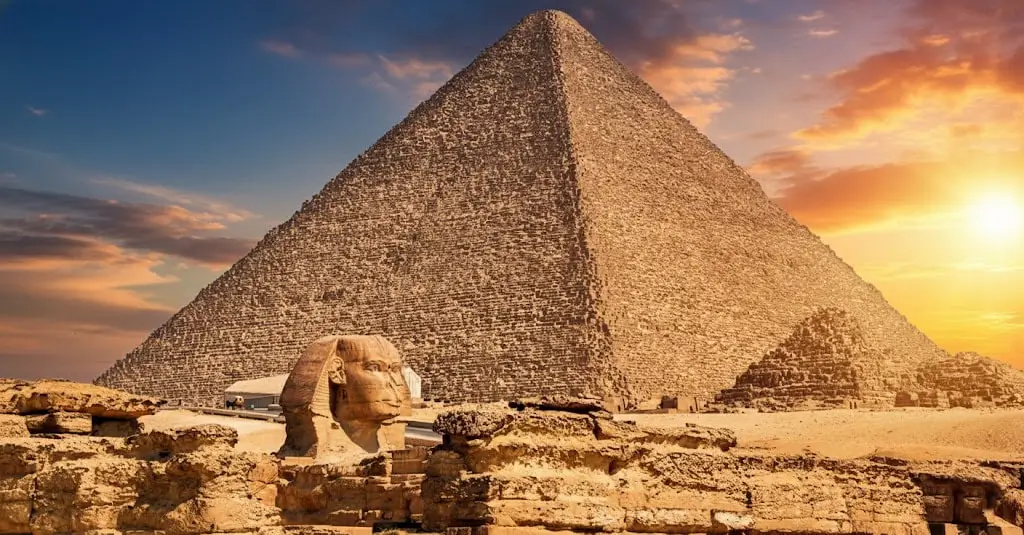
The Great Pyramid of Giza commands the top of every list of the 7 Wonders of the Ancient World. Its immense size is key. But more importantly, it stands as the sole survivor. While six others fell, the Pyramid remains a monumental testament to Old Kingdom engineering (c. 2560 BC).

The Builder and The Scale

Pharaoh Khufu commissioned this massive royal tomb. It originally reached nearly 481 feet. It consists of an estimated 2.3 million blocks. Furthermore, its perfect alignment to the cardinal points demonstrates mathematical mastery. Modern engineers still marvel at the precision of this Wonder of the Ancient World.

The Egyptian Advantage

The Pyramid’s longevity stems from two facts: its solid design and its foundation. Its compressive geometry protected it from stress. It rests on the stable bedrock of the Giza Plateau. This shielded it from severe seismic activity. Consequently, no other site from the 7 Wonders of the Ancient World offers such a tangible connection to the past.

Ready to stand before the last surviving Wonder of the Ancient World? Book our Giza Plateau tour today!

Next, we travel north to the Mediterranean coast for Egypt’s other great contribution to the 7 Wonders of the Ancient World.

FUN

The Lighthouse of Alexandria (The Navigational Marvel)

The Complete History of the Lighthouse of Alexandria (The Lost Wonder)

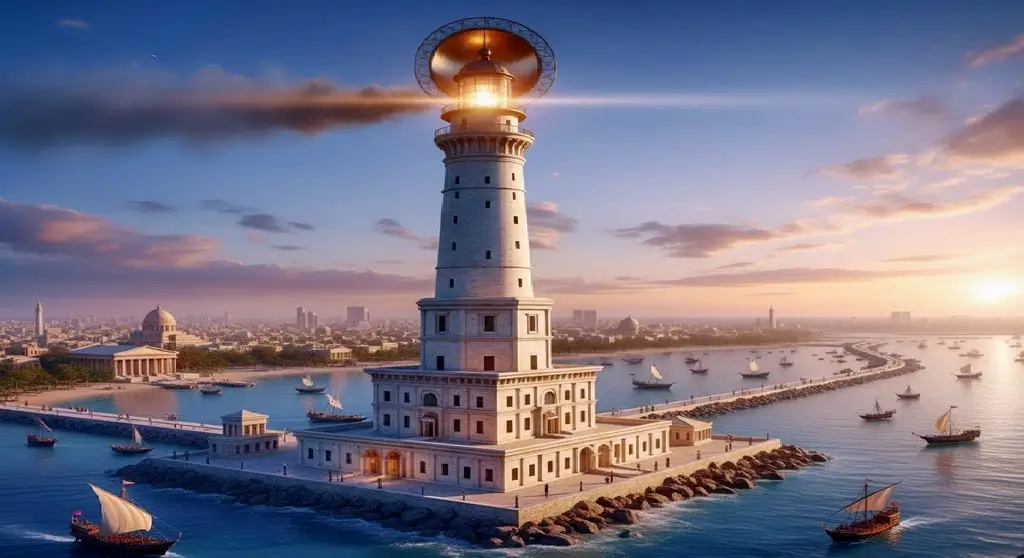
The second Egyptian marvel on the list was the Lighthouse of Alexandria (Pharos). It no longer stands. Nevertheless, its engineering and trade significance secured its place among the 7 Wonders of the Ancient World.

The Tallest Structure After the Pyramid

Ptolemy II commissioned the Lighthouse. Sostratus of Cnidus designed and constructed it around 280 BC. It stood on Pharos Island. Remarkably, it reached an estimated 330 to 450 feet tall. This made it the world’s tallest structure after the Pyramids. The Lighthouse functioned as a critical beacon. It used a huge fire and bronze mirrors. This transformed Alexandria into a secure trade hub for the Ptolemaic empire, solidifying its place among the 7 Wonders of the Ancient World.

Destruction and Discovery

The Lighthouse stood in a high-risk seismic zone. Successively, powerful earthquakes eventually destroyed it. The final blow came in the 14th century AD. However, the legacy endures! Today, Fort Qaitbay occupies the original site. Excitingly, underwater exploration revealed colossal stone blocks. These blocks belonged to the Lighthouse. They lie submerged beneath the harbor waves.

Visitors trace the Lighthouse’s historic footprint by visiting the fort. You can even dive to see the submerged ruins of this Wonder of the Ancient World in the Alexandria harbor!

Now, having explored the two wonders you can visit in Egypt, we examine the six marvels the rest of the ancient world lost to time.

The Profound Egyptian Influence on Greek Civilization

Egypt profoundly influenced ancient Greek civilization in various aspects. Key influences include religious syncretism, with...
Related post
FUN

Monuments to the Gods: The Sacred Sites of Zeus and Artemis

Monuments to the Gods The Sacred Sites of Zeus and Artemis

The ancient Greek world honored its chief deities with structures of unimaginable scale and richness. The next two of the 7 Wonders of the Ancient World represent the pinnacle of Greek religious art and architecture.

Wonder 4: Statue of Zeus at Olympia

This colossal statue honored Zeus, the King of the Gods. The legendary sculptor Phidias created it around 435 BC. Amazingly, the statue stood 40 feet tall, dominating the temple at Olympia. It was a chryselephantine masterpiece. That means the artists used thousands of pounds of ivory for the skin and sheets of gold paneling for the robes and hair. Visitors to the ancient Olympic Games beheld this awesome Wonder of the Ancient World. Consequently, gazing upon it constituted a spiritual experience.

Sadly, its materials proved too valuable to survive. The statue likely suffered destruction by fire after Christians moved it to Constantinople in the 5th century AD.

Wonder 5: Temple of Artemis at Ephesus

The Temple of Artemis stood as the largest building of its kind among the 7 Wonders of the Ancient World. Located in Ephesus (modern Turkey), builders completed the final version around 350 BC. It dedicated itself to Artemis, the goddess of the hunt and the moon. Indeed, the temple surpassed the famous Parthenon in Athens in size. It featured 127 colossal columns. This demonstrated the immense wealth and devotion of its patrons.

The temple experienced a dramatic history. Infamously, a man named Herostratus burned the earlier version down in 356 BC, seeking fame. The final temple met its end in 262 AD, when a Gothic raid destroyed it. Its massive stones found new life, reused in local churches and fortresses.

Our tour of the lost 7 Wonders of the Ancient World continues with two monuments representing royal ambition and military pride.

Abydos: Royal Tombs, City of Osiris, and the Birthplace of Egyptian Kingship

The Enduring Significance of Abydos Abydos holds a unique status in Egypt. Indeed, it is...

Related post
FUN

The Rest of the 7 Wonders of the Ancient World

Wonder 2 The Hanging Gardens of Babylon

The remaining two 7 Wonders of the Ancient World showcase the ambition of powerful kings and the ingenuity of early metalworking.

Wonder 2: The Hanging Gardens of Babylon

The Hanging Gardens of Babylon represent the list’s most mysterious entry. The legend traditionally attributes their creation to King Nebuchadnezzar II (c. 600 BC). He built them to please his Median wife, who missed the mountainous terrain of her homeland. The descriptions detail a stunning achievement: a tiered structure with complex irrigation systems lifting water from the Euphrates River to water unfamiliar flora. This made the gardens a true Wonder of the Ancient World.

However, archaeological evidence for the Gardens in Babylon remains inconclusive. Scholars sometimes suggest the legend actually describes gardens in Nineveh, built by the Assyrian king Sennacherib. Regardless, this legendary site defined the magnificence of the Near East. Their destruction remains unknown, likely resulting from earthquakes and the slow decline of the city.

Wonder 6: The Colossus of Rhodes

The Colossus of Rhodes served as a symbol of defiance and victory. Sculptor Chares of Lindos completed the massive bronze statue around 280 BC. It depicted the sun god Helios. The statue stood over 100 feet tall, built to celebrate Rhodes’ successful defense against a siege. It is important to note that the Colossus did not straddle the harbor entrance, as popular myth suggests.

Sadly, this Wonder of the Ancient World stood for only 54 years. The earthquake of 226 BC toppled the statue. It remained lying in ruins—still a tourist attraction—until Arabs melted the bronze for scrap in 653 AD.

Finally, the list concludes with one last tribute to love and eternal remembrance.

The Ultimate Tribute (Wonder 3: The Mausoleum)

The Ultimate Tribute (Wonder 3 The Mausoleum)

The final Wonder of the Ancient World highlights the profound connection between power, love, and architecture.

Wonder 3: The Mausoleum at Halicarnassus

The Mausoleum at Halicarnassus originated not as a temple or a public work, but as a tomb. Queen Artemisia II commissioned the elaborate structure for her late husband and brother, Mausolus, around 350 BC. Located in modern Bodrum, Turkey, the tomb defined monumental royal burial. It combined Greek columns, Egyptian stepped elements, and Lycian sculpture. Significantly, its name gave the world the term “mausoleum.”

The Mausoleum, one of the 7 Wonders of the Ancient World, survived the longest of the six lost sites. However, successive earthquakes between the 12th and 15th centuries AD eventually destroyed it. Its carved stone blocks were subsequently reused by the Knights of St. John to fortify Bodrum Castle.

So, why did these specific seven capture the ancient imagination, and what lessons did Egypt’s architects learn that others did not?

Meet the Gods: An Ultimate Guide to the Ancient Egyptian Pantheon

The Egyptian cosmos was ruled by a vast and complex pantheon of powerful deities. Far...
Related post
FUN

Analysis: The Fate of the Wonders (The Egyptian Advantage)

Examining the fate of the 7 Wonders of the Ancient World reveals key differences in ancient engineering and geography. The question remains: Why did only the Egyptian Pyramid endure?

Geological Stability

The primary destructor of the six lost Wonders was geology. Earthquakes destroyed the Colossus, the Lighthouse, and the Mausoleum. All these structures stood in seismically active zones along the Aegean and Mediterranean coasts. In contrast, the Great Pyramid rests on the incredibly stable Giza bedrock. This geographical safety protected the Pyramid, where design could not save the others.

Structural Integrity (Stone vs. Frame)

The engineering design mattered. The Pyramid is a solid mass—a perfect expression of compression and stability. Conversely, the Lighthouse, Colossus, and Mausoleum were hollow or top-heavy structures. They suffered devastating shear forces during quakes. Sites like the Temple of Artemis succumbed to shifting political and religious tides. Eventually, people simply reused their stones.

The Hellenic Travel Circuit

The selection of the 7 Wonders of the Ancient World was geographically limited. The list comprised sites accessible via the trade and travel routes of wealthy Greek tourists. This explains why structures of comparable genius in China or India were not included. The list remained a convenient travel route spanning from Egypt to Babylon.

Ultimately, the legacy of the 7 Wonders of the Ancient World continues to shape our perception of antiquity.

Visit the Wonder (Continuing the Journey in Modern Egypt)

The story of the 7 Wonders of the Ancient World provides a humbling narrative. It celebrates human aspiration, but it also confirms the ultimate power of time. The Wonders represent the pinnacle of faith, power, and genius. Yet, only one survived.

The Great Pyramid stands as the enduring symbol of stability. It represents the ancient Egyptian commitment to eternity. Today, the adventure of the 7 Wonders of the Ancient World begins and ends in Egypt.

We invite you to follow the footsteps of the ancient travelers. Visit the Great Pyramid at Giza, and explore the site of the Lighthouse in Alexandria. These sites offer a tangible, awe-inspiring connection to history.

The 7 Wonders of the Ancient World inspire us. However, only the mighty structure at Giza offers a living link to that legendary list.

Ready to stand before the last surviving Wonder of the Ancient World? Explore our tailored Egypt Fun Tours packages today!

Outstanding deluxe tour featuring Cairo, Luxor, Aswan, and a Nile Cruise....
Book now magical 4 days Christmas & New Year Nile cruise to discover Luxor and Aswan attractions and enjoy a different new year holiday....

11 Wonderful Hours in Cairo

I had an 11 hour layover in Cairo, and it couldn’t have been better spent than with Manal from Egypt Fun Tours. I was able to adjust my tour once we left the airport and Manal had some really great suggestions when I told her what it was I wanted

More »

Highly Recommend Egypt Fun Tours!

Several weeks ago, I reached out to Egypt Fun Tours regarding a 9-hour layover in Cairo. From the very beginning, Hani Ahmed was responsive and professional, quickly providing a well-organized itinerary tailored to our limited time. The itinerary included a visit to the pyramids, other historical sites, a delicious dinner,

More »
4-day-christmas-nile-cruise

Hossam Rashwan Tour Guide

We took this trip with Hossam Rashwan as our tour guide, and I must say that Hossam was the greatest tour guide in Luxor who showed us around. Our tour guide’s tales transported us to Luxor’s past, and we felt as if we were living in ancient Egypt. We really

More »
Cairo layover tour - pyramids tour from the airport - Pyramids and GEM Tour from Cairo Airport

Layover tour of Cairo Pyramids

On a recent trip, I had 8 hours from the time I landed in Cairo to when my next flight was scheduled to leave. Luckily, I arrived in the morning and left in the afternoon, so, not being one to sit around an airport for 8 hours, I visited the

More »
Isis with wings

Top-rated Tour Packages

Isis with wings