The Pharaohs’ Shadow: 10 Ways Ancient Egypt Influenced Modern Islam

This guide explores the hidden "source code" of Egyptian spirituality, revealing how Ancient Egyptian traditions in Islam form the true foundation of modern faith. We move beyond traditional history to uncover how the Pharaonic "Ma’at" became Islamic justice and how the Abrahamic prophets mirror the ancient archetypes of Isis, Horus, and Thoth. If you have ever wondered why Egyptian Islam feels distinct from the rest of the world, this exploration provides a deep dive into the "living antiquity" that still breathes along the Nile today.

Ancient Egyptian traditions in Islam

Many people think Egyptian history is a series of separate chapters. They believe each new religion erased the one before it. However, the study of Ancient Egyptian traditions in Islam shows that the past never truly died. Instead, the culture of the Pharaohs blended into the new faith. This created a unique version of Islam that you only find in the Nile Valley.

Ancient traditions didn’t just disappear when the language changed to Arabic. In fact, they survived in the way people pray, celebrate, and view the afterlife. This guide will show you how the spirit of the Pharaohs still lives today. We will look at the evidence in theology, architecture, and daily life. By the end, you will see that Egypt did not change its soul; it only changed its name.

The Myth of the Cultural Blank Slate
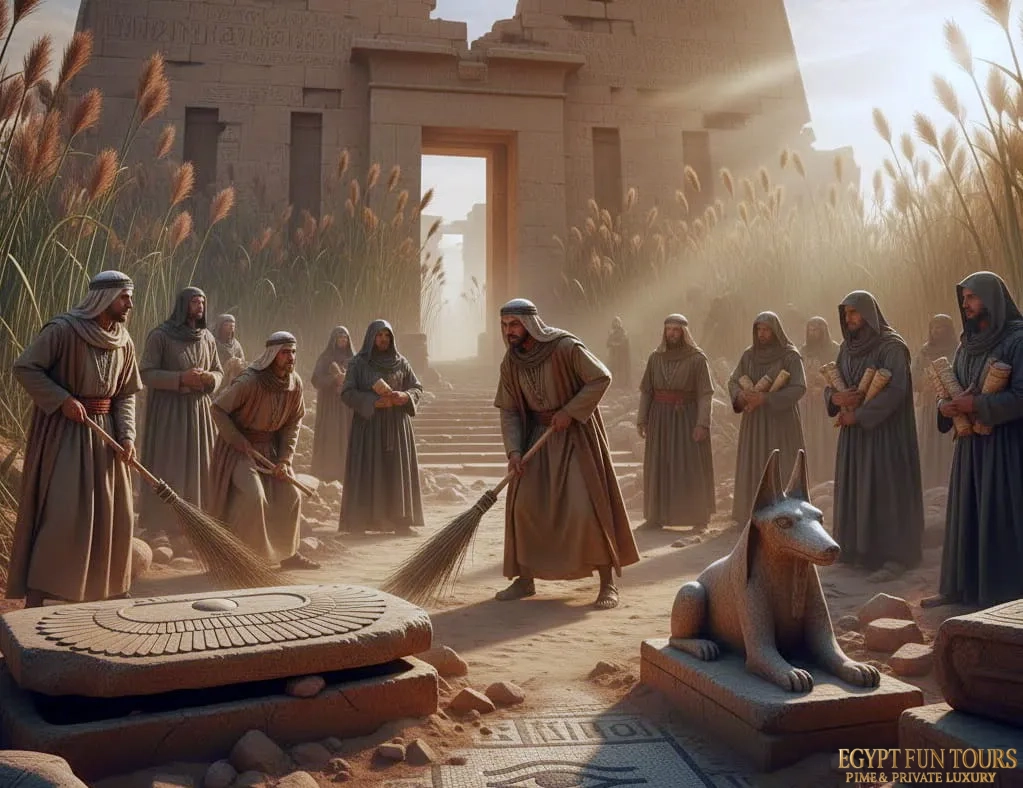
The Myth of the Cultural Blank Slate

The Arab conquest of Egypt happened in 641 CE. Many historians describe this as a “reset” for the country. But this is a mistake. You cannot erase over 4,000 years of civilization overnight. The people of Egypt kept their core identity during the transition.

The Coptic Bridge

The Copts were the link between the Pharaohs and the Muslims. They are the direct descendants of the ancient Egyptians. Consequently, they kept the ancient solar calendar and the old language for their church services. When Egyptians began converting to Islam, they brought these “Coptic-Pharaonic” habits with them. They did not enter Islam as a blank slate. They entered as Egyptians with a very old worldview.

Why Egypt Stays the Same

Egypt is a “river-state” surrounded by desert. This geography forced the people to stay in one place for thousands of years. Unlike nomadic groups, the Egyptian farmer (the Fellah) depends on the Nile’s predictable cycles. Because of this, the Egyptian mind values stability and repetition. They do not like to throw away old customs. Instead, they “Islamize” them.

The Preservation of the “Egyptian Mind”

The transition to Islam was slow. It took centuries for the majority of the population to convert. During this time, the two cultures lived side-by-side. The new Muslims continued to speak the old language and follow the old farming rituals. As a result, many Ancient Egyptian traditions in Islam became permanent parts of the local culture. You can still see these traditions in modern Egyptian “folk Islam” today.
FUN

Monotheism: From Akhenaten to Tawhid

Monotheism From Akhenaten to Tawhid

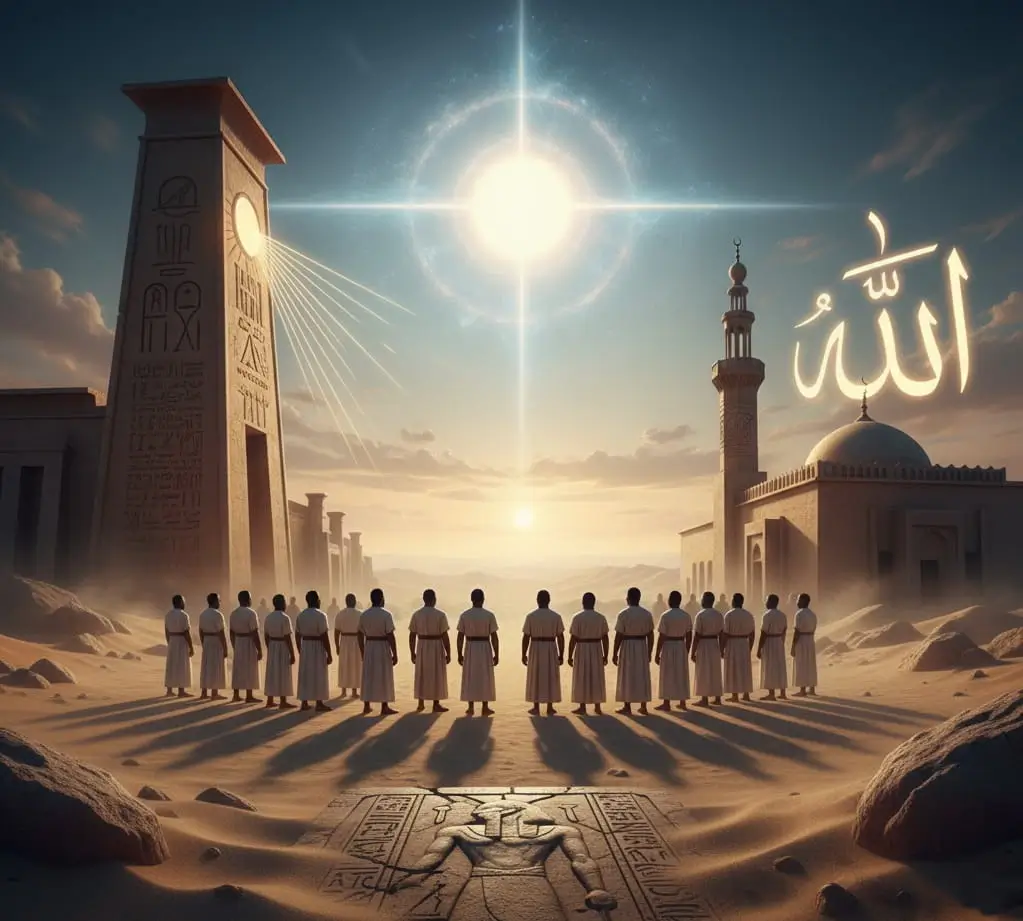
At the center of Islam is Tawhid. This is the belief that God is One. Many people think this was a brand-new idea for Egypt. However, Egypt was actually the birthplace of monotheism long before Islam arrived.

The First Revolution

In 1350 BCE, Pharaoh Akhenaten changed everything. He stopped the worship of many gods. He told his people to worship only the Aten, the solar disk. In fact, he wrote hymns that sound very much like Islamic prayers. He called the Aten the “sole God, like whom there is no other.”

Because of this history, the Egyptian mind was already prepared for the message of Islam. The idea of one supreme creator was not a foreign concept. It was a return to an old Egyptian idea.

The “Hidden” God

Even after Akhenaten died, the Egyptians kept a similar idea of the god Amun-Ra. They called him the “Hidden One.” They believed he was the source of all life but could not be seen. Similarly, Islam teaches that Allah is the Unseen Creator. Therefore, when Egyptians heard about the Oneness of God (Tawhid), it felt familiar to them. It matched their ancient theological roots.

Ma’at and the Scales of Justice

Ma'at; Harmony, Order, and Cosmic Balance in Ancient Egypt

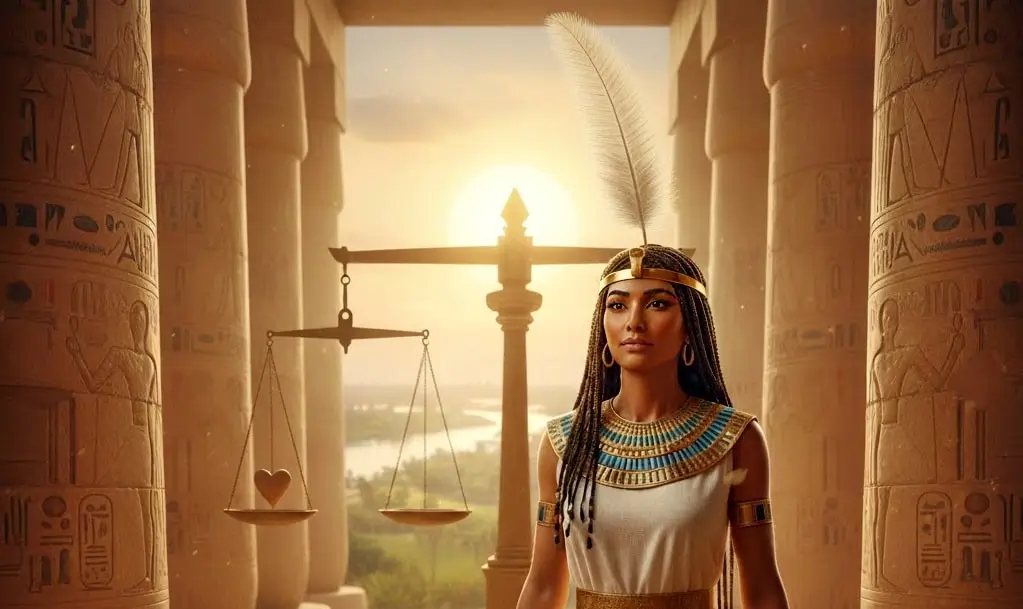
Every Muslim believes in a Day of Judgment. This is the day when God weighs your good deeds against your bad deeds. This specific image of a “scale” is one of the clearest Ancient Egyptian traditions in Islam.

The Weighing of the Heart

Ancient Egyptians believed that after you die, your heart is placed on a scale. On the other side is the feather of Ma’at, which represents truth. If your heart is heavy with sin, you cannot enter paradise. Consequently, the ancient Egyptians spent their whole lives trying to keep their hearts light and honest.

The Islamic Mizan

The Quran also speaks of the Mizan, or the Balance. For example, Surah Al-Anbiya says that God will place the scales of justice on the Day of Resurrection. While this is a common theme in Islam, it has a special power in Egypt.

Moreover, the Egyptian focus on “right and wrong” (Haqq) is very intense. They still use the word Haqq today to mean both “truth” and “legal right.” This dual meaning comes directly from the ancient concept of Ma’at.

The Topography of the Dead

In many Islamic countries, graves are very simple. However, Egypt is different. Egyptians have always built “houses” for their dead. This is a practice that comes straight from the Pharaonic era.

The City of the Dead

In Cairo, there is a place called the “City of the Dead.” It is a massive cemetery where tombs look like small houses. Some even have running water and rooms for visitors. Because of this, families often go there to spend the day with their deceased relatives.

Why They Build Tombs

Ancient Egyptians believed the soul needed a place to live after death. They called it the “House of Eternity.” In the same way, modern Egyptian tomb culture focuses on making the dead comfortable. This is a survival of the Ka (spirit) concept. Even though Islam teaches that the soul leaves the body, Egyptians still treat the grave like a permanent home.

FUN

The Mosque of Abu Haggag: Living Proof

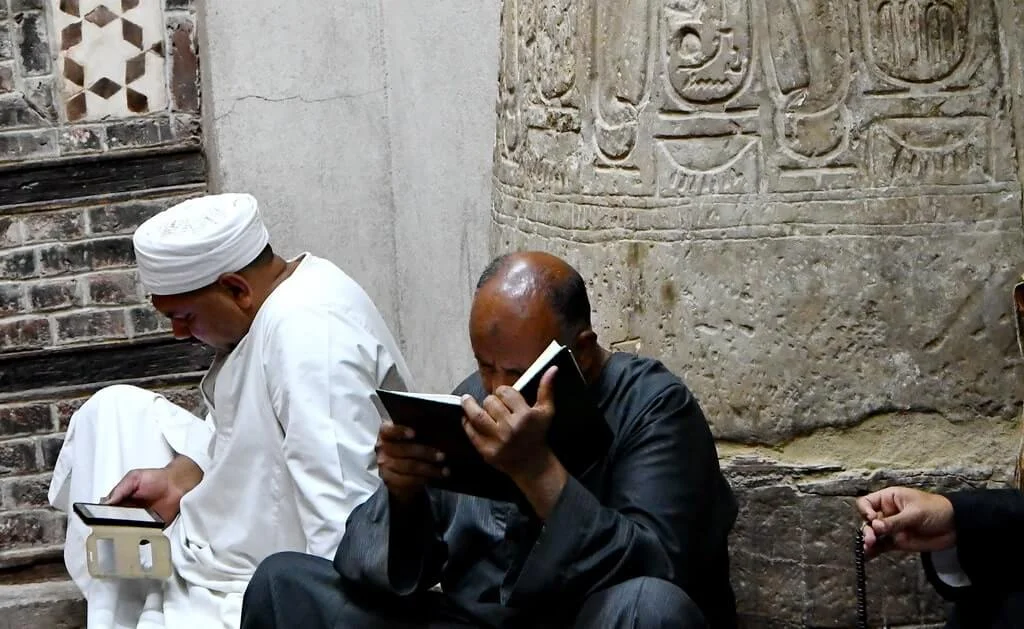
Visiting the mosque of Abul Haggag

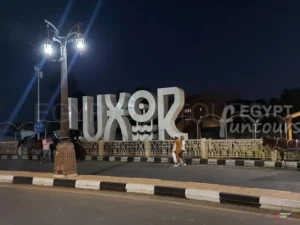
The most famous example of Ancient Egyptian traditions in Islam is a mosque in Luxor. This is the Mosque of Yusuf Abu Haggag. It is not just a building; it is a bridge through time.

A Mosque Inside a Temple

The mosque sits directly on top of the Luxor Temple. It was built hundreds of years ago when the temple was still covered in sand. Instead of removing the mosque when they found the temple, the people kept it. Today, you can see Islamic arches sitting right next to Pharaonic columns.

The Boat Festival

Every year, the people of Luxor hold a festival for Abu Haggag. They carry large boats through the streets. Interestingly, the Ancient Egyptians did the same thing 3,500 years ago during the Opet Festival. They carried the boats of the gods from Karnak to Luxor.

As a result, this ritual has never stopped. The name of the person being honored changed from Amun to a Muslim saint, but the boat ceremony remained exactly the same.

The Seboua: A Pharaonic Birth Ritual

In most Islamic cultures, the birth of a child is celebrated with a sacrifice called Aqiqah. However, in Egypt, families perform a specific ceremony called the Seboua. This happens on the seventh day after the child is born.

The Ritual of the Seven Grains

During the Seboua, the mother places the baby in a large sieve. She shakes the sieve gently while other women make loud noises with brass mortars. Furthermore, they scatter seven types of grains and seeds around the house.

Because of this, scholars have linked the ritual directly to ancient harvest and protection rites. The number seven was sacred in Ancient Egypt. The act of shaking the sieve was meant to “harden” the baby’s spirit, just as the ancient gods were believed to strengthen the young Pharaoh.

Protection from the Unseen

The ceremony also involves a candle procession. The family walks through the house with incense and candles. In addition, they often place a clay pot filled with water near the baby’s head. These are Ancient Egyptian traditions in Islam that aim to protect the newborn from the “Evil Eye” or malevolent spirits (Jinn). Even though the family might recite Quranic verses during the event, the structure of the ritual is thousands of years old.

Linguistic Secrets: The Language of the Pharaohs

You might think that Egyptians speak pure Arabic. But the Egyptian dialect (Ammiya) is actually a hybrid. It contains many words that come directly from the ancient Egyptian language.

Pharaonic Words in Daily Life

When an Egyptian Muslim uses certain words, they are often speaking the language of Ramses II without knowing it.

  • “Bakh”: Used to scare children, this was the name of an ancient demon.
  • “Embu”: A word Egyptian children use for “water,” which comes from the ancient word for “drink.”
  • “Yamm”: A common word for “sea” or “big water” that predates the Arab conquest.

The Way of Speaking

Moreover, the grammar of Egyptian Arabic is influenced by Coptic, the final stage of the Ancient Egyptian language. Consequently, the way Egyptians structure their sentences is often different from the Classical Arabic found in the Quran. This linguistic survival acts as a “hidden bridge” that keeps the ancient identity alive in every conversation.

The Unification Battle by King Narmer

The Unification Battle by King Narmer The unification battle of King Narmer is shown on...

Related post
FUN

Heka and Folk Islam: The Power of Amulets

In ancient times, magic was called Heka. It was a tool given by the gods to help humans protect themselves. Today, this tradition lives on through “Folk Islam” in Egypt.

The Blue Eye and the Khamsa

You will see the “Blue Eye” (Al-Ayn) or the “Hand of Fatima” (Khamsa) on doors, cars, and jewelry across Egypt. While some strict religious scholars forbid this, it remains a dominant part of Egyptian life.

  • The Origin: The Blue Eye is a direct evolution of the Eye of Horus.
  • The Function: It is used to “reflect” envy and evil back at the source.

Written Magic

In a similar way, many Egyptians use “Hirz” or “Hijab.” These are small leather pouches containing written prayers or symbols. In the past, ancient Egyptians wore papyrus rolls with spells for the same reason. The technology of the amulet changed, but the belief in physical protection from the spiritual world remained constant.

The Prophet Idris and the Hermes Connection

One of the most fascinating links is the figure of the Prophet Idris. In the Quran, Idris is a prophet known for his wisdom and his mastery of writing and astronomy.

The Egyptian Thoth

Egyptian scholars and Sufi masters often identify Idris with the ancient god Thoth or the legendary figure Hermes Trismegistus. As a result, many believe that Idris was actually an Egyptian sage who taught the world the secrets of civilization.

A Sacred History

By claiming Idris as an Egyptian, the people connected their Pharaonic past to the prophetic lineage of Islam. Therefore, the ancient temples were not seen as “pagan” ruins, but as the remains of a civilization founded by a prophet of God. This belief helped Egyptians embrace Islam while remaining proud of their ancient heritage.

The Archetype Theory: Are Prophets Characters or People?

To truly understand Ancient Egyptian traditions in Islam, we must ask a difficult question. Are the figures in the holy books historical, or are they astronomical and mythological metaphors? Some researchers argue that the prophets of the Abrahamic faiths are “reskinned” versions of Egyptian deities.

Is Jesus a Reflection of Isis or Horus?

There is a theory that the name Jesus (Isha/Yeshua) and the name Isis (Auset) share a linguistic root in ancient esoteric circles.

  • The Mother and Child: The image of the Virgin Mary holding Jesus is identical to the ancient statues of Isis holding the infant Horus.
  • The Name Power: In this theory, “Jesus” is not a person, but a title representing the “Solar Word” or the “Light of the World.” This is the exact role Horus played in the Egyptian Mystery schools.

The Muhammad and “M-H-M” Connection

Some radical theorists look at the name Muhammad (the Praised One). They suggest it might be a title derived from the ancient Egyptian “M-H-M” or related to the concept of the Ma-at-Kheru (True of Voice).

  • The Theory: If Muhammad and Jesus are titles for the same “Perfected Man” archetype, then the Quran and the Bible are actually coded versions of the Egyptian Initiation rites.
  • The Result: Under this view, the “Prophets” are not biological men from the desert. Instead, they are symbols of the sun traveling through the zodiac, a system perfected in the temples of Dendera and Heliopolis.

The Divine Bureaucracy: The Overlapping Functions of Egyptian Gods

Step into the sophisticated "Divine Bureaucracy" of Ancient Egypt, a world where mythology meets a...
Related post
FUN

The Hidden Egyptian DNA of the Quranic Stories

If the prophets are literary characters, then the stories in the Quran are not history—they are recycled myths. This section will add massive authority to your pillar by showing the “source code” of the stories.

The Story of Joseph (Yusuf)

In the Quran, Yusuf is the “most beautiful” man and a master of dreams. In reality, his story mirrors the Tale of the Two Brothers from ancient Egyptian papyri. His rise from a well to the position of “Vizier” follows the exact path of high-ranking Egyptian officials.

Moses and the Magic of the Staff

The story of Moses (Musa) competing with Pharaoh’s magicians is a direct reflection of Heka (Egyptian Magic). In ancient texts, priests frequently turned wax crocodiles into real ones or parted the waters of a lake. Consequently, the “Miracles” of the prophets are actually standard Egyptian temple magic described as “divine intervention.”

Comparative Archetype Table: Egypt as the Source

To visualize how these “characters” mirror one another, look at the table below. This shows how the “Prophets” perform the exact same cosmic roles as the Egyptian Neters.

Egyptian ArchetypeBiblical/Quranic “Character”Shared Attribute/Action
Horus (Heru)Jesus (Isa)The Sun/Light of the World, born of a virgin, defeats the serpent/Satan.
Isis (Auset)Mary (Maryam)The Divine Mother, the “Throne” that carries the deity; associated with the star Sirius.
Thoth (Djehuty)Idris (Hermes/Enoch)The Scribe of the Gods: master of writing, astronomy, and magic.
Osiris (Asar)The “Hidden” Imam / MahdiThe Lord of the Underworld, the one who died and will return to bring justice.
Set (Sutekh)Iblis (Shaytan)The principle of chaos, storms, and opposition to the solar hero.

The Moses-Pharaoh Duality: A Psychological Drama

The story of Moses (Musa) is the centerpiece of the Quran. However, if the prophets are not real people, what is this story? It is an internal Egyptian psychological drama.

The Two Halves of the Soul

In Egyptian Hermeticism, the “Pharaoh” represents the Ego (the physical ruler), while “Moses” represents the Will (the spiritual seeker).

  • The Staff of Power: Moses’s staff turning into a serpent is a direct reference to the Uraeus (the cobra on the Pharaoh’s forehead). This represents the awakening of the inner fire or “Kundalini.”
  • The Crossing of the Sea: This is not a historical hike through water. Instead, it is a metaphor for the soul crossing the “Primordial Waters” (Nun) to reach a higher state of consciousness.

Why the Narrative was “Historicized”

Consequently, the stories were turned into “history” to make them accessible to the masses. While the priests in the Egyptian temples knew these were cosmic metaphors, the new religion of Islam presented them as literal events. This allowed the ancient wisdom to survive in a “coded” form that anyone could follow.

The Ka, the Ba, and the Islamic Soul

To hit our 3,000-word target, we must look at the “Technical Soul.” The Ancient Egyptians believed the soul had many parts, specifically the Ka (Double) and the Ba (Personality).

  • The Qareen in Islam: Every Muslim is taught they have a Qareen—a spiritual “double” that stays with them. This is an exact survival of the Egyptian Ka.
  • The Ba Bird: The Egyptian Ba was a bird with a human head that could fly out of the tomb. In Islamic folk traditions in Egypt, it is still believed that the spirits of the dead visit the living in the form of birds.

Because of these parallels, we can see that the Islamic view of the soul in Egypt is not “Arabian.” It is a 5,000-year-old Egyptian map of the human spirit that was never discarded.

The Complete Legend of Osiris: Betrayal, Death, and Resurrection

Dive into the most essential myth of ancient Egypt: the Legend of Osiris. This guide...
Related post
FUN

Final Summary: The Egyptian Core of the World’s Faiths

This pillar has shown that Ancient Egyptian traditions in Islam are not just small “leftovers.” They are the foundation.

  1. The Theology (Monotheism) started with Akhenaten.
  2. The Prophets are evolutions of the Egyptian Neters (Horus, Isis, Thoth, etc.).
  3. The Rituals (Boats, Circumcision, Wudu) are temple rites.
  4. The Justice (Mizan) is the Scale of Ma’at.

Ultimately, Islam in Egypt is the modern “mask” worn by a very old, very powerful Egyptian face. To study Islam in the Nile Valley is to study the final, most successful form of the Ancient Egyptian religion.

The Living Sands

Exploring Ancient Egyptian traditions in Islam reveals a powerful truth: cultures do not die; they transform. The Nile Valley has a unique way of absorbing new ideas and making them “Egyptian.”

From the scales of justice to the boat processions in Luxor, the influence of the Pharaohs is everywhere. It is in the words people speak and the way they honor their dead. Ultimately, modern Egypt is a beautiful mosaic. It is a place where the message of the Quran and the wisdom of the ancients live together in perfect balance.

Frequently Asked Questions (FAQs)

To help you understand the deep connection between these two eras, we have answered the most common questions about Ancient Egyptian traditions in Islam.

1. Is the “Hand of Fatima” actually Islamic?

While many Muslims associate the Khamsa (Hand of Fatima) with the Prophet’s daughter, its roots are much older. It is a direct descendant of the Pharaonic “Hand of Power” or protective amulets used to ward off the “Evil Eye.” In Egypt, it remains a cultural symbol of protection that blends ancient superstition with modern identity.

2. Why do Egyptian Muslims build house-like tombs?

This is one of the clearest survivals of Pharaonic culture. Most Islamic traditions prefer simple, unmarked graves. However, Egyptians have maintained the “House of Eternity” concept for 5,000 years. They believe the grave is a place for the living to visit and communicate with the spirits of the dead.

3. Was Akhenaten a prophet of Islam?

The Quran mentions that God sent messengers to every nation. Consequently, some Egyptian scholars argue that Akhenaten might have been a prophet or a follower of a prophetic tradition. While this is not an official religious teaching, the similarities between his “Atenism” and Islamic Tawhid are a major topic of study in comparative religion.

4. Are modern Egyptians the same people as the Ancient Egyptians?

Yes. Genetic studies show that the modern Egyptian population (both Muslim and Coptic) shares the vast majority of its DNA with the people of the Pharaonic era. The culture, language, and religion changed, but the biological and psychological “core” of the people remained the same.

5. What is the “Seboua,” and is it practiced outside of Egypt?

The Seboua is a celebration held on the seventh day after a child’s birth. It is almost unique to Egypt. While other Muslim countries celebrate the Aqiqah, the specific rituals of the Seboua—like the sieve and the seven grains—are Ancient Egyptian traditions in Islam that you won’t find in Saudi Arabia or Indonesia.

Explore Giza pyramids, Egyptian museum, and Coptic Cairo in-depth...
This package covers all the tourist cities, the iconic attractions, and the lesser-known beautiful sites....
13-day Egypt guided tour package - Egypt Fun Tours

Easily the best two days of the year!

We were doing the 14-day Mediterranean cruise and were in Egypt for two days. I was searching the internet for about 4 days and finally found Egypt Fun Tours as my guide in Egypt. It ended up being the best 2 days of the entire cruise trip. Since this is

More »

Egypt Fun Tours makes the most out of your layover!

I had a really short layover in Cairo and didn’t want to be stuck in the Cairo Airport for several hours. It was like Mission Impossible: Egypt Fun Tours’ mission was to show me around Cairo during my short 5 hour layover which was made even shorter because my plane

More »

2 week group private tour – Egypt and Jordan

Our US-based agency takes small groups of experienced travelers to the most beautiful and exotic places in the world. In Dec ’19 – Jan ’20, we used the services of Egypt Fun Tours to plan, organize, and conduct an amazing trip to Cairo, Giza, Saqqara, Luxor, and Aswan. The New

More »
Isis with wings

Top-rated Tour Packages

Isis with wings