Tomb of Sennedjem (TT1): Egypt’s Best-Preserved Artisan Tomb

The Tomb of Sennedjem (TT1) is the best-preserved artisan tomb in the Deir el-Medina necropolis, dating to the 19th Dynasty. As a master craftsman who built the royal tombs of Pharaohs, Sennedjem decorated his own burial chamber with unparalleled skill, featuring vibrant ochre-yellow backgrounds that symbolize the "flesh of the gods." Found entirely intact in 1886, the tomb is famous for its iconic Field of Reeds mural—a depiction of the Egyptian paradise—and its intimate look at the religious devotion and domestic life of a New Kingdom elite laborer.

Step inside the most vibrant burial chamber ever discovered in Egypt. Located in the sun-drenched hills of Deir el-Medina, the Tomb of Sennedjem (TT1) is not merely a grave—it is a 3,000-year-old time capsule. Unlike the weathered walls of many royal monuments, the paintings here remain so fresh they look as if the artist laid down his brush only yesterday.

As a master craftsman in the “Place of Truth” during the reigns of Seti I and Ramesses II, Sennedjem spent his life building the eternal homes of Pharaohs. Yet, in his own final resting place, he created a personal masterpiece that rivals the splendor of the Valley of the Kings. From the famous golden-hued “Field of Reeds” to the intricate rituals of the Book of the Dead, TT1 offers an unparalleled look at the hopes, faith, and daily life of the men who built ancient Egypt.

Whether you are a seasoned researcher or a first-time traveler planning your visit to the Theban Necropolis, this comprehensive guide covers the history, symbolism, and hidden details of this UNESCO World Heritage site.

At a Glance: What You Will Learn

  • The Artisan’s Secret: Why Sennedjem’s tomb is better preserved than most royal sites.
  • Visual Tour: A deep dive into the “Field of Reeds” and the iconography of the vaulted ceiling.
  • The 1886 Discovery: The story of the intact burial that stunned archaeologists.
  • Visitor Pro-Tips: How to reach Deir el-Medina and the best times to photograph the murals.
FUN

The Servant in the Place of Truth: Who Was Sennedjem?

The Servant in the Place of Truth- Who Was Sennedjem

To understand the magnificence of TT1, one must first understand the unique status of the man buried within its walls. Sennedjem was not a king, nor a high-ranking general, but his role was perhaps more vital to the spiritual survival of the Pharaohs than any court official.

The Elite Craftsman of Deir el-Medina

Sennedjem lived during the early 19th Dynasty, serving under two of Egypt’s greatest builders: Seti I and Ramesses II. He held the prestigious title of “Servant in the Place of Truth on the West of Thebes.” The “Place of Truth” (Set Maat) was the ancient name for Deir el-Medina, the secluded village of elite artisans who cut and decorated the royal tombs in the Valley of the Kings and the Valley of the Queens. These were not ordinary laborers; they were literate, highly skilled master artists, stonemasons, and scribes who were provided for by the state to ensure the King’s eternal life.

A Family of Artists

The Tomb of Sennedjem was a family project. Historical records and inscriptions within the tomb reveal that Sennedjem was the patriarch of a large, successful family. He shared his eternal home with his wife, Iy-neferti, and several of their children.

Key Fact: Sennedjem’s son, Khonsu, followed in his father’s footsteps as a master artisan. This hereditary transmission of skill ensured that the artistic techniques used in the royal tombs remained consistent and of the highest quality for generations.

Life in the Village

Living in Deir el-Medina afforded Sennedjem a lifestyle far above that of the average Egyptian peasant. The village was a gated community with its own legal system and healthcare. Because the artisans possessed the “secret knowledge” of the royal tomb layouts, they were kept isolated from the general population. This isolation fostered a competitive and highly creative environment. While they spent their days painting the journey of the Pharaoh through the underworld, they spent their “off-hours” applying those same sacred techniques to their own private tombs. This is why the Tomb of Sennedjem exhibits the same level of craftsmanship as the tombs of the royalty he served.

Why This Matters for Your Visit

When you stand inside TT1, you aren’t just looking at art; you are looking at the personal work of a man who saw the afterlife not as a distant myth, but as a tangible reality he helped build every single day.

  • The Skill Level: Look closely at the brushstrokes; they are the work of a man who practiced his craft on the most important monuments in human history.
  • The Personal Touch: Unlike royal tombs, which are strictly formal, Sennedjem’s tomb includes intimate touches of his family life, making it one of the most “human” sites in all of Luxor.
FUN

The Architecture of Eternity: Layout and Design of TT1

The Architecture of Eternity Layout and Design of TT1

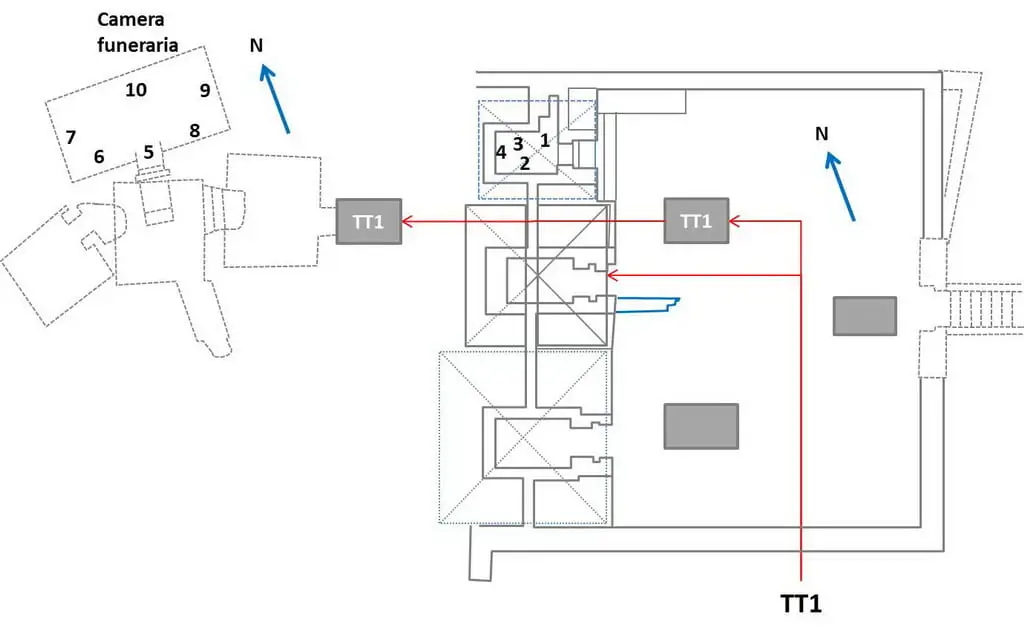
The Tomb of Sennedjem is a textbook example of the “Deir el-Medina Style.” While the royal tombs in the Valley of the Kings were sprawling, multi-corridor complexes carved deep into the limestone, the artisans’ tombs were compact, vertical, and topped with distinct architectural features that signaled their status to the living.

The Superstructure: The Cult Chapel and Pyramid

Originally, the tomb was not just a hole in the ground; it was a visible monument.

  • The Courtyard: A small, walled outdoor space where the family would leave food and drink offerings for the Ka (the life force) of the deceased.
  • The Mud-Brick Pyramid: Surmounting the tomb was a small, steep pyramid. This was a solar symbol representing the primordial mound of creation (the Benben). At the peak sat a pyramidion (capstone), often inscribed with prayers to the sun god, Ra.
  • The Chapel: Below or adjacent to the pyramid was a small room where visitors could pray. This space acted as the bridge between the world of the living and the realm of the dead.

The Descent: The Burial Shaft

To reach the actual burial chamber, one must descend a steep, narrow vertical shaft. In antiquity, once the mummy of Sennedjem and his twenty relatives were placed inside, this shaft was filled with rubble to deter grave robbers.

The Burial Chamber: The “Golden Room”

The Burial Chamber The Golden Room

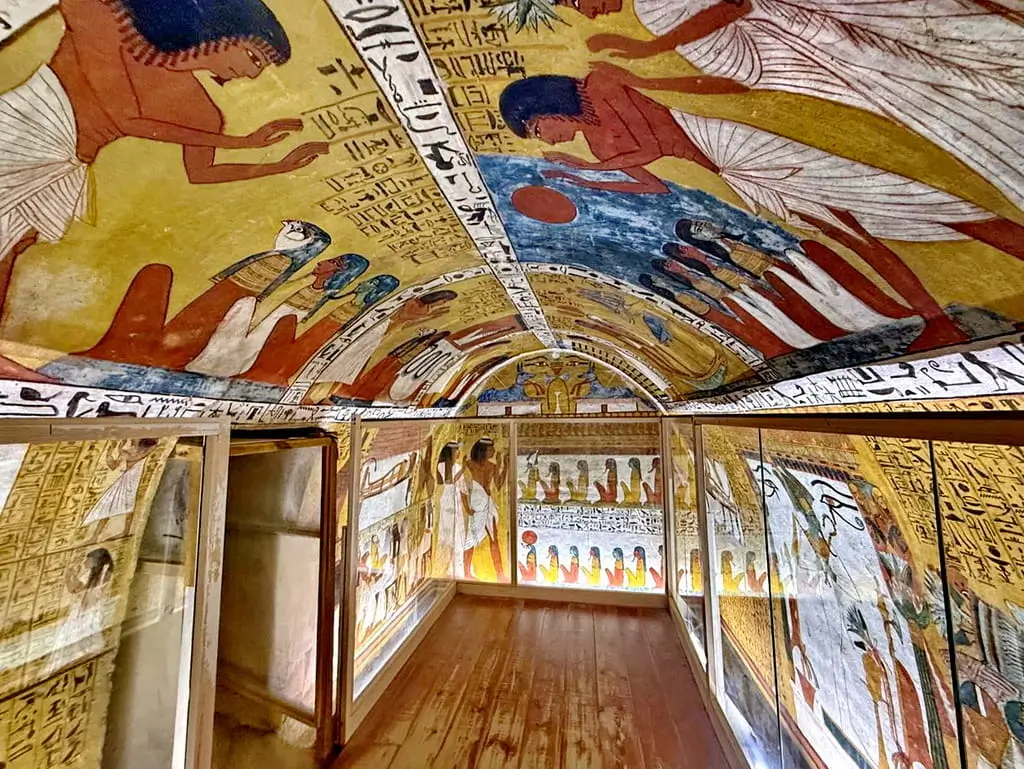
The highlight of TT1 is the burial chamber itself. It is a single, vaulted room that feels surprisingly intimate.

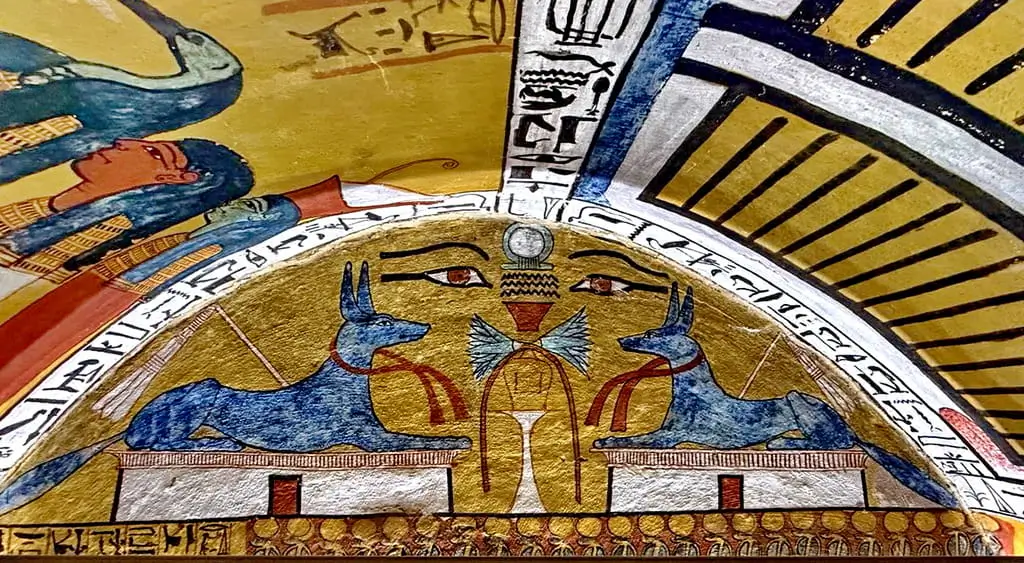
  • The Vaulted Ceiling: The curved ceiling represents the sky, painted with scenes of the celestial bark and the constellations.
  • The Background Color: The most striking feature is the deep ochre-yellow background. In Egyptian color symbolism, yellow represented gold, the indestructible flesh of the gods. By painting his tomb this color, Sennedjem was effectively turning his final resting place into a divine, incorruptible space.
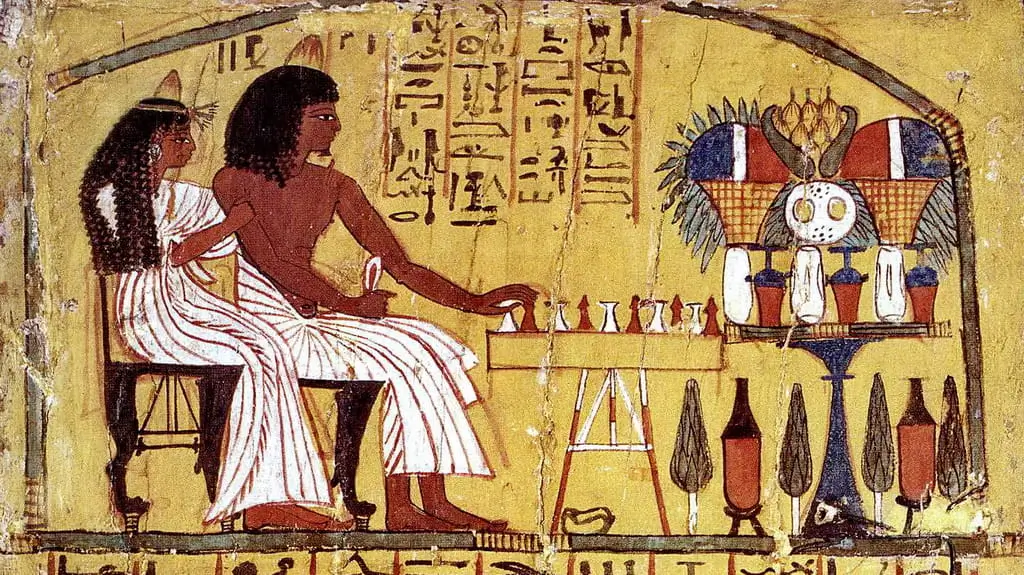
  • The Doorway: The wooden door of the tomb (the original of which is now in the Egyptian Museum in Cairo) was also a work of art, featuring scenes of Sennedjem playing the board game Senet—a metaphor for passing through the dangers of the underworld.

Architectural Innovation

Sennedjem’s tomb is unique because it combines the structural practicalities of a worker’s life with the high-theological aspirations of the state religion. The use of the vault was a sophisticated architectural choice, providing more surface area for the elaborate “Book of the Dead” vignettes that we will explore in the next section.

FUN

The Master’s Palette: Iconography and the “Book of the Dead”

The Master’s Palette Iconography and the Book of the Dead

Furthermore, the true brilliance of the Tomb of Sennedjem lies not just in its structure, but in the breathtaking narrative unfolding across its walls. Because Sennedjem was a master of his craft, the iconography within TT1 serves as a high-definition manual for the journey to the afterlife. In addition to being beautiful, every image was a functional spell designed to ensure the deceased’s safe passage through the underworld.

The Vivid Imagery of the Vaulted Ceiling

To begin with, the vaulted ceiling is divided into meticulous registers that draw the eye upward toward the heavens. Specifically, these scenes depict the solar barque of Ra as it travels through the hours of the night. By illustrating this cycle, Sennedjem ensured that his own soul would be reborn every morning alongside the sun. Moreover, the presence of the sky goddess, Nut, stretching across the ceiling, reinforces the theme of protection and eternal renewal.

The “Opening of the Mouth” Ritual

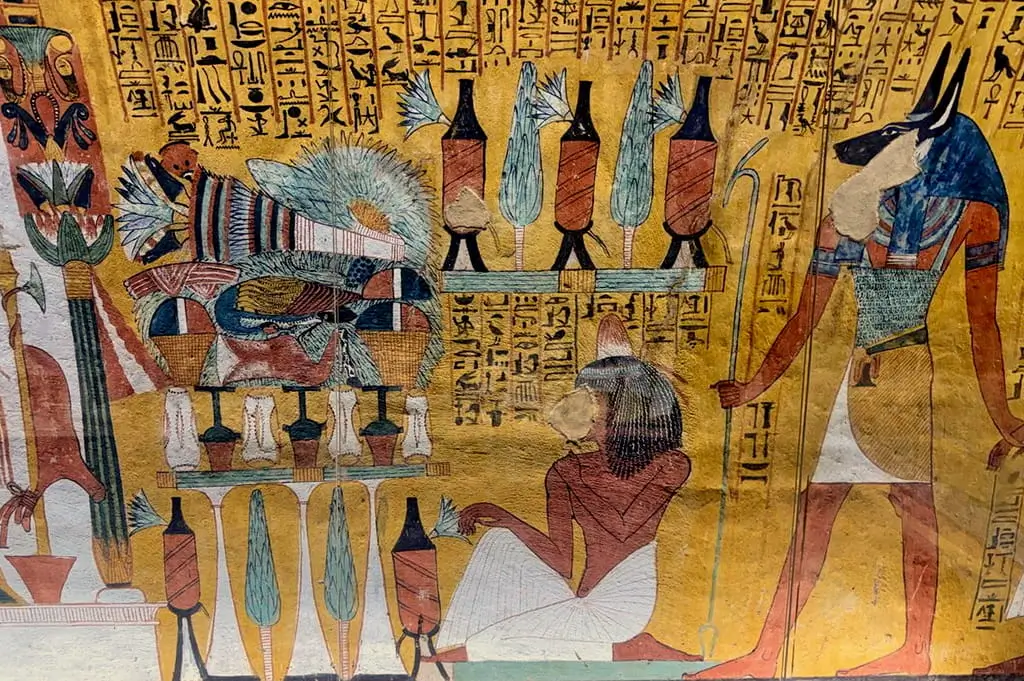
Moving on to the eastern wall, we find a deeply personal depiction of the Opening of the Mouth ceremony. In this scene, Sennedjem’s son, dressed in the leopard skin of a Sem-priest, performs the ritual on his father’s mummy. As a result of this sacred act, the deceased regained the ability to breathe, speak, and eat in the next world. Consequently, this scene is one of the most vital in the entire tomb, as it bridges the gap between the physical body and the eternal spirit.

Pro Tip: When viewing this wall, notice the incredible detail of the ritual tools. Because Sennedjem was an artisan, these tools are rendered with a precision that provides archaeologists with a literal blueprint of New Kingdom religious artifacts.

The Weighing of the Heart

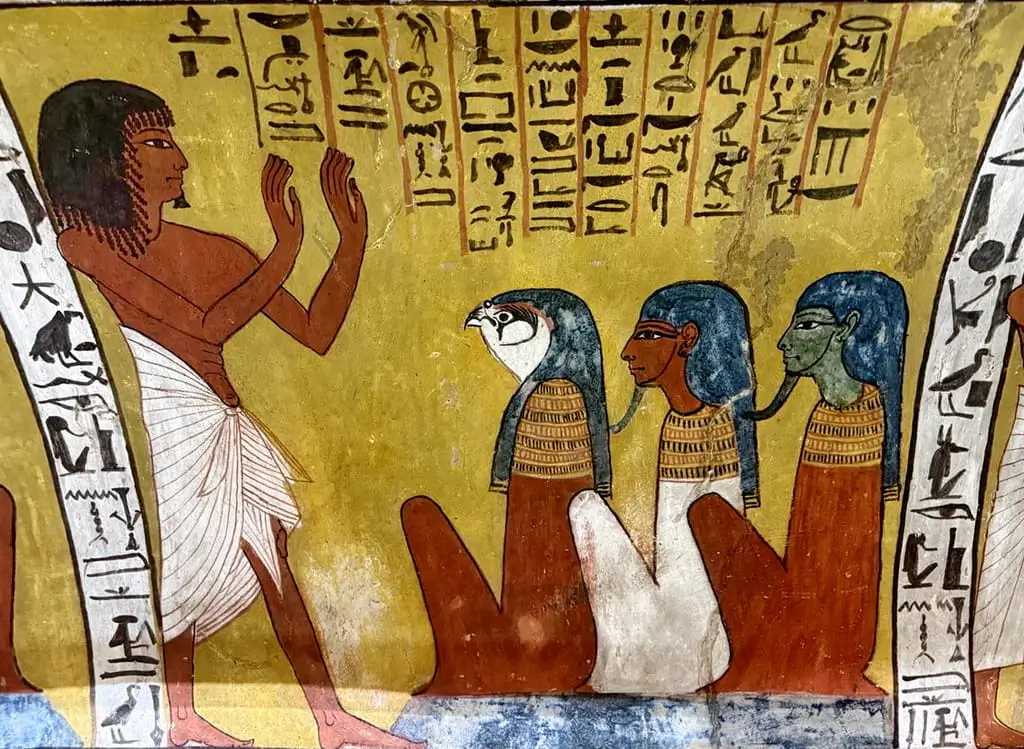
Similarly, no journey to the afterlife would be complete without the Hall of Judgment. On the western wall, we see the classic scene where Sennedjem’s heart is weighed against the feather of Ma’at (truth). If the heart was lighter than the feather, he was permitted to enter the Field of Reeds. Notably, the presence of the god Thoth recording the result and Anubis steadying the scales highlights the high stakes of this spiritual trial.

The Vibrant Use of Polychrome

The Vibrant Use of Polychrome

Finally, it is essential to discuss pigment preservation. Unlike at other sites, where colors have faded to muted browns, the blues, greens, and reds in TT1 remain startlingly bright. This is largely due to the tomb’s sealed environment and the high-quality natural minerals used by the artisans. As a result, the murals provide a rare opportunity to see the ancient Egyptian world exactly as the ancients saw it—saturated, symbolic, and full of life.

FUN

Paradise Found: The Field of Reeds (Iaru)
Paradise Found The Field of Reeds (Iaru)

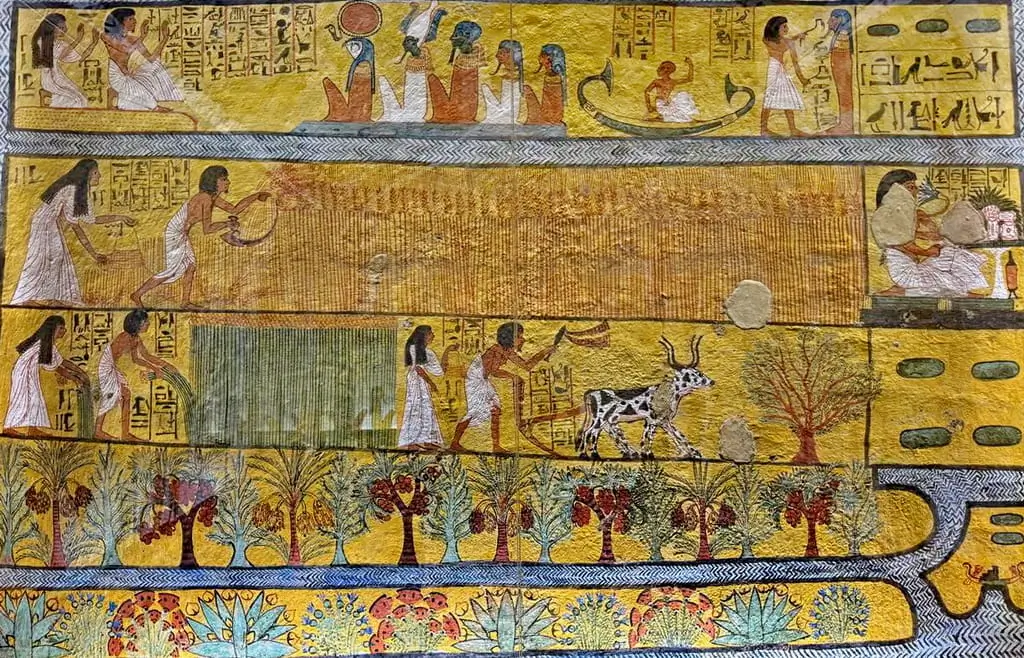
Undoubtedly, the centerpiece of the entire tomb—and perhaps the most famous mural in all of Deir el-Medina—remains the stunning depiction of the Field of Reeds. While many Egyptian tombs focus on the terrifying obstacles of the underworld, this specific section of TT1 highlights the reward. Therefore, it serves as the ultimate “happy ending” for Sennedjem’s earthly journey.

A Perfected Version of Egypt

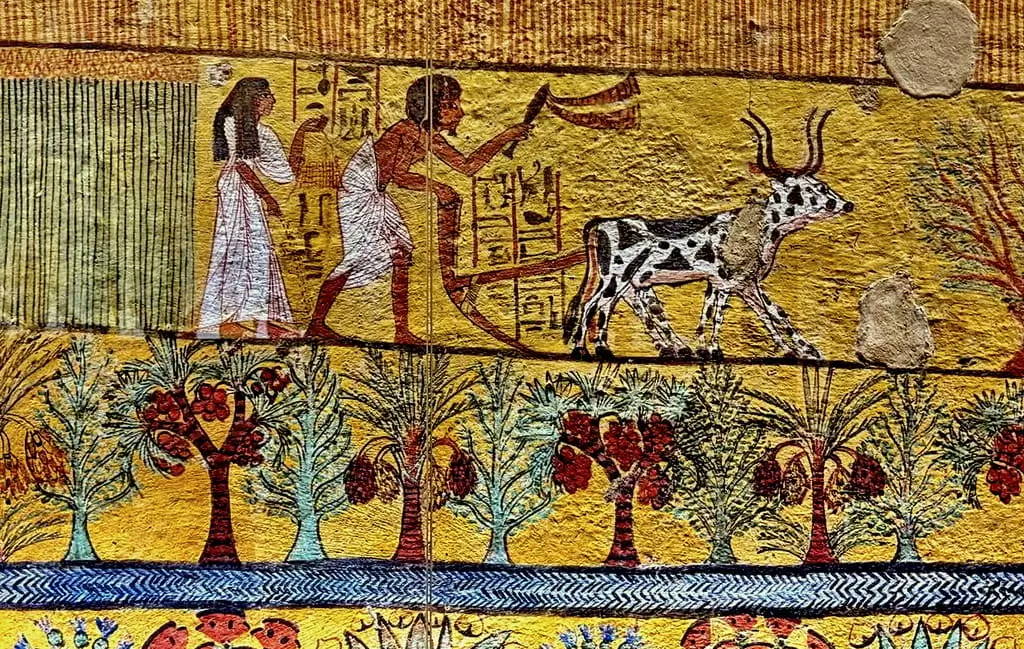
In essence, the Egyptians envisioned the Field of Reeds (Iaru) as a mirror image of the Nile Valley, but without the hardships of drought, famine, or exhaustion. On the northern wall, we see Sennedjem and his wife, Iy-neferti, engaging in agricultural labor. However, they do not perform the grueling toil of a peasant. Instead, they participate in a ritualized, eternal joy. Notice how the wheat grows taller than the people and the trees hang heavy with ripe fruit. Consequently, this scene tells the viewer that in the afterlife, nature provides in abundance for those who lived a righteous life.

Symbolism of the Harvest

Furthermore, the act of harvesting carries deep symbolic weight. By reaping the grain, Sennedjem participates in the cycle of Osiris, the god of regeneration. Just as the farmer cuts the grain only for it to grow again, the gods “harvest” the deceased from the earth only to grant them rebirth in the celestial fields. Moreover, the presence of the couple working together highlights the Egyptian belief that family bonds remained unbroken even after death.

Artistic Composition and Color

From an artistic perspective, this section represents a masterclass in composition. Because the artist set the figures against that signature vibrant yellow background, the greens of the crops and the whites of the linen garments pop with extraordinary clarity. In addition, the artist meticulously organized the registers to show different stages of the harvest—from plowing with oxen to reaping with sickles. As a result, the wall functions as both a religious map and a beautiful work of landscape art.

The Discovery of TT1: An Intact Time Capsule

Switching our focus from the spiritual to the historical, the story of how archaeologists found the Tomb of Sennedjem carries nearly as much drama as the art itself. In 1886, a resident of Deir el-Medina led the French archaeologist Gaston Maspero and the Spanish diplomat Eduardo Toda to a sealed entrance that had remained untouched for over three millennia.

A Rare “Unplundered” Find

Unlike the famous royal tombs, which ancient looters almost always emptied, TT1 remained completely intact. Because debris buried the entrance and the world forgot its location, the treasures inside stayed exactly where the family had left them. When Toda first entered the chamber, he encountered twenty mummies, including Sennedjem, his wife, and their descendants, resting peacefully amidst their funerary furniture.

What Was Inside?
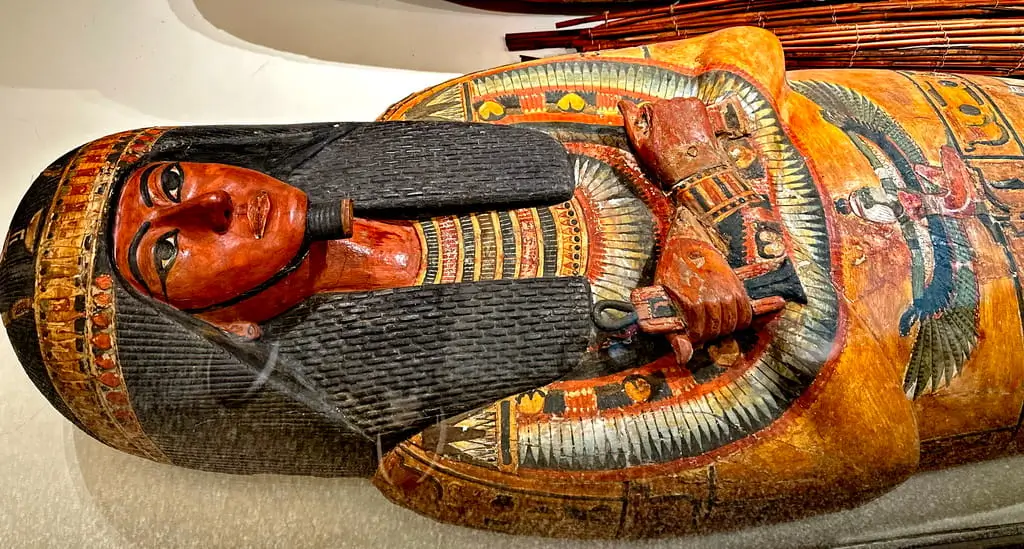
The Sarcophagi of Sennedjem

Beyond the mummies themselves, the tomb contained items that provide an intimate look at New Kingdom life:

  • The Sarcophagi: Intricately painted wooden coffins that mirror the vibrancy of the murals.
  • The Senet Board: A game found in the tomb, which we now know served as a metaphor for navigating the afterlife.
  • Daily Tools: Because Sennedjem worked as an artisan, his measuring rods and cubit sticks lay beside him, linking his professional identity to his eternal soul.

Today, while the Egyptian Museum in Cairo now houses the mummies and most of the artifacts, the “soul” of the discovery remains in the tomb. By visiting the site, you stand in a space that maintained its silence and darkness for 3,200 years until that pivotal day in 1886.

FUN

Preservation and the Modern Visitor: A Sensory Experience

Preservation and the Modern Visitor A Sensory Experience

In light of the tomb’s immense historical value, the current state of preservation in TT1 remains nothing short of a miracle. However, maintaining this “time capsule” requires a delicate balance between public access and scientific conservation. Because the tomb features a small footprint and limited air volume, modern visitors impact the environment every time they enter.

Why the Colors Retain Their Brilliance

To understand why the murals look like Sennedjem painted them yesterday, one must look at the environmental conditions. Since a heavy mud-brick barrier and shifting sands sealed the entrance for millennia, they protected the chamber from oxygen and moisture—the two greatest enemies of ancient art. Furthermore, the artisans of Deir el-Medina chose high-quality mineral pigments, such as ground lapis lazuli for blue and red ochre for earth tones. These minerals resist fading far better than organic dyes.

Tips for the Modern Traveler

If you plan a visit to the West Bank of Luxor, prioritize the Tomb of Sennedjem. To ensure you have the best experience, consider the following:

  • Arrive Early: Because the burial chamber feels crowded quickly, try to reach Deir el-Medina at 6:00 AM or shortly before it closes in the afternoon.
  • Check Photography Rules: While authorities strictly prohibit flash photography to protect the pigments, many visitors now take photos with mobile phones. Regardless, the low lighting makes it difficult to capture the true depth of the yellow background without a steady hand.
  • Explore Nearby Treasures: In addition to TT1, your ticket usually includes access to the Tomb of Inherkhau (TT359) and the Temple of Hathor. By visiting these adjacent sites, you gain a broader perspective on the village life of the “Servants in the Place of Truth.”

The Eternal Legacy of a Master Builder

The Eternal Legacy of a Master Builder

In conclusion, the Tomb of Sennedjem offers much more than a burial site; it serves as a testament to the human desire for beauty and the hope for life beyond the horizon. Through his work, Sennedjem bridged the gap between the royal and the common, proving that a “Servant in the Place of Truth” could create a masterpiece as enduring as any Pharaoh’s monument.

Whether the vibrant artistry of the Field of Reeds or the fascinating history of its intact discovery draws you in, TT1 remains a cornerstone of Egyptian archaeology. Ultimately, as you stand in that golden-hued chamber, you do not just look at history—you witness the eternal dreams of an artist who finally achieved the immortality he so meticulously painted.

Explore the marvelous historical monuments of Egypt....
Explore the wonders of Egypt in 9-day adventure....
God_Anubis_Icon

Very Considerate and Helpful

Guide and driver were on time, open to my requests and took care that I felt safe and saw the Pyramids and parts of old cairo during my less than 24 hour stay between flights. Office staff were great in communicating by email before and during the trip.

More »
4 Days Egypt Experience for Solo Woman Egypt Fun Tours min 1

Amazing experience

My husband and I had a ten-hour layover in Cairo and luckily found Egypt Fun Tours while researching tour companies online. The owner, Hamada, picked us up from the airport and brought us around Cairo. He took us to see the pyramids, which was a memory I will never forget.

More »

Amazing tour to the pyramids of Sakkara and Dahshur

This week we had a great tour with Mohamed to the pyramids of Sakkara and Dahshur, as well as Memphis. He tailored the tour to our preferences, took a lot of time with us, and gave us detailed background information on everything. It was also great that he never tired

More »

Absolutely the best

We visited Cairo over a 15-hour layover. Egypt Fun Tours organized a customized and wonderful experience for us. We could not be happier. The day included a visit to all the great sites, the marketplace, dinner, a boat ride on the Nile, and a host of other special requests. I

More »
God_Anubis_Icon

Top-rated Tour Packages

God_Anubis_Icon