The Great Recycling Strategy of the Tanis Temples
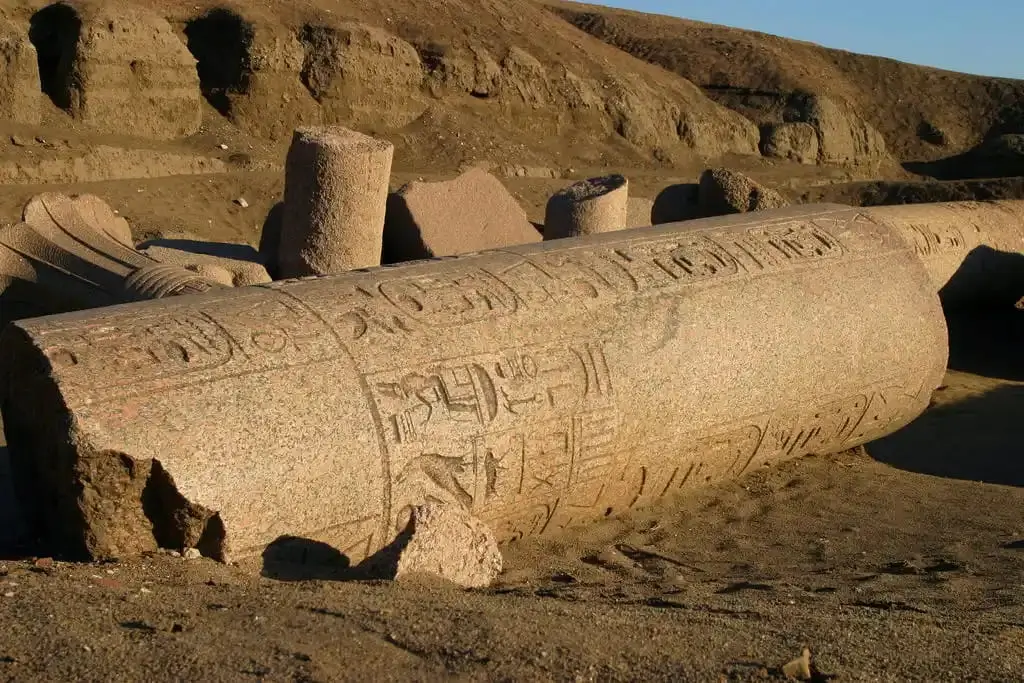
The construction of the Tanis temples represents one of the largest recycling operations in architectural history. Because the Delta region completely lacks natural stone quarries, transporting massive blocks of granite from Upper Egypt presented a major logistical challenge for a divided kingdom.
Consequently, the Tanite pharaohs used the abandoned ruins of Pi-Ramesses as an open-air stone quarry. Over several decades, workers dismantled the temples, palaces, and public plazas of Ramesses II. They transported thousands of tons of carved stone downriver to build the new sacred complex.
Tanis Temples: Decoding the Ramesside Inscriptions
When you walk through the Tanis temples today, almost every major stone block bears the cartouche of Ramesses II, Merneptah, or Osorkon II. This extensive reuse initially created immense confusion for early European explorers. In fact, early archaeologists believed that Ramesses II had built the city himself during the New Kingdom.
However, modern epigraphic analysis reveals a different truth. The 21st Dynasty rulers took Ramesside columns, obelisks, and architraves and re-erected them in entirely new configurations. Furthermore, they occasionally added their own small inscriptions next to the older royal names. Therefore, these structures combine older New Kingdom materials with a distinctly Third Intermediate Period architectural plan.
Inside the Great Temple of Amun-Ra
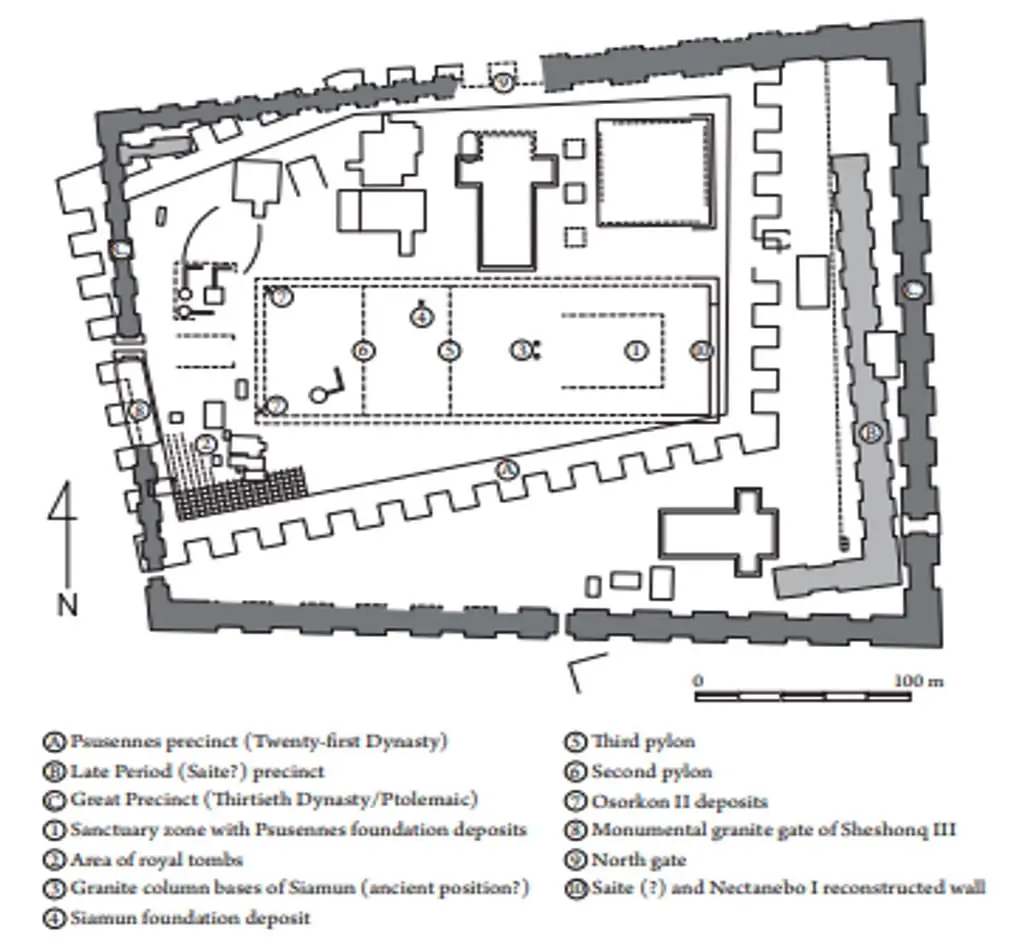
The spiritual and physical heart of the city is the Great Temple of Amun-Ra. This sanctuary remains the largest and most famous of the Tanis temples. Architects enclosed this area with a monumental wall to mimic the layout of Karnak Temple.
The Massive Enclosure Walls
Pharaoh Psusennes I built an immense mud-brick wall to protect the sacred precinct. Later, Shoshenq III reinforced this structure. This wall was not merely defensive; it also held deep religious meaning. In Egyptian cosmology, a temple enclosure wall represented the boundary of the organized universe. It held back the chaotic forces of Nun, the primeval waters. The wall at Tanis measured up to 15 meters in width and 10 meters in height, effectively isolating the sacred ground from the bustling commercial city outside.
The Monumental Gateway and First Pylon
The main entrance to the Great Temple faced the west, pointing toward the ancient Nile branch. Visitors originally greeted a massive pylon gateway constructed by Shoshenq III. Fronting this gateway stood colossal statues of Ramesses II in red granite. Workers had carefully transported these monoliths from Pi-Ramesses. One of these monoliths, famously known as the “Colossus of Tanis,” originally stood over 14 meters tall. Today, its colossal torso and fractured crown lie prostrate near the entrance, showcasing the sheer scale of the recycled monuments.
The Sacred Avenue of Obelisks
Beyond the main gateway lay an expansive courtyard that featured an unparalleled concentration of stone pillars. Today, the site boasts more obelisks than almost any other single location in Egypt, with fragments of over two dozen distinct pillars scattered across the terrain.
Workers originally arranged these pink granite obelisks in pairs along the central axis of the temple. They served as solar fingers reaching toward the sky, channeling divine power down into the dark sanctuary. Interspersed between these obelisks were palmiform and papyriform columns, creating a dense stone forest that led directly to the inner chambers.
The Sacred Lake
To the north of the main temple axis lies the Sacred Lake. Workers lined this large rectangular basin with dressed limestone blocks. Groundwater from the Nile naturally filled the basin. The lake served two essential purposes for the priesthood:
- Ritual Purification: The priests of Amun bathed here multiple times a day before entering the inner sanctuary.
- Cosmological Drama: It represented the primeval waters from which the primordial mound of creation first emerged.
Tanis Temples: Exploring the Temples of Mut and Khonsu
To complement the Great Temple of Amun-Ra, builders constructed secondary Tanis temples within the enclosure to honor the rest of the Theban Triad.
The Temple of Mut
Situated to the south of the main Amun precinct, the Temple of Mut was constructed by Pharaoh Siamun and later embellished by Apries during the 26th Dynasty. Mut represented the sky, motherhood, and the protective aspect of the divine eye.
The architecture of this temple is notable for incorporating Hathoric columns. These unique pillars feature the dual-faced visage of the goddess Hathor, sporting cow ears. This architectural choice underscored the syncretism between Mut and Hathor as cosmic mothers. Furthermore, excavations in this area yielded numerous statues of the lioness-headed goddess Sekhmet, who embodied the fierce aspect of the divine feminine.
The Temple of Khonsu
Khonsu, the moon god and child of Amun and Mut, also had a dedicated sacred space among the Tanis temples. Although smaller than the temples of his divine parents, this structure played a critical role during lunar festivals. The building featured a hypostyle hall with columns bearing detailed reliefs of the moon god in both his human and falcon-headed manifestations. The architectural placement of this temple allowed for processionals that connected the child god to the main temple of Amun during specific astronomical alignments.