The Resilient Heritage of the Thirteenth Dynasty
Ultimately, the Thirteenth Dynasty of Egypt proves that an empire is far more than the identity of its king. The era did not witness a sudden, apocalyptic collapse of Egyptian civilization. Instead, it highlighted the spectacular resilience of the systems built during the Middle Kingdom.
While the crown fractured and foreign dynasties seized the Delta, the deep-rooted civil service kept the core of Egyptian culture alive. The administration preserved the language, the religious traditions, and the artistic techniques of the land. When the remnants of the court finally retreated south, they carried this intact institutional knowledge with them. This bureaucratic survival ensured that even in its dark intermediate hours, the spark of ancient Egypt never truly went out.
Recommended Academic Readings
To delve deeper into the nuanced historical debates surrounding the Thirteenth Dynasty, these foundational and specialized scholarly texts provide invaluable insights:
Grajetzki, W. (2006). The Late Middle Kingdom in Egypt: Introduction to its History and Culture.
- Why Read: This is a critical text for understanding why the Thirteenth Dynasty is culturally unified with the Middle Kingdom. Grajetzki argues effectively that despite rapid changes in kingship, there was no immediate structural break in daily life or artistic administration.
Ryholt, K. S. B. (1997). The Political Situation in Egypt during the Second Intermediate Period, c. 1800–1550 B.C.
- Why Read: This monumental, groundbreaking study completely reframed how historians look at the chronology and king-lists of this era. Ryholt presents the opposing political viewpoint, placing the Thirteenth Dynasty at the dawn of the Second Intermediate Period due to its fragmented kingships.
Ben-Tor, D. (2007). Scarabs, Chronology, and Interconnections: Egypt and Palestine in the Second Intermediate Period.
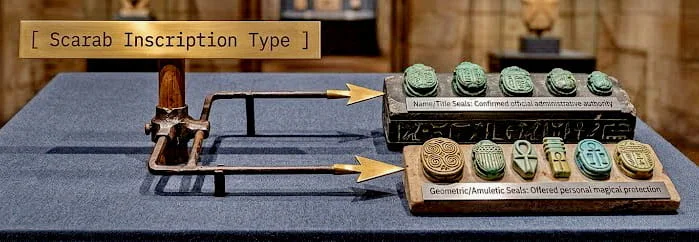
- Why Read: For a comprehensive look at how small artifacts reconstruct imperial history, Ben-Tor offers the definitive guide on Thirteenth Dynasty scarab design styles (such as the distinct “Type C” square head) and how they trace the evolution of the administrative network.
Miniaci, G., & Grajetzki, W. (Eds.). (2015). The World of Middle Kingdom Egypt (2000–1550 BC).
- Why Read: A fantastic collection of archaeological papers focusing on settlement archaeology and provincial cemeteries like Abydos, highlighting the continuity of material culture into the later dynasties.
Frequently Asked Questions (FAQs)
1. Is the Thirteenth Dynasty considered part of the Middle Kingdom or the Second Intermediate Period?
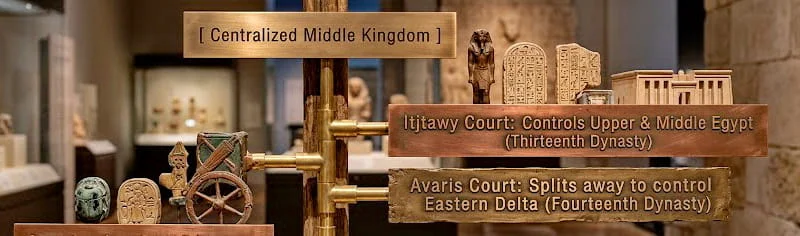
It depends entirely on an expert’s academic focus. Art historians and cultural archaeologists group the Thirteenth Dynasty within the Late Middle Kingdom because there is a seamless continuation of artistic styles, language, and administrative systems from the Twelfth Dynasty. Conversely, political historians often group it with the Second Intermediate Period because the era saw the throne fracture among dozens of short-lived rulers, leading directly to territorial division.
2. How did the central government stay functional if kings changed so quickly?
The state survived thanks to a robust, highly centralized bureaucratic network inherited from King Senusret III of the Twelfth Dynasty. Power shifted from an individual divine monarch to the institutional Office of the Vizier. While kings rotated rapidly, powerful, multi-generational families of civil servants stayed in office at the capital of Itjtawy, consistently executing tax collection, judicial processes, and asset tracking across the country.
3. Who were the most powerful pharaohs of this dynasty?
While many of the 50+ kings remain obscure figures known only from fragments, the consecutive reigns of two brothers stand out: Neferhotep I and Sobekhotep IV. Ruling together for over two decades, they restored stability, commissioned expansive monument projects at religious hubs like Abydos, and successfully projected military influence north into the Levant and south into Nubia.
4. What caused the ultimate collapse of the Thirteenth Dynasty?
The collapse was primarily structural and economic rather than an explosive foreign invasion. Over generations, a massive population influx of Near Eastern settlers grew dominant in the eastern Nile Delta. Eventually, a rival localized state—the Fourteenth Dynasty at Avaris—split away, cutting the Thirteenth Dynasty off from lucrative Mediterranean trade. Severely impoverished, the administrative state weakened, allowing the incoming Hyksos (the Fifteenth Dynasty) to push south and force the royal court to abandon Itjtawy for Thebes.
5. Why are private scarab seals and stelae so important to this specific era?
Because the royal court could no longer finance immense stone pyramids, elite artisans shifted their business model to cater to the non-royal upper-middle class. The resulting explosion of private funerary stelae at Abydos and the mass production of personal scarab seals created a detailed, localized paper trail. Scribes and officers used these unique geometric and hieroglyphic seals to sign documents, providing modern archaeologists with the exact names, titles, and familial links of the people who actually kept Egypt running.
To understand the broader socio-political structure and how this era fits into the macro-cycles of pharaonic power, see our master guide on The Dynasties of Ancient Egypt.