The Thirtieth Dynasty: The Epic Rise & Fall of Egypt’s Last Native Pharaohs

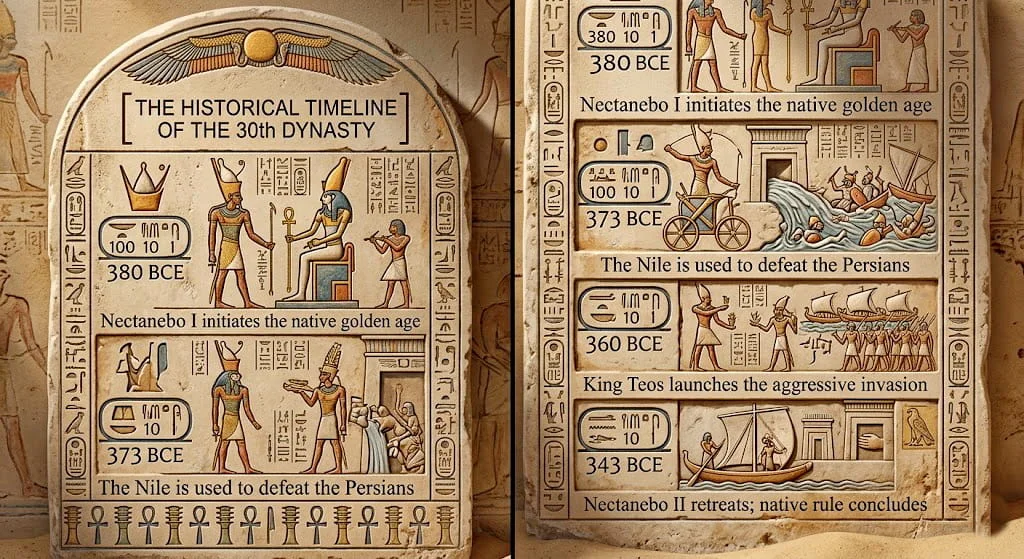
The Thirtieth Dynasty of Egypt represents a vibrant cultural golden age and the final era of native pharaonic independence. Founded by Nectanebo I in 380 BCE, the dynasty successfully defended the Nile Valley against massive Persian invasions using brilliant tactics, including the deliberate flooding of the Delta. This military stability funded a massive architectural renaissance, characterized by extensive temple constructions at Philae and Karnak alongside the development of the highly detailed "Sebennytic" artistic style. Although aggressive foreign campaigns and internal betrayal under King Teos compromised the kingdom, Nectanebo II continued the grand building legacy until a massive Persian invasion in 343 BCE forced his retreat south. This definitive collapse ended native rule, but the dynasty's artistic achievements and the legendary myths surrounding Nectanebo II heavily influenced the subsequent Ptolemaic and Greco-Roman worlds.
The eye of Horus
WhatsApp
Email
Print

Thirtieth Dynasty of Egypt: The Sunset of Native Egyptian Rule

For three thousand years, the Nile Valley bore witness to an unparalleled human epic. Dynasties rose like the annual river floods. Kings carved the names of gods into enduring stone. Consequently, they created a civilization that seemed completely eternal. Yet, every great empire must eventually face its twilight. In the fourth century BCE, Ancient Egypt gathered its remaining strength for one magnificent final stand. This grand finale of sovereign Pharaonic history emerged under the celebrated Thirtieth Dynasty of Egypt (c. 380–343 BCE).

Thirtieth Dynasty of Egypt: A Fierce Struggle for Independence
Thirtieth Dynasty of Egypt A Fierce Struggle for Independence

This era brought intense global conflict, but the 30th Dynasty was much more than a brief postscript to a glorious past. Instead, it was a period of fierce patriotism, profound artistic revival, and astonishing military resilience. For nearly four decades, a powerful line of rulers from Sebennytos in the Central Delta successfully held the line. They fiercely defended their borders against the mightiest empire of the ancient world: the Achaemenid Persian Empire.

Thirtieth Dynasty of Egypt: The Cultural Rebirth of the Last Pharaohs

However, we should not view the Thirtieth Dynasty merely as the end of an era. If we do, we miss its true brilliance. Under the iron will of Nectanebo I, the strategic boldness of Teos, and the intense religious devotion of Nectanebo II, Egypt actually experienced a massive cultural renaissance.

Furthermore, the pharaohs rebuilt temples from the Delta to the borders of Nubia. They restored ancient cults to their full glory. Meanwhile, a unique, highly refined style of art flourished everywhere. This artistic rebirth proved to the Mediterranean world that the spiritual heart of Egypt was still beating strong.

Ultimately, this is the history of the last native shield. It is a thrilling story of shifting alliances with Greek city-states, brilliant defensive strategies, and an unyielding commitment to the ancestral gods. Because these kings used the Nile itself as a weapon, the 30th Dynasty represents the final chapter of an independent Egypt ruled by Egyptian hands. Thus, they set a monumental stage that forever influenced the Ptolemaic and Greco-Roman eras that followed.

The Rise of Nectanebo I and the Thirtieth Dynasty of Egypt

The story of the Thirtieth Dynasty of Egypt begins with a dramatic seizure of power. During the fourth century BCE, Egypt suffered from political instability and constant threats from abroad. In 380 BCE, a powerful general from Sebennytos decided to take action. His name was Nectanebo I.

He led a successful military coup against Nepherites II, the last ruler of the 29th Dynasty. By overthrowing the old regime, Nectanebo I claimed the dual crown of Upper and Lower Egypt. He quickly established his family’s hometown of Sebennytos as the new seat of royal power. This bold political move successfully initiated the Thirtieth Dynasty of Egypt, restoring strong centralized leadership to the Nile Valley.
Divider

Defeating the Persians: The Great 373 BCE Invasion

Defeating the Persians The Great 373 BCE Invasion

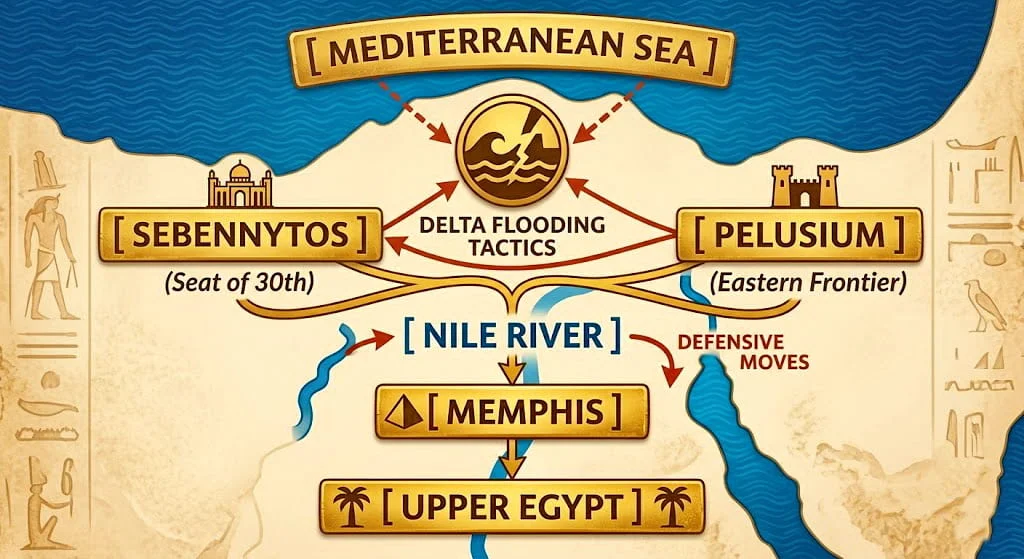
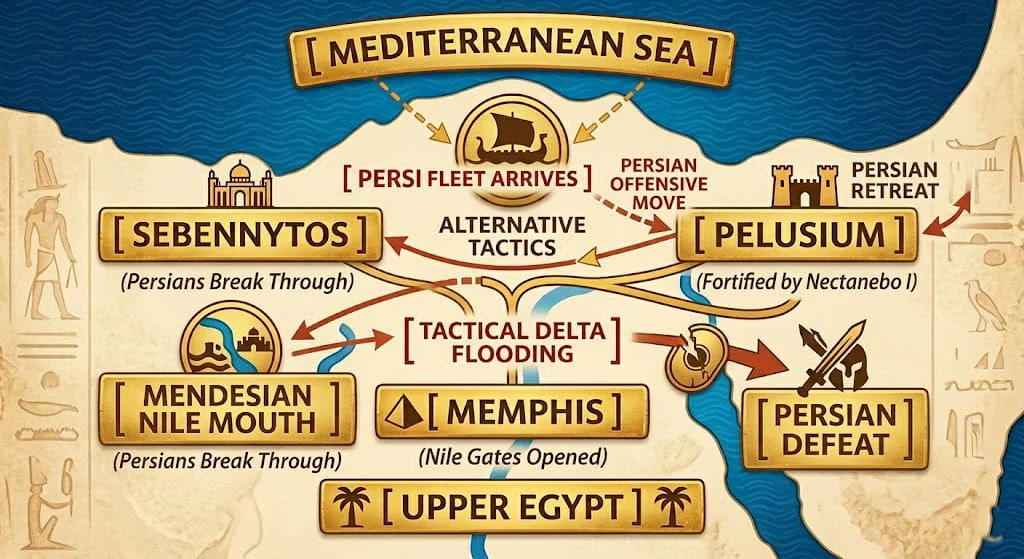
Nectanebo I immediately faced a massive threat to his new kingdom. The Achaemenid Persian Empire wanted to conquer Egypt again. Therefore, Artaxerxes II sent a massive military force to invade the Nile Delta in 373 BCE. This legendary invasion force included over 200,000 Persian soldiers and Greek mercenaries.

The enemy fleet sailed down the Mediterranean coast toward the crucial border fortress of Pelusium. However, Nectanebo I had already heavily fortified the eastern frontiers. Because the defenses at Pelusium were too strong, the Persian commanders shifted their strategy. They successfully broke through a different branch of the Nile near Mendes instead.

The Nile River as a Tactical Weapon

The Persian army slowly marched toward Memphis, but Nectanebo I used the geography of his homeland to his advantage. He deliberately delayed the enemy until the annual summer floods began. Then, the pharaoh ordered his engineers to open the Delta dikes.

Consequently, rushing waters flooded the entire region. The fields transformed into deep mud, and the Persian supply lines quickly collapsed. Because the invading army became completely trapped in the swampland, they had to retreat. This brilliant victory secured the independence of the Thirtieth Dynasty of Egypt for over a decade.

The Architectural Renaissance Under Nectanebo I

The Architectural Renaissance Under Nectanebo I

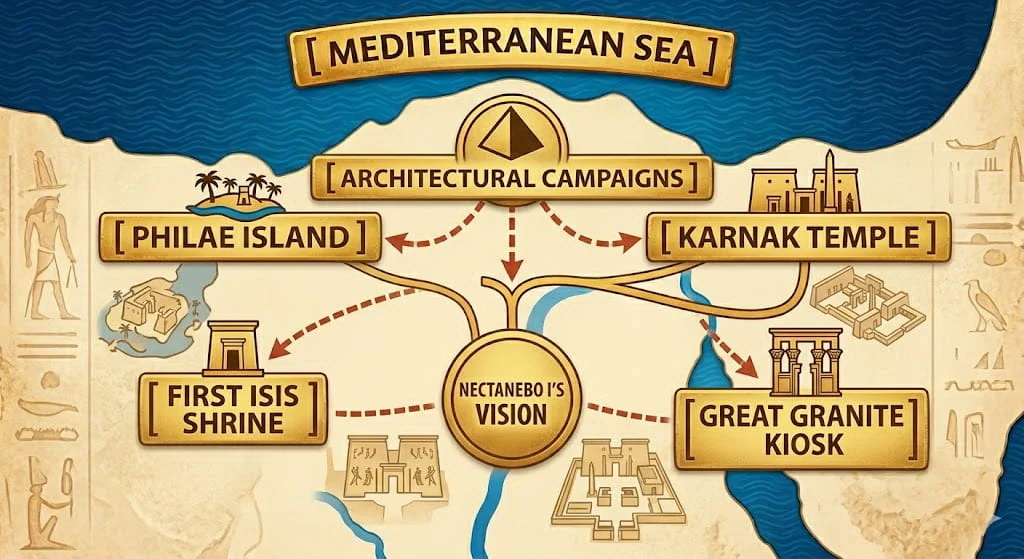
Following this brilliant military victory, Nectanebo I shifted his focus toward rebuilding the country. He wanted to legitimize his new royal line in the eyes of the priesthood. Therefore, he launched one of the most extensive temple construction campaigns in Late Period history.

He dedicated massive wealth to the gods, and his builders worked on sacred sites throughout the entire land.

  • The Sacred Island of Philae: He constructed the very first shrine to the goddess Isis on this island. This beautifully decorated structure laid the architectural foundation for the famous Philae temple complex.
  • The Karnak Temple Complex: He built a massive sandstone enclosure wall around the main precinct. Furthermore, he erected a magnificent granite kiosk near the second pylon to honor Amun-Ra.
  • The Restorations at Memphis and Heliopolis: His workmen restored older shrines and carved monumental statues from fine Egyptian basalt.

Through these grand building projects, Nectanebo I brought about a magnificent cultural renaissance. He proved that the Thirtieth Dynasty of Egypt possessed both the wealth and the religious devotion of the ancient Old Kingdom pharaohs. Ultimately, his stable thirty-year reign gave the nation a glorious period of peace and prosperity before the next storm arrived.

Golden Scarab

The Ambitious Offense and Betrayal of King Teos

The Ambitious Offense and Betrayal of King Teos

When Nectanebo I passed away, his son Teos inherited the throne of the Thirtieth Dynasty of Egypt. Unlike his father, who focused primarily on defending the borders, Teos chose a highly aggressive foreign policy. He believed that the best defense against the Achaemenid Persian Empire was a massive, preemptive offensive strike. Therefore, he began planning a grand military campaign to conquer Persian-controlled territories in Phoenicia and Syria.

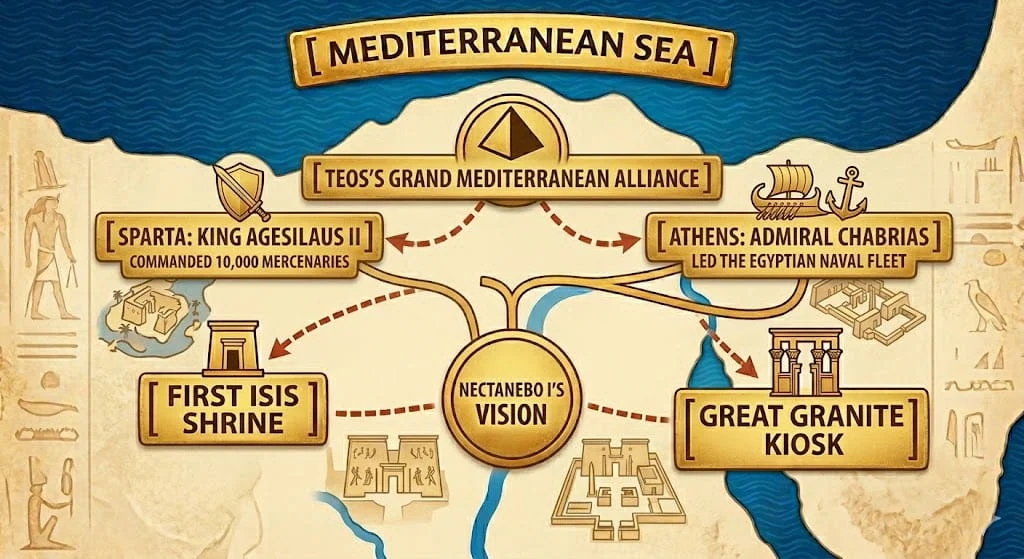
To guarantee success, Teos recognized that he needed elite international military power. He looked across the Mediterranean Sea and successfully formed a powerful alliance with the leading Greek city-states of the era.

  • The Spartan Alliance: Teos recruited the legendary, aging Spartan King Agesilaus II to command a fierce force of 10,000 elite Greek mercenaries.
  • The Athenian Alliance: He appointed the highly experienced Athenian Admiral Chabrias to lead and optimize the strategic Egyptian naval fleet.

The Financial Crisis and the Temple Tax Conflict

An international mercenary army of this scale required immense financial backing. Unfortunately, the royal treasury of the Thirtieth Dynasty of Egypt could not support these massive military costs. To solve this problem, Admiral Chabrias advised Teos to implement a series of radical, aggressive economic reforms.

Consequently, the pharaoh stripped the wealthy Egyptian temples of their traditional gold, silver, and agricultural resources. He forced the powerful priesthood to pay heavy taxes to the crown. Furthermore, he placed a strict tax on every single consumer good and agricultural product across the nation.

While these harsh laws successfully raised the necessary capital for the war, they completely alienated the influential religious elite. The priests viewed this policy as a direct attack on the sacred cosmic order, known as Ma’at.

The Levantine Campaign and the Final Coup

The Levantine Campaign and the Final Coup

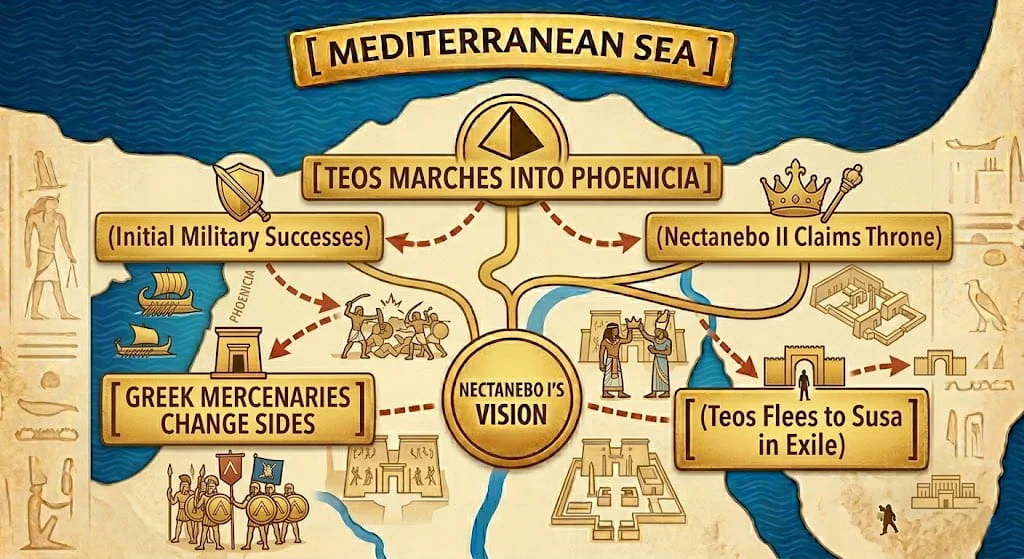
Despite growing anger at home, Teos marched his massive combined army into the Levant. The initial campaign was a brilliant success, as Egyptian and Greek forces pushed deep into Phoenicia. However, the political situation back in the Nile Valley quickly disintegrated into chaos.

Nectanebo, the pharaoh’s brother who was serving as the regent of Egypt, seized the perfect opportunity to strike. He gathered the angry priests and political nobles to launch a swift coup. They declared Nectanebo’s young son, Nectanebo II, as the rightful ruler of the Thirtieth Dynasty of Egypt.

The Collapse of Teos’s Rule

When news of the internal rebellion reached the front lines in Syria, the military coalition instantly fractured. The Egyptian soldiers refused to fight for Teos and enthusiastically declared their loyalty to the new king, Nectanebo II.

Furthermore, King Agesilaus II and his Spartan mercenaries changed sides because they realized Nectanebo II could better guarantee their future payments. Left completely alone and betrayed by his own family, Teos had to flee the battlefield. In a stunning historical twist, he escaped east and sought political asylum from his former enemy, the Persian emperor in Susa. This dramatic betrayal effectively ended his brief, turbulent two-year reign.

Nectanebo II: The Sacred Era of the Thirtieth Dynasty of Egypt

By claiming the throne through a military coup, Nectanebo II became the final ruler of the Thirtieth Dynasty of Egypt. He understood that his controversial rise to power required immediate spiritual validation. Therefore, he chose a political strategy that completely reversed the secular policies of his predecessor, King Teos. Nectanebo II immediately restored all traditional privileges to the powerful priesthood and returned their confiscated lands.

He dedicated his entire reign to serving the ancestral gods, presenting himself to the public as the ultimate living champion of Ma’at. Consequently, this deep religious commitment sparked an incredible wave of architectural creativity across the Nile Valley, rivaling the great building phases of the New Kingdom.

The eye of Horus

The Prolific Building Campaigns of the Late Period

The Prolific Building Campaigns of the Late Period

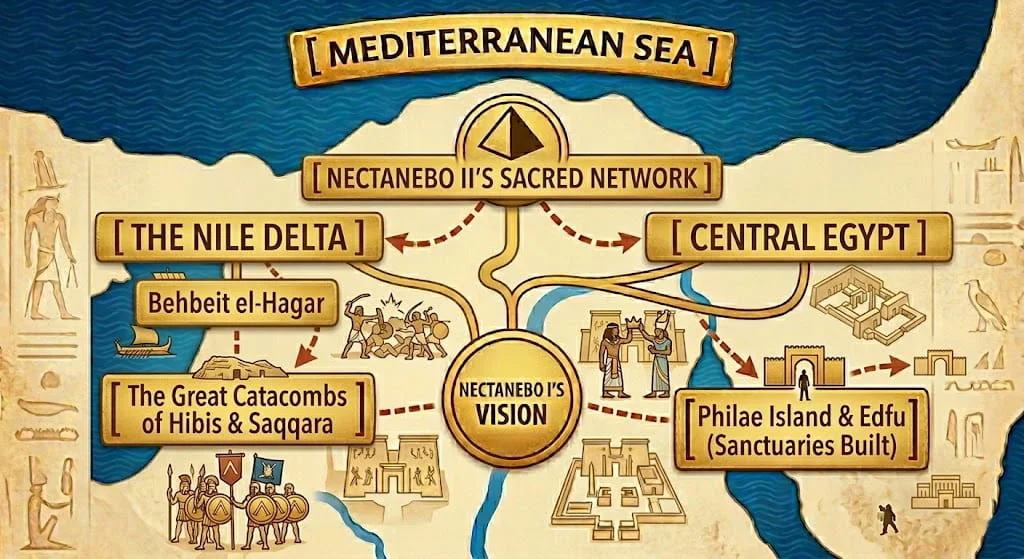
Nectanebo II launched an extraordinary temple construction campaign that reached every corner of the country. He wanted to leave a permanent mark on Egyptian soil, so he used high-quality building materials like fine limestone, sandstone, and dark basalt.

  • Behbeit el-Hagar (The Delta): He initiated the construction of a magnificent, massive granite temple dedicated entirely to the goddess Isis. This site became one of the jewel projects of the Thirtieth Dynasty of Egypt.
  • The Saqqara Necropolis: He commissioned extensive underground works for the sacred Apis bulls, constructing majestic galleries that emphasized his devotion to ancient animal cults.
  • The Expansion of Philae and Edfu: He added beautiful monumental gateways, decorated screens, and courtyard walls to these remote southern sanctuaries.

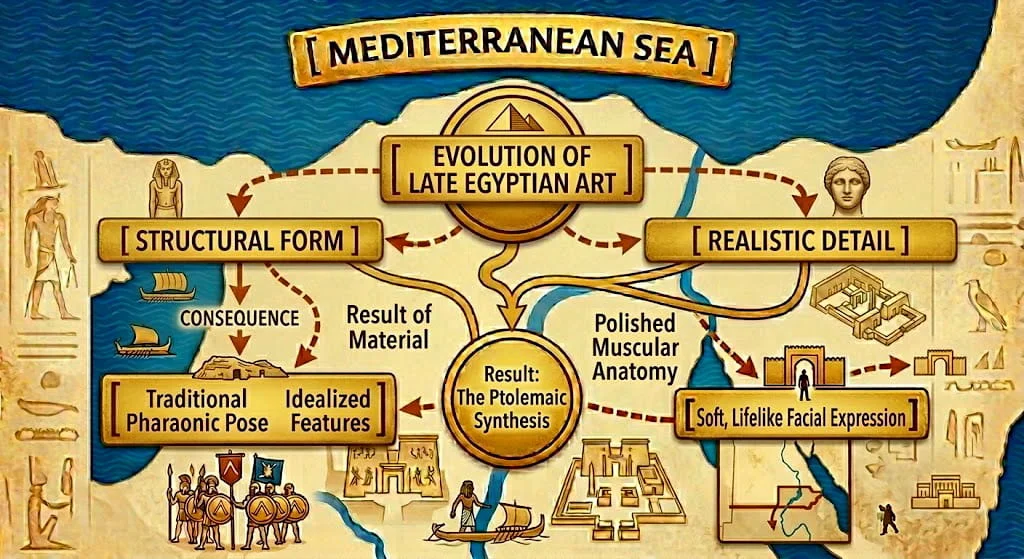
Furthermore, this intense focus on divine architecture created the “Sebennytic style” of art. Sculptors carved statues with soft, naturalistic facial expressions and beautifully polished muscular anatomy. This unique artistic sophistication directly influenced the master builders of the later Ptolemaic era.

The Gathering Storm: Artaxerxes III Invades

The Gathering Storm Artaxerxes III Invades

While Nectanebo II focused heavily on his religious and artistic duties, a massive geopolitical storm gathered on the eastern horizon. The aggressive Persian Emperor, Artaxerxes III, desperately wanted to recapture the Nile Valley and destroy the independent Thirtieth Dynasty of Egypt.

In 350 BCE, Artaxerxes III launched his first major invasion, but Nectanebo II successfully repelled the strike with the help of skilled Greek mercenary generals. However, this early victory created a dangerous sense of overconfidence within the Egyptian military command.

The Fall of Pelusium and the End of Native Rule

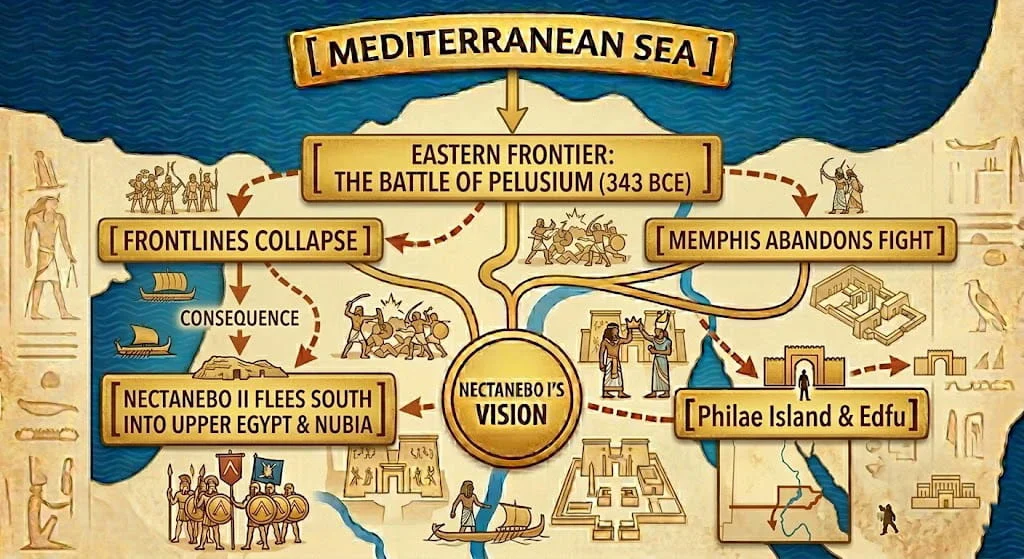
In 343 BCE, the Persian Emperor returned with an overwhelming force of over 300,000 soldiers, Phoenician naval ships, and elite Greek mercenaries. The two massive armies clashed along the eastern frontier at the critical stronghold of Pelusium.

Unfortunately, the strategic situation quickly disintegrated for the defenders. The Persian commanders used clever flanking maneuvers to bypass the primary marshland fortifications. When the frontline defenses collapsed, panic spread through the Egyptian ranks.

Nectanebo II realized he could not hold the Delta, so he retreated south to Memphis to organize a secondary defense. However, as local cities surrendered to the advancing Persians one by one, the pharaoh abandoned the capital. He gathered his royal treasures and fled south into Upper Egypt and Nubia, where he disappeared from the historical record forever.

This tragic retreat marked the definitive end of the Thirtieth Dynasty of Egypt. It closed the final chapter of independent pharaonic civilization led by native rulers, opening the gateway to centuries of foreign rule.

The Legacy, Art, and Historical Impact of the Thirtieth Dynasty of Egypt

Although the Thirtieth Dynasty of Egypt ended in political collapse, its cultural impact echoed across the Mediterranean world for centuries. This final period of native independence was not a stagnant conclusion to a dying empire. Instead, it was an incredibly influential golden age of creativity. The monumental achievements of this era deeply shaped the subsequent Ptolemaic and Greco-Roman periods, leaving a permanent mark on the history of Egypt.

Divider

The Masterpieces of the Sebennytic Artistic Style

The Masterpieces of the Sebennytic Artistic Style

The brilliant artisans of the Thirtieth Dynasty of Egypt developed a highly sophisticated visual style. Art historians refer to this unique aesthetic as the “Sebennytic style,” named after the hometown of the royal family.

This artistic movement successfully blended traditional Pharaonic rules with a softer, more lifelike realism.

  • The Mastery of Hard Stone: Sculptors primarily worked with extremely difficult materials like green graywacke, dark basalt, and black granite. They polished these stones to a mirror-like finish.
  • Anatomical Realism: Statues from this era feature beautifully rounded muscles, naturalistic body proportions, and soft, smiling facial expressions.
  • Hieroglyphic Precision: Scholars note that the inscriptions carved into these monuments display an extraordinary level of detail and linguistic purity.

When the Greek Ptolemaic kings later took control of the country, they completely adopted this style. The famous reliefs seen today at temples like Edfu, Kom Ombo, and Dendera directly copied the innovations developed during the Thirtieth Dynasty of Egypt.

The Myth of the Last Pharaoh: Nectanebo in Folklore

The Myth of the Last Pharaoh Nectanebo in Folklore

The dramatic departure of Nectanebo II deeply impacted the psychological consciousness of the Egyptian people. Because they could not accept that their final native king had vanished forever, a fascinating network of myths and romantic folklore quickly developed across the ancient world.

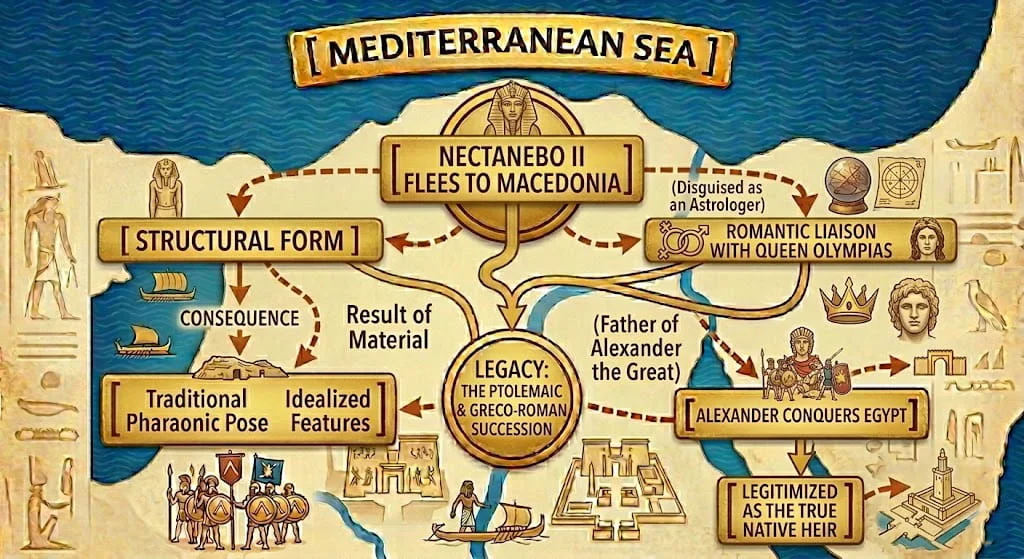
The most famous of these stories appeared in the legendary Alexander Romance texts. According to these popular tales, Nectanebo II did not simply escape into Nubia. Instead, he traveled to Macedonia while disguised as a powerful Egyptian sorcerer and astrologer.

The Secret Lineage of Alexander the Great

The legend claims that the exiled pharaoh used his magical powers to seduce Queen Olympias, the wife of King Philip II of Macedon. Consequently, this mythical union resulted in the birth of Alexander the Great.

When Alexander later marched his army into Egypt in 332 BCE to expel the Persians, the local population did not view him as a foreign conqueror. Instead, because of this widespread myth, they enthusiastically welcomed him as the true, legitimate son of Nectanebo II. This powerful political folklore allowed the new Greek rulers to seamlessly claim the divine title of Pharaoh.

The eye of Horus

Thirtieth Dynasty of Egypt: The Final Native Shield

Thirtieth Dynasty of Egypt The Final Native Shield

Ultimately, the Thirtieth Dynasty of Egypt stands as a heroic, magnificent finale to independent Pharaonic history. Rulers like Nectanebo I and Nectanebo II successfully held back the massive Persian empire for nearly forty years through brilliant military defense and strategic diplomacy. At the same time, they funded an extraordinary architectural renaissance that kept the sacred flame of ancient Egyptian culture burning bright.

When Nectanebo II retreated south into the mists of history, a magnificent three-thousand-year-old tradition of native governance finally concluded. However, the spiritual heart, artistic style, and religious institutions of the Thirtieth Dynasty of Egypt survived. They formed the very cultural foundation that allowed the wonders of ancient Egypt to endure throughout the Greco-Roman world and live on forever in human history.

Divider

Cairo Day Trip

Great trip organised. I had a 12-hour layover in Cairo and had a great time with Sherif, who answered every question I had on ancient Egypt. Highly recommend.

More »

Great one day tour in Cairo

My husband and I had a long layover in Cairo on our way to Kenya in 2010. Since we had never been to Egypt, we decided to sign up for a one-day tour with Egypt Fun Tours Day Trips. Our guide was there when we arrived and quickly guided us

More »
15-Day Historical Egypt Tour Package

all good!

we took pyramid and Cairo city tours and all went smoothly. The were very flexible to adapt to our requirements. Car, car driver and guide were great. very knowledgable and professional tour. Very recommendable

More »

Perfect layover Tour

I had a 10 hour layover in Cairo so booked a tour with Hani at Egypt Fun Tours. The tour was brilliant. I saw exactly what I wanted to see during the day which included the pyramids, Sphinx, Egyptian museum and the Bazaar. Hani was very knowledgeable and was the

More »

Amazing one day tour

Fantastic tour. We were picked up at the airport early in the morning (6 am), and were dropped off in the evening after discovering amazing Cairo. The guide was knowledgeable and took us to many hidden places, which we wouldn’t have found without him. Thank you!

More »
God_Anubis_Icon

Top-rated Tour Packages

God_Anubis_Icon
WhatsApp
Email
Print