Business of Immortality: Democratization of the Afterlife and the Market

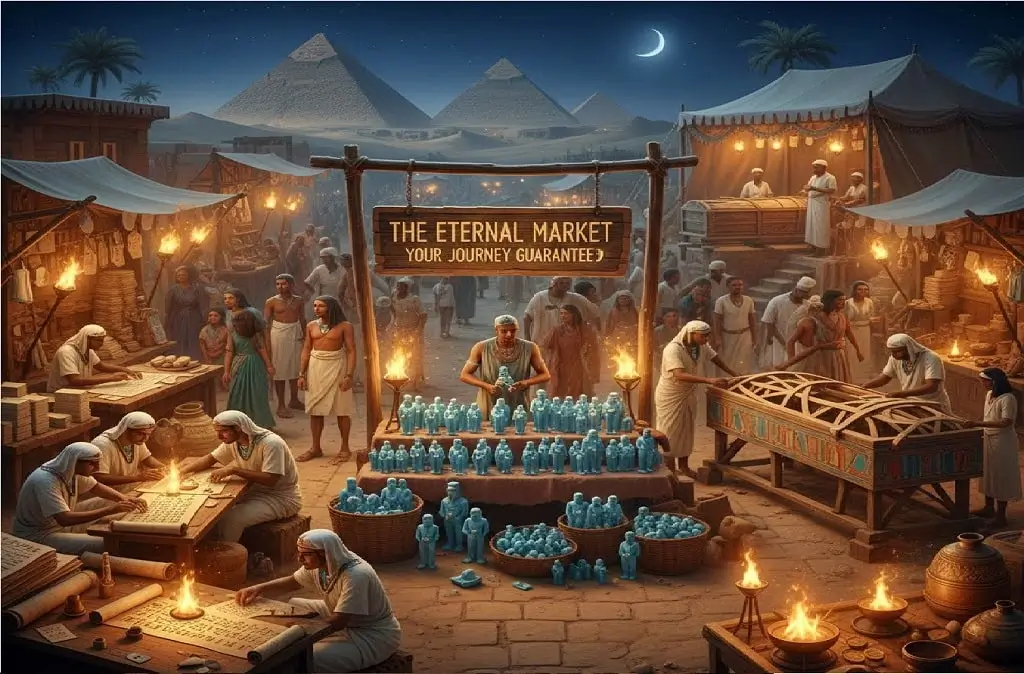
The Business of Immortality: Trace the incredible Democratization of the Afterlife in Ancient Egypt. Learn how eternal life became a mass-market commodity, shifting from a royal privilege to a purchasable service. Discover the tiered pricing structures and three major industries—from mummification services to Shabti factories—that fueled a massive, enduring funerary economy.

From Royal Monopoly to Mass Market

You have studied the architecture, the rituals, and the sacred texts. Now, understand the financial engine that drove this entire system. For the earliest Egyptian dynasties, eternal life was an exclusive right. It belonged only to the Pharaoh. His soul alone made the journey; his pyramid alone guaranteed immortality. This system constituted a royal monopoly on the divine. Then, this changed completely, initiating the Democratization of the Afterlife.

The Paradigm Shift: Access for All

During the Middle Kingdom, a seismic shift occurred. We call this the Democratization of the Afterlife. The texts and rituals that once belonged only to the King suddenly became available to wealthy and middle-class citizens. This was not a gift from the gods. This was an economic opportunity. People began to believe they could buy their way to paradise. This belief created a massive, sustained demand for funerary goods and services.

This profound social and theological change turned the afterlife into a commodity. Egyptians now needed specific products to guarantee resurrection: specialized texts, custom artifacts, and expert services. This demand fueled a massive industry. It shaped the Egyptian economy for the next two thousand years. You must now look at the afterlife as a business.
FUN

The Pillars of the Funerary Market

The Pillars of the Funerary Market

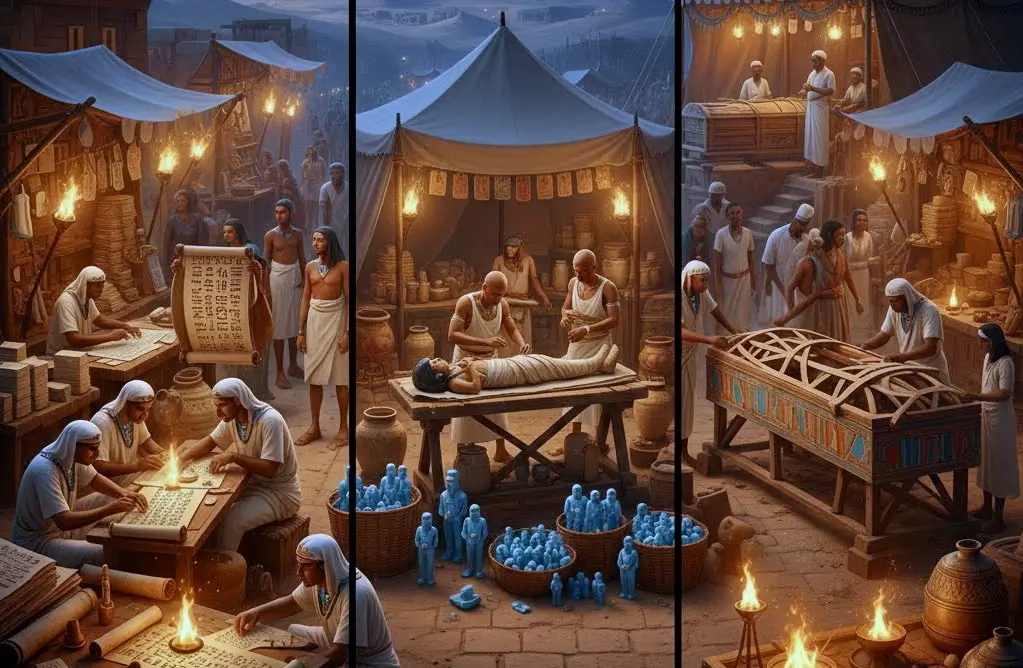
The shift toward the Democratization of the Afterlife created a relentless, massive demand. This demand, in turn, fueled the growth of three sophisticated industries. These industries provided the goods and services every non-royal Egyptian now deemed essential for a successful journey to the Field of Reeds. You must understand them as specialized, commercial enterprises.

A. The Text Industry: Scribes and Papyrus

The essential commodity was the text itself—the spells, prayers, and maps that formed the deceased’s eternal passport.

  • The Scribe as Manufacturer: Scribes working in the Per Ankh (the “House of Life,” essentially a scriptorium attached to major temples) manufactured these texts. They copied and customized the Book of the Dead (and earlier, the Coffin Texts).
  • Mass Production: To maximize profit and speed, scribes did not custom-write every scroll. They often kept pre-written, standardized scrolls ready. These scrolls included blanks. The family paid the fee; the scribe then quickly filled in the deceased’s name and titles. This standardized approach significantly lowered the cost and increased the speed of sale.
  • Cost of Materials: Papyrus and precious pigments made the final product expensive. The text industry controlled the supply of eternal security, making it a lucrative business.

B. The Mummification Industry: The Wabet

The preservation of the body was the most essential—and most expensive—service.

Specialized Trade: The process moved from a simple family affair to a specialized trade. Professional embalmers operated in the Wabet (the purification or embalming place), often near major cemeteries.

Tiered Pricing: You could purchase mummification services on a tiered pricing structure, much like modern services.

  • High-End: This package offered the full, Pharaonic-style treatment: 70 days, use of expensive oils, removal of internal organs, and placement in Canopic Jars. Only the very wealthy afforded this.
  • Mid-Range: This service used cheaper solvents, shorter timelines, and simpler processes, bypassing the full 70-day drying period.
  • Low-End: The cheapest option involved simple preservation methods with minimal cost, making some form of burial accessible to people with low income.

C. The Artifact Market: The Shabti Factory

We move from services and texts to objects. The final market provided the necessary physical goods.

  • Standardized Production: As you saw with the Shabti figures, demand necessitated mass production. Artisans created faience figures and standardized nested coffins in large numbers.
  • The Eternal Outsourcing: The ability to afford a full set of 401 Shabti figures became the ultimate status symbol of the New Kingdom. It showed the family possessed the financial power to ensure their relative would never perform manual labor in the afterlife. The market delivered the required immortality kit.
FUN

Social Mobility and Afterlife Aspiration

Social Mobility and Afterlife Aspiration

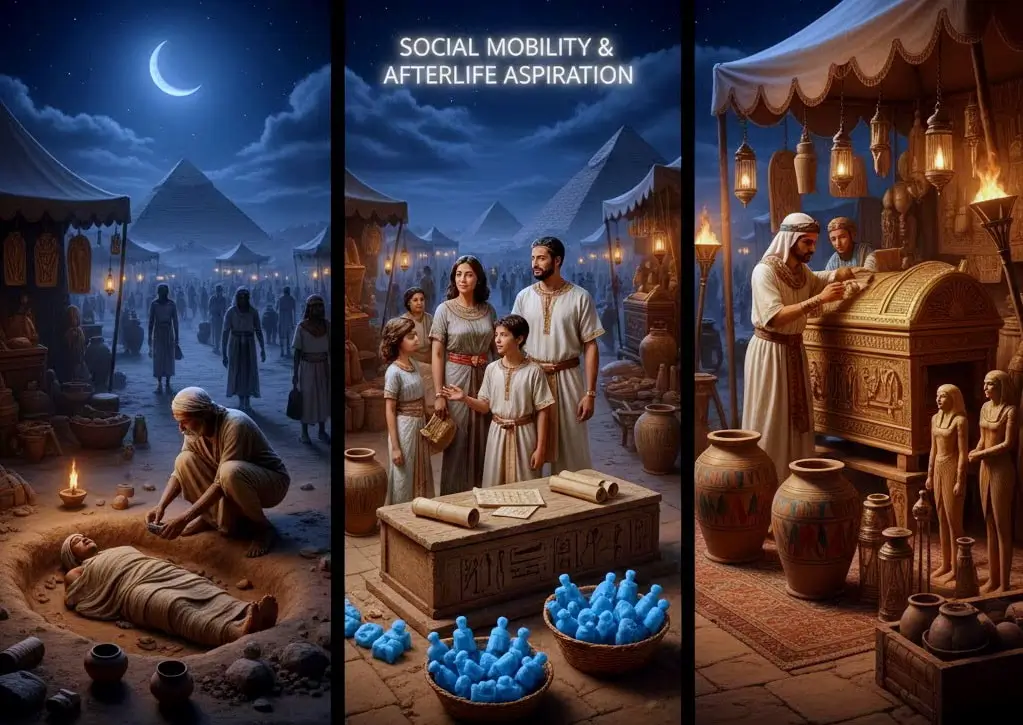
The Democratization of the Afterlife did more than just create industries; it redefined social ambition. Eternal security became the ultimate form of status. The ability to purchase the necessary funerary goods became a public, powerful declaration of a family’s success.

Status Display: The Coffin and The Tomb

You could not hide your preparations for eternity. They became a visual testament to your family’s wealth.

  • The Coffin Quality: Coffin style became a clear social marker. Only the elite afforded sarcophagi of fine, imported wood carved and gilded with gold leaf. The emerging middle class commissioned plain, stuccoed wooden coffins. The quality of the coffin literally dictated the quality of the journey.
  • Tomb Decoration: Families commissioned elaborate, painted tomb decorations, even in non-royal cemeteries. These decorations served two purposes: they acted as a guidebook for the deceased’s soul, and they publicly demonstrated the family’s piety and resources to the living community.

The Middle Class Finds Its Place

The most significant social impact centers on the non-noble population.

  • Buying In: The availability of cheaper Coffin Texts (written on inner coffins rather than expensive papyrus) and mass-produced faience Shabtis allowed the middle class to “buy in” to the system.
  • Aspiration Achieved: A simple, prepared burial provided the same potential for eternal life that the Pharaoh claimed. For the first time, individuals outside the royal court possessed the tools needed to command an army of workers and navigate the underworld successfully. Securing a complete burial became the ultimate expression of social and religious achievement for the common citizen.

This ability to secure eternal life provided a powerful engine for social mobility. It gave non-nobles an aspirational goal that drove economic activity for millennia.

The Profound Egyptian Influence on Greek Civilization

Egypt profoundly influenced ancient Greek civilization in various aspects. Key influences include religious syncretism, with...
Related post
FUN

The Eternal Cost

You have now seen the complete system. The Democratization of the Afterlife stands as a unique achievement in ancient history. It confirms the Egyptians did not just practice religion; they commercialized it. This entire system depended on a relentless, self-perpetuating economic loop.

A Self-Perpetuating Industry

The market created its own demand. You believed eternal life required specific, specialized goods. Consequently, you had to buy them. This belief fueled massive economic growth. The funerary market required thousands of skilled laborers: scribes, embalmers, stonemasons, carpenters, and faience workers. They all depended on the fear of eternal annihilation and the promise of a peaceful afterlife. This massive expenditure became a constant stimulus for the Egyptian economy.

Legacy of the System

This practice defines ancient Egyptian civilization. It shows their mastery of magic, religion, and commerce. The willingness of families, generation after generation, to pay the “eternal cost” proves the depth of their belief.

Ultimately, the Egyptian funerary market confirms one powerful truth: the ancient Egyptians left nothing to chance. They prepared for every contingency, ensuring comfort, status, and eternal security. They achieved this by creating the world’s most enduring and profitable industry—the business of immortality.

Ancient Egyptian Mummies: From Pharaohs to Powdered Medicine

This article explores the dark, two-sided history of Ancient Egyptian Mummies. Discover the staggering scale...
Related post
FUN

❓ Frequently Asked Questions (FAQ)

1. What does the “Democratization of the Afterlife” mean?

This term means the accessibility of eternal life shifted. It moved from a near-exclusive right of the Pharaoh during the Old Kingdom to a possibility for the elite and, eventually, the middle class. The change occurred gradually, starting with the Coffin Texts in the Middle Kingdom.

2. How did the afterlife become a market?

The belief system demanded specific physical provisions for the deceased—preserved bodies, magic spells, and servants. This constant demand for goods like coffins, papyrus scrolls, and Shabti figures created lucrative, specialized industries. People purchased eternal security.

3. What were the three main industries that profited from this?

Three main industries formed the core of the funerary market:

  • The Text Industry: Scribes produced and sold the Book of the Dead scrolls.
  • The Mummification Industry: Professional embalmers sold tiered burial packages, ranging from basic to Pharaonic-level preservation.
  • The Artifact Market: Workshops mass-produced standardized coffins, canopic jars, and funerary servant figures (Shabtis).

4. What were the Coffin Texts?

The Coffin Texts represent the first step in this shift. They were spells and guides, previously reserved for the Pharaoh’s pyramid walls (Pyramid Texts), that scribes began to paint directly onto the interior of wealthy non-royal coffins. You used these texts as a portable instruction manual to navigate the afterlife.

5. Could the average farmer afford the afterlife?

While the market did democratize access beyond royalty, it still largely favored those with wealth. The middle class could afford basic mummification and simple funerary goods. The poorest classes, however, generally received simple, desert burials with minimal provisions, showing that economic reality still limited full participation.

The Lost City of Tanis: Capital of Northen Egypt in Delta

The Ancient Egyptian City of Tanis was the vital capital of the 21st and 22nd...
Related post
FUN
Discover the remarkable wonders of Cairo and Giza....
Let's have a fantastic journey to Cairo to view the most famous historical locations from the era of the Pharaohs. Also, we shall discover modern...

Alexandria! Wow!

Muhammad is the best! He showed me a world I never thought possible! The tombs in Alexandria, by far, were my favorite! I never knew there was a place on earth that contained both Greek and Egyptian carvings in the same tombs! The history and culture of Egypt is so

More »

Valley of Whales – Wadi El Hitan and Wadi El Rayan

What a blast! It was an amazing day and a 5-star day trip. Everything was organised from A to Z by Hamada and Mohamed at Egypt Fun Tours in a timely manner. Pick up/drop off from/to the hotel, exquisite lunch and snacks, 4×4 jeep. Everything was as advertised. Also, the

More »
Amazing Egypt Tours Vacations in December Egypt Fun Tours

Amazing trip with Egypt Fun Tours

We had the time of our lives on a trip to Egypt and the Bahariya/White Desert with Egypt Fun Tours, too. I would highly recommend this company. They are very familiar with organizing this trip, and this means they are well-connected in the desert area. This was invaluable to us

More »
Premium Cairo Tour Package Egypt Fun Tours

THE MOST AMAZING TRIP

Hi Hamada! Sorry, we were so quick to say goodbye—my mom was fading 🙂 I just wanted to say thank you for THE MOST AMAZING trip… You thought of every detail, improvised, adapted, overcame every challenge, multitasked personalities, and did it all with grace, intelligence, and kindness. From the bottom

More »
Isis with wings

Top-rated Tour Packages

Isis with wings