God Horus: The Definitive Guide to the Sky God of Ancient Egypt

Horus is arguably the most vital deity in the Egyptian pantheon. He is the ancient god of kingship, the sky, and protection, famously depicted as a falcon or a falcon-headed man. His powerful story is intrinsically linked to the central Osiris myth, where he avenges his father, defeats the chaotic god Set, and restores divine order to Egypt. Every pharaoh, from the earliest dynasties, was considered the living manifestation of Horus on Earth, making him the cornerstone of Egyptian political and religious life.

🦅 Welcome to the World of Horus: The Falcon God

God Horus is arguably the most vital deity in the entire Egyptian pantheon. He is the ancient god of kingship, the sky, and powerful protection. You recognize him instantly. He is famously depicted as a majestic falcon or a man crowned with a falcon’s head. His story is not just a myth. It is the core narrative of order, justice, and succession in Ancient Egypt.

Every pharaoh, from the earliest dynasties, was considered the living manifestation of Horus on Earth. This divine link made Horus the cornerstone of Egyptian political and religious life for millennia. Therefore, understanding Horus is necessary to understand Ancient Egypt itself.

His powerful story is intrinsically linked to the central Osiris myth. Here, Horus achieves his greatest triumph. He avenges his murdered father, defeats the chaotic god Set, and victoriously restores divine order to the land of Kemet. In fact, this epic contest is the most famous story in the entire religion. We will explore his birth, his battles, and his enduring legacy. This guide will offer you the most complete and authoritative look at the Falcon God.

Understanding the Forms: Horus the Elder vs. Horus the Younger

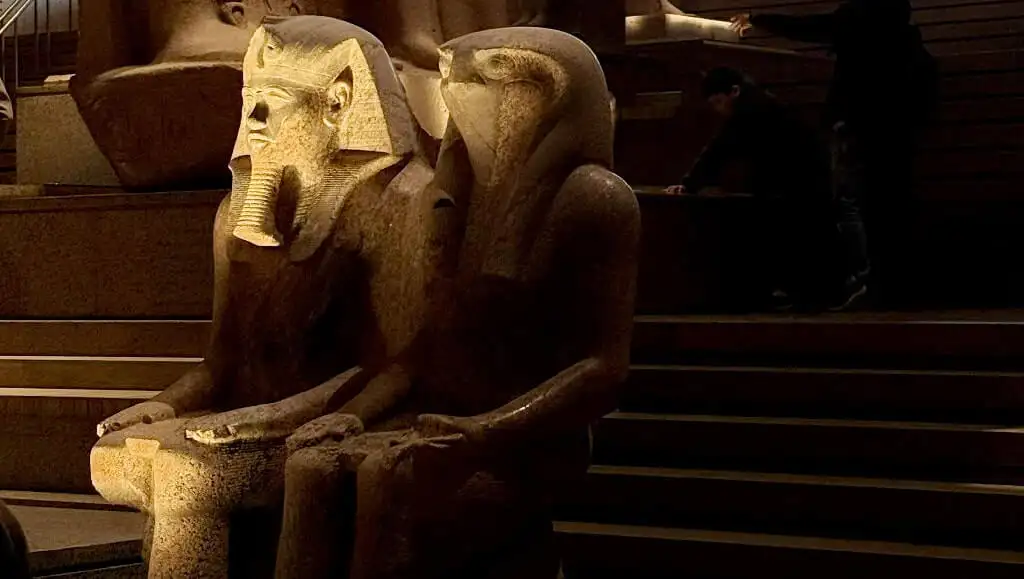
Understanding the Forms; Horus the Elder vs. Horus the Younger-min

The name “Horus” can be confusing. Consequently, we must clarify a common misunderstanding right away. Ancient Egyptians worshiped several gods known by the name Horus. They are often split into two main figures.

Horus the Elder (Haroeris)

Horus the Elder, or Haroeris, is the older version. Generally speaking, he is a primeval sky god. He is the brother of Osiris and Set. His eyes were the sun and the moon. This version represented the vast, original expanse of the sky.

Horus the Younger

Horus the Younger is the most famous version. He is the son of Osiris and Isis. This figure is the one who fought Set. He is the focus of the kingship myth. Therefore, when people refer to the “God Horus,” they are almost always speaking of this powerful, royal son. We will focus primarily on this royal son throughout this guide.

FUN

⚔️ The Myth of Horus: Chaos and Kingship

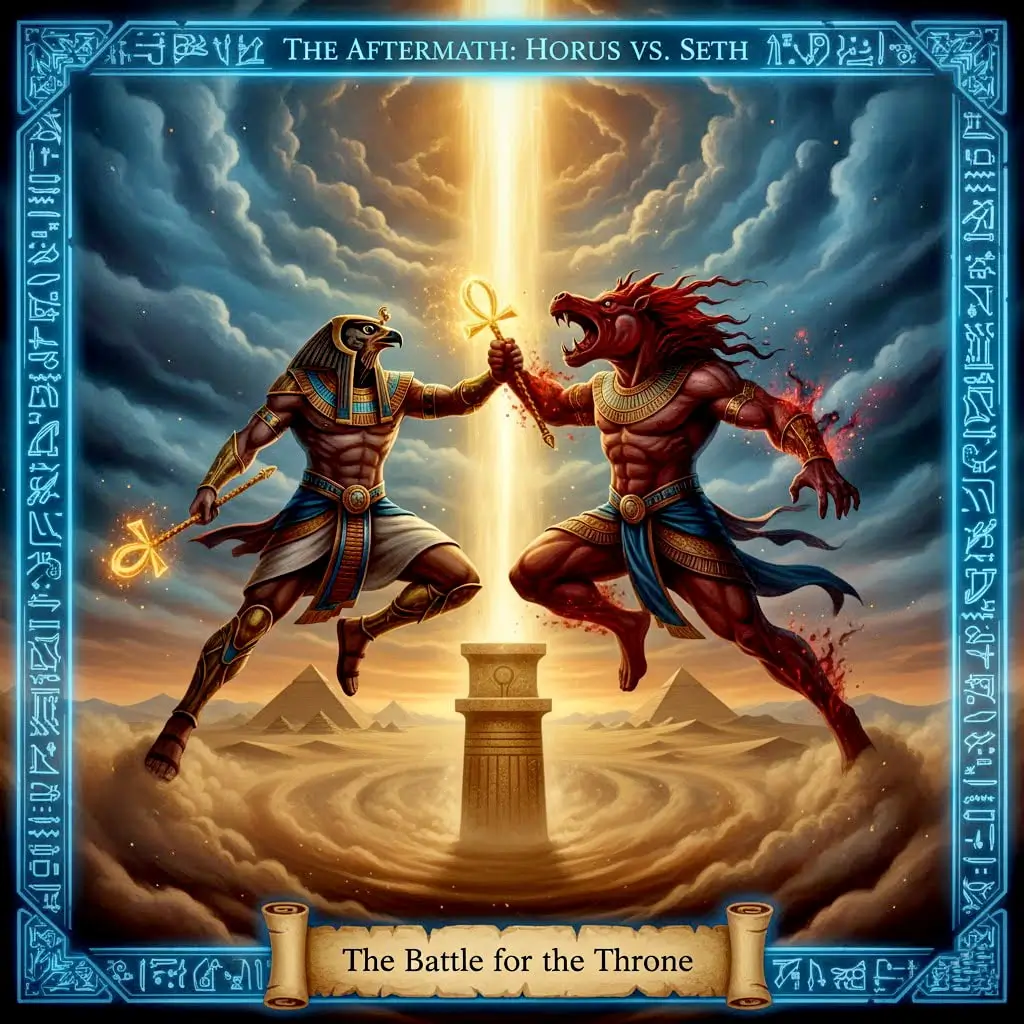
The Aftermath Horus vs. Seth

The story of Horus is an epic tale of betrayal, revenge, and the ultimate victory of order over chaos. This narrative is the foundational myth of Ancient Egyptian kingship and morality.

The Origin Story: Horus’s Divine Birth

The legend of Horus begins with the tragic fate of his father, Osiris. Osiris was the benevolent king of Egypt. However, his brother, the chaotic god Set, grew intensely jealous of his power and popularity. Set hatched a cruel plot. He tricked Osiris into lying down in a custom-made chest, which Set then sealed and threw into the Nile River. This chest became Osiris’s coffin. Set had murdered his brother.

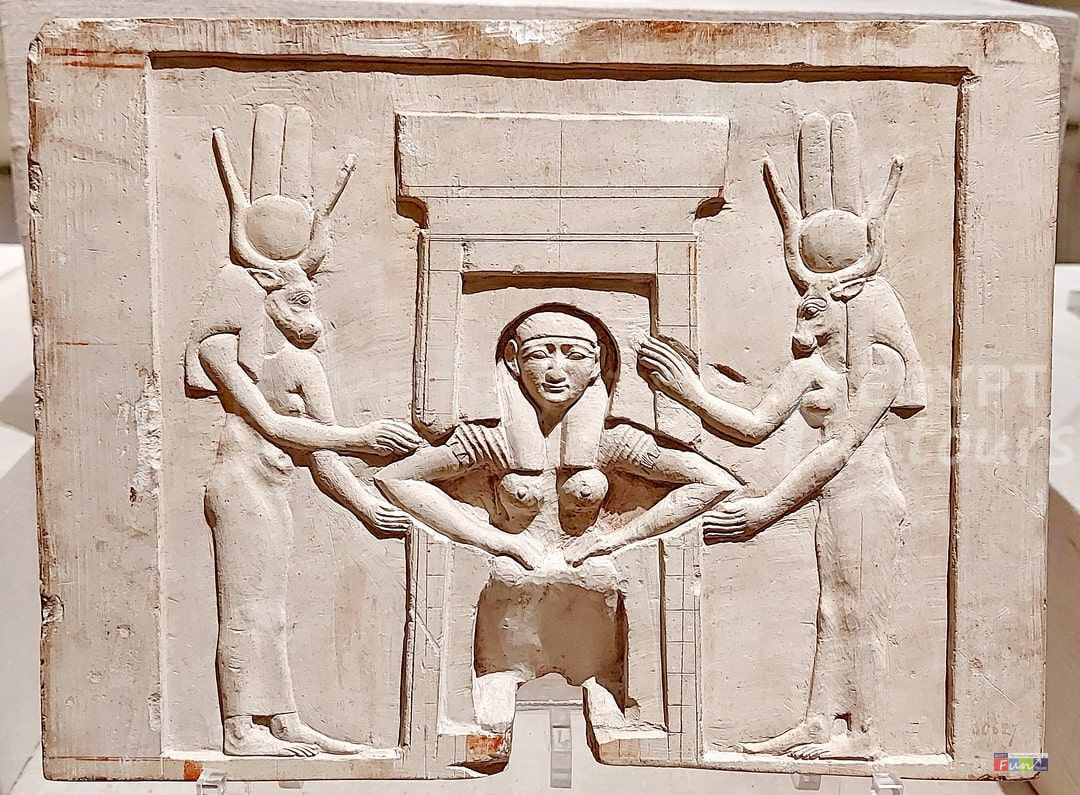
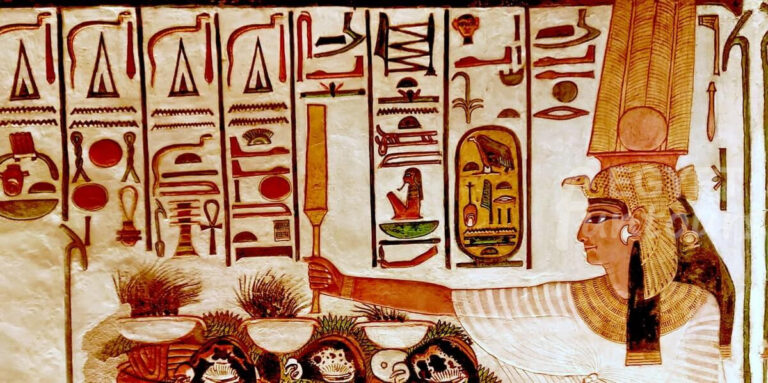
birth of isis NMEC Egypt Fun Tours

Immediately, the goddess Isis, Osiris’s grieving wife and sister, began a desperate search for her husband’s body. She was the mistress of magic. Eventually, she recovered the body of Osiris, but the evil Set found it again. He then brutally tore Osiris’s body into fourteen (or sixteen) pieces and scattered them across the land of Egypt.

Isis did not surrender. Consequently, she painstakingly gathered all the fragments of Osiris. Using her formidable magic, she temporarily resurrected him. Furthermore, she transformed herself into a kite bird (a falcon-like raptor) and hovered over his body. She used her wings to draw breath into him. In this brief moment, she conceived her son, Horus. This miraculous, posthumous conception made Horus the rightful heir. It also established his link to the falcon and to the sky.

The Secret Upbringing and Childhood

Hiding in the Reeds; Birth at Chemmis

Isis fled the populated areas. Therefore, she raised the young Horus in secret, hidden in the dense papyrus marshes of the Nile Delta. She feared Set, who sought to kill the child and end the royal lineage. This period, often depicted in art, shows Isis as the perfect protective mother. She shielded the young Horus from snakes, scorpions, and the constant threat of his murderous uncle.

The Epic Battle for Egypt: Horus vs. Set

When Horus reached maturity, he emerged from the marshes. He was driven by one sacred duty: to avenge his father and reclaim the throne of Egypt.

The Contest for the Throne: Years of Conflict

The struggle between Horus and Set was long and brutal. It was not a single battle, but a protracted series of contests and trials held before the Ennead (the court of the gods). The gods debated fiercely. Could a son inherit the throne? Should the brutal Set be allowed to rule?

The conflict involved physical contests, clever tricks, and magical duels. For example, Set tried to blind Horus. Horus, in turn, castrated Set. The violence of this feud showed the true struggle between two fundamental forces:

  • Horus represented Ma’at (Order, Truth, Justice).
  • Set represented Isfet (Chaos, Disorder, Violence).

Ultimately, the court of the gods, led by the sun god Ra, ruled in favor of Horus. He was the son of Osiris. He was the champion of order. Horus was declared the rightful king, and Set was cast out to dwell in the barren desert, the land of chaos.

The Restored Eye: The Story of the Wadjet

The most significant injury Horus suffered during the battle with Set was the loss of his left eye. Set tore it out and either buried it or swallowed it. However, the wise god Thoth, the god of magic and knowledge, intervened. Thoth magically healed and restored the eye.

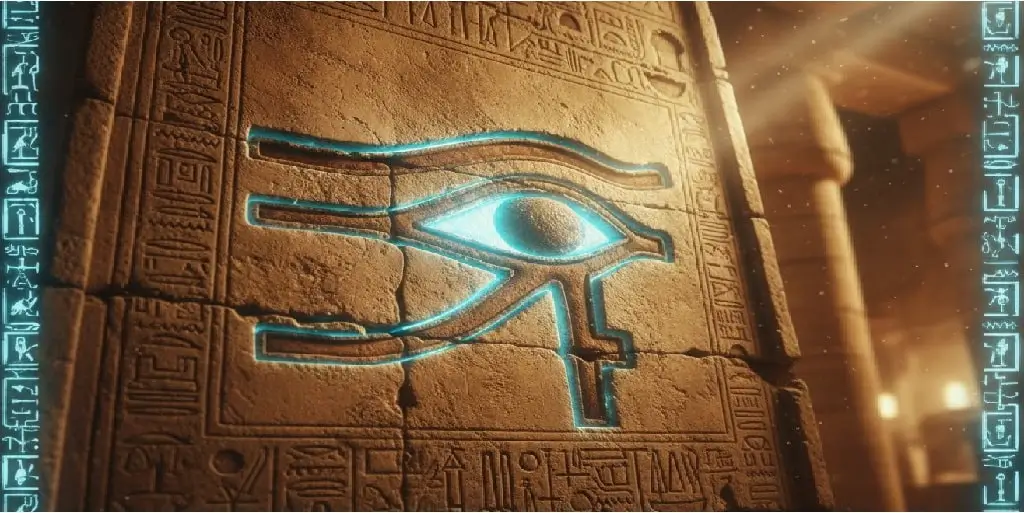
This restored eye is known as the Wadjet (or Utchat). It is the most powerful and recognizable symbol associated with Horus. Consequently, the healing of the eye represents the restoration of health, light, and the cosmic order that Horus had secured for Egypt. It serves as the transition point for our next section.

FUN

The Power of Horus: Symbols and Imagery

The Eye of Horus; The Ultimate Symbol of Protection, Healing, and Mathematics

Horus is instantly recognizable through his iconic symbols. These images are not merely decorative. Instead, they convey deep religious and protective meanings. They were central to daily life and belief in Ancient Egypt.

The Eye of Horus (Wadjet): More Than Just a Symbol

The Eye of Horus is arguably the most recognizable ancient Egyptian symbol in the world. You often confuse the Eye of Horus with the “Eye of Ra,” but they represent distinct concepts. The Eye of Horus, known as the Wadjet (or Udjat), links specifically to Horus’s left eye. This is the eye that Set tore out during their epic battle. Its restoration by Thoth made it a potent symbol. What Does the Eye of Horus Mean? The Wadjet holds profound meanings:

  • Protection: It is a powerful amulet, warding off evil and danger.
  • Royal Power: It represents the authority and legitimacy of the pharaoh.
  • Health and Restoration: It symbolizes healing, completeness, and wholeness.
  • Sacrifice and Healing: It signifies the sacrifice Horus made and the divine intervention that restored him.

Therefore, people wore the Eye of Horus as jewelry. It also appeared on coffins, temples, and boats. This was to ensure protection in both life and the afterlife.

The Eye of Horus as a Mathematical Fraction

Remarkably, the Eye of Horus also served a practical, mathematical function. Ancient Egyptian scribes used its distinct parts to represent fractions. Specifically, these fractions were used for measuring grain, medicine, and land:

  • 1/2
  • 1/4
  • 1/8
  • 1/16
  • 1/32
  • 1/64

Collectively, these fractions added up to 63/64. The missing 1/64 was thought to be provided by magic, representing the perfection the gods offered.

Here is a visual representation of how the different parts of the Eye of Horus correspond to these fractions:

The Eye of Horus as a Mathematical Fraction

The Falcon: His Sacred Form

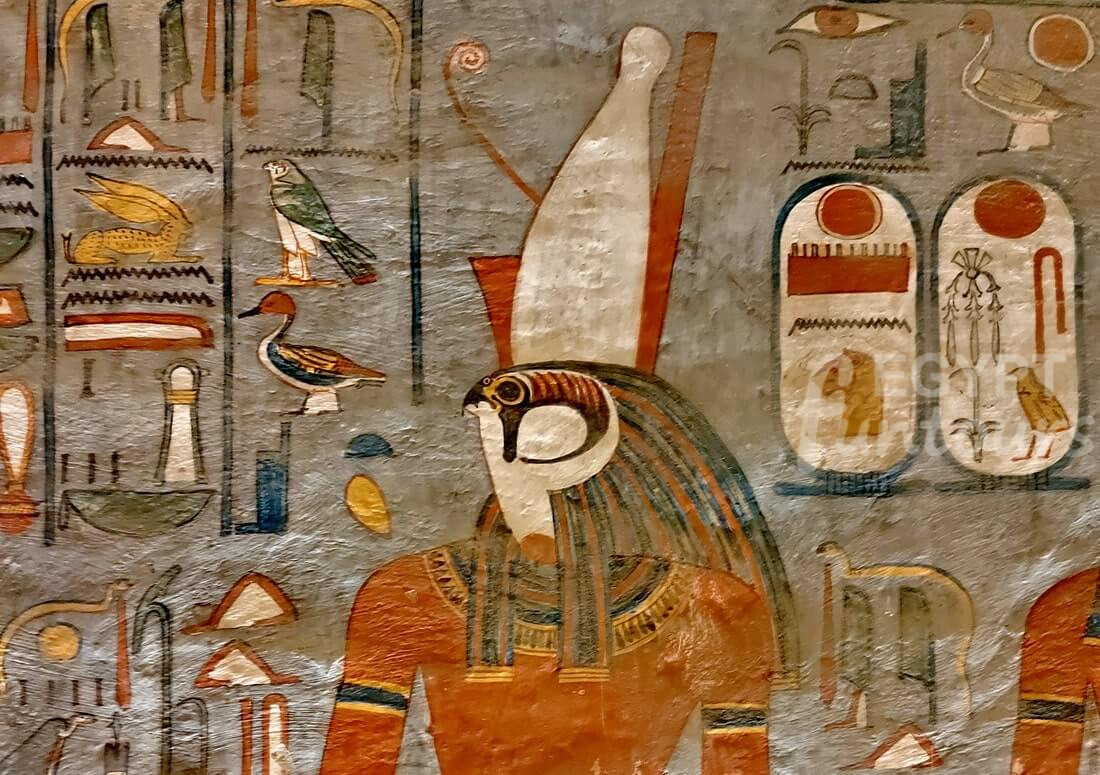
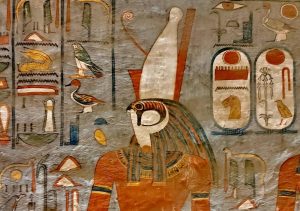
Horus is most often depicted as a majestic falcon. Sometimes, he appears as a falcon-headed man. This imagery is not accidental. Indeed, the falcon was a powerful symbol in ancient Egypt long before Horus became widely worshiped.

Why the Falcon?
  • Sky and Sun: Falcons fly high above the Earth. They are masters of the sky. This directly connects them to the sun and the heavens. Horus was, after all, a sky god.
  • Keen Vision: Falcons possess exceptional eyesight. This ties into Horus’s role as “The Distant One” or “He who is far above.” He observes all from his vantage point. It also links to the concept of the all-seeing eye.
  • Hunting Prowess: Their skill as hunters signifies strength, speed, and dominance. These were qualities associated with the king.

The specific falcon species most likely associated with Horus is either the Lanner Falcon or the Peregrine Falcon. Both are native to Egypt and embody the swift, powerful characteristics attributed to the god.

The Double Crown (Pschent)

As the unifier of Egypt and the rightful king, Horus is often depicted wearing the Pschent, or the Double Crown.

What the Double Crown Represents:
  • Unification: The Pschent combines the White Crown of Upper Egypt and the Red Crown of Lower Egypt. It symbolizes Horus’s success in bringing the two lands together.
  • Pharaonic Authority: This crown was worn by the pharaohs. It solidified their status as the living embodiment of Horus and the legitimate rulers of a united Egypt.

Thus, the crown serves as a constant visual reminder of Horus’s victory and his role as the divine patron of kingship.

Egyptian Phoenix Bennu: Myth, Symbolism, and Legacy

Forget the fire. The original legend is even better. Meet the Bennu, the Egyptian Phoenix....
Related post
FUN

Roles and Manifestations of Horus

Family vacation itinerary - 10 days luxury tour

The impact of Horus extended far beyond mythology. He was interwoven into the very fabric of Egyptian society, bureaucracy, and funerary beliefs. His roles were vast, and he appeared in many different forms across the millennia.

Horus as King: Divine Patron of the Pharaohs

The most enduring and significant role of Horus was his connection to the earthly ruler. The pharaoh was never merely a human king. Instead, he was considered the ultimate intermediary between the gods and the people. Crucially, he was viewed as the living incarnation of Horus on Earth.

  • During Life: The pharaoh was Horus, the victorious, reigning, and active king.
  • Upon Death, the pharaoh transitioned into Osiris, the resurrected lord of the underworld.

This powerful dualism provided a continuous cycle of power. As soon as the old pharaoh (Osiris) died, his son (the new Horus) would ascend to the throne. Therefore, the kingdom of Egypt was perpetually ruled by the divine heir. Every pharaoh had five official names in his royal titulary. The Horus Name was typically the oldest and most important.

  • Its Form: The Horus Name was written inside a rectangular frame called a serekh. This frame represented the palace facade, with the falcon of Horus perched on top.
  • Its Purpose: This name proclaimed the king’s legitimacy. It announced to the world that he was the rightful successor, the Horus who had defeated chaos and unified Egypt. Consequently, this name was one of the first things inscribed on monuments and seals.

The Four Sons of Horus: Guardians of the Body

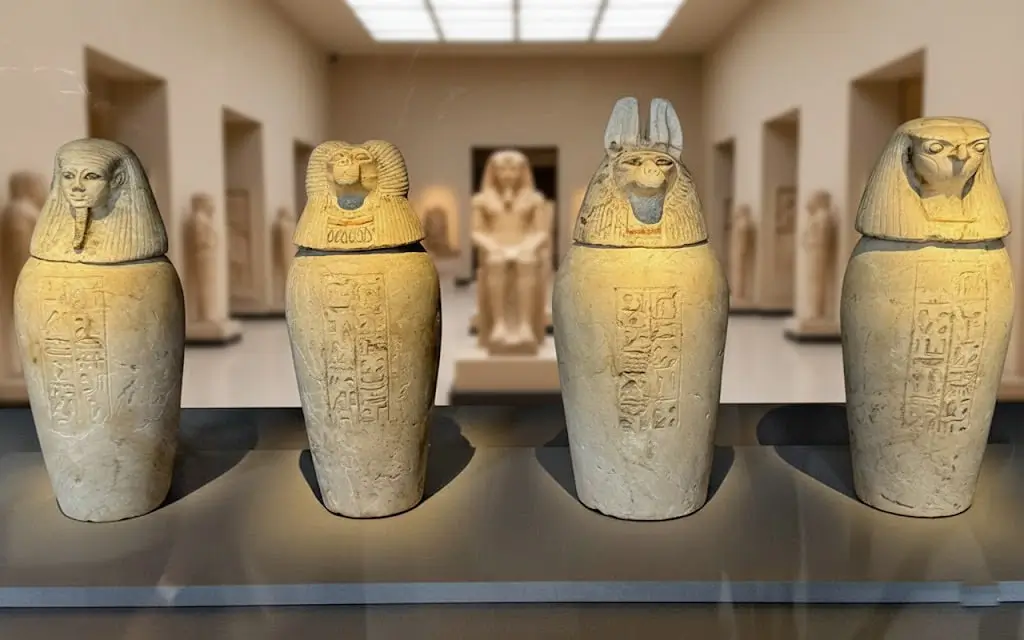
Canopic Jars The Sacred Vessels of the Egyptian Afterlife

Horus’s importance continued after death, specifically in the preparation for the afterlife. Following the Osiris myth, the four sons of Horus became key figures in funerary practices. They were responsible for protecting the internal organs removed during the mummification process. These four deities were tasked with guarding the canopic jars, where the deceased’s viscera were placed.

Son of Horus Protected Organ Head/Depiction Role/Direction
Imsety The Liver Human Head Guarded the South
Hapy The Lungs Baboon Head Guarded the North
Duamutef The Stomach Jackal Head Guarded the East
Qebehsenuef The Intestines Falcon Head Guarded the West

Furthermore, these sons were often invoked in spells from the Book of the Dead. They ensured the integrity of the body, which was necessary for the ka (life force) and ba (soul) to reunite and achieve eternal life. Thus, they were vital links between Horus and the realm of the dead.

The Many Faces of the Falcon God

As Egyptian religion evolved, various regional deities merged. As a result, Horus took on several composite forms, expanding his scope of power. This is one of Horus’s most powerful and recognizable forms.

  • The Name: Ra-Horakhty literally means “Ra (who is) Horus of the Two Horizons.”
  • The Merging: This deity combines the solar power of Ra (the supreme creator and sun god) with the royal authority of Horus.
  • The Imagery: He is depicted as a falcon-headed man wearing the sun disk and the uraeus (cobra) on his head. Therefore, he represents the sun’s daily journey from rising (the eastern horizon) to setting (the western horizon).

Heru-pa-khered (Harpocrates): Horus the Child

This form shows the god’s vulnerability and innocence.

  • The Name: Heru-pa-khered simply means “Horus the Child.” The Greeks called him Harpocrates.
  • The Imagery: He is frequently shown naked, sitting on a lotus blossom, with his finger held to his mouth.
  • The Misconception: People often mistake this gesture as a symbol of silence or secrecy. In reality, the finger to the mouth is the ancient Egyptian hieroglyphic symbol for “child.” He represents the hope, the new beginning, and the vulnerable heir protected by Isis.

Heru-Behdeti: The Winged Sun Disk

This manifestation is primarily a fierce protector.

  • The Origin: This form originated in the city of Behdet (perhaps modern Edfu).
  • The Imagery: He appears as a sun disk with two large falcon wings extended outwards. Two cobras, or uraei, hang from the disk.
  • The Purpose: It served as a massive, powerful protective emblem. Consequently, you often see this winged disk carved high above the entrances to temples across Egypt, warding off evil forces from the sacred space.

God Thoth: The Egyptian God of Wisdom, Writing, and the Moon

Thoth (or Djehuty) is one of the most important and powerful ancient Egyptian gods. He...
Related post
FUN

Legacy and Worship

Luxor and Aswan Nile Cruises - Edfu Temple - Egypt Fun Tours

Horus was a national deity whose worship spanned the entirety of Egyptian history and extended well into the Greco-Roman period. His enduring power can still be seen in the monumental temples dedicated to him.

The Great Temple of Horus at Edfu

While Horus was worshiped everywhere, his primary cult center stands today as the best-preserved Egyptian temple.

A Monument to Victory

The Temple of Edfu (located in Upper Egypt) is dedicated to Horus of Behdet (Heru-Behdeti), the winged sun disk form of the god. The temple was built during the Ptolemaic period (3rd to 1st century BCE). Significantly, it was built on the legendary site of the great battle between Horus and Set.

  • Iconography: The temple walls are covered with dramatic reliefs detailing the sacred drama. They show Horus, often depicted as a man with a falcon’s head, battling Set, who is sometimes shown as a hippopotamus.
  • The Pylon: The massive entrance gate, or pylon, features colossal images of Pharaoh Ptolemy XII Neos Dionysos ritually subduing his enemies—a human depiction of Horus’s own eternal victory over chaos.

Therefore, Edfu is not just a temple; it is a permanent dramatization of the central myth of Horus as the triumphant avenger and protector of Egypt.

The Role of Festivals and Rituals

The worship of Horus was highly ritualized, celebrated through numerous annual festivals.

The Festival of the Beautiful Reunion

One of the most important festivals involved the annual journey of Horus to meet his consort, the goddess Hathor.

  • The Event: Hathor’s statue would be loaded onto a ceremonial barque (boat) from her temple at Dendera. Then, she would travel down the Nile to Edfu to “reunite” with Horus.
  • The Meaning: This reunion was a metaphor for fertility, renewal, and the life-giving inundation of the Nile River. Moreover, it symbolically regenerated the land and the royal line. The festival included feasting, music, and a great public celebration.

Coronation Rites

Every coronation ceremony was a ritualistic re-enactment of Horus taking the throne from his father Osiris. During the ceremony, the pharaoh would be purified and invested with the Double Crown. Thus, the human ruler became the living god, ensuring the continuity of Ma’at (cosmic order).

The Enduring Influence of Horus

The impact of Horus did not end with the last pharaoh. His imagery and theological concepts permeated later cultures and religions.

  • Greco-Roman Period: During this era, the worship of Egyptian gods spread throughout the Mediterranean. Horus (often as Harpocrates) was widely revered as a protective deity and a symbol of childhood and hope.
  • Christianity: The protective nature of the Eye of Horus may have influenced later protective and all-seeing symbols. The story of Horus as a miraculous child protected from a murderous uncle (Set) by his divine mother (Isis) has parallels with later traditions of the divine child and the protective virgin mother. However, scholars caution against drawing direct, unproven links. Nonetheless, the powerful imagery of divine birth, battle against evil, and kingship proved universally resonant.

🐑 God Khnum: The Definitive Guide to the Egyptian Creator God

Khnum is the ancient Egyptian ram-headed creator god and master artisan. Known as "the divine...
Related post
FUN

The Unbeatable Falcon

The Foundation of Kingship: God Horus Myth

The God Horus stands as a towering figure in human history. He is the champion of the sky, the protector of the innocent, and the eternal blueprint for the ideal king. His life—from his magical conception to his ultimate victory over chaos—provided the foundation for 3,000 years of Egyptian civilization.

He proved that order, even when brutally shattered, could be restored. His name, his face, and his powerful Wadjet eye remain the most recognized symbols of a civilization built on the promise of justice and eternal life. To look at the stars is to see the sky god Horus.

Weather conditions in Egypt

10 Days Egypt Trip of Cairo, Luxor, and Hurghada...
Witness the best attractions of Cairo & Luxor for 5 Days...

Amazing tour to the pyramids of Sakkara and Dahshur

This week we had a great tour with Mohamed to the pyramids of Sakkara and Dahshur, as well as Memphis. He tailored the tour to our preferences, took a lot of time with us, and gave us detailed background information on everything. It was also great that he never tired

More »

AMAZING Layover Tour

We had the MOST amazing layover tour with Egypt Fun Tours. Hanni was amazing, and we loved every moment. Pyramids, authentic food, and Islamic Cairo – amazing!

More »
9-day tour package - Egypt Fun Tours

You’re in “GREAT HANDS” with Egypt Fun Tours!

We first went to Egypt in July 2010. We were to pass through Cairo on our way to Africa, and we had arranged to be picked up from the Cairo airport and shown around the city during our 6-hour layover. This was arranged through emails with Hamada, of Egypt Fun

More »
12 Days Solo Woman Tour Package (Queen Cleopatra)

Mohamed is Very Kind Person

Mohamed. I just want to thank you again for your kindness. You made our trip memorable. Give your family and the Egypt Fun Tours crew all my love and thank them again for me. Take care. Enjoy the season! Love. Linda

More »

AMAZING TOUR, SOLO TRAVELER.

I am a California woman who traveled to Egypt alone, and thanks to Egypt Fun Tours, I had a great time. Hani, Mohammed, Kamal, and David (my driver) were very professional and very knowledgeable. I appreciate how respectful they were and how protective they were of me. They showed me

More »
Isis with wings

Top-rated Tour Packages

Isis with wings