Hyenas in Ancient Egypt: Pets, Scavengers, and Deities of the Desert

While Ancient Egyptians worshipped the lion and mummified the cat, they ate the hyena. During the Old Kingdom, noblemen attempted a strange biological experiment: domesticating the Striped Hyena. Reliefs at Saqqara depict these bone-crushing predators being bound, force-fed like geese, and fattened for ritual slaughter. However, the experiment failed. Too stubborn to tame and too biologically repulsive to revere, the hyena was eventually cast out of the Egyptian home, becoming the only major African predator with no god to represent it.

Hyenas in Ancient Egypt

We know the Egyptians were the greatest animal lovers in history. They worshipped the falcon, mummified the crocodile, and invited the cat into their living rooms and the dog into their hunt. But for a brief, strange window in the Old Kingdom (c. 2600–2100 BC), they tried to love the Hyena. Hyenas in Ancient Egypt were not much different than today.

The Reality:

Before you imagine pharaohs walking with the laughing hyenas of the savannah, we need to clarify the species.

  • The Animal: These were Striped Hyenas (Hyaena hyaena).
  • The Look: Unlike the spotted hyena of the south, these are solitary, nocturnal scavengers with a massive, mohawk-like mane and a jaw strong enough to snap a giraffe’s femur.

The Failed Experiment:

The relationship between the Egyptian and the Hyena is a story of a failed domestication.

  • The Food: Reliefs in the tombs of Saqqara show servants wrestling these beasts to the ground to force-feed them meat. They were being fattened for the dinner table.
  • The Pet: Other scenes show them on leashes, hinting that the Egyptians tried to turn this bone-crusher into a hunting companion.

The Rejection:

It didn’t work. By the Middle Kingdom, the hyena disappeared from the leash and the menu. It became a symbol of the unclean “other.” In this guide, we will examine the fascinating evidence of this “hyena era.” Examine the Mastaba of Mereruka, where the stone reliefs clearly prove the force-feeding. Discover why the hyena became the only animal the Egyptian gods utterly rejected.

FUN

The Old Kingdom: Taming Hyenas in Ancient Egypt

Hyenas in Ancient Egypt Egypt Fun Tours 1

To modern eyes, the idea of eating a scavenger is repulsive. To the Old Kingdom nobility, it appears to have been a luxury. During the Fifth and Sixth Dynasties (the pyramid-building age), the Egyptians engaged in a bold biological experiment. They didn’t just hunt the desert game; they tried to bring the desert into the barnyard.

The Fattening Farms

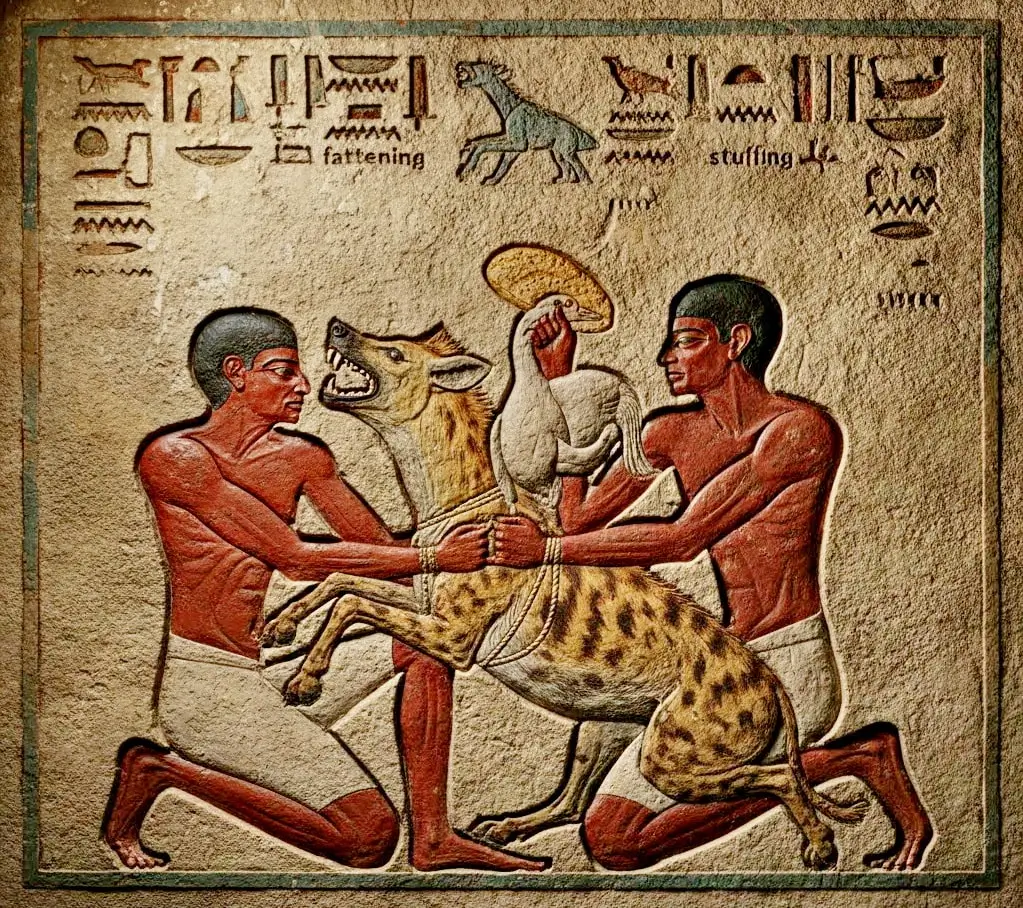
The most damning evidence comes from the necropolis of Saqqara. If you walk into the Mastaba of Mereruka (a powerful vizier of the 6th Dynasty) or the nearby Tomb of Kagemni, you will see a scene that stops most tourists in their tracks.

The “Foie Gras” Technique: The reliefs depict a scene of industrial animal husbandry, but the animal is wrong.

  • The relief depicts a Striped Hyena lying on its back. Binders tied its four paws tightly to stop the animal from slashing the handlers.

  • The Action: Two men are pinning it down. One holds the animal steady, while the other forces large pieces of meat (usually geese or ducks) down the hyena’s throat.
  • The Inscription: Hieroglyphs often accompany these scenes with labels like “fattening” or “stuffing.”

Why did they do this? Archaeologists believe this was a form of ritual fattening. Just as the Egyptians force-fed geese to create fatty livers (similar to modern foie gras), they force-fed hyenas to make them fleshy enough for slaughter.

  • The Diet: They weren’t feeding them garbage. They were feeding them prime meat to alter the taste of the hyena meat, presumably to make it palatable for a funerary feast or a temple offering.

Hunting Companions

The experiment went beyond food. The Egyptians also tried to harness the hyena’s killer instinct. In other Old Kingdom reliefs, you can see hyenas depicted in a different context: The Hunt.

  • The Leash: Hyenas are shown wearing collars and leashes, walking alongside the sleek Saluki hunting dogs.
  • The Logic: It makes sense on paper. A Saluki is fast, but a Striped Hyena has infinite stamina and jaws that can crush bone. If you could tame one, you would have the ultimate hunting partner—a tank to go with your Ferrari.

The “Semi-Domestication” Historians call this “proto-domestication.” The Egyptians were capturing cubs from the wild and raising them in captivity. They successfully domesticated the donkey, the cat, and the goose, and simply assumed they could do the same with the hyena. They were wrong.

FUN

Why It Failed (Biology vs. Culture)

Hyenas in ancient Egypt - Egypt Travel Package

The hyena experiment ended quickly. By the beginning of the Middle Kingdom (c. 2050 BC), tomb scenes almost entirely replaced hyena force-feeding and hunting reliefs with images of dogs and oryx. The reasons for this failure were foundational, rooted in three key areas: biology, practicality, and the very foundation of Egyptian religion—the sanctity of the dead.

Biology Trumps Ambition

The fundamental reason the hyena cannot be domesticated like a dog is simple: Hyenas are not dogs.

  • Aggression & Temperament: Striped Hyenas are fiercely independent and naturally aggressive. They possess none of the co-dependence or inherent loyalty that defines the wolf-dog relationship. They remain dangerous and unpredictable, requiring constant vigilance and the effort of multiple servants (as seen in the reliefs).
  • The Breeding Problem: True domestication requires producing offspring that are tamer than their parents. Hyena breeding males are notoriously aggressive and difficult to control, making it almost impossible for Egyptians to maintain a controlled, reliable breeding stock.
  • Cost vs. Reward: Why risk the lives of servants and spend time feeding expensive meat to a dangerous animal when the sleek Saluki and other native Egyptian dog breeds performed the hunting duties perfectly and safely? The hyena became obsolete.

The Cultural Repulsion (The Anubis Conflict)

The practical failure coincided with a religious shift that made the hyena a profound cultural taboo. The entire Egyptian civilization was built on the belief in the Afterlife, which necessitated the preservation of the physical body.

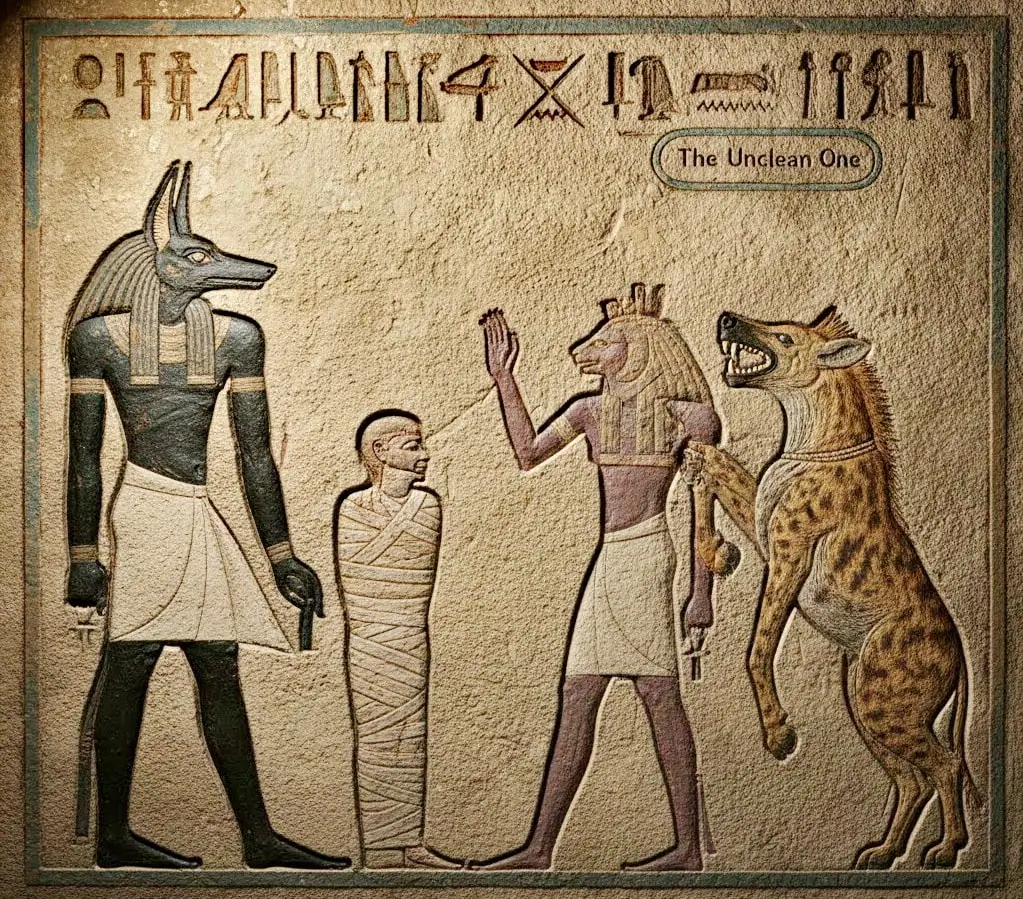
  • The Guardians: The god Anubis, often depicted as a man with the head of a Jackal, was the guardian of the necropolis and the patron of embalmers. While the jackal also scavenged, it was symbolically “clean” and seen as patrolling the desert edge, guiding the dead.
  • The Destroyer: The hyena was the jackal’s dark counterpart. Hyenas are powerful enough to dig up graves, destroy flimsy coffins, and consume the remains.

The hyena thus became the direct embodiment of the force that threatens the mummy—the vessel for the spirit’s journey into the afterlife. To consume or embrace the hyena was to invite chaos and to endanger one’s own eternity. The two practices—reverence for the preserved body and the farming of a grave-robber—could not coexist.

Final Appearance

By the New Kingdom (c. 1550 BC), the hyena rarely appears in Egyptian art unless it is:

  1. A wild beast being hunted (a symbol of conquering the wilderness).
  2. In satirical papyri, often drawn in a comical, human-like posture to ridicule the elite.

The powerful, unpredictable scavenger was a failed pet and a threat to the most sacred Egyptian belief. It was swiftly written out of the history books, the dinner menu, and the divine hierarchy.

Cheetah in Ancient Egypt

Cheetahs in Ancient Egypt The cheetah was a significant animal in ancient Egypt. Egyptians used...

Related post
FUN

No God for the Hyenas in Ancient Egypt (Symbolism)

No God for the Hyenas in Ancient Egypt (Symbolism)

The greatest confirmation of the hyena’s low cultural standing is its absence from the religious pantheon. In a world where every creature—from the dung beetle to the baboon—had a divine patron, the hyena was effectively orphaned.

The Unclaimed Scavenger

The Egyptians’ relationship with their environment was defined by dualism: Order (Ma’at) vs. Chaos (Isfet). Most wild animals found a place in the divine order:

Animal Symbolic Role Deity
Lion Royal Power, War Sekhmet
Jackal Guide, Protector Anubis
Cat Fertility, Domesticity Bastet
Hyena None None

The hyena did not fit. It was not noble enough for the power gods, and it was too destructive for the protector gods.

The Embodiment of Chaos

The hyena became associated with the chaotic fringe of the desert. Its nocturnal habits and spine-chilling calls fit the profile of the unsettling “other” that existed outside the cultivated Nile Valley.

  1. Taboo: The hyena’s bone-crushing jaws and willingness to destroy mummies made it a living symbol of Isfet—the disorder that threatened the perfection of the afterlife.
  2. Magic: In certain magical rituals, priests invoked the hyena’s cunning and power. These curses aimed to disorient or “freeze” enemies, harnessing the predator’s chaotic nature.
  3. The Lion’s Prey: Later reliefs often depict the hyena as a chaotic, unworthy victim during the lion hunt, further cementing its low status.

The Contrast: The jackal offered watchful protection near the tomb; the hyena, conversely, presented an existential threat to eternal life. It was a failure of the sacred order.

Sacred Predators: Role of Cats in Ancient Egypt (Pest Control & Deities)

The Cats in Ancient Egypt held a unique and elevated status, evolving from practical pest...
Related post
FUN

Hyenas in Ancient Egypt: The Ultimate Outcast

Hyenas in Ancient Egypt, The Ultimate Outcast

The story of the hyena in Ancient Egypt is unique because it is a story of rejection. For a brief period in the Old Kingdom, Egyptians tried to force the wild into their civilization—they tried to eat the scavenger, and they tried to leash the predator. The evidence carved into the tombs of Saqqara serves as a fascinating, if disturbing, record of their ambition.

Ultimately, the experiment failed. The hyena proved biologically incompatible with domestication and spiritually incompatible with the Egyptian concept of the sacred afterlife. It was too chaotic, too dangerous, and too closely associated with the destruction of the dead.

The hyena was expelled from the kitchen, banished from the hunt, and denied a place in the pantheon. It returned to the hostile desert, leaving behind a legacy not of power or piety, but of a failed dream.

The Egyptian Scarab: Symbol of Rebirth, Protection, and Power (Dung beetle)

The Egyptian scarab stands as the enduring symbol of rebirth and regeneration in the ancient...
Related post
FUN
On this tour you will visit the most famous mosques in Cairo like "El Azhar Mosque", Al Morsy Abu EL Abbas Mosque" in Alexandria, "Al...
Explore the marvelous historical monuments of Egypt....

HANDS DOWN, the best cultural experience I’ve ever had

Thank you, Egypt Fun Tour, for a most memorable trip. I admit I didn’t do any of the planning (it was all done by my boyfriend), but as you can read in the reviews below, Hani (the owner of Egypt Fun Tours) is superbly organized and accommodating with scheduling. My

More »

Great layover Tour!!

I had an excellent layover tour with Hani. He is knowledgable, fun, and passionate about his city. I went for a tour of the pyramids, sphinx, and to a papyrus factory which were all great. Ask him any question about Egyptian history and he will surely know the answer! Also

More »

Day trip to Wadi el Hitan and Wadi el Rayan

We went on a full-day trip to Wadi el Hitan and Wadi el Rayan with Mohamed (Hamada). Mohamed was a wonderful guide, always making sure we had plenty of water and enough to eat, and providing us with information about the area and Egypt more generally. He also gave us

More »

Valley of Whales – Wadi El Hitan and Wadi El Rayan

What a blast! It was an amazing day and a 5-star day trip. Everything was organised from A to Z by Hamada and Mohamed at Egypt Fun Tours in a timely manner. Pick up/drop off from/to the hotel, exquisite lunch and snacks, 4×4 jeep. Everything was as advertised. Also, the

More »
Isis with wings

Top-rated Tour Packages

Isis with wings