Out of Egypt: The Profound Influence of Ancient Egypt on Christianity

This guide explores the profound and often overlooked influence of Ancient Egypt on Christianity. We trace the unbroken chain of faith, revealing how ancient symbols like the Ankh evolved into the Coptic Cross and how the iconography of Isis nursing Horus foreshadowed the Virgin Mary. Discover how the Desert Fathers invented monasticism in the Egyptian sands and how the pharaonic concept of the "dying and rising god" prepared the cultural soil for the Christian gospel.

The Cradle of Faith: Where the Old Gods Met the New

“Out of Egypt I called my son.” (Hosea 11:1). Consider this biblical prophecy. It reminds us of a historical fact that many overlook: Jesus spent his early childhood in Egypt. To the Holy Family, Egypt was not a strange, foreign land; it served as a neighbor and a refuge. Consequently, the relationship between Ancient Egypt and Christianity began not with conflict, but with sanctuary.

Many people assume that when St. Mark brought Christianity to Alexandria in the first century, the new faith simply destroyed the old pagan ways. However, the reality proves far more complex and fascinating. The early Egyptian Christians, known as Copts, did not erase their heritage. Instead, they absorbed, adapted, and transformed it.

In fact, the “Old Faith” of the pharaohs provided the fertile soil in which the “New Faith” grew. Therefore, to truly understand the history of the church, we must look back to the Nile. This guide explores the profound connection between Ancient Egypt and Christianity. We will examine how ancient symbols became Christian icons, how the theology of the afterlife evolved, and how the Egyptian desert birthed the worldwide monastic movement.

FUN

Visual Iconography: The Image of the Divine
Part III; Isis, The Grieving Widow, and the Quest for Byblos

When early Christians sought to depict their new faith, they naturally looked to the artistic language they already knew. As a result, the visual link between Ancient Egypt and Christianity is striking and undeniable.

From Isis to Mary: The Mother of God

Nowhere is this connection clearer than in the image of the mother and child. For millennia, Egyptians worshipped statues of the goddess Isis nursing her divine son, Horus (Isis Lactans). She sat on a throne, holding the child on her lap, offering him her breast.

When Christianity took root, Egyptian artisans simply continued this artistic tradition. They created the earliest icons of the Virgin Mary nursing the infant Jesus (Maria Lactans) using the exact same pose and composition. To the Egyptian eye, the transition was seamless. They saw the same archetype: a divine mother protecting a savior son.

From Ankh to Cross

Furthermore, consider the most famous symbol of the pharaohs: the Ankh. This looped cross symbolized “Life” and “Eternal Existence.” Early Christians in Egypt recognized the power of this symbol. They did not reject it; they adopted it.

They adapted the Ankh into the Coptic Cross (or Crux Ansata). They kept the loop at the top to symbolize the eternal nature of Christ’s sacrifice. Thus, a symbol that once promised life to the pharaohs now promised eternal life to the Christian believer.

Theological Parallels: Concepts of the Soul and Afterlife
Theological Parallels; Concepts of the Soul and Afterlife

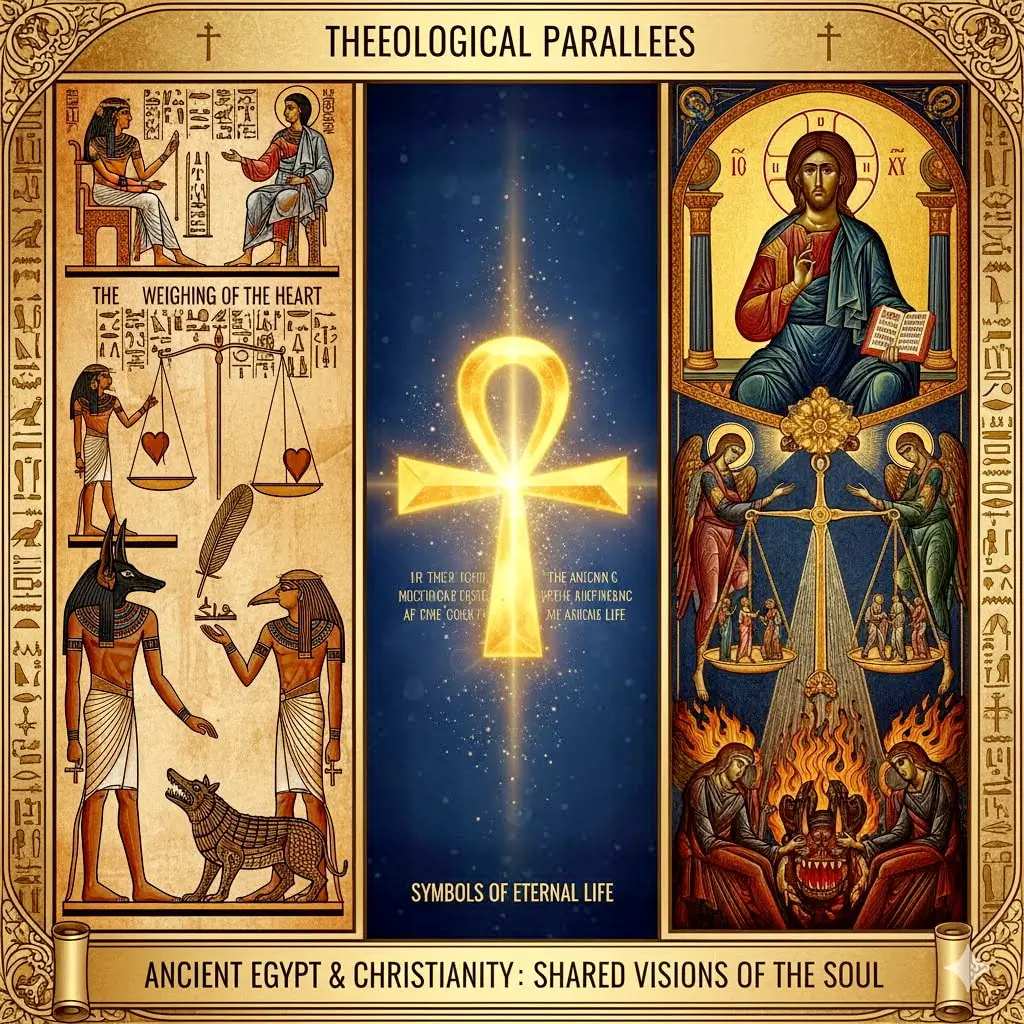
Beyond the visual similarities, the deep influence of Ancient Egypt and Christianity also extends into profound theological concepts, particularly concerning death, judgment, and the hope for eternal life. These shared ideas made the transition to the new faith more fluid for many Egyptians.

The Dying and Rising God

Ancient Egyptians built their entire understanding of the afterlife around the Legend of Osiris. He represented the prototype of the “dying and rising god”—a divine being who suffered death, was resurrected, and then became the judge and provider of eternal life in the underworld.

  • Osiris’s Role: He offered a path to immortality, promising that just as he rose, so too could his followers. This concept resonated powerfully in a land where the cycles of death and rebirth (like the flooding Nile and sprouting crops) were central to existence.
  • Christian Transformation: Early Christians found an echo of this powerful narrative in Christ’s death and resurrection. While the theological specifics differ—Christ conquered death to rule the living, and Osiris ruled the dead—the fundamental idea of a divine figure who overcomes death to grant eternal life provided a familiar framework.

Judgment and the Heart

The concept of a final judgment also shows striking parallels between Ancient Egypt and Christianity.

  • The Weighing of the Heart: Egyptians believed that after death, the god Anubis weighed a person’s heart against the feather of Ma’at (Truth and Justice). A pure heart allowed entry to the Field of Reeds (paradise), while a heavy, impure heart meant annihilation in the “Lake of Fire.”
  • The Last Judgment: Christianity, too, presents a final judgment where deeds are accounted for. The righteous enter heaven, and the unrighteous face damnation. This established understanding of accountability and a divine arbiter provided a strong foundation for the Christian doctrine of the Last Judgment.

The Halo: A Divine Radiance

Consider the halo, the ring of light around the heads of saints and divine figures in Christian art. This ubiquitous symbol also finds its roots in ancient Egyptian solar iconography.

  • Solar Disks: Ancient Egyptian gods like Ra, Horus, and Amun-Ra were frequently depicted with a sun disk or radiant circle behind their heads, signifying their divinity and connection to the life-giving sun.
  • Christian Adaptation: Early Christian artists adapted this visual convention to denote holiness and divine favor around Christ, the Virgin Mary, and the saints. It became a clear visual cue for sanctity, connecting the ancient concept of divine radiance with the new spiritual heroes.

The Trinity vs. The Triad

Furthermore, the very concept of a divine “three-in-one” may have found a receptive audience in Egypt.

  • Egyptian Triads: Ancient Egyptian theology often revolved around divine “triads”—groups of three gods forming a unified spiritual family (e.g., Osiris, Isis, and Horus; or Amun, Mut, and Khonsu at Thebes). These triads represented different aspects of a single divine force or lineage.
  • The Christian Trinity: While the Christian doctrine of the Trinity (Father, Son, and Holy Spirit as one God) is unique, the concept of thinking about divinity in terms of three interconnected entities was not alien to Egyptian thought. This familiarity may have made the sophisticated theological explanation of the Trinity more digestible for early Egyptian converts compared to cultures accustomed to vastly different divine structures.

FUN

The Desert Fathers: Egypt’s Gift to the Church

The Desert Fathers; Egypt's Gift to the Church - Ancient Egypt and Christianity

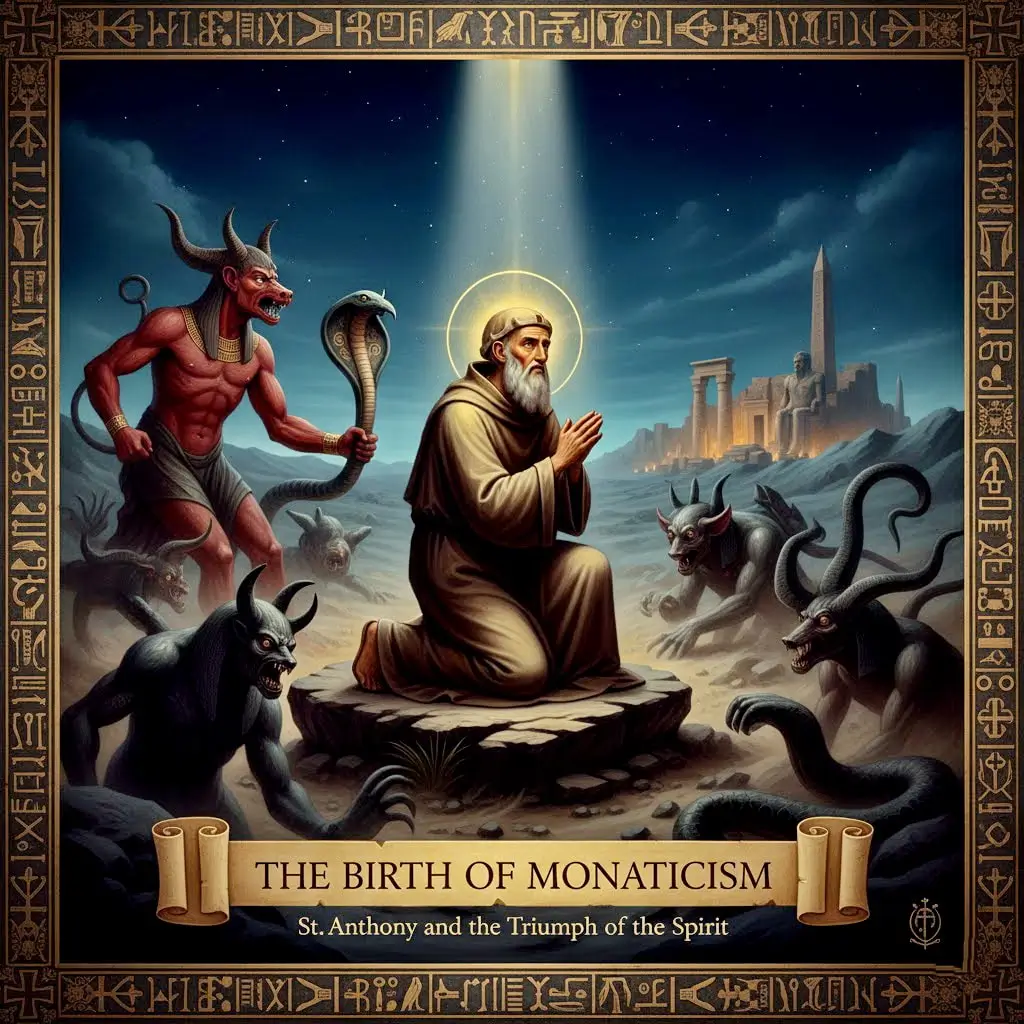
While symbols and theology offer fascinating parallels, the most concrete historical link between Ancient Egypt and Christianity lies in the birth of monasticism. In fact, the very concept of the “monk” was born in the Egyptian desert.

St. Anthony the Great: The First Monk

It began with a man named Anthony (c. 251–356 AD). Seeking a purer form of faith, he sold his possessions and fled into the harsh Eastern Desert. There, he became the first “Christian hermit,” establishing a lifestyle of prayer, fasting, and solitude.

Crucially, Anthony’s biography describes him fighting “demons” in the desert. Historians note that these demons were often described as taking the forms of wild beasts or strange creatures—descriptions that mirror the ancient Egyptian gods and spirits depicted in the abandoned tombs and temples surrounding him. In this way, the struggle between Ancient Egypt and Christianity played out literally in the minds of these early ascetics.

From Hermits to Monasteries

Soon, thousands followed Anthony’s example. The desert became a “city of God.” Another Egyptian saint, Pachomius, organized these scattered hermits into walled communities, creating rules for eating, working, and praying together.

This system became the blueprint for Christian monasticism worldwide. When travelers from Rome and Europe visited Egypt, they took these rules back home. Consequently, every Benedictine abbey or Franciscan friary in Europe today can trace its organizational roots directly back to the sands of Egypt and the legacy of the Desert Fathers.

Ancient Egyptian Economy

The existence of the Nile River, which was one of the factors of the ancient...

Related post
FUN

Words of Power: Language and Liturgy

Words of Power; Language and Liturgy - Ancient Egypt and Christianity

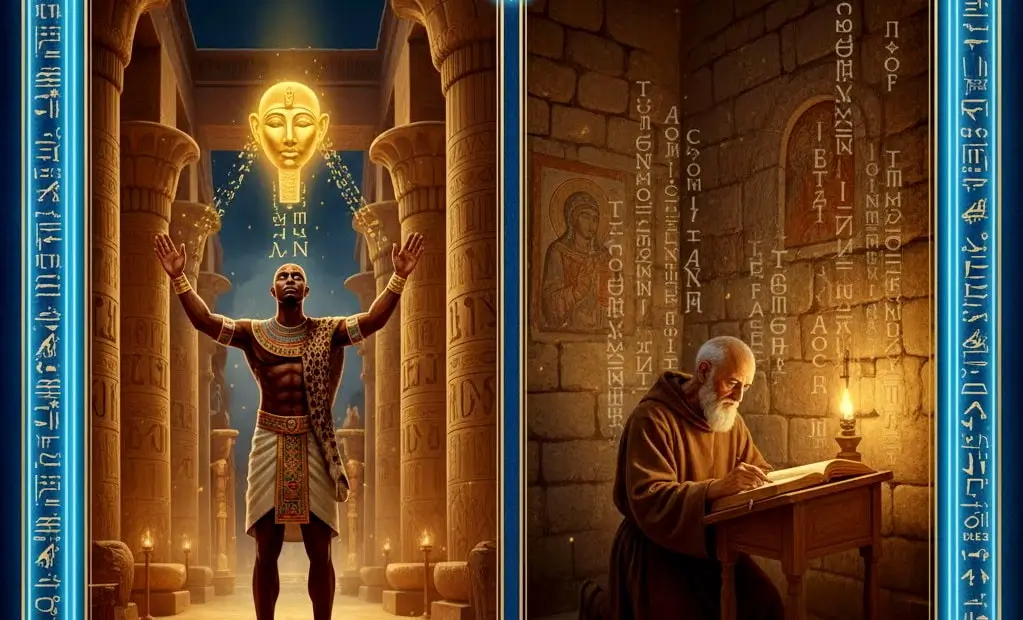
The connection between Ancient Egypt and Christianity is not just visual; it is audible. When you step into a Coptic church today, or even when you say a simple prayer, you are hearing echoes of the pharaohs.

The Mystery of “Amen”

Consider the word used by billions of Christians (and Jews and Muslims) to end a prayer: “Amen.” While linguists generally trace this to a Hebrew root meaning “truth” or “so be it,” many historians note a fascinating cultural parallel. For centuries, the supreme god of Egypt was Amun (or Amen), the “Hidden One.” When priests invoked his name at the end of rituals, they were calling upon the hidden power of the divine. While a direct linguistic link is debated, the cultural continuity of ending a sacred invocation with this specific sound suggests a deep, perhaps subconscious, heritage.

The Coptic Language: The Pharaohs’ Tongue

More concretely, the liturgical language of the Egyptian Church—Coptic—provides the strongest link. Coptic is not a foreign tongue; it is the final stage of the ancient Egyptian language itself. When the Egyptians adopted Christianity, they stopped using hieroglyphs (pictures) and started writing their native language using the Greek alphabet. Therefore, when Coptic monks chant today, they are speaking the direct descendant of the language spoken by Ramesses and Thutmose, preserved within the vessel of Christianity.

The Final Judgment: Weighing of the Heart and the Hall of Two Truths

The Final Judgment stands as the most critical event in the ancient Egyptian conception of...
Related post
FUN

The First Monotheist? The Akhenaten Connection

The First Monotheist; The Akhenaten Connection - Ancient Egypt and Christianity

Finally, we must look at the radical theological experiment that predated the Bible. Centuries before Christianity, one pharaoh attempted to banish the pantheon of gods and worship a single deity.

Akhenaten’s Revolution

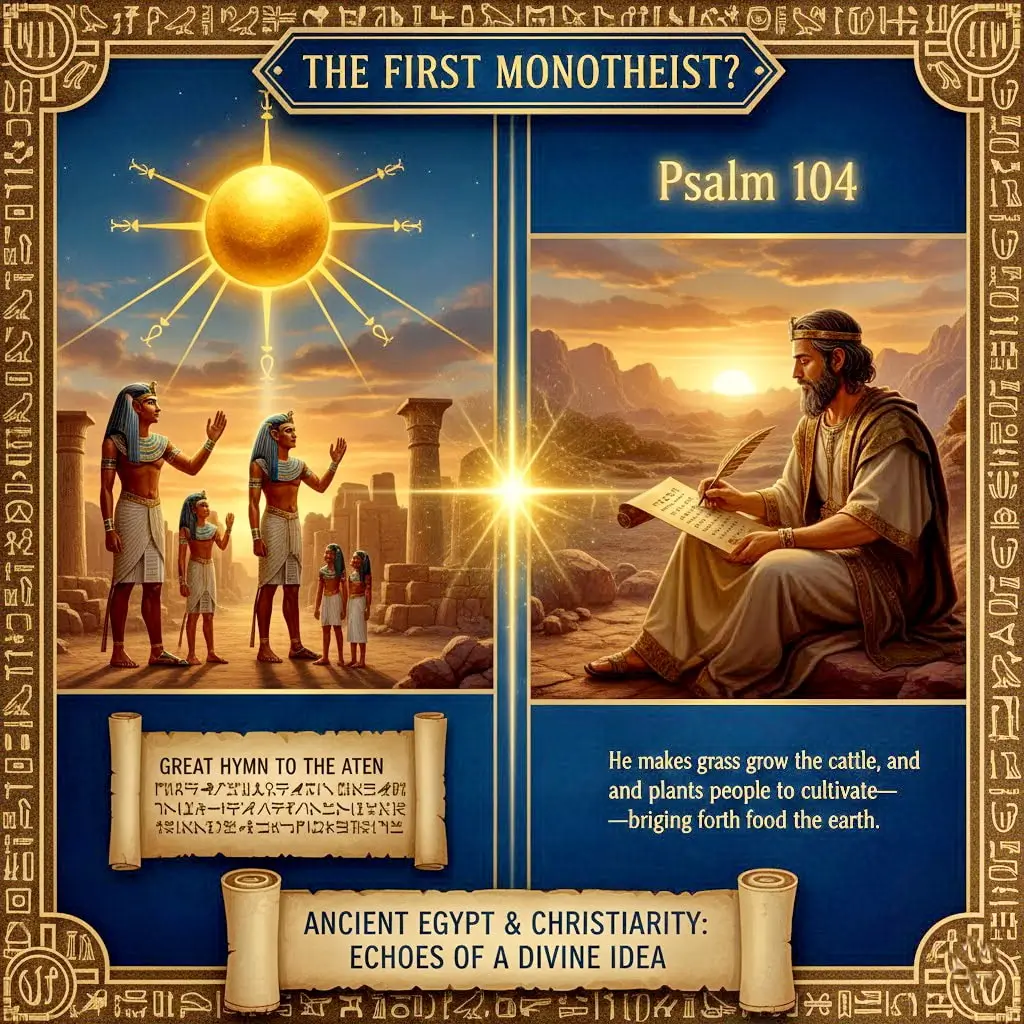
Pharaoh Akhenaten (ruled c. 1353–1336 BCE) declared that there was only one god: the Aten (the sun disk). He outlawed the old gods, closed their temples, and built a new capital. While his revolution collapsed after his death, it established the concept of monotheism in the Egyptian consciousness.

Psalm 104 vs. The Great Hymn to the Aten

The most startling evidence of a link between Ancient Egypt and Christianity (via the Hebrew tradition) is found in the Bible itself. If you compare the biblical Psalm 104 with Akhenaten’s “Great Hymn to the Aten,” the similarities are undeniable. Both texts praise a single creator who feeds the beasts, makes the sun rise, and sustains all life. Many scholars believe that the Hebrew writers, who lived in the shadow of Egypt, were influenced by this poetic tradition, absorbing the Egyptian praise of the One God into their own scriptures.

A Day in the Life of a Pharaoh: The Toughest Job in Egypt

Forget the life of pure luxury. Discover the pharaoh's real job. This article delves into...
Related post
FUN

An Unbroken Chain

Ultimately, the story of Ancient Egypt and Christianity is not one of replacement, but of transformation. When the old temples closed, the faith of the people did not simply vanish. Instead, it flowed into a new vessel.

We see this legacy everywhere. It lives in the Coptic Cross, born from the Ankh. It echoes in the chants of monks, whose way of life began in the Egyptian desert. It shines in the halo of the saints, a remnant of the solar disk. Ancient Egypt provided the deep, fertile soil in which the roots of Christianity grew strong. Therefore, to study the history of the Church is, in many ways, to study the final, enduring chapter of the Pharaohs.

FAQs About Ancient Egypt and Christianity

Here are the quick, direct answers to the most common questions about the connection between Ancient Egypt and Christianity.

Q: Did the story of Horus inspire Jesus?

A: Historians debate the extent of this influence. While Jesus is a distinct historical figure, early Christians clearly used familiar Egyptian imagery (like Isis nursing Horus) to depict Mary and Jesus. Furthermore, themes of a “dying and rising god” and a “savior son” (Horus) likely made the story of Christ easier for Egyptians to accept.

Q: Is the Christian cross an Egyptian symbol?

A: The specific “Coptic Cross” (with a loop at the top) is a direct adaptation of the Egyptian Ankh, the symbol of life. Early Egyptian Christians adopted it to symbolize the eternal life promised by Christ’s sacrifice.

Q: Did Egyptians believe in one god before Christianity?

A: Generally, no. They were polytheistic (many gods). However, for a brief period under Pharaoh Akhenaten, they worshipped a single creator god, the Aten. Many scholars see this as a precursor to the monotheism of Judaism and Christianity.

Discover the treasures of Egypt and witness the immortal monuments of the Pharaohs....
Classic Honeymoon in Egypt exploring Cairo, Luxor, and Aswan....

Great guided tour of pyramids

We travelled to Cairo on Friday, May 3, 2019, from Toronto. We landed at 0530 and were met by a representative of Fun Tours at the departure gate. We were only on a layover of 6 hours, and the tour company came with a private van, water, a driver, and

More »

7 night Egypt Experience Cairo, Aswan, Luxor

Trip of a lifetime!! COVID SAFE!! Knowledgeable guide who loves to share the magic of Egypt with tourists. Friendly and accommodating. This company goes to the extreme to make clients feel welcome and help them. A family company that takes good care of its support staff. Must book the 7-night

More »
Giza pyramids Tours - Egypt Fun Tours

Thanks to egypt fun tours!

Thank u Hani for the enlightening tour of Giza and Saqqara. Thank u also for the great recommendation – Felfela – which we enjoyed a lot. returning the commission u got at the papyrus shop was something we didn’t expect and truly appreciate. shookran!

More »

Great one day tour in Cairo

My husband and I had a long layover in Cairo on our way to Kenya in 2010. Since we had never been to Egypt, we decided to sign up for a one-day tour with Egypt Fun Tours Day Trips. Our guide was there when we arrived and quickly guided us

More »
Isis with wings

Top-rated Tour Packages

Isis with wings