The Pyramid of Unas: The Birthplace of the Pyramid Texts

The Pyramid of Unas is a revolutionary landmark in Saqqara, marking the first time in history that a Pharaoh inscribed the walls of his tomb with sacred literature. These Pyramid Texts, carved in vibrant blue hieroglyphs, provided King Unas with the magical spells and passwords needed to navigate the afterlife. While the exterior is modest, the interior remains a masterpiece of 5th Dynasty theology, featuring a magnificent ceiling decorated with stars and a massive sarcophagus of dark greywacke. Today, it stands as the birthplace of the world's oldest religious corpus, offering a direct window into the spiritual transformation of the Pharaoh into an immortal being.

The Pyramid of Unas: Entering the Birthplace of the Pyramid Texts

The Pyramid of Unas may appear as a modest heap of limestone from the outside, but its interior holds one of the most significant treasures in human history. While earlier Pharaohs built massive monuments like the Great Pyramid, they left their inner walls blank and silent. King Unas, the final ruler of the 5th Dynasty (c. 2375–2345 BCE), shattered this tradition. He transformed the interior of his tomb into a living document, creating the world’s oldest known religious corpus: the Pyramid Texts.

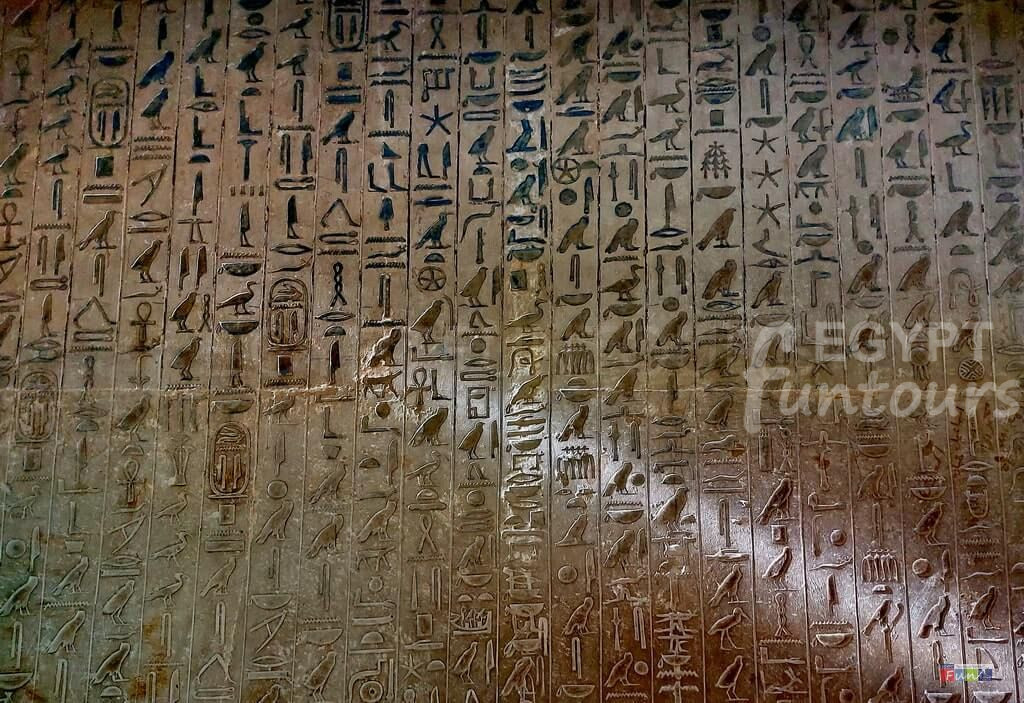
When you descend into the burial chamber, the silence of the desert disappears. Instead, you encounter walls covered from floor to ceiling in exquisite, blue-painted hieroglyphs. These inscriptions do not merely record history; they act as a high-tech “software” for the afterlife. These spells protected the King’s soul, guided him past celestial monsters, and ensured his successful transformation into an immortal star in the night sky.

The Pyramid of Unas remains a highlight of any Saqqara itinerary. Recent lighting upgrades and conservation efforts now allow visitors to see the vibrant contrast between the golden limestone and the “Egyptian Blue” pigments with unparalleled clarity.

In this guide, we explore the revolutionary legacy of King Unas. We will decode the meaning behind the Pyramid Texts, walk the length of his massive processional causeway, and provide the essential logistics you need to experience this spiritual masterpiece firsthand.

FUN

King Unas: The Last Ruler of the 5th Dynasty

King Unas The Last Ruler of the 5th Dynasty

To appreciate the pyramid’s innovation, you must understand the king who broke centuries of silence. King Unas (reigned c. 2375–2345 BCE) ruled Egypt for approximately 30 years during a pivotal transition in the Old Kingdom. As the final Pharaoh of the 5th Dynasty, he represents both the conclusion of the era of the sun temples and a revolutionary beginning for Egyptian funerary theology.

A Bridge Between Dynasties

Unas navigated a period of shifting power. While he maintained the traditional bureaucratic structures of his predecessors, he also paved the way for the 6th Dynasty. Historical records, including the Turin King List, confirm his long reign, yet he left no male heir. This vacancy eventually led to the rise of King Teti, who married Unas’s daughter, Princess Iput I, to stabilize the throne. Consequently, the Pyramid of Unas serves as the architectural and theological bridge between these two great eras.

The Shift from Scale to Substance

By the time Unas took the throne, the era of “Giantism”—the massive scale of the Giza pyramids—had ended. Pharaohs began to prioritize the spiritual “machinery” of the tomb over its physical size. Unas’s pyramid stands only 43 meters (141 feet) tall, significantly smaller than the Great Pyramid. However, he redirected his resources into the interior. He chose to invest in the power of the written word, ensuring his immortality through magic rather than just sheer volume of stone.

Economic Challenges and Famine Theories

Economic Challenges and Famine Theories

The reliefs found along the Unas causeway suggest his reign faced environmental challenges. Some carvings depict emaciated people, which many historians interpret as evidence of a regional famine caused by a drying climate at the end of the 5th Dynasty. Despite these hardships, Unas maintained sufficient central authority to construct a complex featuring imported materials, including high-quality alabaster and the rare pigments used in his inscriptions.

FUN

The Pyramid Texts: Deciphering the Map to the Afterlife

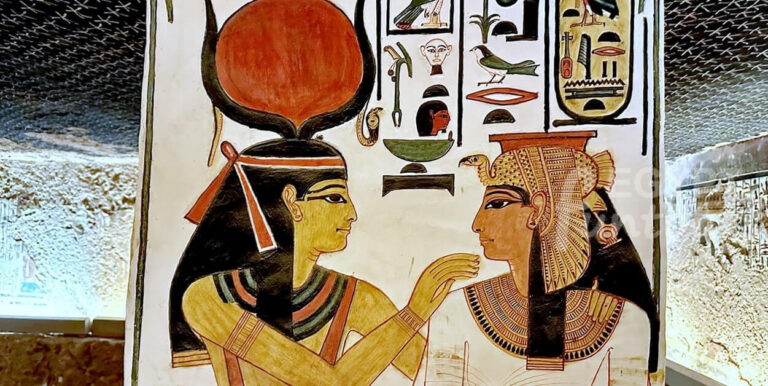
THe pyramids text ancient egyptian book of dead egypt fun tours

The Pyramid of Unas holds its greatest treasure deep underground. Here, for the first time in Egyptian history, a Pharaoh inscribed the walls of his burial chamber with religious liturgy. These inscriptions, known as the Pyramid Texts, consist of 283 “spells” or utterances designed to protect the King and ensure his eternal life.

A Revolutionary Innovation

Before King Unas, the internal chambers of the pyramids remained plain. By introducing the Pyramid Texts, Unas revolutionized Egyptian theology. He moved the “magic” of the afterlife from oral tradition into a permanent, physical form. These texts acted as a powerful spiritual manual, providing the King with the passwords and incantations necessary to navigate the dangerous landscape of the Duat (the underworld).

The Power of the Spells

The texts served three primary functions:

  • Protection: Spells shielded the King from malevolent spirits and dangerous creatures like snakes and scorpions.
  • Transformation: The inscriptions helped the King’s ka (spirit) and ba (personality) unite into an akh—an effective, immortal being.
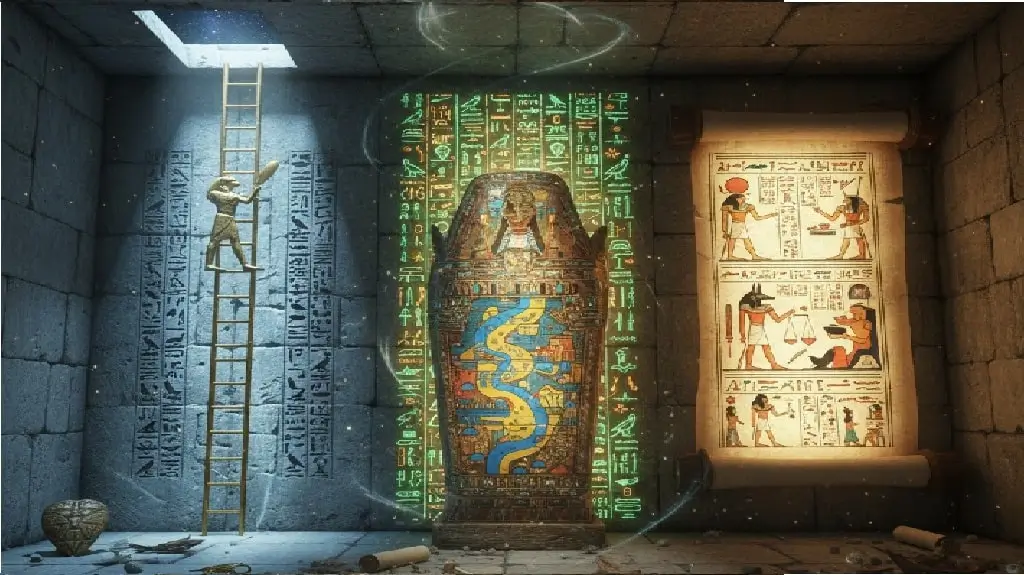
  • Ascension: Many utterances describe the King climbing a celestial ladder or flying like a bird to join the sun god, Ra, in his solar barque.

Artistry and Symbolism in Blue

The visual presentation of the Pyramid Texts is as significant as the words themselves. The scribes carved the hieroglyphs with incredible precision and filled them with Egyptian Blue pigment. This color was not a random choice; blue symbolized the heavens and the life-giving waters of the Nile.

Above the texts, the ceiling of the burial chamber features a magnificent canopy of five-pointed stars. This design creates a symbolic universe where the King rests beneath the night sky, surrounded by the very spells that will launch him into eternity.

The “Cannibal Hymn”

Egyptian Funerary Texts; Pyramid, Coffin, Book of the Dead

One of the most famous and enigmatic sections of the Pyramid Texts found in this tomb is the “Cannibal Hymn.” In this text, the King is described as a terrifying force who “eats the gods” to absorb their power and magic. While modern readers might find the imagery startling, to the ancient Egyptians, it represented the Pharaoh’s ultimate dominance over all spiritual forces in the universe.

FUN

Interior Architecture: Descending into the Blue Vault

Interior Architecture, Descending into the Blue Vault

While the exterior of the Pyramid of Unas appears weathered, the interior architecture remains remarkably intact. The layout follows a sophisticated plan designed to transition the King from the physical world to the celestial realm. As you descend, you move through a series of spaces that combine structural engineering with deep religious symbolism.

The Entrance and Descending Passage

The journey begins on the north side of the pyramid. A narrow, sloping passage leads deep into the bedrock. This descent represents the King’s entrance into the Duat (the underworld). Today, a modern wooden walkway protects the floor, but the original limestone walls still press closely, creating a sense of transition and mystery.

The Antechamber and Three Portcullises

The passage opens into a small horizontal corridor before reaching the antechamber. To protect the burial, the architects installed three massive granite portcullis slabs. These giant stones once dropped from the ceiling into slots in the wall, permanently sealing the inner sanctum against grave robbers. Passing these blocks today serves as a reminder of the extreme measures taken to ensure the King’s “House of Eternity” remained undisturbed.

The Burial Chamber: A Celestial Masterpiece

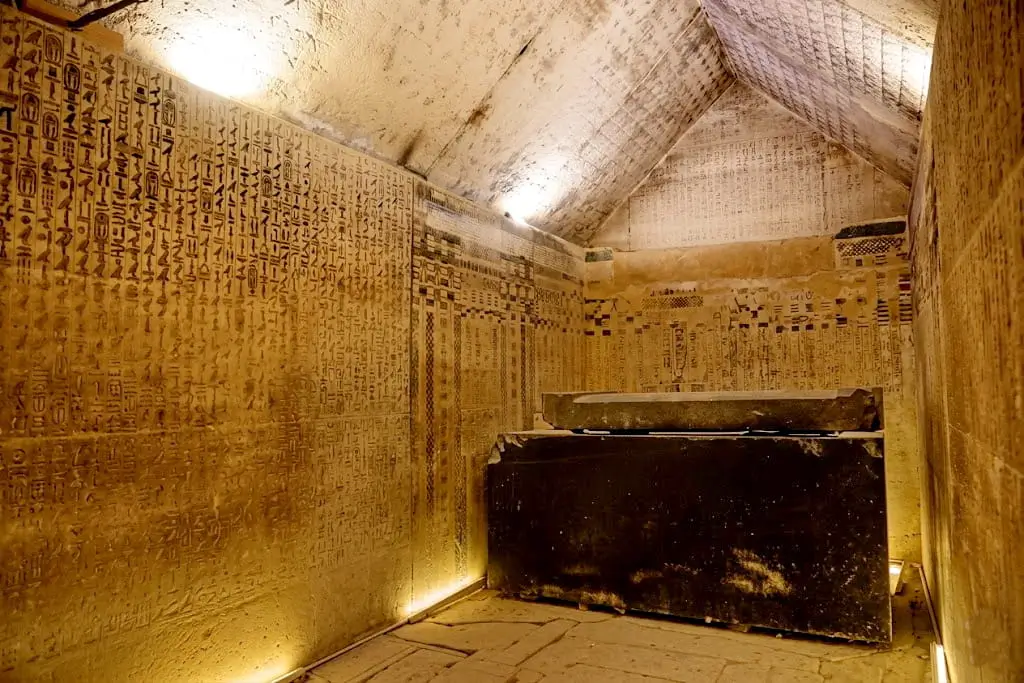
The burial chamber is the architectural heart of the pyramid. Located to the west of the antechamber, it houses the King’s final resting place.

  • The Sarcophagus: At the western end sits a massive sarcophagus carved from dark grey greywacke (often identified as basalt). It stands in stark contrast to the white limestone walls around it.
  • Alabaster Accents: The wall behind the sarcophagus features exquisite panels of Egyptian Alabaster (calcite). The natural veining of the stone creates a shimmering, ethereal backdrop that reflects the dim light, symbolizing the purity of the afterlife.
  • The Gabled Ceiling: Above you, two massive limestone beams lean against each other to form a gabled ceiling. This structural choice distributes the immense weight of the pyramid above, but the decoration transforms it into a religious vision: a vast, night sky filled with hundreds of yellow, five-pointed stars.

The Serdab (The Hidden Room)

To the east of the antechamber lies a small, uninscribed room with three niches, known as the Serdab. This “cellar” room likely held the King’s ka statues or funerary furniture. While it lacks the vibrant Pyramid Texts found in the other rooms, its presence is essential to the tomb’s function as a complete ritual complex.

FUN

The Causeway and Valley Temple: The Processional Path

The Causeway and Valley Temple The Processional Path

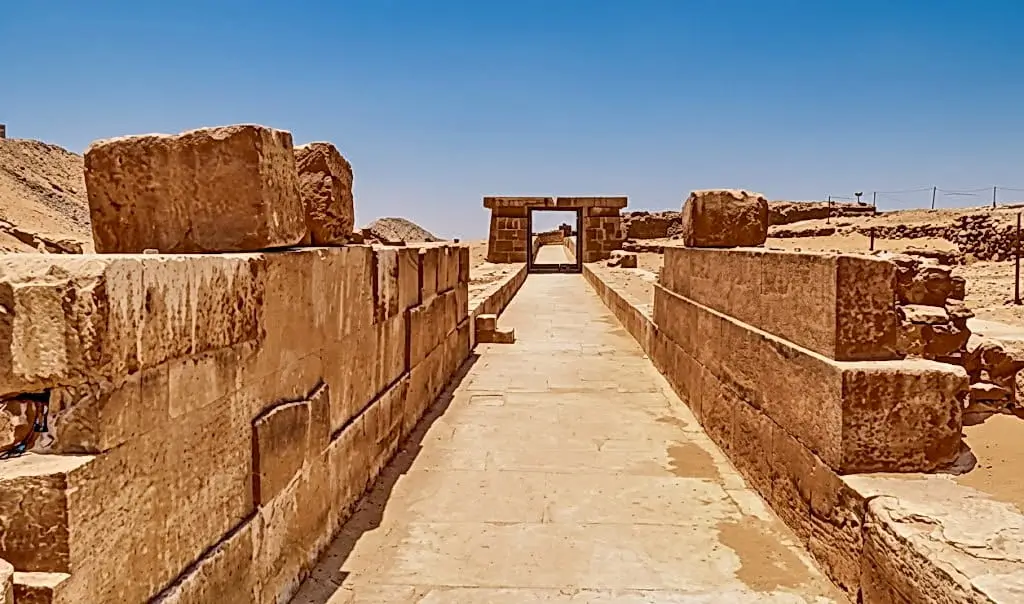
While the interior of the pyramid holds the spiritual secrets, the external complex of the Pyramid of Unas showcases the sheer scale of 5th Dynasty engineering. The funerary complex includes a Valley Temple and a massive processional causeway that connected the Nile to the desert plateau.

The Longest Causeway in Saqqara

The Causeway of Unas is one of the best-preserved and most impressive structures of its kind. Stretching nearly 750 meters (2,460 feet), it served as the formal path for the King’s funeral procession.

  • Architecture: In antiquity, the causeway was a fully enclosed, roofed tunnel. A narrow slit in the ceiling allowed a single beam of light to illuminate the interior, creating a dramatic, sacred atmosphere.
  • The Reliefs: The walls of the causeway originally featured over 1,000 meters of intricate carvings. These reliefs depict a wide range of subjects, from the transport of massive granite columns from Aswan to scenes of daily life, such as harvesting honey and hunting desert animals.

The Valley Temple

At the edge of the desert, where the Nile’s waters once reached, stood the Valley Temple. This structure served as the gateway to the pyramid complex.

  • Function: Historians believe this temple was the site for the initial funerary rites and the “Opening of the Mouth” ceremony.
  • Status in 2026: While the temple is largely in ruins today, its foundations still reveal the use of high-quality basalt and fine limestone. It remains a crucial part of the site’s layout, marking the start of the King’s journey toward the afterlife.

The Boat Pits

Near the upper end of the causeway, archaeologists discovered two massive, boat-shaped pits lined with limestone.

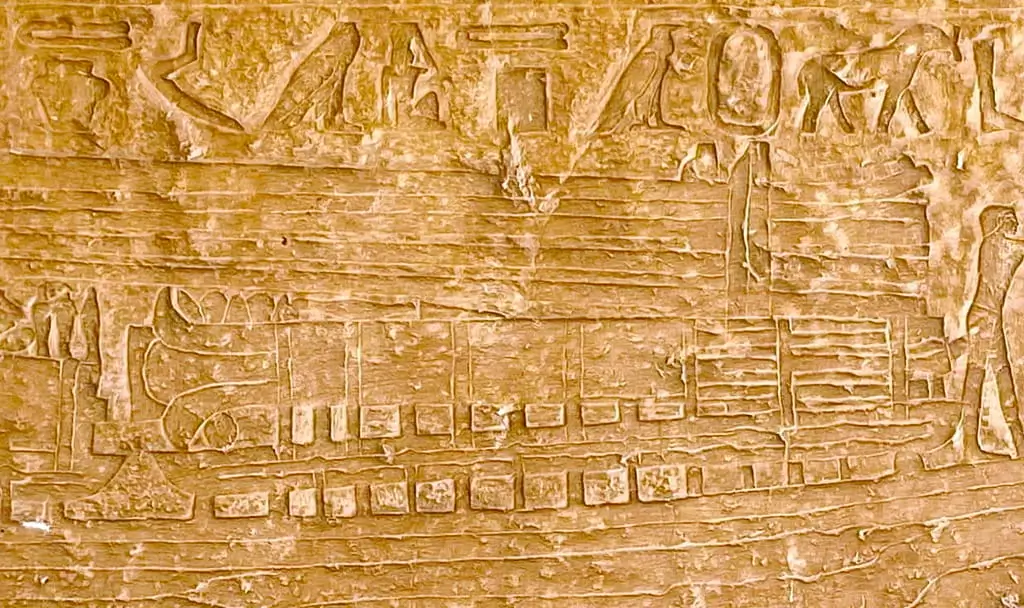
  • Symbolism: Similar to the famous Solar Boat of Khufu at Giza, these pits likely held wooden boats intended for the King’s celestial journey across the sky with the sun god, Ra.
  • Discovery: Although the wooden boats have long since decayed, the 45-meter-long pits remain as a testament to the maritime traditions that permeated Egyptian funerary beliefs.
FUN

Visitor Logistics: Exploring the Pyramid of Unas

To make the most of your visit to the Pyramid of Unas in 2026, you should be aware of the specific access rules that protect this delicate site.

  • Limited Access: To preserve the Pyramid Texts from humidity and carbon dioxide, the Ministry of Tourism and Antiquities often limits the number of visitors allowed inside the burial chamber simultaneously.
  • Photography: In 2026, mobile photography is permitted, but you must strictly turn off your flash. The intense light from flashes can degrade the ancient blue pigments over time.
  • The Best View: For the best exterior photos of the pyramid and the Step Pyramid in the background, walk about 100 meters south of the Unas entrance during the “Golden Hour” (late afternoon).

The Evolution of Sacred Spells: Unas vs. Teti

Although the two pyramids are located within walking distance of each other in Saqqara, their interiors reveal a fascinating shift in how the Pharaohs prepared for eternity.

FeaturePyramid of Unas (5th Dynasty)Pyramid of Teti (6th Dynasty)
ChronologyThe first to use the Pyramid Texts.The second major use of the texts.
Number of Spells283 Utterances (concentrated).Nearly 400 Utterances (expanded).
Artistic StyleDeeply carved, vibrant Egyptian Blue hieroglyphs.Finer, smaller carvings; often more delicate in execution.
Ceiling DesignGolden stars on a flat/gabled limestone sky.A dense canopy of stars, more tightly packed than Unas’s.
Key ThemesFocused on the King’s raw power and the “Cannibal Hymn.”Shifted toward the King’s identification with Osiris and rebirth.

Key Technical and Theological Differences

1. The Volume of Information

In the Pyramid of Unas, the texts are carefully curated and focused. By the time of King Teti, the “library” of spells had grown. Teti’s scribes included more protective utterances and specific rituals for the “Opening of the Mouth” ceremony, reflecting a growing complexity in Egyptian religious thought.

2. Visual Precision

While Unas’s hieroglyphs are famous for their bold, deep carving and intense blue pigment, Teti’s inscriptions are often praised for their elegance. Because Teti’s pyramid suffered more structural damage over the millennia, the texts in Unas are generally better preserved and easier for visitors to read. However, Teti’s burial chamber offers a more intimate atmosphere due to the smaller scale of the hieroglyphs.

3. The Osirian Shift

One of the most significant theological changes occurs between these two monuments. In the Pyramid of Unas, the King is often portrayed as a solar deity ascending to Ra. In the Pyramid of Teti, we see a stronger emphasis on Osiris, the god of the dead. Teti is more frequently identified as “Osiris-Teti,” signaling a permanent shift in how all future Egyptian Pharaohs would view their journey through the underworld.

Expert Visit Strategy: Seeing Both in One Day

Since Egypt Fun Tours clients usually visit both sites, we recommend seeing them in chronological order:

  1. Start at Unas: Experience the “Original” version. Pay close attention to the vibrant blue color and the aggressive power of the early spells.
  2. Move to Teti: Note the increased density of the text. Notice how the inscriptions begin to “wrap” around more surfaces of the chamber, showing the evolution toward the even more complex tombs of the Middle Kingdom.
Live between the artifacts of the ancient Egypt and discover wonders....
Enjoy the best 2 days Luxor tour and discover amazing temples & tombs dates back to the Pharaohs era. Read more about 2 days in...
God_Anubis_Icon

2 week group private tour – Egypt and Jordan

Our US-based agency takes small groups of experienced travelers to the most beautiful and exotic places in the world. In Dec ’19 – Jan ’20, we used the services of Egypt Fun Tours to plan, organize, and conduct an amazing trip to Cairo, Giza, Saqqara, Luxor, and Aswan. The New

More »

Transit Stopover in Cairo

We have just returned from a two week holiday in Cape Town. On the way out our airline schedule meant that we had a 15 hour stop in Cairo. We decided to arrange a tour of the city and after asking for quotes/itineraries we chose Egypt Fun Tours. This worked

More »

What an amazing day!

I had a 12 hour layover on my way to Dar es Salaam and wanted to take full advantage of my time in Cairo. After researching for many hours, I came across Egypt Fun Tours and emailed for more information. I received a prompt reply with full details of several

More »
God_Anubis_Icon

Top-rated Tour Packages

God_Anubis_Icon