The Tomb of the Butchers: A Masterpiece of Daily Life in Saqqara

The Tomb of the Butchers stands as a vibrant masterpiece of 5th Dynasty art, offering an unparalleled glimpse into the professional elite of the Old Kingdom. Carved directly into the Saqqara cliffs, the mastaba of Irukaptah is world-renowned for its row of 14 colorful, rock-cut statues and remarkably preserved reliefs of ancient slaughterhouses and market trade. Its sheltered location has protected the original pigments for over 4,000 years, making it an essential destination for those seeking to understand the daily life, economic logistics, and artistic brilliance of Egypt’s royal meat industry.

The Vivid World of Irukaptah

The Tomb of the Butchers, also known as the Tomb of Irukaptah, is one of the most vibrant monuments in Saqqara. It dates back to the 5th Dynasty (c. 2400 BCE), specifically the reign of King Nyuserre or Menkauhor. Irukaptah held several high titles, including “Head of the Butchers of the Great House.” Consequently, his tomb serves as a fascinating window into the logistics of the royal palace. Unlike the grand royal pyramids nearby, this mastaba focuses on the energy and color of ancient Egyptian daily life.

The tomb is famous for its unique architecture and well-preserved colors. It is carved directly into the limestone cliff rather than built with blocks. Because of its sheltered location, the pigments on the statues and reliefs remain remarkably bright. For visitors, this site offers a refreshing break from the larger, more austere monuments. It provides a personal and detailed look at a man who managed the vital food supplies of the Pharaoh’s court.
FUN

The Butcher in Ancient Society: Irukaptah’s Professional World

To understand this tomb, you must understand Irukaptah’s rank. He was not a simple laborer. He was the “Head of the Butchers of the Great House.” In the 5th Dynasty, this was a high-status position. The “Great House” refers to the Royal Palace. Consequently, Irukaptah managed the meat supply for the Pharaoh himself.

The Logistics of the Royal Kitchens

Meat was a luxury in ancient Egypt. While the common people ate bread, beer, and fish, the elite consumed beef and poultry. Irukaptah oversaw the selection of the finest bulls. He also managed a large staff of specialized slaughterers. These men had to follow strict religious laws. Every animal killed for the palace was considered a potential offering to the gods. Therefore, butchery was a sacred act as much as a culinary one.

Economic Power of the Priesthood

Irukaptah likely worked closely with the priests of the nearby Sun Temples. The Old Kingdom economy relied on “Redistribution.” The Pharaoh collected cattle as taxes. Then, he redistributed the meat to the temples and high officials. Irukaptah sat at the center of this economic web. His tomb reflects this wealth. He had the resources to hire the best sculptors in Saqqara to carve his rock-cut gallery.

FUN

Architecture: A Gallery Carved in Stone

Architecture A Gallery; Carved in Stone

The design of the Tomb of the Butchers is distinct from the typical Saqqara mastaba. Instead of a free-standing structure, Irukaptah chose a rock-cut layout. This choice allowed his architects to create a long, gallery-like space that feels intimate and alive.

The Rock-Cut Façade

The entrance leads directly into the limestone bedrock. This method provided a natural “refrigerator” effect, which helped preserve the delicate painted scenes. Furthermore, the solid rock walls allowed the artists to carve deep into the stone. They created high-relief figures that almost step out from the walls.

The Corridor of Statues

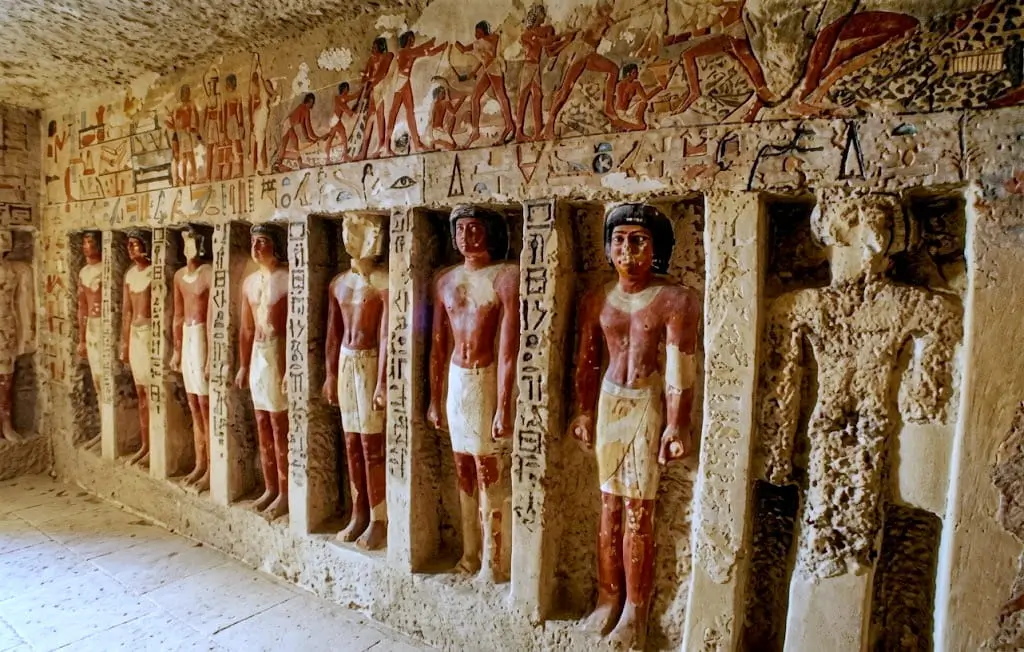
The most striking feature is a row of 14 statues carved directly into the walls of the main chamber. There are ten statues on the left side and four on the right. These figures represent Irukaptah at different stages of his life.

  • The Colors: Most statues still retain their original red and yellow skin tones.
  • The Details: Each figure wears a white kilt, which contrasts sharply against the dark limestone.
  • The Symbolism: These statues acted as “backup bodies” for Irukaptah’s soul. If his mummy were ever destroyed, his spirit could inhabit any of these stone versions to live forever.

The Science of Color: Preserving the 5th Dynasty Palette

The Tomb of the Butchers is famous for its polychromy (use of multiple colors). In most 5th Dynasty tombs, the paint has flaked away. However, Irukaptah’s statues still glow with life.

The Pigments of the Old Kingdom

Ancient artists used natural minerals to create their paints. They ground these minerals into fine powders and mixed them with a binder like egg white or plant gum.

  • Red and Yellow: These came from ochre, a natural iron oxide found in the desert. Artists used red for the skin of men and yellow for the skin of women.

  • White: They used gypsum or powdered limestone to create the crisp white kilts seen on the 14 statues.

  • Black: This came from charcoal or soot, used for the hair and the pupils of the eyes.

  • Green and Blue: These were rare and expensive. They were made from ground malachite or “Egyptian Blue” (a synthetic pigment made of copper and silica).

The Preservation Secret

Why is this tomb so colorful? The answer lies in its rock-cut nature. Most mastabas are built of limestone blocks above ground. These are exposed to wind, heat, and moisture. In contrast, Irukaptah’s tomb is a cave. It stays at a constant temperature year-round. This stable environment protected the organic binders in the paint. When you stand in the corridor today, you see the exact colors the artists saw 4,400 years ago.

The Catacombs of Kom Esh-Shokafa: Roman-Egyptian Underworld

Descend into one of the "Seven Wonders of the Middle Ages" at the Catacombs of...
Related post
FUN

The Reliefs: Butchery, Banquets, and Business

The tomb’s name comes from the incredible detail of its wall carvings. These scenes do not focus on war or gods. Instead, they celebrate the professional pride of Irukaptah and his team.

The Slaughtering Scenes

You will see detailed depictions of butchers at work. The scenes show men pinning down bulls and sharpening their knives. They are shown expertly carving the meat to prepare it for the King’s offerings. These scenes are not just art; they are a historical record. They show the specific tools and techniques used in the Old Kingdom food industry.

Agricultural and Trade Scenes

Beyond butchery, the tomb features scenes of typical Egyptian life:

  • The Harvest: Workers are shown gathering grain and tending to livestock.
  • Market Life: Small figures engage in trade, swapping goods and recording transactions.
  • The Banquet: Irukaptah appears sitting at a table piled high with food. This scene ensured that his soul would never go hungry in the afterlife.

The Tomb of Hekashepes: Unveiling the Golden Secret of Saqqara

The Tomb of Hekashepes is a landmark 2023 discovery in Saqqara’s Gisr el-Mudir, revealing a...
Related post
FUN

A Comparative Analysis: Irukaptah vs. The Tomb of Ty

Feature Tomb of Irukaptah Tomb of Ty
Focus Specialized Industry (Butchery) General Estate Management
Statues 14 Rock-Cut Wall Statues Serdab Statues (Hidden)
Atmosphere Intimate and Vivid Grand and Majestic
Art Style High Relief, Heavy Paint Delicate, Low Relief

While Ty shows the “CEO” perspective of an estate, Irukaptah shows the “Operations” perspective. Ty’s reliefs are elegant and thin. Irukaptah’s reliefs are bold and muscular. By visiting both, a traveler gets a full view of the 5th Dynasty social structure.

The Sacred Geometry of the Rock-Cut Gallery

Ancient architects did not dig into the cliff randomly. They followed a strict plan. The Tomb of the Butchers follows a linear “Processional” axis.

The Entrance Portico

The journey begins at the entrance portico. Here, the sun hits the stone at an angle. This creates deep shadows in the carvings. The transition from the bright desert sun to the cool, dark tomb was symbolic. It represented the transition from the world of the living to the world of the dead.

The Main Hall and the Statues

As you move into the hall, the statues greet you. The placement of the 10 statues on the left is intentional. In Egyptian art, the left side often represents the “Heart” and the “Will.” These statues face the entrance to receive the offerings brought by the family. The statues are not identical. Some show Irukaptah as a young, fit man. Others show him with the slight belly of a successful, wealthy official.

The Tomb of Hekashepes: Unveiling the Golden Secret of Saqqara

The Tomb of Hekashepes is a landmark 2023 discovery in Saqqara’s Gisr el-Mudir, revealing a...
Related post
FUN

Visitor Insights: Tips for Your Visit

The Tomb of the Butchers is a “hidden gem” that many large tour groups skip. However, it is essential for anyone interested in Egyptian art history.

  • Lighting: The tomb is deep and can be dark. The ministry installed modern LED lighting. These lights reveal the colors without damaging the paint.
  • Proximity: The tomb is located near the Pyramid of Unas and the Tombs of Niankhkhnum and Khnumhotep. You can easily visit all three in one morning.
  • Art Appreciation: Bring a small flashlight. It will help you see the fine details of the butchers’ knives and the expressions on the carved statues.
Book now 6 day Egypt itinerary to Cairo, Luxor, Aswan & Abu Simbel, it's wonderful adventure trip to Egypt, visit the best tourist attractions in...
Embark on a 7 night Nile cruise from Aswan to visit the stunning temples and tombs in Luxor and Aswan joined by a private tour...
God_Anubis_Icon

Day trip to Wadi el Hitan and Wadi el Rayan

We went on a full-day trip to Wadi el Hitan and Wadi el Rayan with Mohamed (Hamada). Mohamed was a wonderful guide, always making sure we had plenty of water and enough to eat, and providing us with information about the area and Egypt more generally. He also gave us

More »

Early Layover Tour in Cairo

My husband, 2 sons – aged 9 & 11 – and I landed in Cairo at 5:15am on Saturday 12 January 2013. We had booked an early layover tour with Egypt Fun Tours after reading the great reviews in TripAdvisor. As promised he and his driver awaited us in a

More »

Excellent Tour

Really excellent tour from Mohamed, and we learned so much about Egypt and went to places we never would have found as tourists at home. My girlfriend had a 12 hour stop over on the way to Ethiopia and it was the perfect way to see Cairo. I hope people

More »

Layover tour of Cairo Pyramids

On a recent trip, I had 8 hours from the time I landed in Cairo to when my next flight was scheduled to leave. Luckily, I arrived in the morning and left in the afternoon, so, not being one to sit around an airport for 8 hours, I visited the

More »

Valley of the Kings, Hepchepsut

I never had a more positive experience and educational time than this tours. Learning about a variety of kings and queens was amazing! The tour guide was super nice and helped me and my friend every step of the way! Including bargaining for a few souvenirs! I will never forget

More »
God_Anubis_Icon

Top-rated Tour Packages

God_Anubis_Icon