Seventh Dynasty of Egypt: Mystery, Chaos and Authority

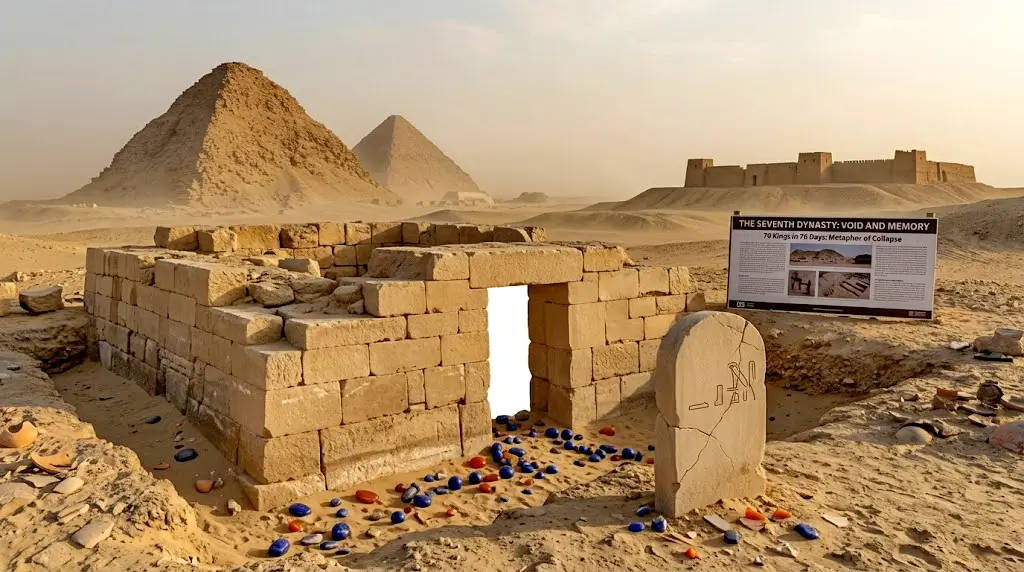
The Seventh Dynasty of Egypt serves primarily as a historical metaphor for the complete collapse of centralized Old Kingdom authority rather than a record of actual, functioning rulers. Often characterized by Manetho's symbolic account of "seventy kings in seventy days," this era marks a profound systemic failure where the state fractured into localized, powerless claims. Because no archaeological evidence exists for these kings, historians view the dynasty as a "historiographical ghost"—a necessary, yet artificial, placeholder used to bridge the void between the stable Old Kingdom and the fragmented First Intermediate Period.
The eye of Horus
WhatsApp
Email
Print

The “Ghost” of the Seventh Dynasty of Egypt: A Study in Historical Mystery

Visit the Temple of Seti I at Abydos and look at the long rows of royal names. These carvings show a clear, unbroken line of kings. New Kingdom pharaohs created this list to prove that Egyptian rule lasted from the dawn of time. However, modern history tells a different story. It reveals a jarring gap: the “Seventh Dynasty of Egypt.”

Historians often call this era the start of the First Intermediate Period. It occupies a strange space in the Egyptian record. We define this period not by the monuments it left behind, but by its total silence. You will find no temple carvings or tomb walls from this time. The priest Manetho is our only source. Later writers, such as Africanus and Eusebius, preserved his work. They struggled to understand his tale of “seventy kings in seventy days.” They could not easily link this story to a collapsing state.

Was the Seventh Dynasty a real political power? Or is it a historical “ghost”? Perhaps later writers invented it to hide the collapse of the Old Kingdom. We must peel back the layers between idealized kingship and the messy truth. We will move beyond the labels in this article and will examine why this “lost” dynasty remains one of the most debated chapters in the Egyptian story.

Divider

The Sources: How Do We Know (or Think We Know)?

The Sources How Do We Know (or Think We Know)

We face a significant problem when studying the Seventh Dynasty: the total lack of direct evidence. We rely on later records to reconstruct this era, but these sources often present conflicting information.

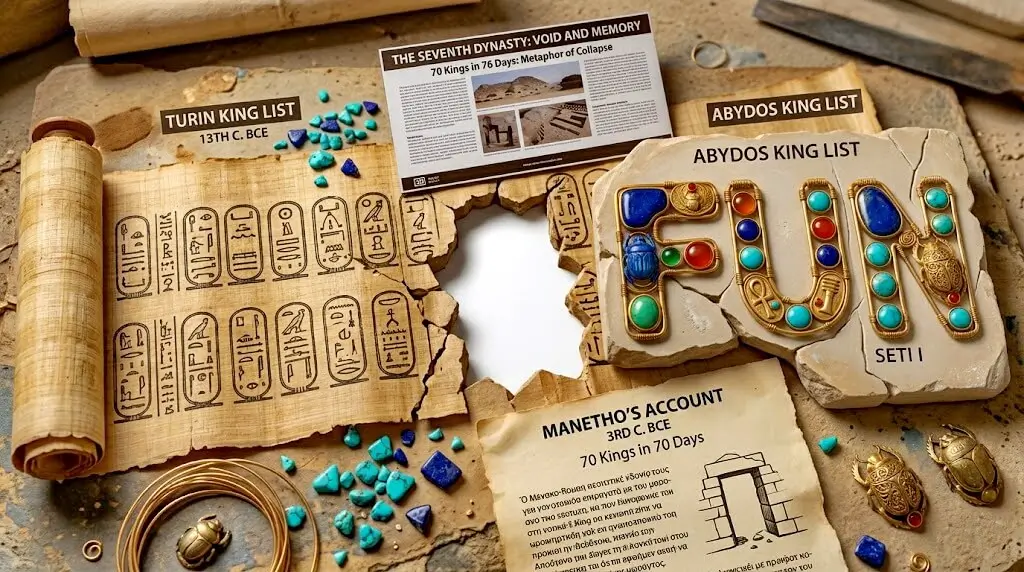
  • Manetho’s Account: The primary source for the Seventh Dynasty is the Egyptian priest Manetho, who wrote in the 3rd century BCE. He famously described the period as “70 kings who ruled for 70 days”. Historians today interpret this not as a literal count of rulers, but as a symbolic description of complete political collapse.
  • The Turin King List: This 13th-century BCE papyrus is a crucial document for Egyptian chronology. However, it contains a frustrating gap precisely where the Seventh and Eighth Dynasties should be. This physical hole in the record suggests that even ancient chroniclers struggled to organize this chaotic time.
  • The Abydos King List: Created by Seti I, this monument presents an idealized version of history. It skips the chaotic transition of the Seventh Dynasty entirely. Instead, it jumps from the final legitimate kings of the Old Kingdom directly to the stabilizing rulers of the Middle Kingdom. This omission reveals how New Kingdom pharaohs preferred to present a seamless chain of ancestors, actively erasing periods of instability from the national memory.

As we navigate these conflicting lists, it becomes clear that the Seventh Dynasty is a product of historiographical convenience. It serves as a placeholder in the timeline—a name given to a void that the ancient Egyptians themselves found too painful or disorganized to document.

Golden Scarab

The Nature of the Seventh Dynasty of Egypt: Symbol vs. Reality

We must move beyond the search for specific kings to understand this era. The Seventh Dynasty represents decentralization in its most extreme form. Rather than a functioning administration, it likely marks the moment the central state in Memphis ceased to function as a unified power.

  • A Failed Replacement: The concept of the Seventh Dynasty highlights a crisis where the state failed to produce a singular, recognized king.
  • Minor Claimants: Historians suspect that minor claimants to the throne existed in the old capital, but they held zero authority over the wider Egyptian state.
  • The Power of the Metaphor: The “70 kings” mentioned by Manetho act as a collective symbol for a ruling body that fractured under the weight of its own internal failures.
  • Systemic Collapse: By labeling this chaos as a “dynasty,” historians created a structural bridge to move from the Old Kingdom’s absolute order to the fragmented reality of the First Intermediate Period.

This “dynasty” serves as the definitive symbol of a system failure. It reminds us that when absolute authority evaporates, history struggles to record the names of those who stood in the resulting void.

The eye of Horus

The Pivot to Authority: The Rise of the Eighth Dynasty

While the Seventh Dynasty remains a phantom, the Eighth Dynasty represents the first, desperate attempt by the old administration to reclaim order. Unlike its predecessor, which serves primarily as a symbol of collapse, the Eighth Dynasty contains names of actual historical figures who attempted to rule from Memphis.

  • A Shift Toward Reality: History classifies the Eighth Dynasty as a tangible political entity rather than a symbolic void.
  • Evidence of Authority: We possess actual royal names from this period, such as Qakare Ibi, who left behind physical evidence of his claim to the throne.
  • The Memphis Holdout: These rulers maintained a fragile, localized authority within Memphis, desperately trying to project the image of a unified Old Kingdom.
  • The Impending Transition: Despite these efforts, the Eighth Dynasty failed to halt the inevitable decline, setting the stage for the final shift of power to the provincial city of Herakleopolis.

This period shows a state struggling to maintain a central identity. It was a brief, tenuous bridge before the total fragmentation of the First Intermediate Period began in earnest.

Divider

Pessimistic Literature and the Cultural Memory of Chaos

The collapse of the Old Kingdom was so profound that it fundamentally altered the Egyptian psyche. As centralized authority vanished, scholars and scribes responded by creating a new literary genre: pessimistic literature. These texts serve as the cultural memory of the era, capturing the fear and uncertainty that defined the Seventh Dynasty.

  • The Admonitions of Ipuwer: This is the most essential text for understanding this period.
  • Social Inversion: The text provides a grim look at a society in reverse, describing a world where “the rich are low in income, and the low in income are rich.”
  • The Loss of Ma’at: These writings capture the terrifying feeling that order (Ma’at) had vanished, leaving only chaos in its wake.
  • Intellectual Processing: Rather than literal history, these works are profound meditations on what happens to a society when the Pharaoh—the unique source of divine authority—disappears.
  • Capture of the Moment: Through these warnings, we gain a glimpse into the suspense and dread felt by the people who lived through the death of the Old Kingdom.

This literature confirms that the trauma of the Seventh Dynasty was not merely political; it was a total societal rupture. By documenting this collapse, these ancient authors ensured that the “ghost” of this era would haunt Egyptian history for centuries to come.

The eye of Horus

Seventh Dynasty of Egypt: Legacy of the Chaos

The Seventh Dynasty was not merely an end; it functioned as a powerful, cautionary blueprint that shaped the entire Middle Kingdom. This era of fragmentation left a deep scar on the Egyptian collective consciousness, influencing how subsequent rulers portrayed themselves and their governance.

  • Defining the First Intermediate Period: The collapse of the Sixth and the subsequent vacuum of the Seventh Dynasty established the template for the instability that would characterize the First Intermediate Period.
  • The Propaganda of Restoration: Middle Kingdom pharaohs skillfully used the memory of this “era of chaos” to validate their own rise to power.
  • Reinventing Order: By contrasting their own stable, centralized rule against the “ghost” of the Seventh Dynasty, new monarchs framed themselves as the essential restorers of Ma’at.
  • Structural Memory: The period served as a historical boogeyman, a recurring reminder of what happens when the central authority of the throne is compromised or lost.

In essence, the legacy of the Seventh Dynasty is not found in stone monuments or royal tombs, but in the persistent narrative of stability versus chaos that defined the Egyptian state for the next millennium. It taught the Egyptian state that the survival of the nation was inextricably linked to the singular authority of the Pharaoh.

The Seventh Dynasty serves as more than just a missing chapter in the chronicles of the Old Kingdom; it acts as a permanent, haunting symbol of systemic collapse. As we have explored, the legendary “seventy kings in seventy days” recorded by Manetho is not a literal accounting of power. Instead, it is a potent metaphor for the total evaporation of centralized authority.

The Seventh Dynasty: Conclusion

This period represents the exact moment when the stability of the Old Kingdom shattered, giving way to the decentralized, provincial power that would define the First Intermediate Period. While later pharaohs attempted to erase this chaos from their official king lists, the cultural memory of the collapse remained embedded in the literature of the time. Ultimately, the Seventh Dynasty teaches us a vital historical lesson: the survival of an empire depends upon the coherence of its leadership. When that singular authority fails, history is left to struggle with the silence of the void.

The Seventh Dynasty (FAQs)

Was the Seventh Dynasty a real historical period?

Historians view it as a symbolic representation of a collapse rather than a functioning dynasty. It captures the era when the central government in Memphis lost its ability to maintain order.

Why is it often called a “shadow” or “ghost” dynasty?

It earns this title because it lacks physical archaeological evidence like temple carvings or royal tombs. It exists primarily as a literary placeholder in historical records to explain the transition between eras.

What does “70 kings in 70 days” mean?

Most modern scholars interpret this phrase as a metaphor for complete anarchy. It signifies that so many minor, powerless individuals claimed the throne that the central state effectively ceased to function.

How does the Eighth Dynasty differ from the Seventh?

While the Seventh Dynasty is largely symbolic, the Eighth Dynasty is considered a real, albeit fragile, attempt to restore order from Memphis. We have physical names and evidence for kings from the Eighth Dynasty, unlike the Seventh.

What role did literature play in understanding this era?

Texts like the Admonitions of Ipuwer provide essential cultural insight into the trauma of the period. These works capture the societal fear and the perceived loss of Ma’at (order) that followed the collapse of the central government.

Divider
Souqs and Markets in Egypt - Egypt Fun Tours

Cairo walking tours

After a rocky start (the driver had been in an accident on his way to pick me up,) the company very quickly sent another driver/guide named Mohammed, who was a real pro. Thoroughly enjoyed my first day in Egypt!

More »
9-day tour package - Egypt Fun Tours

You’re in “GREAT HANDS” with Egypt Fun Tours!

We first went to Egypt in July 2010. We were to pass through Cairo on our way to Africa, and we had arranged to be picked up from the Cairo airport and shown around the city during our 6-hour layover. This was arranged through emails with Hamada, of Egypt Fun

More »

My Dream Came True

I had waited 60 years to get to Egypt; in fact, it was my 60th birthday gift to myself. I went with my oldest daughter, and the experience was excellent. It was meticulously planned by the tour company and was designed for me and my daughter. I never had a

More »
God_Anubis_Icon

Top-rated Tour Packages

God_Anubis_Icon
WhatsApp
Email
Print