The Eleventh Dynasty: Theban Warriors and the Rebirth of United Egypt

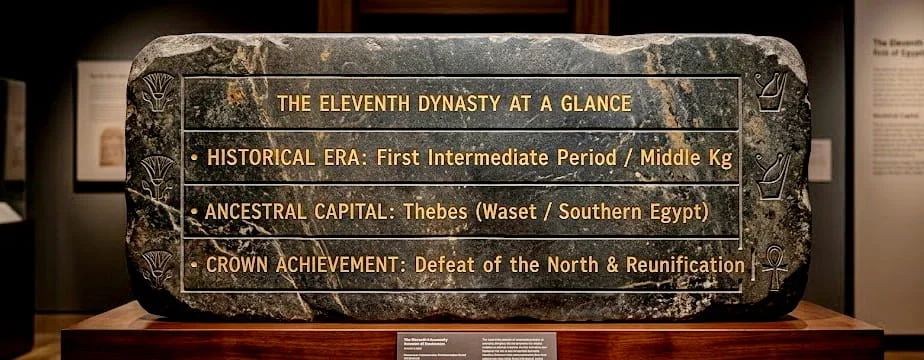
The Eleventh Dynasty was a transformative lineage of resilient local warlords from the southern stronghold of Thebes who systematically combined military brilliance with economic strategy to end the fragmentation of the First Intermediate Period. Led by the legendary Mentuhotep II, who earned the title "Binder of the Two Lands" after defeating northern opposition, they achieved national reunification and rebuilt the structural foundations of the Egyptian state. By centralizing power away from local nomarchs, standardizing Middle Egyptian as the classical literary language, and pioneering revolutionary rock-cut terraced architecture at Deir el-Bahari, this dynasty engineered a sophisticated cultural and political renaissance that directly paved the way for the golden age of the Middle Kingdom.
The eye of Horus
WhatsApp
Email
Print

Eleventh Dynasty of Egypt: The Birth of a United Egypt

The Eleventh Dynasty of Egypt stands as one of the most dramatic turning points in ancient history. It was the catalyst that rescued the Nile Valley from over a century of civil war and political fragmentation. Originating as a line of fierce regional governors in the southern stronghold of Thebes (modern-day Luxor), this family systematically built a military and administrative powerhouse that challenged, and ultimately defeated, the northern rulers of Herakleopolis.
Eleventh Dynasty of Egypt The Birth of a United Egypt

The dynasty’s story divides perfectly into two chapters: the early wartime pharaohs who ruled only the south, and the triumphant reigns starting with Mentuhotep II, who wore the double crown of a unified Egypt. By blending military might with a spectacular rebirth of centralized art and architecture, the Eleventh Dynasty laid the foundations for the Middle Kingdom—Egypt’s classic golden age of culture, literature, and economic prosperity.

The Theban Roots: From Local Nomarchs to Southern Kings

The story of the Eleventh Dynasty does not begin with an imperial pharaoh sitting on a golden throne. Instead, it starts in the rugged, overlooked landscape of Upper Egypt. During the height of the First Intermediate Period, Thebes (ancient Waset) was a small, provincial town. It was completely overshadowed by older northern administrative centers like Memphis and Herakleopolis.

Intef the Elder: The Ancestral Patriarch

The true founder of the Theban line was not a king, but a powerful local warlord known to history as Intef the Elder, Son of Ikui (Intef-aa). He ruled only as a nomarch (provincial governor) of the Theban district.

Later Middle Kingdom generations deeply respected Intef the Elder. They carved his name inside the famous Hall of Ancestors temple at Karnak, celebrating him as the root of their entire royal family tree. He never claimed a royal cartouche or wore a pharaoh’s crown. However, he successfully united the southernmost districts under his personal control. This created a solid, independent territory that was completely free from the northern king’s authority.

The Bold Declaration of Kingship: Sehertawy Intef I

The official political break with the north happened around 2125 BCE under Intef the Elder’s successor, Intef I. Watching the northern Tenth Dynasty struggle with weak rulers and collapsing tax bases, this ambitious leader decided to bypass old traditions completely.
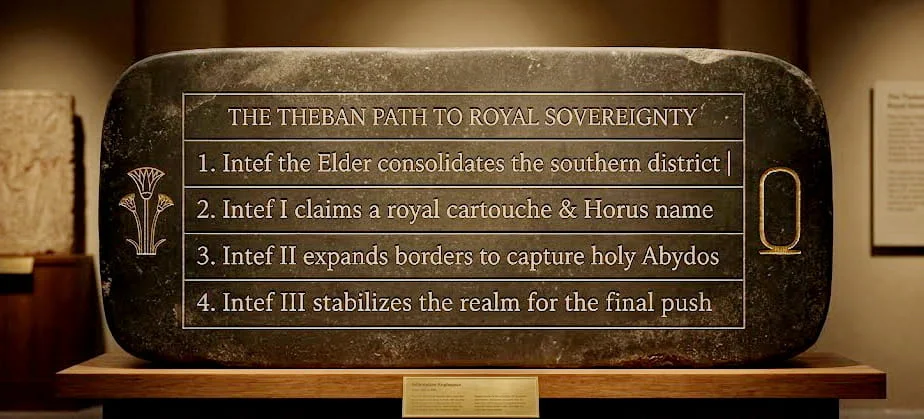
The Bold Declaration of Kingship Sehertawy Intef I

Intef I became the first member of his family to write his name inside a royal cartouche. He took the provocative royal title Sehertawy, which translates boldly to “He who has quieted the Two Lands.” This title was a direct declaration of war against Herakleopolis. It signaled that Thebes would no longer take orders from the north, and intended to conquer and rule all of Egypt.

Consolidation and Border Wars: Intef II and Intef III

The early Theban kingdom grew into a highly dangerous military threat during the long, fifty-year reign of Intef II (Wahankh). He was a brilliant battlefield commander who focused his armies on expanding the northern border.

  • The Capture of Abydos: Intef II launched a massive military push northward into the 8th Nome of Upper Egypt. He successfully captured the highly strategic and deeply sacred city of Abydos.
  • Controlling the Holy Ground: By taking Abydos, Thebes won a huge psychological victory. They took control of the legendary burial place of Osiris, the god of the afterlife. This gave the early Eleventh Dynasty massive spiritual authority over the entire country.
  • The Shield of Asyut: The northern advance of Intef II was finally stopped by the rulers of Asyut. These governors remained fiercely loyal to the Herakleopolitan kings, creating a heavily guarded buffer zone that locked the two kingdoms in a tense, frozen conflict for decades.

When Intef II died, his successor Intef III (Nakhtnebtepnefer) took over a stable, prosperous southern state. He spent his brief eight-year reign reinforcing these hard-won borders, repairing local economies, and preparing the royal treasury for the final, unavoidable war of reunification.

The Grand Strategy of Waset: Geographic and Economic Power of the Eleventh Dynasty of Egypt

The early Eleventh Dynasty did not defeat the North through raw battlefield numbers alone. Instead, the Theban rulers executed a brilliant, multi-generational grand strategy. They transformed their isolated southern base of Waset into an economic and military fortress. By exploiting unique geographical advantages, they systematically choked the wealth of Herakleopolis while building an unstoppable war chest.

Eleventh Dynasty of Egypt: The Geographical Fortress of Upper Egypt

From a military standpoint, Waset possessed an exceptional defensive layout. Located along a narrow, easily defensible stretch of the Nile Valley, the Theban kingdom was naturally protected from sudden enemy invasions.

Unlike the flat, wide-open plains of the Delta and Middle Egypt—which left the Tenth Dynasty exposed to constant foreign incursions—the southern terrain was tightly bordered by high limestone cliffs. This topography allowed the Theban armies to monitor all river traffic using small, elevated outposts, turning the southern Nile into an impassable security zone.

Choking the Trade Routes: The Economic War

The true genius of the Theban strategy lay in their aggressive control over Egypt’s most lucrative trade routes. Thebes sat precisely at the crossroads of two major commercial lifelines:
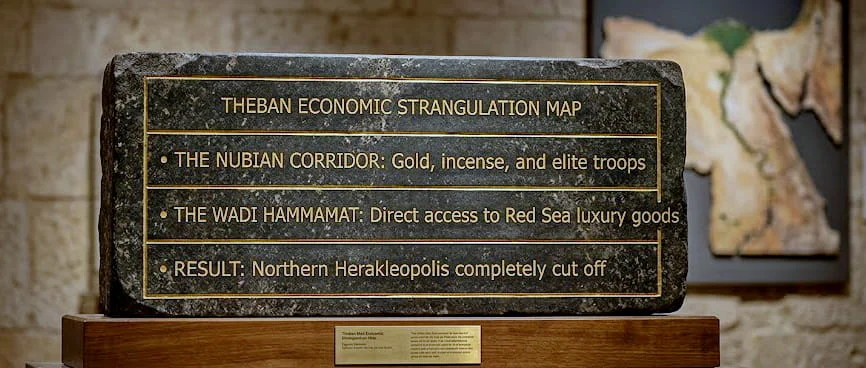
Choking the Trade Routes The Economic War

By sealing the Nubian Corridor to the south, the Eleventh Dynasty cut off the Herakleopolitan kings from their primary source of gold, unfamiliar oils, and ivory. Simultaneously, the Thebans seized control of the Wadi Hammamat. This dry riverbed was the shortest, most vital desert highway connecting the Nile directly to the Red Sea.

While the North starved for luxury imports and valuable raw materials, the royal treasury of Waset overflowed with wealth. The early kings used this economic advantage to fund massive infrastructure projects and buy the loyalty of neighboring districts.

The Weaponization of the Desert: Medjay and Elite Archery

With an overflowing treasury, the Theban kings fundamentally revolutionized the Egyptian military. They abandoned the old Old Kingdom model of relying on untrained, seasonal peasant conscripts. Instead, they built Egypt’s first highly organized, professional standing army.

  • The Medjay Mercenaries: Thebes weaponized its southern connections by recruiting elite nomadic warriors from the Eastern Desert known as the Medjay. These fierce trackers were unmatched in desert scouting, guerrilla warfare, and long-range border patrols.
  • The Famous Theban Archers: The Eleventh Dynasty specialized heavily in longbow warfare. Local workshops mass-produced powerful wooden longbows, training entire battalions of specialized shock-troops. As seen in the tombs of local generals, these archers could rain down arrows from incredible distances, shattering enemy frontlines before hand-to-hand combat even began.

By combining an unassailable defensive base, absolute control over international trade, and a highly specialized professional army, the rulers of Waset turned their provincial town into an unstoppable superpower. The stage was perfectly set for a final, decisive showdown against the North.

Eleventh Dynasty of Egypt: Mentuhotep II and the War of Reunification

The multi-generational cold war between the north and south reached its explosive climax under the fifth ruler of the Theban line: Nebhepetre Mentuhotep II. Ascending the throne around 2061 BCE, this young, fiercely ambitious pharaoh inherited a wealthy, highly militarized southern state. He spent the first fourteen years of his reign consolidating his power, waiting for the perfect strategic moment to launch an all-out war of conquest.

The Spark of Rebellion: The Asyut Campaign

The long-awaited catalyst for war erupted in the fourteenth year of Mentuhotep II’s reign, triggered by a desperate political revolt in the north. The fiercely loyal Herakleopolitan ally, the nomarch of Asyut, launched an aggressive military push into the sacred neutral territory of Abydos.
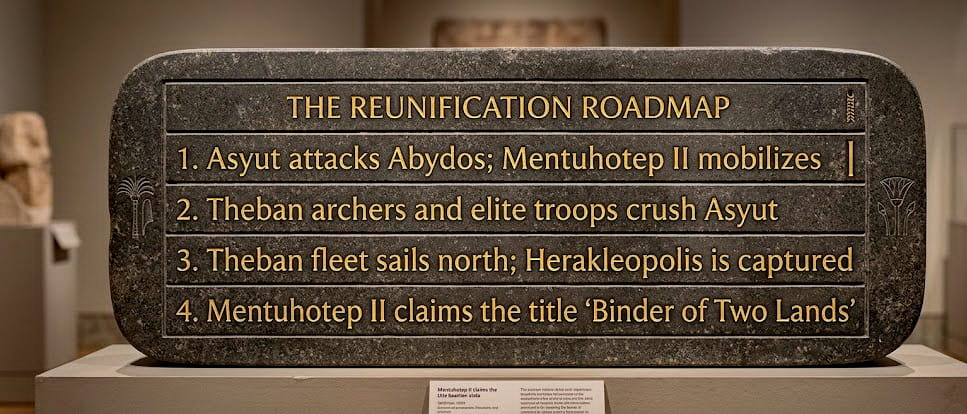
The Spark of Rebellion The Asyut Campaign

This structural breach of borders gave Mentuhotep II the exact justification he needed. He immediately mobilized the entire Theban standing army. Led by the elite longbow battalions and fierce Medjay desert trackers, the southern forces surged northward. The heavily fortified city of Asyut was surrounded and crushed, eliminating the primary northern shield.

Eleventh Dynasty of Egypt: The Siege and Fall of Herakleopolis Magna

With the defensive line at Asyut completely shattered, the path to Lower Egypt lay wide open. The massive Theban river fleet sailed triumphantly down the Nile, sweeping aside local resistance until they reached the gates of the northern capital, Herakleopolis Magna.

The final siege was brutal and decisive. Mentuhotep II’s professional troops overran the city’s defenses, capturing and dismantling the palace of the Tenth Dynasty. The northern king fled or died in the chaos, and the centuries-long political fragmentation of the First Intermediate Period came to an end. For the first time in over a century, a single pharaoh held absolute authority over both Upper and Lower Egypt.

The Evolution of Royal Titles: The Semantic Triumph

Mentuhotep II understood that military victory had to be locked in through powerful state propaganda. To project his absolute authority over the unified nation, he strategically altered his official royal Horus name three distinct times throughout his reign, mapping his political journey through his changing titles:

  • Sankhibtawy (He who gives life to the heart of the Two Lands): His initial title upon taking the throne, signaling his intent to restore health and prosperity to the fractured Nile valley.
  • Neteryhedjet (Divine is the White Crown): Adopted during the height of the civil war, emphasizing his absolute allegiance to the white crown of Upper Egypt and his divine right to conquer.
  • Sematawy (Binder of the Two Lands): The ultimate political declaration chosen after his grand northern victory. This title announced to every citizen, scribe, and foreign trader that Egypt was officially reunited under a single, supreme ruler.

Through calculated battlefield brilliance and masterfully executed political branding, Mentuhotep II transformed himself from a local Theban warlord into the universally recognized savior of Egypt, officially launching the glorious era of the Middle Kingdom.
Divider

Restructuring the Nation’s Bureaucracy: Breaking the Nomarchs

Winning the civil war on the battlefield was only the first step for Mentuhotep II. Next, he had to solve a massive structural problem to ensure lasting peace. During the Old Kingdom collapse, provincial governors (nomarchs) had gained unchecked power. They made their titles hereditary, pocketed local taxes, and raised independent private armies. Therefore, Mentuhotep II executed an aggressive political restructuring program to strip these governors of their autonomy. Consequently, he placed all power back into the hands of the central crown.

Eleventh Dynasty of Egypt: The Systematic Removal of Northern Dissidents

First, Mentuhotep II showed no mercy to the provincial elites who had fought alongside the defeated Tenth Dynasty. In the immediate aftermath of his military victory, he systematically removed the ruling families of northern and central Egypt.

Eleventh Dynasty of Egypt The Systematic Removal of Northern Dissidents

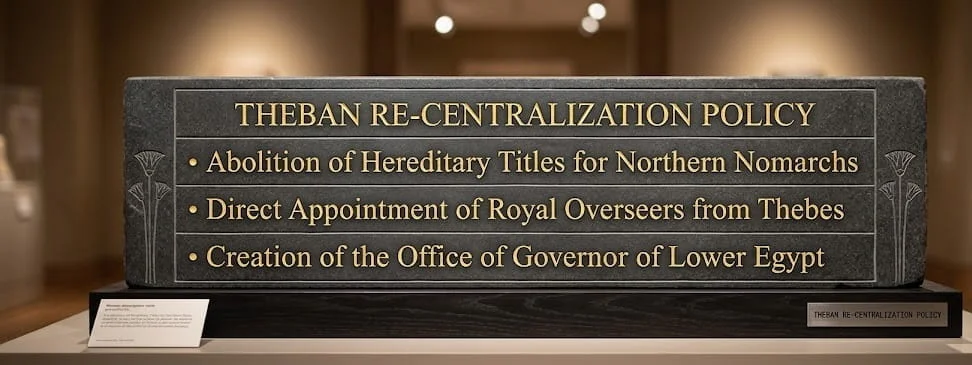
Furthermore, he completely abolished the hereditary rights of these northern nomarchs. If a local governor had opposed the Theban advance, the crown confiscated his lands. Meanwhile, the pharaoh disbanded his private militia and stripped his family of all titles. In their place, the pharaoh appointed fiercely loyal, hand-picked administrators chosen directly from the royal court in Thebes.

The Co-Option of Strategic Allies: The Neutral Zones

In contrast to his harsh northern policy, Mentuhotep II used a much more subtle, diplomatic strategy in central Egypt. For instance, powerful ruling families in districts like Beni Hasan (the Oryx Nome) and Hermopolis (the Hare Nome) had chosen to remain neutral during the civil war. They had refused to send troops to aid Herakleopolis.

Because he recognized their immense local influence, the pharaoh chose to co-opt rather than crush them. Thus, he allowed these specific families to retain their local administrative positions. However, he stripped them of their absolute military independence. As a result, they had to pay heavy taxes directly to the royal treasury and submit all legal disputes to royal judges. Ultimately, this compromised approach kept the peace while ensuring absolute federal control.

Eleventh Dynasty of Egypt: The Return of the Vizier and Supreme Centralization

To lock in this new era of royal dominance, Mentuhotep II fully restored the traditional administrative offices of the Old Kingdom. However, he updated them to maximize efficiency. Specifically, he reinstated the supreme office of the Vizier (Tjaty). He then appointed brilliant Theban statesmen like Dagi and Bebi to oversee the entire national judiciary and tax collection system.

  • The Governor of Lower Egypt: Additionally, Mentuhotep II created a brand-new, powerful bureaucratic position called the Governor of Lower Egypt. This official acted as a direct royal viceroy. He traveled across the Delta to audit local scribes, monitor grain storage, and dismantle budding local conspiracies.
  • The Royal Progresses: Similarly, the pharaoh weaponized the royal court by conducting frequent, highly publicized tours down the Nile. Thousands of elite troops accompanied him on these trips. Therefore, these “Royal Progresses” forced local elites to publicly pledge their allegiance and hand over local tax revenues directly to the king.

By breaking the hereditary power of the provincial governors, the Eleventh Dynasty successfully unified Egypt’s economy. They replaced dissidents with loyal bureaucrats and built a highly centralized network of royal overseers. In conclusion, they transformed a collection of squabbling feudal baronies into a single, highly organized imperial superpower.

Golden Scarab

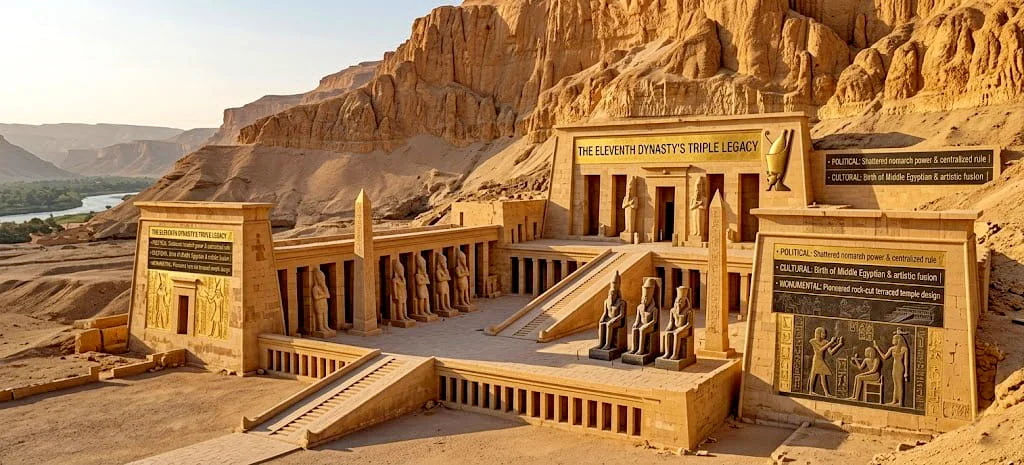
Eleventh Dynasty of Egypt: Architecture and the Royal Necropolis at Deir el-Bahari

After restoring political stability, Mentuhotep II turned his attention to monumental building projects. He wanted to visually solidify his divine authority across the unified landscape. Therefore, he chose an amphitheater of high limestone cliffs in western Thebes as his burial site. Today, we call this breathtaking desert valley Deir el-Bahari. Here, his architects constructed a revolutionary mortuary complex that completely broke away from Old Kingdom traditions.

Eleventh Dynasty of Egypt: A Radical Shift from the Memphis Pyramids

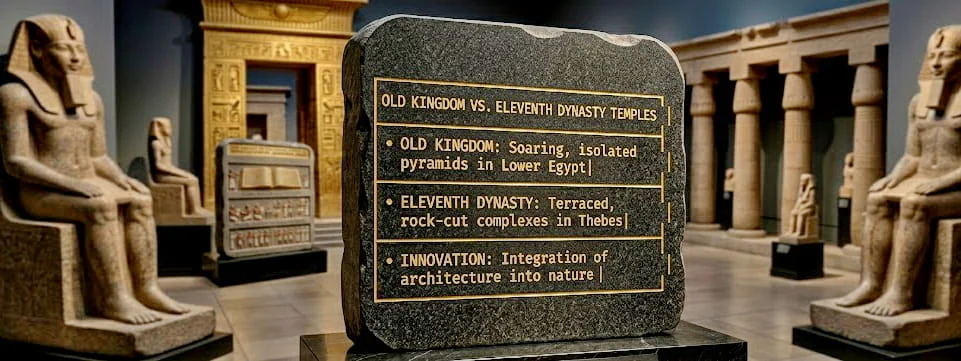
During the Old Kingdom, pharaohs built soaring, smooth-sided pyramids in the north to symbolize their solar power. However, the Eleventh Dynasty chose a completely different architectural language. Instead of competing with the northern landscape, Mentuhotep II decided to integrate his monument directly into the towering cliffs of the south.

Eleventh Dynasty of Egypt A Radical Shift from the Memphis Pyramids

Consequently, this choice created a stunning visual effect. The sharp, vertical lines of the temple columns perfectly mirrored the natural fissures of the mountain backdrop. This brilliant design showed that the king did not want to dominate nature. Instead, he wanted to merge his eternal resting place with the sacred landscape of Thebes itself.

Eleventh Dynasty of Egypt: Terraces, Hypostyle Halls, and the Primeval Mound

The core structure of the temple featured a brilliant layout that deeply influenced future generations. Visitors approached the complex via a massive, hundred-foot-wide walled causeway leading from the Nile valley.

  • The Layered Terraces: First, visitors climbed a grand ramp to reach a spectacular, elevated two-tiered terrace. Shady groves of imported tamarisk and sycamore trees originally surrounded this platform.
  • The Pillared Porticoes: Next, double rows of square limestone columns lined the front of each terrace. These porticoes offered a clean, geometric facade that shielded the inner sanctuaries from the harsh desert sun.
  • The Central Core: In the middle of the upper terrace stood a massive, solid square masonry structure. Egyptologists still debate its exact form. Some believe it supported a small symbolic pyramid, while others argue it was a flat-topped mastaba representing the primeval mound of creation.

Behind this central structure, the temple cut deep into the living rock of the mountain. Architects built a brilliant hypostyle hall featuring eighty columns, which led directly to the dark, sacred subterranean burial shaft.

Eleventh Dynasty of Egypt: The Mass Grave of the Slain Warriors

In addition to its artistic beauty, the necropolis at Deir el-Bahari holds a somber historical treasure. Nearby, archaeologists discovered a hidden, rock-cut tomb containing the mummified remains of sixty men.

Because these bodies show clear signs of severe battlefield trauma, historians call this site the Tomb of the Slain Warriors. Arrow wounds, broken bones, and smashed skulls prove these men died in a violent, coordinated assault.

Furthermore, Mentuhotep II took great care to bury them wrapped in fine linen sheets stamped with his royal cartouche. This collective burial proves they died during the brutal siege of Asyut or Herakleopolis. By placing his fallen soldiers right next to his own grand monument, the pharaoh honored their sacrifice. Ultimately, this structural detail reminds us of the high human cost of the War of Reunification.

The eye of Horus

Eleventh Dynasty of Egypt: Art, Reliefs, and Intellectual Rebirth

The reunification of Egypt sparked a spectacular renaissance in art, sculpture, and intellectual thought. During the isolation of the First Intermediate Period, southern artists had lost access to the royal workshops of Memphis. As a result, they developed a distinct, highly stylized provincial aesthetic. However, when Mentuhotep II united the nation, he merged these raw southern traditions with classical northern techniques. This brilliant fusion created a bold new artistic identity for the Middle Kingdom.

From Provincial Boldness to Classical Refinement

Early Eleventh Dynasty art from the Theban region was initially unrefined. Scribes and sculptors worked without formal royal training, which led to a highly unique style.

From Provincial Boldness to Classical Refinement

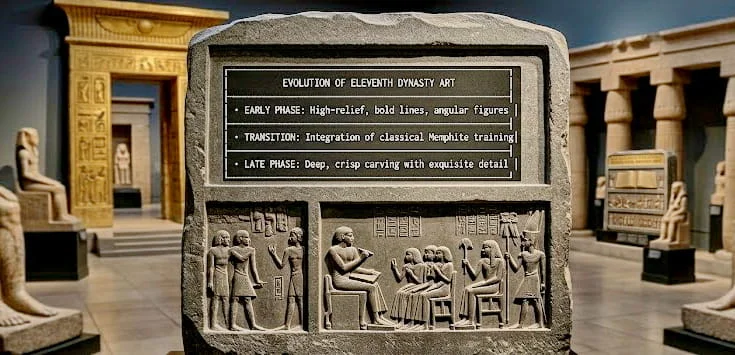
Consequently, early Theban reliefs featured short, muscular figures with large, prominent eyes and angular limbs. While these carvings lacked the delicate proportions of the Old Kingdom, they radiated an immense, vibrant energy.

Following the capture of Memphis and Lower Egypt, Mentuhotep II deliberately moved northern artists and master craftsmen southward to Waset. These masters reintroduced classical rules of proportion and elegance. Therefore, late Eleventh Dynasty reliefs achieved a magnificent balance. They combined the deep, crisp, shadow-casting carvings of the south with the fluid, graceful lines of traditional Old Kingdom masterpieces.

The Innovation of Sunken Relief and Painted Limestone

Furthermore, Eleventh Dynasty workshop masters revolutionized architectural sculpture by perfecting the use of sunken relief. Instead of carving away the entire background to leave raised figures, sculptors cut deep, precise silhouettes directly into the flat stone surfaces.

  • Enhanced Visibility: This technique worked beautifully under the intense, blinding Egyptian sun. The deep cuts created dark, sharp shadows that made complex hieroglyphs and royal figures instantly scannable from a distance.

  • The Royal Sarcophagi: The finest examples of this transition appear on the limestone sarcophagi of the royal women at Deir el-Bahari, such as Queen Ashayet and Princess Kawit. Master craftsmen decorated these monuments with exquisite daily life scenes. For instance, one famous relief depicts Princess Kawit as she drinks from a cup while a servant meticulously styles her hair.

  • Vibrant Pigmentation: Artists painted these limestone reliefs with bright, rich mineral pigments. They used deep ochre for skin tones, brilliant malachite for jewelry, and pure gold leaf to highlight royal cartouches and divine symbols.

The Scriptorium Reborn: Scribes and Intellectual Mastery

Intellectual life experienced an equally profound rebirth. The royal court at Thebes built a highly organized network of scriptoriums, which revitalized the national administration. Scribes abandoned the chaotic local dialects of the civil war era and embraced a standardized, elegant form of the written language known today as Middle Egyptian.

Moreover, this intellectual revival laid the groundwork for the greatest literary explosion in ancient history. Scribes began collecting old historical texts, recording regional star maps, and drafting complex architectural plans for new temples. By establishing this rigorous, elite academic culture, the Eleventh Dynasty built the perfect foundation for the classic statecraft literature and philosophical masterpieces that defined the heights of the Middle Kingdom.
Divider

The Final Reigns and Transition to the Twelfth Dynasty

Following the exceptionally long and prosperous reign of Mentuhotep II, the Eleventh Dynasty entered its final, short-lived chapter. While the empire remained politically unified, a sudden succession of shorter reigns created instability within the royal court at Thebes. Ultimately, this unstable period led to a quiet, strategic coup d’état that brought a peaceful end to the dynasty while launching Egypt into an even greater imperial era.

The Declining Years: Mentuhotep III

The first transition of power occurred around 2010 BCE, when Nebtawyre Mentuhotep III succeeded his legendary father. He inherited a completely centralized, smoothly running bureaucratic machine. Therefore, he chose to focus his twelve-year reign on economic expansion and securing Egypt’s borders rather than domestic warfare.

The Declining Years Mentuhotep III

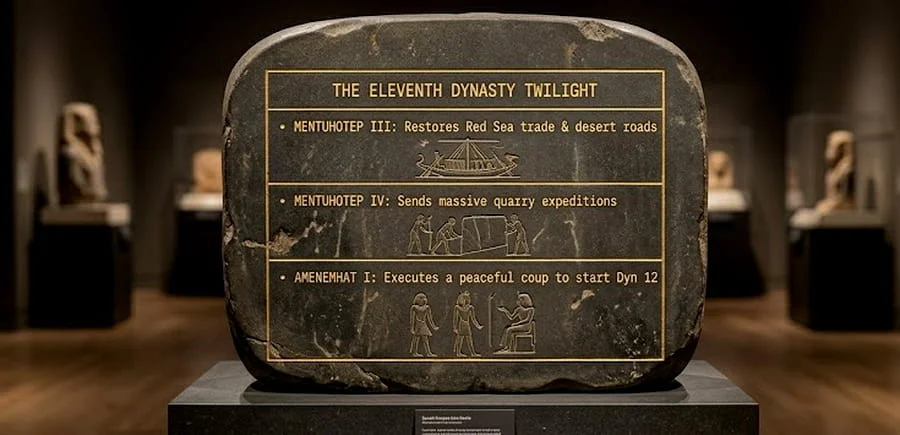
Most notably, Mentuhotep III reopened the critical trade routes through the Wadi Hammamat to the Red Sea. He commissioned a high-ranking official named Henenu to lead a massive expedition of three thousand men into the desert. Henenu successfully cleared the ancient road, dug several new freshwater wells, and brought back valuable blocks of greywacke stone for royal monuments. Additionally, he established maritime contact with the legendary land of Punt, restoring the flow of precious frankincense and myrrh to royal temples.

The Strategic Enigma: Mentuhotep IV

In contrast to his predecessor, the final ruler of the line, Nebtawyre Mentuhotep IV, remains a deeply mysterious historical figure. In fact, later scribes completely omitted his name from the official royal king lists at Abydos and Saqqara, treating his brief seven-year reign as an illegitimate or highly unstable period.

Despite his official erasure, contemporary rock inscriptions in the Wadi Hammamat prove that Mentuhotep IV maintained strong executive control over the country’s resources. He ordered a massive expedition of ten thousand workers to quarry stone for his future royal sarcophagus.

To ensure absolute safety and structural success, the pharaoh placed his most trusted official in total command of this colossal workforce: his Grand Vizier, a brilliant military strategist and administrator named Amenemhat.

The Ascent of Amenemhat I and the Birth of Dynasty 12

The precise end of the Eleventh Dynasty remains a subject of intense historical debate because no clear records of a violent civil war exist. Instead, the transition appears to have been a highly calculated, peaceful political takeover executed by the Grand Vizier himself.

  • The Prophetic Portents: Royal scribes recorded several supernatural events during the final Wadi Hammamat expedition. For instance, a pregnant wild gazelle reportedly walked up to the designated sacrificial stone to give birth. Workers interpreted this unusual event as a divine sign that the location held a great destiny.
  • The Sudden Disappearance: Shortly after the expedition returned successfully to Thebes, Mentuhotep IV completely vanished from the historical record. He left behind no heirs, no completed tomb, and no surviving monuments.
  • The Rise of the Twelfth Dynasty: Seizing the political vacuum, the Grand Vizier claimed the double crown around 1991 BCE, taking the throne as Amenemhat I.

To legitimize his new regime, the new pharaoh masterfully published a famous propaganda text known as the Prophecy of Neferti. This brilliant literary work claimed that a wise priest had predicted Amenemhat’s rise centuries earlier, calling him a savior who would protect Egypt from chaos.

By shifting the capital northward and retaining the highly efficient bureaucracy built by the Intefs and Mentuhoteps, Amenemhat I smoothly transformed the localized Eleventh Dynasty into the globally dominant Twelfth Dynasty, bringing the Middle Kingdom to its absolute architectural and economic peak.

The eye of Horus

The Lasting Legacy of the Eleventh Dynasty

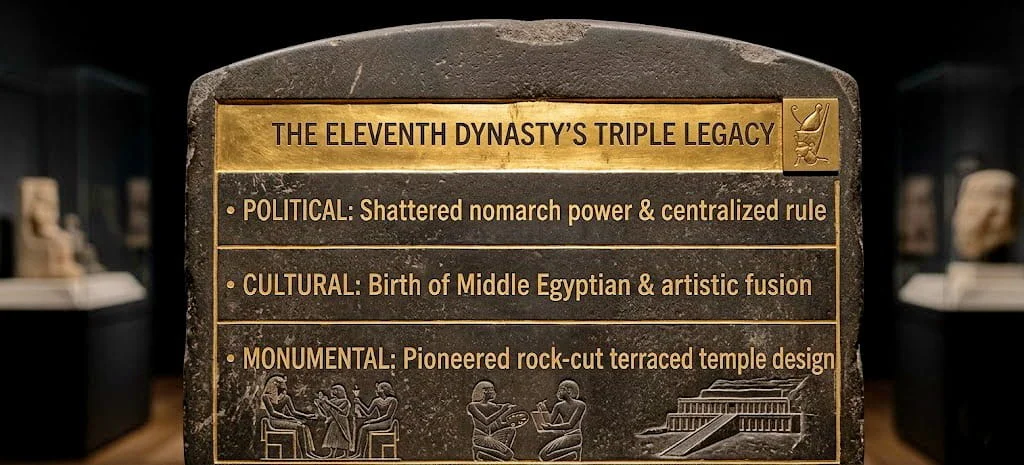
Ultimately, the Eleventh Dynasty of Egypt remains one of the most transformative lineages in ancient history. They successfully rescued the Nile Valley from the deep fragmentation of the First Intermediate Period. Originating as a line of resilient local warlords in the southern stronghold of Thebes, this family systematically combined military brilliance with calculated economic strategy. Through their efforts, they crushed northern opposition and achieved a monumental national reunification under the legendary Mentuhotep II.

The Lasting Legacy of the Eleventh Dynasty

Furthermore, their century-long rule fundamentally rebuilt the structural foundations of the Egyptian state. By stripping the provincial nomarchs of hereditary power, they restored absolute authority to the central crown. Simultaneously, their workshops pioneered groundbreaking advancements in deep sunken relief, while their royal scriptoriums standardized Middle Egyptian as the classic literary language for centuries to come.

In conclusion, the early Theban kings did not merely win a civil war. Instead, they engineered a sophisticated administrative, cultural, and architectural renaissance. Their innovations directly paved the way for the global dominance and unparalleled prosperity of the Twelfth Dynasty. Thus, the Eleventh Dynasty proudly stands as the true architect that launched the magnificent golden age of the Middle Kingdom.

Divider

Big tick off our bucket list!

Booked the evening before and were able to do everything we hoped to in a day, with a knowledgeable guide & at a reasonable price! Lunch was included and absolutely delicious! Learnt about the history of Egypt, which was the most important part of sightseeing in Cairo/Giza. Hamada also gave

More »

Day Trip to Alexandria

An enjoyable drive from Cairo to Alexandria. It was an enriching trip. I learnt so much history about the ancient civilisation. The tour guide explained the history of each site we visited. There is so much to see. I would definitely highly recommend visiting Alexandria. It’s rich in history. The

More »

Outstanding layover tour

I had the opportunity to do a layover tour with Egypt Fun Tours this Friday, and it was amazing. I had a 10-hour layover tour in Cairo, and I was met by Mohamed on time at the airport. He picked me up in a clean, new, safe, and comfortable van.

More »
God_Anubis_Icon

Top-rated Tour Packages

God_Anubis_Icon
WhatsApp
Email
Print