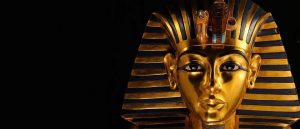
Giza Pyramids Complex: The Eternal Horizon of the Fourth Dynasty

The Giza Pyramid Complex remains the ultimate testament to human ingenuity, spanning the intersection of monumental engineering, divine kingship, and enduring mystery. This comprehensive guide explores the Fourth Dynasty’s "Eternal Horizons"—from the mathematical precision of the Great Pyramid of Khufu and the monolithic majesty of the Great Sphinx to the vibrant "wonder tales" of the Westcar Papyrus. By synthesizing recent archaeological breakthroughs, such as the Diary of Merer and the discovery of the Workers' Village, we move beyond modern myths to reveal the sophisticated reality of the Pyramid Age. Whether you are analyzing the technical slope of the Seked or the political prophecy of the Sun God Ra, this pillar serves as the definitive record of Egypt’s most iconic landscape.

The Giza Pyramids Complex stands as the most recognizable silhouette in human history. Situated on the limestone plateau of the Western Desert, these monuments are not merely archaeological relics; they are the physical manifestation of the Old Kingdom’s spiritual and political zenith. For nearly four millennia, the Great Pyramid of Giza held the title of the tallest artificial structure on Earth, and it remains the only member of the Seven Wonders of the Ancient World still largely intact today.

Giza Pyramids: A Royal Necropolis of Unmatched Scale

While three primary peaks dominate the skyline, the plateau actually houses nine distinct pyramids that Fourth Dynasty rulers (c. 2613–2494 BCE) constructed. Architects designed these structures as “Eternal Horizons”—complex funerary machines that facilitated the King’s transition from a mortal ruler to a celestial deity.

  • The Great Pyramid (Horizon of Khufu): King Khufu, the second ruler of the Fourth Dynasty, commissioned this monument, which stands as a masterpiece of geodetic precision.
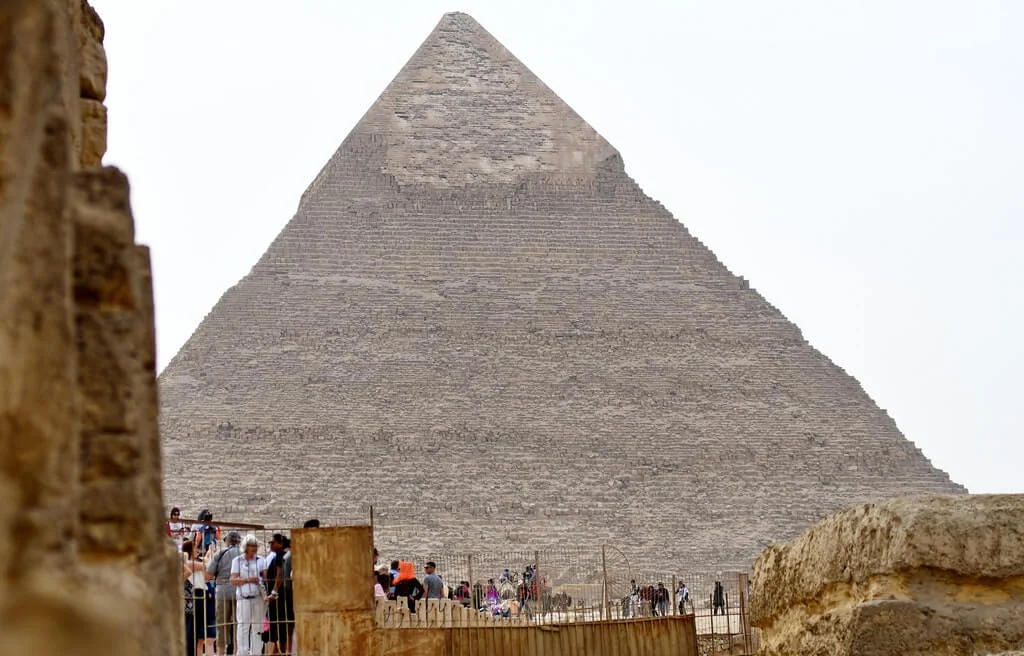
  • The Pyramid of Khafre: Khufu’s son constructed this pyramid. It appears taller due to its higher elevation on the plateau and remains the second-largest pyramid in existence.
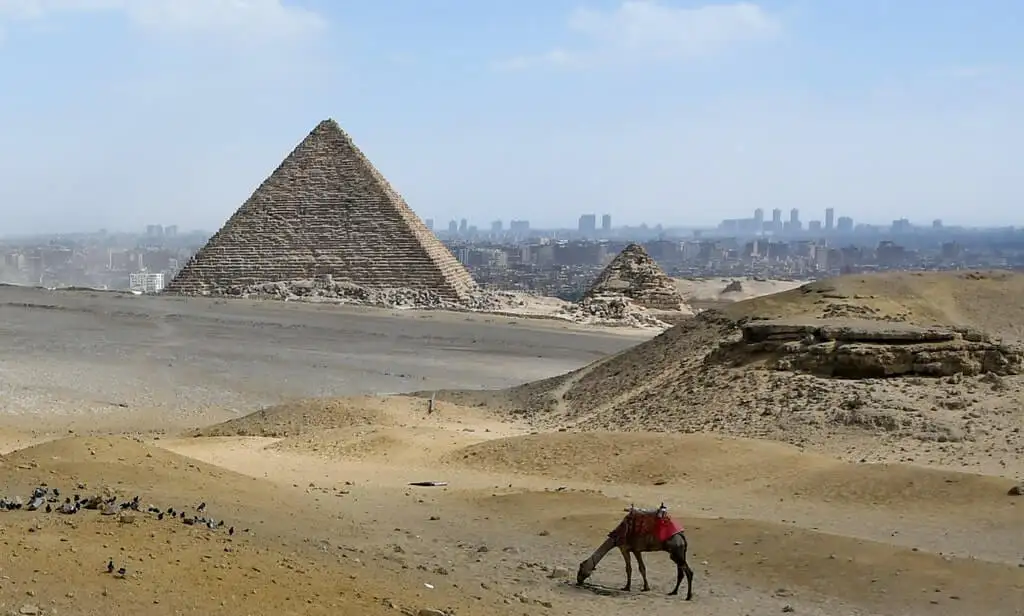
  • The Pyramid of Menkaure: Menkaure, the smallest of the three major kings, distinguished his tomb with an expensive red granite casing.

Giza Pyramids: The Sacred Satellite Pyramids

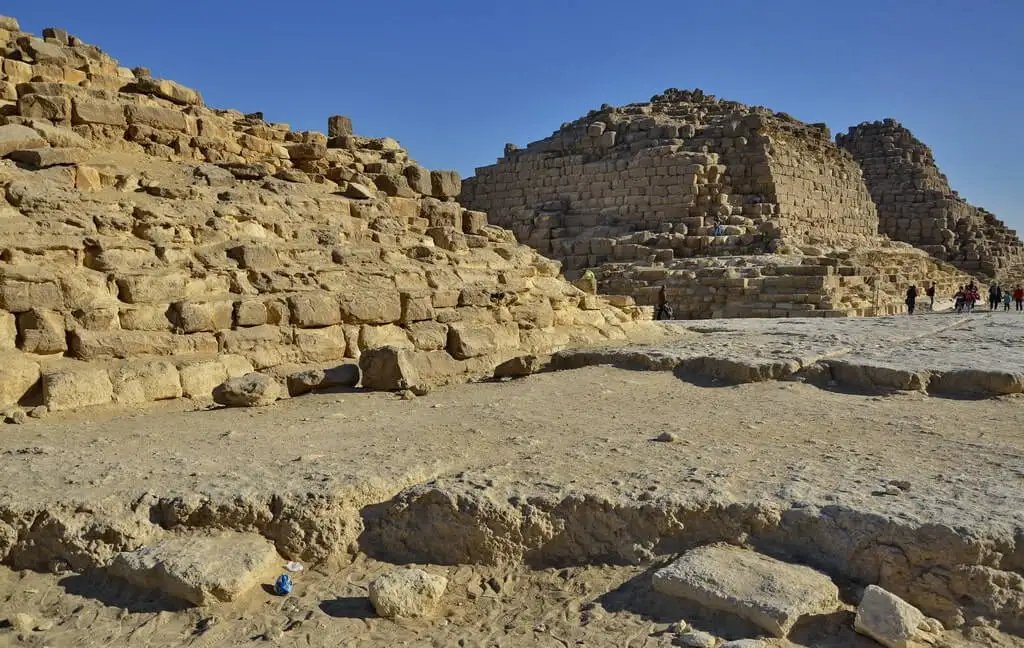
Six “Queen’s Pyramids” surround these giants. These structures honor the royal women who stabilized the dynastic line. To the east of Khufu’s monument, three smaller structures house his wife, Queen Henutsen, his daughter Hetepheres II, and a third royal female whose identity scholars still debate. Similarly, three miniature pyramids sit to the south of Menkaure’s tomb to serve as the final resting places for his royal consorts. Together, these structures formed a “City of the Dead” that unified the royal family in the afterlife, reflecting how they governed the living on the banks of the Nile.

FUN

The Great Pyramid of Khufu: An Engineering Masterpiece
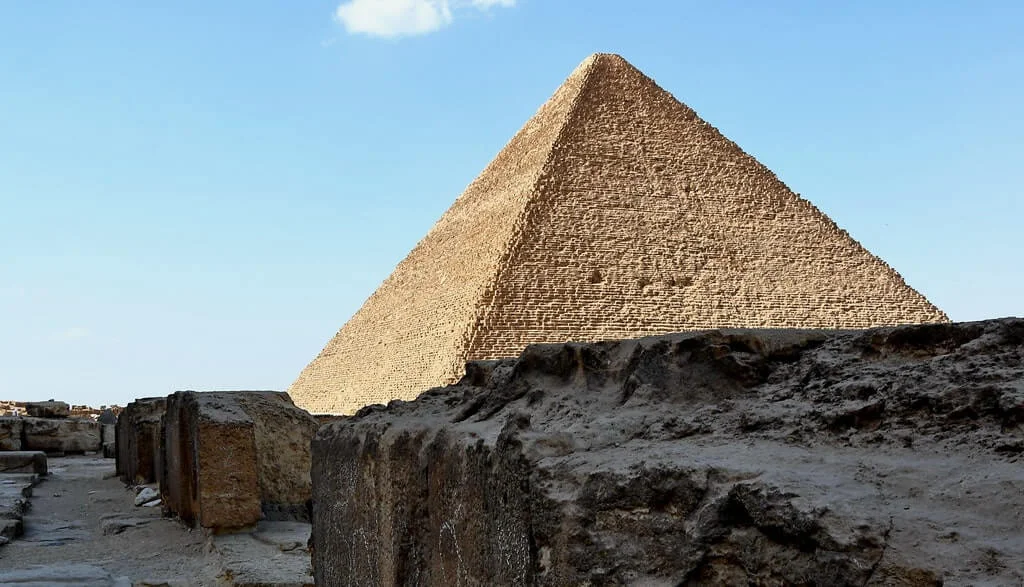
Great Pyramid of King Khufu Facts - Egypt Fun Tours

The Great Pyramid of Khufu (known to the ancients as Akhet Khufu or “The Horizon of Khufu”) is the largest and most complex pyramid ever constructed. Originally standing at 146.6 meters, it has lost approximately 8 meters of its height due to the stripping of its polished Tura limestone casing over the millennia. Covering a staggering 13 acres, each side of its base measures roughly 230.3 meters, aligned with uncanny precision to the four cardinal points.

Giza Pyramids: The Funerary Architecture of the Complex

The pyramid was the centerpiece of a vast, interconnected ritual landscape. This complex served as a machine for the King’s afterlife and consisted of:

  • The Main Pyramid: The primary eternal residence of the King.
  • The Mortuary Temple: Located on the eastern face, where daily offerings were made to the deceased Pharaoh.
  • The Causeway: A covered limestone corridor connecting the high plateau to the valley below.
  • The Valley Temple: Situated at the edge of the Nile (near modern-day Nazlet El-Seman), this temple served as the grand entrance to the complex and the site of initial purification rites.
  • The Enclosure Wall: A high limestone wall that demarcated the sacred precinct from the surrounding necropolis of nobles and workers.

Internal Anatomy: A Journey Through Stone
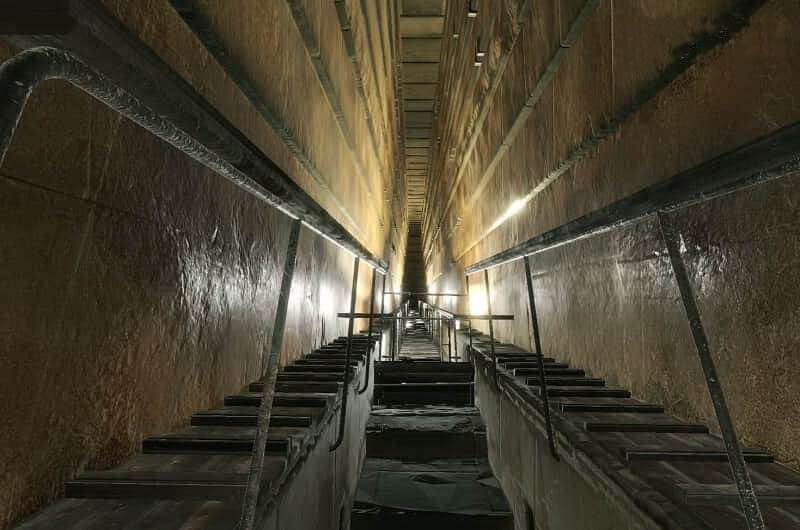
Inside the great pyramid - Egypt Fun Tours

Unlike most pyramids with subterranean burials, Khufu’s monument features a unique tripartite chamber system built high within the masonry core.

1. The Descending Passage and the Subterranean Chamber

The original entrance, located on the north face, leads to a 100-meter descending passage. This corridor terminates in the Subterranean Chamber (historically called the “Blind Chamber”). Carved directly into the bedrock, it appears unfinished, suggesting a change in the builders’ plans as the pyramid rose higher.

2. The Ascending Passage and the Queen’s Chamber

Branching off the descending path is a 36-meter ascending passage that opens into a horizontal corridor leading to the Queen’s Chamber. Despite its name—coined by early explorers—this room was likely intended for the King’s Serdab (a chamber for his spirit statue) or as a secondary burial vault.

3. The Grand Gallery and the King’s Chamber

The ascent culminates in the Grand Gallery, a soaring, 48-meter-long corridor featuring a magnificent corbelled ceiling. This leads to the King’s Chamber, the heart of the pyramid. Constructed entirely of red Aswan granite, it houses a lidless, monolithic sarcophagus. Interestingly, the sarcophagus is slightly wider than the entrance to the room, proving it was placed there during construction, before the ceiling was sealed.

Giza Pyramids: Structural Integrity and Historical Proof
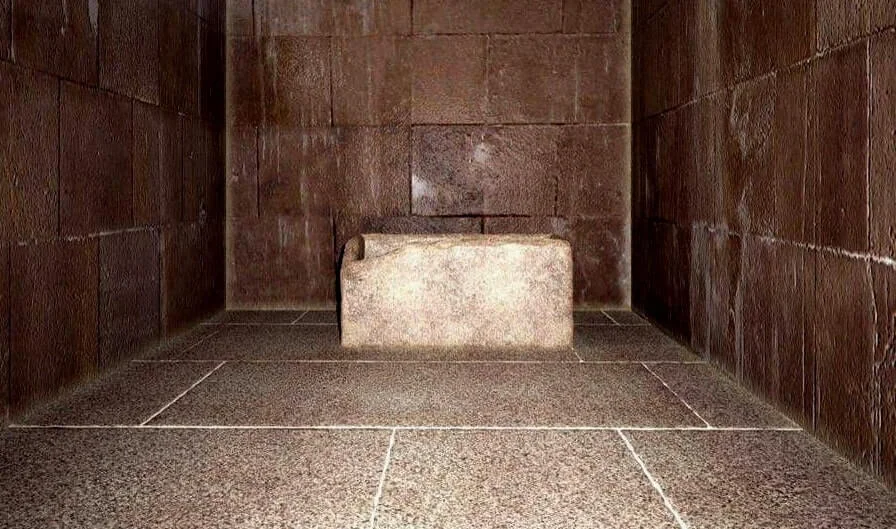
King Khufu's Burial Chamber and Beyond

Above the King’s Chamber lie five relieving chambers, designed to distribute the immense weight of the limestone blocks above and prevent the burial vault from collapsing.

The Campbell’s Chamber Inscription

In the highest of these relieving chambers, researchers discovered red ochre “quarry marks” left by the ancient builders. One specific inscription identifies the work crew as “The Friends of Khnum-Khufu” and references the 23rd year of his reign. This is the only contemporary evidence within the structure that definitively links the Great Pyramid to Pharaoh Khufu, confirming both his ownership and the approximate 23-year duration of the construction project.

Exterior Geometry

The pyramid’s design is governed by a Seked (slope) of 5.5 palms, resulting in a face angle of 51.52 degrees. This specific geometry is what allows for the mathematical relationships between the pyramid’s height and the perimeter of its base—proportions that continue to fascinate mathematicians and architects today.

Engineering a Miracle: The Geodetic Precision

The Great Pyramid of Khufu is often cited as the most accurately aligned structure on Earth. Specifically, its four sides are aligned with the four cardinal points (North, South, East, and West) with an average error of only 3 minutes of arc (1/20th of a degree).

1. Giza Pyramids: Finding True North

The builders did not have a magnetic compass. Instead, they likely used a method involving the stars.

  • The Simultaneous Transit Method: Scholars believe the Egyptians observed two circumpolar stars (like Kochab and Mizar). By hanging a plumb line (the bay) and marking the point where the stars were vertically aligned, they could find True North with incredible accuracy.
  • The Result: The error is so small that it is practically invisible to the naked eye, even with modern instruments.

The Mathematics of the Slope: Pi and the Golden Ratio

There is a long-standing debate among mathematicians regarding whether the Egyptians intentionally encoded the constants pi (Pi) and Phi (Phi) into the Great Pyramid.

The pi Relationship

If you take the perimeter of the base of the Great Pyramid and divide it by twice its height, the result is approximately 3.14159.

  • Formula: 2 times Height approx pi
  • Why it matters: This suggests that the pyramid was designed as a “squaring of the circle” in three dimensions.

The Seked: The Egyptian Unit of Slope

Architects used a unit called the Seked. It measures the horizontal run for every one-cubit rise.

  • The Great Pyramid has a Seked of 5.5 palms.
  • This specific slope (approximately 51.8 degrees) is the only angle that naturally produces the $\pi$ and $\Phi$ proportions seen in the structure. Therefore, whether it was intentional or a byproduct of the Seked system, the result remains a mathematical masterpiece.

Structural Engineering: The Internal Support

Building a structure that weighs 6 million tons requires more than just stacking blocks. The internal chambers would have collapsed under the weight of the masonry above them if not for ingenious engineering.

1. The Relieving Chambers

Above the King’s Chamber, the builders constructed five separate compartments topped by massive gabled limestone blocks.

  • The Function: These “Relieving Chambers” redirect the thousands of tons of vertical pressure outward into the core of the pyramid, protecting the flat ceiling of the burial chamber.
  • The Discovery: It is within these chambers that the only original “graffiti” mentioning Khufu was found, proving the pyramid’s ownership.

2. The Grand Gallery’s Corbelled Ceiling

The Grand Gallery is a soaring 48-meter-long hallway. To prevent collapse, the walls were built using corbelling. Each layer of stone was set slightly inward from the one below it. This creates a self-supporting arch that has stood for over 4,500 years without mortar.

Logistics: The 2.3 Million Block Challenge

To finish the Great Pyramid in 23 years (as indicated by the Diary of Merer and the Westcar Papyrus), the logistics were staggering.

  • Rate of Construction: Workers had to set one block every 2 to 3 minutes, working 10 hours a day, every day, for over two decades.
  • The Ramp Debate: While the “Straight Ramp” theory is popular, it would have required more material than the pyramid itself. Instead, many modern engineers support the Internal Ramp or Spiral Ramp theory, suggesting that stones were moved up the structure using a ramp built into the core.

The Casing Stones: The “White Mirror”

We often forget that the pyramids today are “naked.” In antiquity, they were covered in highly polished Tura Limestone.

  • The Effect: The pyramid would have acted like a giant mirror, reflecting the Egyptian sun so brightly it could be seen from miles away.
  • The Precision: These casing stones were fitted with joints so tight that a razor blade cannot fit between them. Consequently, the pyramid didn’t just look like a mountain; it looked like a solid, glowing crystal.

Giza Pyramids: Technical Summary Table

Feature Technical Specification Significance
Base Alignment Within 3 minutes of arc Perfect cardinal orientation
Side Lengths 230.3 meters (755 feet) Max difference of only 4.4 cm
Corner Angles Near-perfect 90 degrees Error of less than 0.1%
Casing Material Polished Tura Limestone Solar reflection and protection
FUN

The Pyramid of Khafre: Grandeur and Intrusion

The Pyramid of King Chephren - Giza Pyramids Complex

Rising to a height of 137 meters with a 210-meter base, the Pyramid of Khafre is the second-largest structure in Egypt and the only one to retain a portion of its original polished limestone casing at its apex. While the burial chamber is reinforced with granite, the vast bulk of the monument consists of local limestone blocks, representing a massive feat of logistics.

The pyramid’s modern history is as colorful as its ancient origins. In 1818, the interior was breached by Giovanni Battista Belzoni, a flamboyant Italian explorer and circus strongman whose methods often blurred the line between archaeology and tomb raiding. Belzoni’s ego is immortalized controversially: upon reaching the burial chamber, he carved his name and the date—“Belzoni March 2, 1818”—directly into the southern wall. To modern scholars, this inscription is a jarring piece of 19th-century graffiti, serving as a permanent reminder of an era when the treasures of the Pharaohs were treated as personal prizes for European adventurers.

The Pyramid of Menkaure: The Granite Marvel

The Pyramid of King Mycarinus

The Pyramid of Menkaure is the smallest of the three primary Giza monuments, standing at a height of 66.5 meters. Despite its smaller stature, it is architecturally significant for its extensive use of Aswan granite for the lower sixteen courses of its exterior—a much harder and more expensive material than the local limestone used for the core.

Historical records suggest that Menkaure died before the monument’s completion, leaving his successor, Shepseskaf, to finish the complex in haste using mudbrick for the associated temples. This transition in materials provides a rare glimpse into the shifting economic priorities at the end of the 4th Dynasty.

A Lost Treasure: The Fate of the Sarcophagus

The modern exploration of this pyramid is marked by a significant maritime tragedy. In 1837, the British explorer Howard Vyse discovered a magnificent, ornate basalt sarcophagus within the burial chamber. In an attempt to transport this priceless artifact to the British Museum, it was loaded onto the ship Beatrice.

Tragically, the ship vanished in a storm in 1838 while crossing the Mediterranean. The sarcophagus of Menkaure, along with other irreplaceable artifacts, remains on the seabed to this day—a haunting loss for the archaeological record. While early explorers like Vyse and Belzoni are often criticized for their aggressive “collection” methods, the story of Beatrice serves as a sobering reminder of the risks involved in the 19th-century scramble for Egyptian antiquities.

The Satellite Pyramids: Honoring the Royal Women

The Queens' Pyramids - Egypt Fun Tours - Giza Pyramids Complex

While the three massive peaks of Giza dominate the skyline, the plateau is also home to several smaller satellite pyramids that emphasize the importance of the royal family in the afterlife. These structures were built for the wives, sisters, and daughters of the Pharaohs, ensuring they would accompany the King into the “Eternal Horizon.”

The Eastern Cemetery: Khufu’s Royal Women

To the east of the Great Pyramid lie three subsidiary pyramids, often designated by archaeologists as G1-a, G1-b, and G1-c.

  • Queen Henutsen: The southern-most of these is traditionally attributed to Queen Henutsen.
  • Princess Hetepheres II: Another is believed to belong to Khufu’s daughter, Hetepheres II, whose lineage was critical to the dynastic succession.
  • The Anonymous Tomb: The third pyramid remains a subject of debate, belonging to a royal female whose name has been lost to time.

Giza Pyramids: The Southern Satellite Pyramids of Menkaure

Similarly, to the south of the Pyramid of Menkaure, three “miniature” pyramids stand in a row. These are believed to have been intended for his principal queens and sisters.

Architectural Preservation: Visitors often notice that these smaller pyramids are in a much more advanced state of decay compared to the primary monuments. This is largely due to the use of lower-quality local limestone for their exterior casing. Because these satellite structures were built with softer stone, the harsh desert winds and sand erosion have significantly weathered their outer layers. However, the internal substructures—the burial chambers and descending passages—remain remarkably well-preserved, showcasing the same expert craftsmanship found within the Great Pyramid.

The Great Sphinx: Guardian of the Giza Plateau

The Great Sphinx - Giza Pyramids Complex

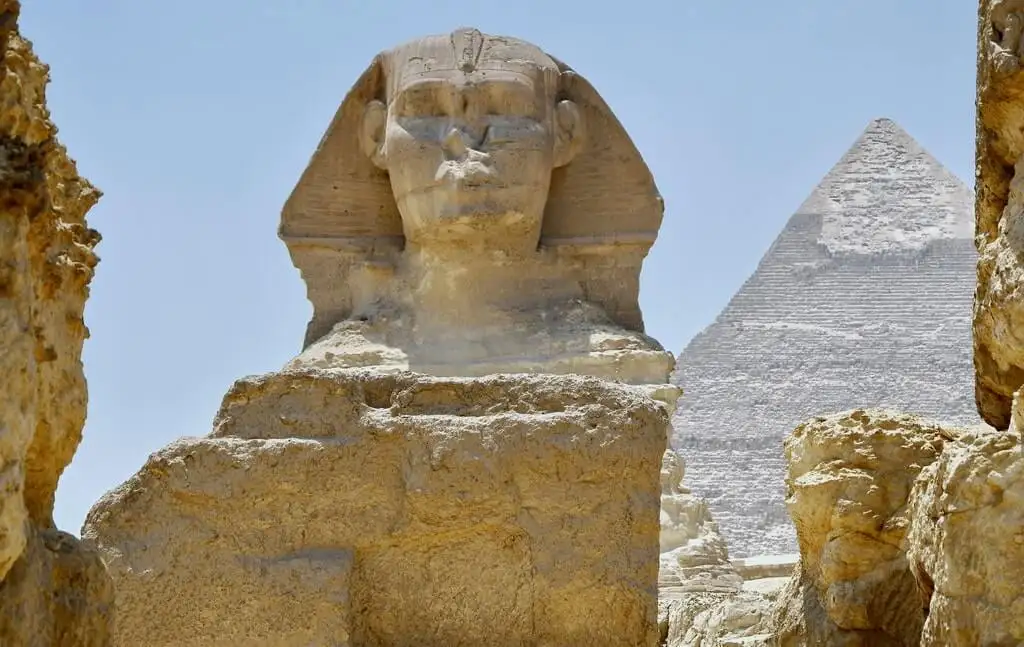
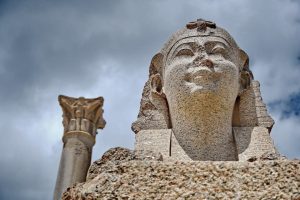
The most enigmatic feature of the Giza Complex is undoubtedly the Great Sphinx. Representing a couchant lion with the head of a king—widely believed to be Khafre—this colossal monument serves as a divine guardian for the royal necropolis.

Geological Marvel and Scale: Unlike the pyramids, which were built block-by-block, the Sphinx was hewn directly from the living bedrock of the plateau. It is a colossal monolithic sculpture, carved from a single outcropping of limestone that remained after the surrounding area was quarried for construction materials.

  • Dimensions: The monument measures an impressive 73 meters (240 feet) in length and stands 20 meters (66 feet) in height.
  • The Dream Stele: Positioned between the Sphinx’s massive paws is the “Dream Stele” of Thutmose IV, a later addition that highlights the enduring spiritual significance of the statue throughout Egyptian history.

Symbolic Orientation: The Sphinx is oriented precisely from West to East, facing the rising sun. This alignment connects the monument to the solar cycle of death and rebirth, reinforcing the King’s identity as a manifestation of the sun god, Harmakhet (Horus in the Horizon). Its placement adjacent to the Valley Temple of Khafre suggests that the Sphinx was an integral part of the ritual causeway, welcoming the King’s spirit as it traveled from the Nile to his eternal resting place.

FUN

The Builders of Giza: Beyond the Slave Labor Myth

For centuries, popular culture—fueled by Hollywood and early Greek historians like Herodotus—claimed the pyramids were built by thousands of mistreated slaves. However, modern archaeology has completely overturned this narrative.

1. Heit el-Ghurab: The Lost City of the Pyramid Builders

Discovered south of the Sphinx, this “Lost City” was a highly organized urban center. It wasn’t a camp of shacks; it was a sophisticated support system for the greatest construction project in human history.

  • The Scale: The village housed an estimated 10,000 to 20,000 workers and their families.
  • The Infrastructure: Excavations have revealed bakeries, breweries, and even a dedicated medical facility.
  • Dietary Evidence: Archaeologists found thousands of animal bones (cattle, sheep, and goats). The sheer volume suggests the workers were fed prime cuts of meat, a luxury in the ancient world. This indicates that the laborers were highly valued state employees, not disposable slaves.

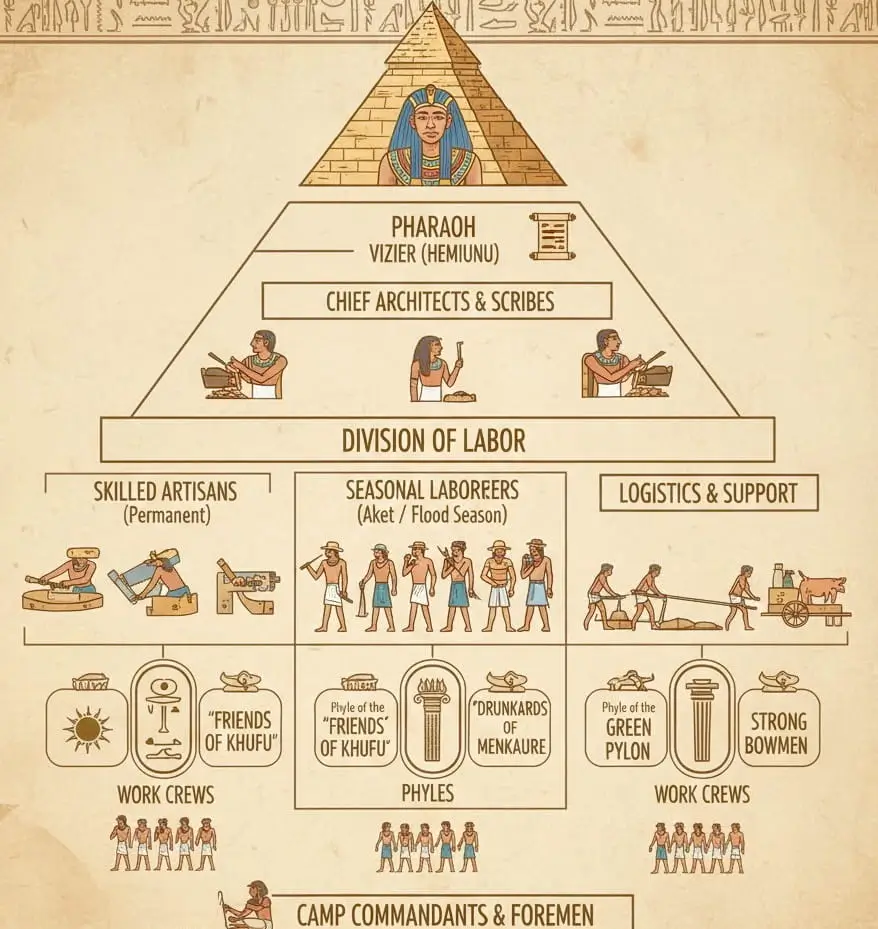
The Organization of the “Phyles”

Giza Pyramids Complex; The Organization of the Phyles

Specifically, the workforce was divided into a hierarchical system of “Phyles” (labor units). These groups often had competitive names like “The Friends of Khufu” or “The Drunkards of Menkaure.”

The Division of Labor:

  1. The Skilled Artisans: These were the permanent residents of the village—the stonemasons, architects, and foremen who worked year-round.
  2. The Seasonal Laborers: During the Aket (the Nile flood season), farmers who could not work their fields were conscripted into service.
  3. The Logistics Team: For every man moving a stone, there were dozens of others baking bread, brewing beer, and tanning leather to support the effort.

The “Diary of Merer”: The Ultimate Proof

In 2013, a discovery at Wadi al-Jarf provided the most significant evidence in the history of Giza: the Diary of Merer. This is the only first-hand account of the pyramid’s construction ever found.

  • What it is: A daily log kept by a middle-ranking inspector named Merer.
  • What it reveals: Merer describes leading a crew of 200 men to transport high-quality Tura limestone via boat across the Nile to Giza.
  • The “Khufu” Connection: The diary specifically mentions that the stone was destined for the “Horizon of Khufu” (the Great Pyramid) and was overseen by the Vizier Hemiunu, Khufu’s half-brother and the pyramid’s chief architect.

Medical Science on the Plateau

Furthermore, the skeletal remains of the workers show that they had access to advanced medical care.

  • Evidence of Surgery: Archaeologists found skeletons with successfully healed bone fractures and even evidence of brain surgery (trepanation).
  • The “Welfare” State: To heal such injuries, a worker would have needed weeks of rest and feeding by the state. This level of care is only possible in a society that views its laborers as a vital national asset.

Comparison: Popular Myth vs. Archaeological Reality

Feature The “Slave” Myth The Archaeological Reality
Workforce Slaves / Foreign Captives Skilled Egyptian Citizens
Motivation Fear / The Lash National Pride / Religious Duty / Rations
Living Conditions Mud Huts / Starvation Organized Cities / High-Protein Diet
Proof Speculation / Herodotus The Diary of Merer / Workers’ Village

The Pyramid as a National Identity

Ultimately, the Giza Pyramids were not just tombs. They were the engine of the Egyptian economy. By bringing people from every village in Egypt together to work on a single goal, the Pharaohs created a unified national identity. The pyramids were built in Egypt just as much as Egypt built the pyramids.

FUN

Beyond the Tomb: Analyzing Controversial Theories

The Mountains of Eternity - The Egyptian Pyramids

The Giza Pyramids are so precise and massive that they have birthed a “second history”—a series of alternative theories that challenge the traditional archaeological timeline. While these ideas are rarely supported by the academic community, they form a vital part of the pyramids’ modern cultural legacy.

1. The Orion Correlation Theory (The Celestial Mirror)

Proposed by Robert Bauval in 1983, this theory suggests that the layout of the three Giza Pyramids was intended to mirror the Belt of Orion.

  • The Claim: The Great Pyramid, the Pyramid of Khafre, and the smaller Pyramid of Menkaure are slightly offset from a straight line. Proponents argue that this offset perfectly matches the alignment of the stars Alnitak, Alnilam, and Mintaka.
  • The Evidence: Ancient Egyptian texts frequently mention “Sah” (the constellation of Orion) as the celestial home of Osiris.
  • The Scientific Rebuttal: Astronomers point out that due to precession (the wobbling of Earth’s axis), the stars would not have aligned perfectly with the pyramids in 2500 BCE. The alignment actually matches better with the sky of 10,500 BCE, which leads to the next controversy.

2. The Great Sphinx and the Water Erosion Hypothesis

One of the most debated topics in geology is the age of the Great Sphinx. While Egyptology dates it to the reign of Khafre (c. 2500 BCE), some researchers, such as John Anthony West and Dr. Robert Schoch, suggest it is much older.

  • The Claim: The weathering patterns on the Sphinx’s body are vertical and rounded—marks typically caused by prolonged, heavy rainfall.
  • The Implication: Heavy rain hasn’t fallen in Egypt since the end of the last Ice Age (approx. 10,000 BCE). This would mean the Sphinx predates the Egyptian civilization we know.
  • The Academic View: Most geologists attribute the weathering to “haloclasty” (salt crystallization) and the varying quality of the limestone layers, rather than rainfall. Furthermore, there is no archaeological evidence (pottery, tools, or settlements) on the plateau that dates back to 10,000 BCE.

3. The Giza Power Plant Theory

In his book The Giza Power Plant, Christopher Dunn proposed that the Great Pyramid was not a tomb, but a geomechanical power plant that used the Earth’s vibrations to generate energy.

  • The Claim: The “Queen’s Chamber” was used to mix chemicals (hydrated zinc and diluted hydrochloric acid) to create hydrogen gas, while the Grand Gallery acted as a resonator.
  • The “Proof”: Supporters point to the lack of soot from torches inside the pyramid (suggesting they used electric light) and the “acoustic properties” of the granite King’s Chamber.
  • The Reality Check: While the theory is a favorite in the “ancient aliens” and “lost technology” communities, no traces of these chemicals have ever been found. Furthermore, the discovery of the Diary of Merer (a 4th Dynasty papyrus) confirms that the pyramid was part of a funerary complex, detailing the transport of limestone blocks specifically for Khufu’s tomb.

Peer Note: While these theories capture our imagination, the physical evidence—the workers’ villages, the nearby tombs of nobles, and the written papyri—all point toward the pyramids being the ultimate expression of Old Kingdom funerary cults.

The Legacy of Mystery

Ultimately, whether these theories hold water or not, they prove that the Giza Pyramids continue to function exactly as they were intended: as monuments that transcend time. They are “Eternal Horizons” that force us to question the limits of human ingenuity.

Quick Comparison: Fact vs. Speculation

Theory Proposed Date Main Driver Academic Status
Standard Archaeology 2500 BCE Funerary Cult / Ma’at Verified
Orion Correlation 10,500 BCE Astronomical Mapping Speculative
Water Erosion 10,000 BCE Geological Weathering Disputed
Power Plant Unknown Acoustic/Chemical Energy Fringe

The Final Word: A Summary of Significance

The significance of the Giza Pyramids transcends their physical presence on the plateau. They represent a unique moment in history where religion, science, and social organization converged to achieve the “impossible.”

1. The Birth of National Identity

Before the Pyramids, Egypt existed as a collection of disparate nomes (provinces). By centralizing the labor of tens of thousands of citizens toward a single divine goal, the Pharaohs of the 4th Dynasty essentially “built” the concept of the Egyptian nation. The worker from the Delta and the mason from Aswan became part of a singular, collective effort.

2. The Architectural Benchmark

Technically, the Great Pyramid remains the standard against which experts measure all ancient engineering. Its design incorporates mathematical constants like $\pi$ (Pi) and $\phi$ (Phi)—whether by intention or as a result of the Seked system. This shows a profound understanding of harmony and geometry. It remained the tallest structure on Earth for over 3,800 years, a record that remains unparalleled in history.

3. The Theological Gateway

As the Westcar Papyrus and the Horus vs. Seth myths show, the Pharaoh served as the mediator between the earthly and the divine. The pyramid manifested this role physically as the “Horizon” where the King’s soul ascended to join the circumpolar stars (the “Imperishables”).

Key Takeaways for the Authoritative Record

  • Human Agency: A well-fed, medically cared-for, and highly organized Egyptian workforce built the Giza complex, not slaves or extraterrestrials.

  • Mathematical Precision: The alignment to True North and the specific slope angles demonstrate a mastery of stellar observation and geodetic surveying.
  • Political Stability: The transition from the 4th to the 5th Dynasty highlights how these monuments solidified the “Divine Right of Kings.”
  • Material Legacy: Despite the loss of the Tura limestone casing and the treasures within, the core masonry stands as a permanent record of the Old Kingdom’s economic and spiritual power.

Ultimately, the Giza Pyramids represent more than “the monarchs’ ultimate resting places.” They deliver an enduring message from the 26th century BCE. They prove that a society unified by a shared vision and masterful engineering can create a legacy that literally withstands the test of time.

FUN

Chronological Timeline of the 4th Dynasty

The “Pyramid Age” was a brief but explosive period of architectural evolution. Below is the timeline of the monarchs who transformed the Egyptian landscape.

Ruler Est. Reign Major Contribution
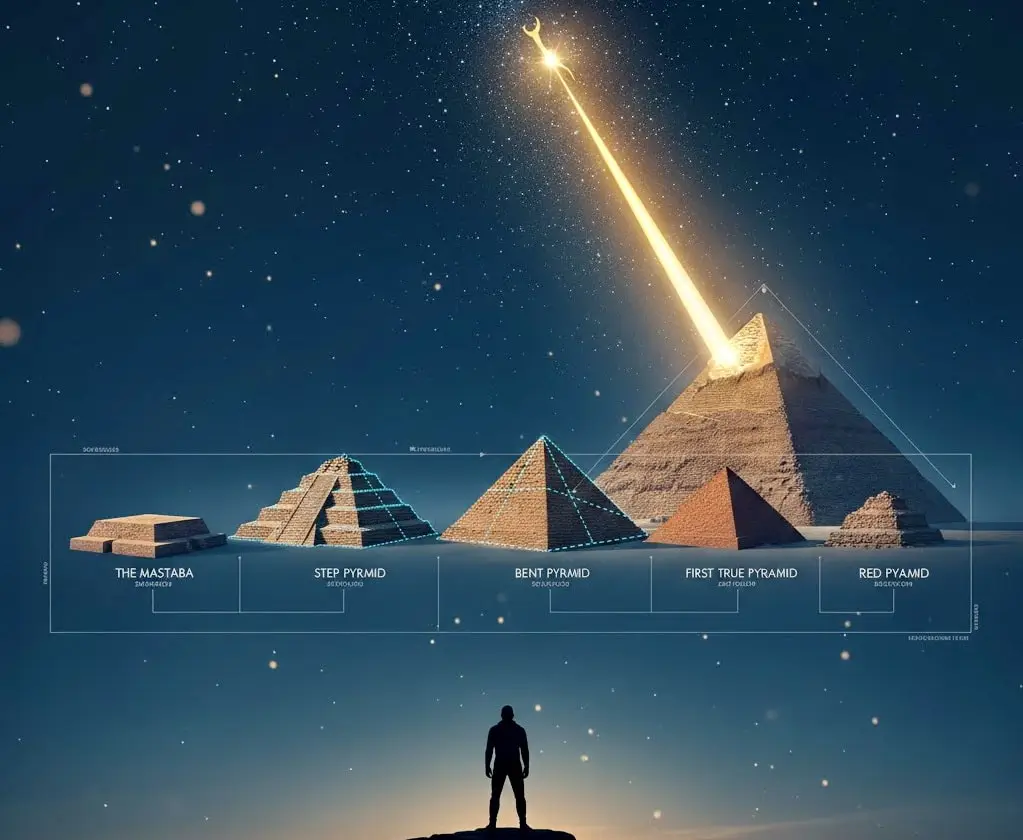
Sneferu 2613–2589 BCE Built the Bent and Red Pyramids; perfected the true pyramid shape.
Khufu (Cheops) 2589–2566 BCE Commissioned the Great Pyramid; center of the Westcar Papyrus legends.
Djedefre 2566–2558 BCE Built his pyramid at Abu Rawash; first to use “Son of Ra” in his title.
Khafre (Chephren) 2558–2532 BCE Built the second-largest of the Giza pyramids and the Great Sphinx.
Menkaure (Mykerinos) 2532–2503 BCE Built the third, smallest of the Giza pyramids using costly red granite.

Glossary of Essential Terms


To speak like an Egyptologist, you must understand the specific terminology of Old Kingdom construction and theology.

  • Akhet: The season of the Nile inundation (flood). Seasonal laborers primarily worked on the pyramids during this time.
  • Benben: The sacred, pyramid-shaped stone that represented the first dry land to emerge from the primeval waters of chaos.
  • Corbelled Ceiling: A structural technique where builders set each layer of stone slightly inward to create a self-supporting arch (seen in the Grand Gallery).
  • Hieratic: The “cursive” form of hieroglyphs. Scribes used this for daily record-keeping, such as in the Diary of Merer.
  • Mastaba: A flat-roofed, rectangular tomb structure that served as the predecessor to the pyramid.
  • Phyle: A labor unit or “gang” of workers. These groups often carried specific names and competed for prestige during construction.
  • Seked: The ancient Egyptian measurement for a pyramid’s slope. It calculates the horizontal run for every one-cubit rise.
  • Tura Limestone: High-quality white limestone from across the Nile. Workers used this for the outer “casing” of the Great Pyramid.

Modern Conservation & Visiting Giza

Today, the Giza Plateau remains a UNESCO World Heritage site. Maintaining a 4,500-year-old limestone structure in a modern environment presents unique challenges.

  • The Sphinx Restoration: Wind erosion and rising groundwater levels threaten the Great Sphinx. Recent efforts focus on salt-extraction and the replacement of deteriorating stones with limestone that matches the original density.
  • Air Quality Control: Inside the Great Pyramid, the breath of thousands of daily tourists creates high humidity that can damage the stone. Authorities installed a sophisticated ventilation system in the King’s Chamber to regulate the micro-climate.
  • The Grand Egyptian Museum (GEM): Located just outside the plateau, this world-class facility now houses the treasures of the Giza kings. This includes the intact Solar Boat of Khufu, which moved from its original pit to this new location.

Quick Facts for Social Sharing

  • Total Weight: Approximately 6 million tons.
  • Block Count: Roughly 2.3 million individual stones.
  • Tallest Record: It was the tallest artificial structure for 3,800 years until the Lincoln Cathedral was completed in 1311 AD.
  • Mortar-less: The core is held together primarily by gravity and precision fitting, though a “gypsum mortar” was used for leveling.

Before you go, check Egypt’s weather, and contact us to arrange your perfect Egypt trip.

Explore the amazing wonders of Egypt....
The most memorable holiday in Egypt with your family....

Great layover Tour!!

I had an excellent layover tour with Hani. He is knowledgable, fun, and passionate about his city. I went for a tour of the pyramids, sphinx, and to a papyrus factory which were all great. Ask him any question about Egyptian history and he will surely know the answer! Also

More »

Transit Stopover in Cairo

We have just returned from a two week holiday in Cape Town. On the way out our airline schedule meant that we had a 15 hour stop in Cairo. We decided to arrange a tour of the city and after asking for quotes/itineraries we chose Egypt Fun Tours. This worked

More »

Big tick off our bucket list!

Booked the evening before and were able to do everything we hoped to in a day, with a knowledgeable guide & at a reasonable price! Lunch was included and absolutely delicious! Learnt about the history of Egypt, which was the most important part of sightseeing in Cairo/Giza. Hamada also gave

More »
Isis with wings

Top-rated Tour Packages

Isis with wings