The Tomb of Menna (TT69): A Masterpiece of Ancient Egyptian Art

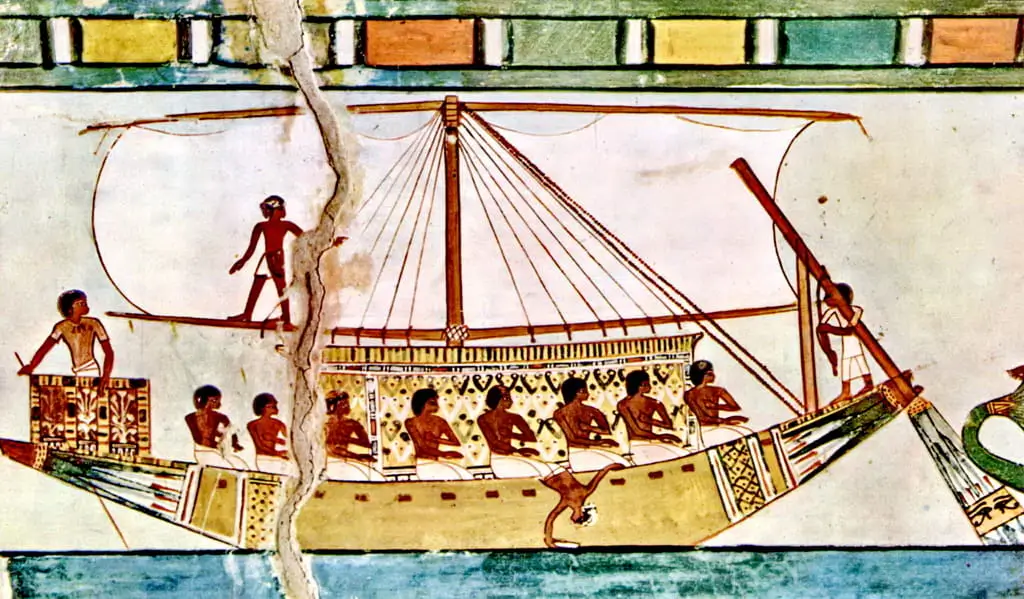
The Tomb of Menna (TT69) is the crown jewel of the Theban Necropolis. It offers a vivid, high-definition look at 18th Dynasty life through the eyes of the Pharaoh’s chief land surveyor. While ancient rivals tried to "blind" Menna by scratching out his eyes, they failed to erase his legacy. From the vibrant agricultural scenes to the symbolic marsh hunts, the tomb remains an essential masterpiece for anyone seeking the most human side of Ancient Egypt.

The Scribe’s Vibrant Legacy: A Guide to the Tomb of Menna (TT69)

The Valley of the Kings offers golden grandeur, but the Tomb of Menna (TT69) in Luxor’s Theban Necropolis provides something far more intimate: a high-definition window into New Kingdom daily life. Menna served as the “Scribe of the Fields” during the 18th Dynasty, leaving behind a burial chamber that stands as one of Egypt’s most artistically significant and well-preserved private tombs.

Entering TT69 feels like stepping into an ancient storybook. Unlike the rigid, formal registers found in royal monuments, these wall paintings burst with movement, humor, and remarkably fresh colors that have defied three millennia. From the detailed agricultural scenes depicting the ancient harvest to the iconic imagery of fishing in the Nile marshes, the Tomb of Menna remains the undisputed “gem” of the Tombs of the Nobles.

Whether you appreciate the pinnacle of Egyptian draughtsmanship or want to see how a high official managed the King’s wealth, this guide covers everything you need to know about the Tomb of Menna (TT69). Discover the hidden artistic details and the legacy of the man who measured the Pharaoh’s grain.

FUN

The Identity of Menna: Overseer of the Fields

The Identity of Menna Overseer of the Fields

To understand why the Tomb of Menna (TT69) contains such specific and vibrant imagery, you must first understand the man himself. Menna served as a high-ranking official during the mid-18th Dynasty, likely during the prosperous reigns of Thutmose IV and Amenhotep III. His prestigious title, “Overseer of the Fields of the Lord of the Two Lands,” placed him at the very center of the Egyptian economy.

The Architect of the Empire’s Wealth

Ancient Egypt functioned on a grain-based economy where the Nile’s harvest dictated the wealth of the nation. As the Chief Scribe and surveyor, Menna didn’t just record data; he managed the Pharaoh’s primary source of power. His responsibilities included:

  • Land Surveying: Using knotted ropes to measure the boundaries of fields after the annual Nile flood.
  • Tax Assessment: Calculating the expected grain yield to ensure the royal granaries remained full.
  • Labor Management: Overseeing the vast network of farmers, winnowers, and scribes who worked the black soil of the Nile Valley.

The exquisite detail you see on the walls of TT69 serves as a permanent “professional resume.” By documenting his earthly success so meticulously, Menna ensured that the gods recognized his bureaucratic integrity and granted him the same high status in the afterlife.

A Man of the 18th Dynasty Elite

Menna belonged to the burgeoning “middle-upper class” of the New Kingdom. Unlike the pharaohs who focused on divine battles and celestial journeys, Menna’s tomb reflects the values of the Theban elite: family, professional pride, and a deep appreciation for the natural beauty of the Egyptian landscape.

When you look at the figures in the Tomb of Menna, you aren’t just looking at religious icons; you are meeting a man who lived at the height of Egypt’s international influence. His tomb serves as a testament to an era where art, wealth, and administrative precision reached their zenith.

FUN

The Agricultural Masterpieces: A Visual Narrative of the Nile

The Agricultural Masterpieces A Visual Narrative of the Nile

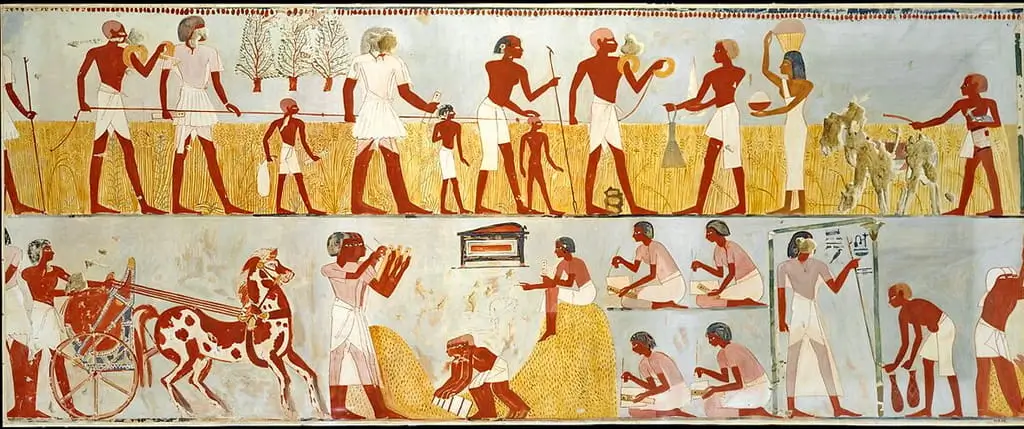
The primary fame of the Tomb of Menna (TT69) rests on its stunning agricultural registers. These paintings do more than decorate a wall; they provide a step-by-step manual of the ancient Egyptian farming cycle. Because Menna supervised these activities in life, their presence in his tomb guaranteed him a successful harvest for all eternity.

The Precision of the Land Survey

The Precision of the Land Survey

One of the most historically significant scenes in TT69 depicts the land survey process. You will see Menna’s subordinates holding a long, knotted measuring rope—the ancient world’s version of a surveyor’s tape.

Following the annual Nile flood, the river rearranged the boundaries of the fields. Menna’s team had to remeasure the “Black Land” to determine exactly how much grain each farmer owed the Pharaoh. The artists captured the tension of this moment:

  • The Scribes: They stand with palettes and papyrus, ready to record every cubit.
  • The Farmers: Look for the subtle body language of the local laborers, who often look on with a mix of respect and apprehension.

The Rhythms of the Harvest

As you move along the wall, the narrative transitions to the actual harvest. This section is a masterpiece of movement and color. You will observe:

  • Reaping the Grain: Laborers use flint-edged sickles to cut the wheat, leaving the tall stalks behind.
  • The Threshing Floor: Oxen driven by farmers tread over the grain to separate the kernels from the husks. The artists used a unique stippling technique here to show the texture of the scattered grain.
  • Winnowing: In one of the most fluid scenes, workers toss the grain into the air using wooden scoops. The light Egyptian breeze carries away the light chaff while the heavy grain falls back to the floor.

Human Touches and Realism

What distinguishes the Tomb of Menna from more formal royal tombs is the inclusion of “genre scenes”—small, human moments that bring the ancient world to life. While the official work continues, the artists tucked away delightful details:

  • The Water Skin: A tired worker takes a long drink from a goatskin bag hanging from a tree.
  • The Quarreling Girls: In a rare display of ancient humor, two young girls pull each other’s hair over a dropped basket of grain.
  • The Sleeping Laborer: Under the shade of a tree, a field hand takes a nap while his colleagues work.

These details prove that the artists of TT69 were not just following a template; they were observing the real world and celebrating the humanity of the people who built Egypt’s wealth.

The Catacombs of Kom Esh-Shokafa: Roman-Egyptian Underworld

Descend into one of the "Seven Wonders of the Middle Ages" at the Catacombs of...
Related post
FUN

Mastering the Wild: The Fishing and Fowling Scenes

Mastering the Wild The Fishing and Fowling Scenes

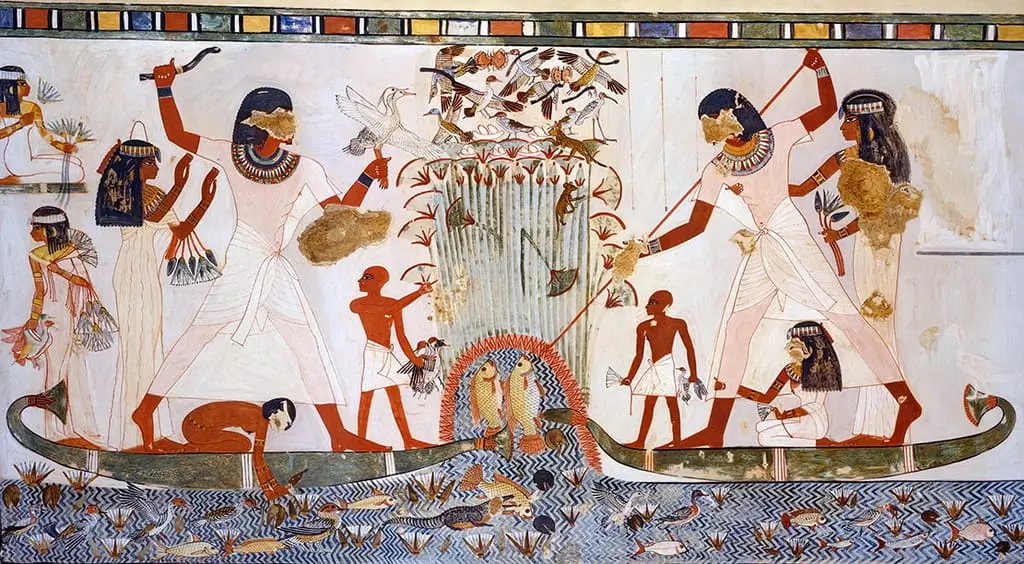
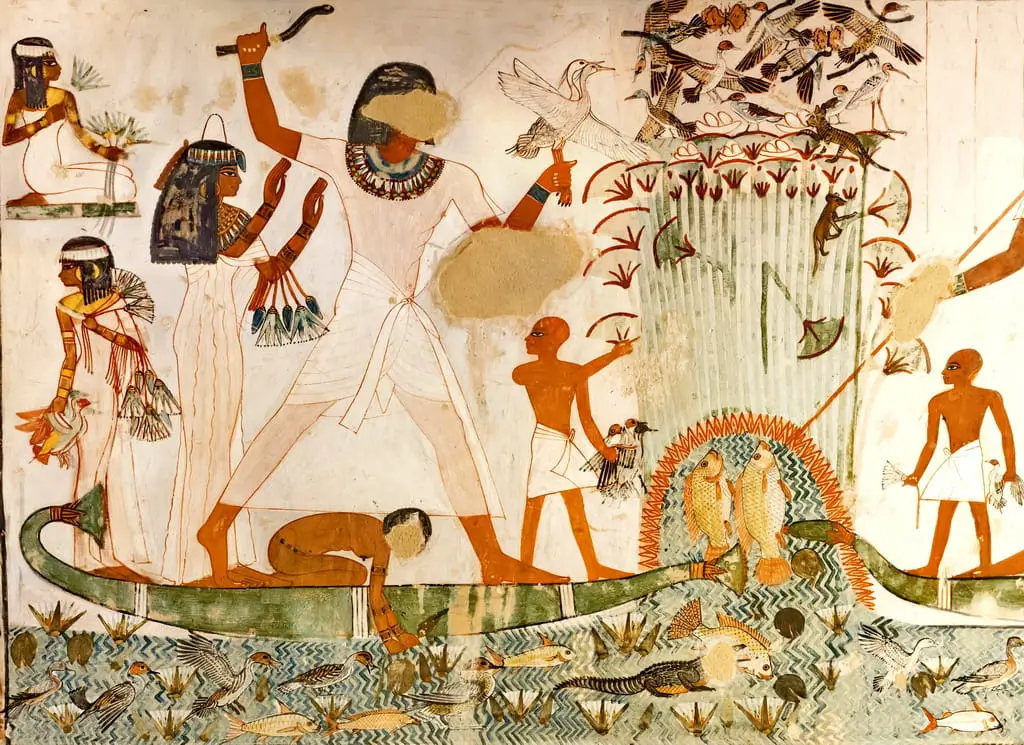
If the agricultural registers showcase Menna’s control over the well-mannered world, the scenes of fishing and fowling demonstrate his mastery over the wild. This wall is a riot of color and biological detail, capturing the lush biodiversity of the ancient Nile Delta.

The Symbolic Ordering of Chaos

In Ancient Egyptian belief, the thick, tangled papyrus marshes represented Isfet—the forces of chaos and unpredictability. By depicting Menna standing tall on a reed boat, poised to harpoon fish or strike down birds, the artists show him maintaining Ma’at (divine order).

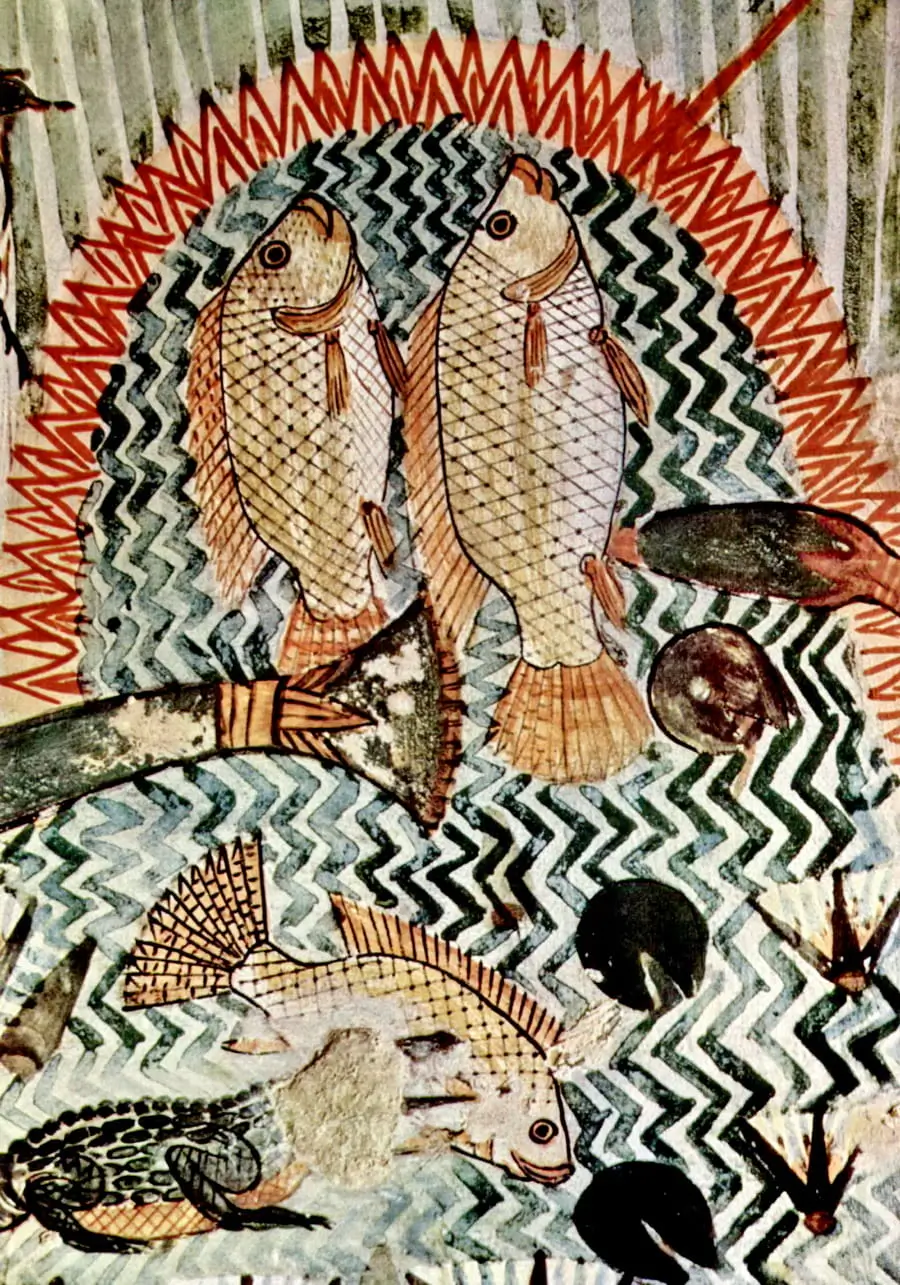
  • The Dual Hunt: Menna appears in a “balanced” composition. On one side, he uses a throw-stick to bring down waterfowl; on the other, he plunges a double-pronged harpoon into the water to catch two fish simultaneously.
  • The Tilapia and the Nile Perch: The artists rendered the fish with such anatomical precision that ichthyologists can still identify the species today. The Tilapia, specifically, symbolized rebirth and regeneration, reinforcing the tomb’s theme of eternal life.

A Masterclass in Naturalism

The background of this scene is a dense thicket of papyrus blossoms, painted in a vibrant, cool green that has remained remarkably fresh. Within this “forest” of reeds, the artists tucked away a bustling ecosystem:

  • Predators in the Reeds: Look for the small, agile cat—likely a marsh cat or a domesticated feline—creeping up a papyrus stem to raid a bird’s nest. Nearby, a mongoose or ichneumon prepares to do the same.
  • The Butterfly Effect: Delicate butterflies and dragonflies hover above the water, painted with thin, confident strokes that showcase the “Scribe of Contours” at the height of his skill.
  • The Hidden Crocodile: Beneath the boat, a small crocodile waits in the water, adding a touch of lurking danger to the otherwise peaceful family outing.

The Intimate Family Portrait

Unlike royal art, where the King stands alone in his majesty, the Tomb of Menna emphasizes the family unit. Menna’s wife and daughters accompany him on the papyrus skiff. They are depicted on a smaller scale, holding onto his legs or reaching for lotus flowers.

Their inclusion serves a dual purpose: it highlights the high social status and domestic bliss Menna enjoyed in life, and it ensures that his family will accompany him through the “Fields of Reeds” in the world to come. This blend of high-stakes religious symbolism and tender family intimacy is exactly what makes TT69 a masterpiece of 18th Dynasty art.

The Tomb of Pashedu (TT3): Spirituality and the Palm Tree of Life

The Tomb of Pashedu (TT3) is a spiritual masterpiece in Deir el-Medina, famous for its...
Related post
FUN

The Hall of Judgment: Securing the Eternal Harvest

The-Tomb-of-Menna-TT69-The Hall of Judgment Securing the Eternal Harvest

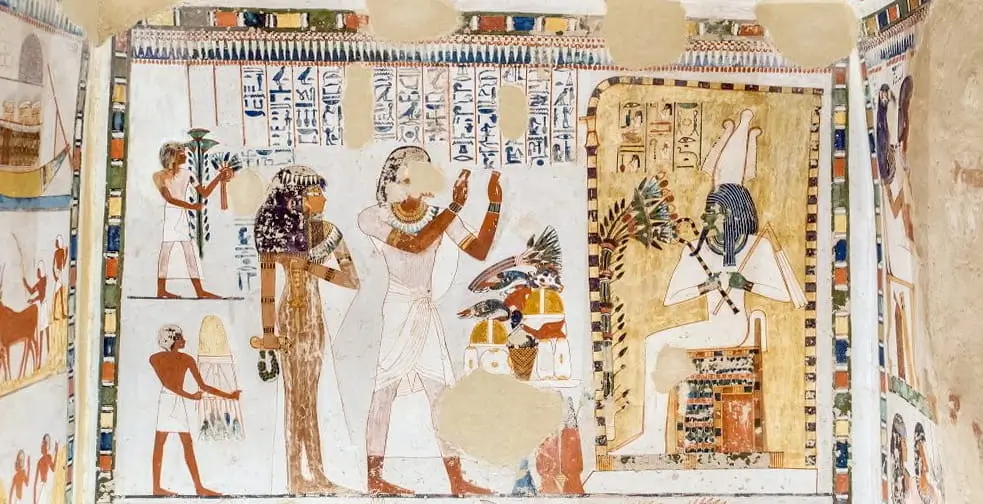
As you move into the inner chambers of TT69, the narrative shifts from the sun-drenched fields of the Nile to the solemn halls of the Duat (the Underworld). Here, Menna faces the most critical moment of his existence: the Weighing of the Heart. This scene determined whether he would enter the “Fields of Reeds” or face eternal non-existence.

The Divine Audit: The Weighing of the Heart

For a man who spent his life measuring the Pharaoh’s grain, the metaphor of the scales was deeply personal. The artists depicted this scene with incredible clarity and religious tension:

  • The Scales of Ma’at: In the center of the hall stands a massive golden scale. Anubis, the jackal-headed god of mummification, kneels to check the plummet, ensuring the balance is perfectly level.
  • The Feather of Truth: On one side of the scale sits the feather of Ma’at, representing cosmic order and truth. On the other sits Menna’s heart, containing the record of all his deeds.
  • The Divine Scribe: Thoth, the ibis-headed god of wisdom, stands ready with his palette and reed pen. Just as Menna recorded the harvest on earth, Thoth now records the final “tax assessment” of Menna’s soul.

The preservation in this section allows you to see the intricate patterns on the “Devourer” (Ammit)—the terrifying beast with the head of a crocodile, the mane of a lion, and the hindquarters of a hippopotamus—waiting to consume the hearts of the unjustified.

The Negative Confession and the Justified Soul

Surrounding the judgment scene, Menna appears before a panel of 42 judges. He performs the “Negative Confession,” declaring that he has not stolen, has not cheated the widow, and—most importantly for a land surveyor—has not moved the boundary stones of his neighbor’s field.

Because the paintings remain so vivid, you can still see the expression of calm confidence on Menna’s face as he passes the test. He is “Ma’at Kheru”—True of Voice.

The Final Presentation to Osiris

Having passed the judgment, Menna enters the presence of Osiris, the Lord of the Dead. Osiris sits beneath a beautiful baldachin, his skin painted a symbolic green to represent fertility and resurrection. This final image secured Menna’s place in the eternal cycle of the Nile, transforming him from a mortal “Scribe of the Fields” into a divine being who would live forever among the gods.

The Tomb of Ramose (TT55): A Masterpiece of Artistic Revolution

The Tomb of Ramose (TT55) acts as a rare artistic time capsule, capturing the transition...
Related post
FUN

Technical Brilliance and the Mystery of the Memory Sanction

Technical Brilliance and the Mystery of the Memory Sanction

The Tomb of Menna (TT69) remains a masterpiece for two reasons: the skill of the painters and a strange act of ancient sabotage. While the art is beautiful, a closer look reveals that someone tried to “erase” Menna from eternity.

The “Scribe of Contours” and the Theban Style

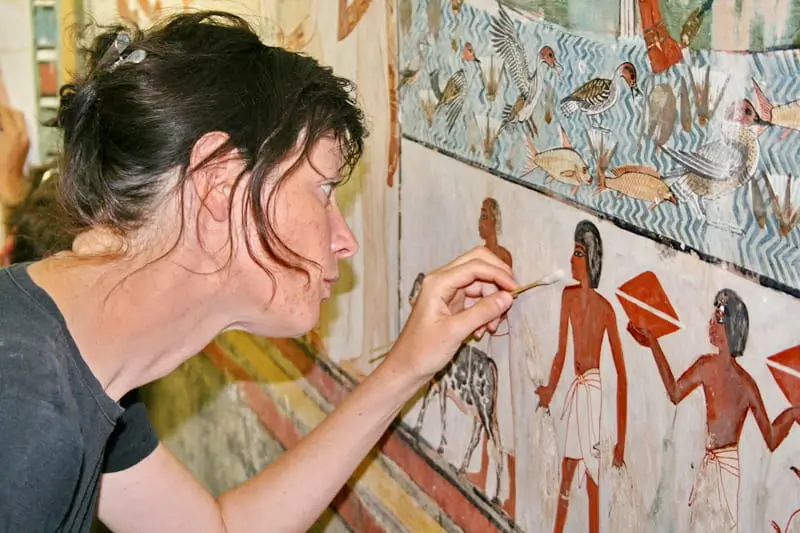
The artists who worked on TT69 were among the best in the New Kingdom. They used a style called the “Theban Style,” which focused on elegance and fine lines. First, the master artists applied a smooth layer of white plaster over the limestone walls. Next, they used a “Scribe of Contours” to draw the outlines in red ochre. Finally, they filled these shapes with vivid pigments. Because they used high-quality minerals like lapis lazuli for blues and malachite for greens, the colors never faded. The simple, clean lines make the figures look like they are moving, even today.

The Mystery of the Scratched Eyes

As you walk through the tomb, you will notice a haunting detail. In many scenes, someone carefully scratched out Menna’s eyes and face. This was not random vandalism. It was a calculated “Memory Sanction” or Damnatio Memoriae.

In Ancient Egyptian belief, a spirit needed its image to see and receive offerings. By destroying the eyes of the statue or painting, an enemy could “blind” the deceased in the afterlife. Because this damage only targets Menna and not the gods or his family, historians believe a personal rival or a disgruntled relative performed this act. They wanted to ensure that while the tomb remained beautiful, Menna himself could not enjoy it.

The Innovation of the “Genre Scene”

In addition to the mystery, the Tomb of Menna is famous for introducing “genre scenes.” These are small, realistic moments of daily life. For example, you can see a young boy tending to a calf or a worker resting under a tree.

These simple details changed Egyptian art forever. Before this period, art was very stiff and formal. The artists of TT69 broke those rules. They added humor and emotion to the walls. As a result, the tomb feels like a living world rather than a dark burial chamber.

Why the Preservation is Unrivaled

Why the Preservation is Unrivaled

Finally, we must look at why these paintings survived so well. The tomb sits in the dry, rocky hillside of Sheikh Abd el-Qurna. This location protected the plaster from moisture. Furthermore, the modern glass barriers and UV-filtered lighting now prevent damage from tourists. Consequently, you can see the original brushstrokes exactly as the artist intended them over three millennia ago.

This itinerary solves the "Egyptian Paradox": how to see the 5,000-year-old monuments without feeling like you are trapped in a museum....
Explore the glorious attractions of the Pharaohs and tag two days at the beach....
God_Anubis_Icon

Early Layover Tour in Cairo

My husband, 2 sons – aged 9 & 11 – and I landed in Cairo at 5:15am on Saturday 12 January 2013. We had booked an early layover tour with Egypt Fun Tours after reading the great reviews in TripAdvisor. As promised he and his driver awaited us in a

More »
Souqs and Markets in Egypt - Egypt Fun Tours

Cairo walking tours

After a rocky start (the driver had been in an accident on his way to pick me up,) the company very quickly sent another driver/guide named Mohammed, who was a real pro. Thoroughly enjoyed my first day in Egypt!

More »

Valley of the Kings, Hepchepsut

I never had a more positive experience and educational time than this tours. Learning about a variety of kings and queens was amazing! The tour guide was super nice and helped me and my friend every step of the way! Including bargaining for a few souvenirs! I will never forget

More »

Great guided tour of pyramids

We travelled to Cairo on Friday, May 3, 2019, from Toronto. We landed at 0530 and were met by a representative of Fun Tours at the departure gate. We were only on a layover of 6 hours, and the tour company came with a private van, water, a driver, and

More »

Lenka Traverlers

Egypt Fun Tours was contracted by our travel agency, Lenka Travelers, to arrange and guide us through parts of Egypt and Jordon. They did a fabulous job. The hotels, restaurants, places we visited, and transportation were the best. Our guide in Egypt, Mohammad, was very knowledgeable, spoke perfect English, and

More »
God_Anubis_Icon

Top-rated Tour Packages

God_Anubis_Icon