Ancient Egyptian Art: Eternal Forms, Purpose and Symbolism

Ancient Egyptian art was not decoration; it was creation. Explore the purpose of Egyptian art, the strict canon of proportion, powerful Ancient Egyptian symbolism, and how these eternal forms helped secure life after death.

Ancient Egyptian art stands alone in the history of civilization. For three millennia, its style remained remarkably consistent, achieving an eternal quality unmatched by any other culture. This incredible stability was not due to a lack of creativity, but rather a profound philosophical commitment. The fundamental purpose of Egyptian art was never aesthetic beauty alone; it was utilitarian, serving as a powerful tool to ensure cosmic order (Ma’at) and secure a successful, eternal afterlife. Every statue, tomb painting, and coffin was deliberately created according to strict Egyptian art conventions and imbued with rich Ancient Egyptian symbolism. We will explore the history, the immutable rules, and the powerful meanings that defined this masterful visual language.

FUN

The Foundations: Why Did Egyptians Create Art?

The Foundations, Why Did Egyptians Create Art

Unlike most Western art, which often celebrates change, individual genius, or visual realism, the purpose of Egyptian art was entirely pragmatic and sacred. The Ancient Egyptians created art primarily as a tool for preservation, ensuring the survival of the spirit in the afterlife and maintaining cosmic balance in the present.

Art for the Gods and the Afterlife

Egyptian art was created for specific, functional goals centered on eternity and divine service:

  • Securing Eternity: The most critical function of art was to provide an eternal residence for the ka (life-force) and the ba (soul/personality) of the deceased. If the mummified body was damaged, a statue or painting of the deceased—made to last forever—could serve as a backup vessel for the spirit.
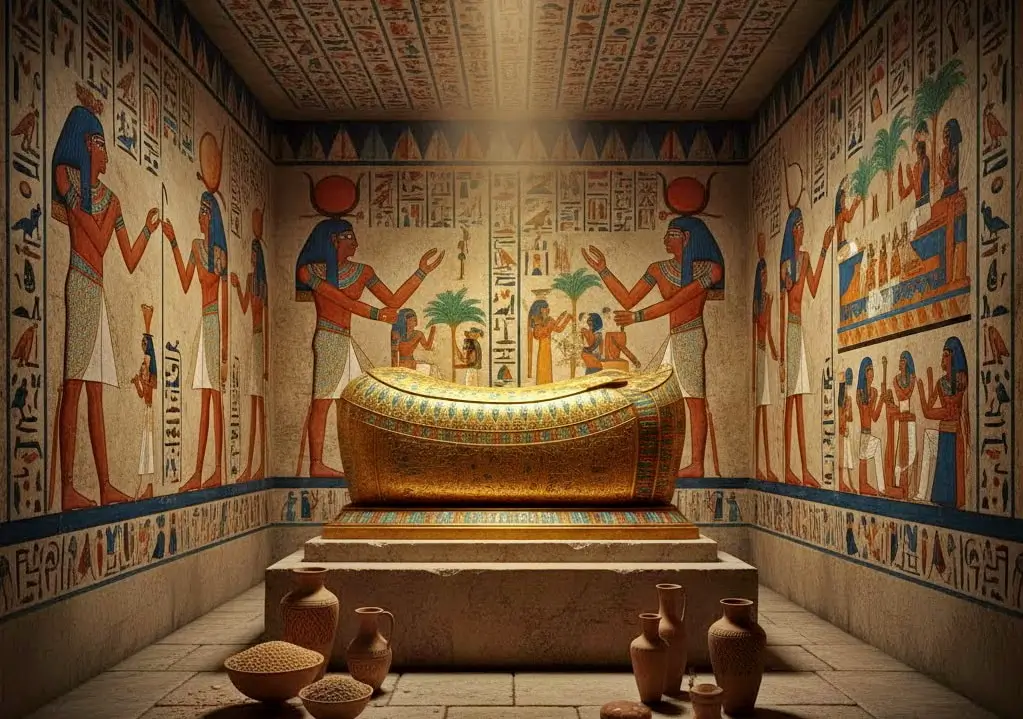
  • Provisioning the Dead: Tomb paintings and reliefs were not meant to be admired by the living; they were magic. They depicted scenes of the deceased receiving offerings, farming, feasting, and enjoying daily life. These images served as perpetual magic spells, ensuring that the funerary art would eternally provide the necessary sustenance, status, and pleasure in the afterlife, regardless of whether the living remembered to bring offerings.
  • Serving the Divine: Temple art was created to honor and house the gods. Statues of deities were often ritually fed, clothed, and cared for by priests, acting as conduits between the spiritual realm and the earth.

Maintaining Ma’at: Art as Cosmic Order

Every piece of art was designed to promote and reinforce Ma’at—the fundamental concept of truth, justice, and cosmic order. Artistic stability was essential for spiritual stability.

  • Immutability: The art resisted change for thousands of years because change implied chaos. By strictly adhering to established Egyptian art conventions, artists reinforced the belief that the divine order was unchanging and eternal.
  • Propaganda and Power: Art also served a clear political purpose. Reliefs and massive temple walls documented the pharaoh’s success in battle, his closeness to the gods, and his dedication to public works. This visual record reinforced the pharaoh’s divine right to rule and his ability to maintain stability.

FUN

The Immutable Rules: Conventions of Egyptian Art

The Immutable Rules, Conventions of Egyptian Art

For the purpose of Egyptian art—to ensure eternity—consistency was paramount. Egyptian artists followed strict rules and Egyptian art conventions for nearly 3,000 years, making their style instantly recognizable. These conventions prioritized clarity, permanence, and function over visual realism. In painting and relief, color was not decorative; it held deep symbolic meaning.

Hierarchical Scaling and Idealism

One primary rule governed the size of figures in reliefs and paintings:

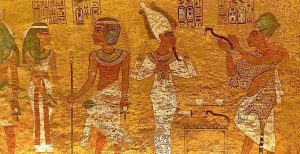
  • Hierarchical Scaling: Size equals status. The largest figure in any scene is the most important, whether that is the Pharaoh, a powerful god, or a high official. For example, a god or a Pharaoh always dwarfs the common farmers or enemies, visually reinforcing the Ancient Egyptian social hierarchy.
  • Idealism: Figures were rarely shown aging or flawed. Instead, they represented the perfect, idealized state in which the individual wished to exist for eternity. If a person was shown with flaws, it usually indicated they were lower-status or a servant.

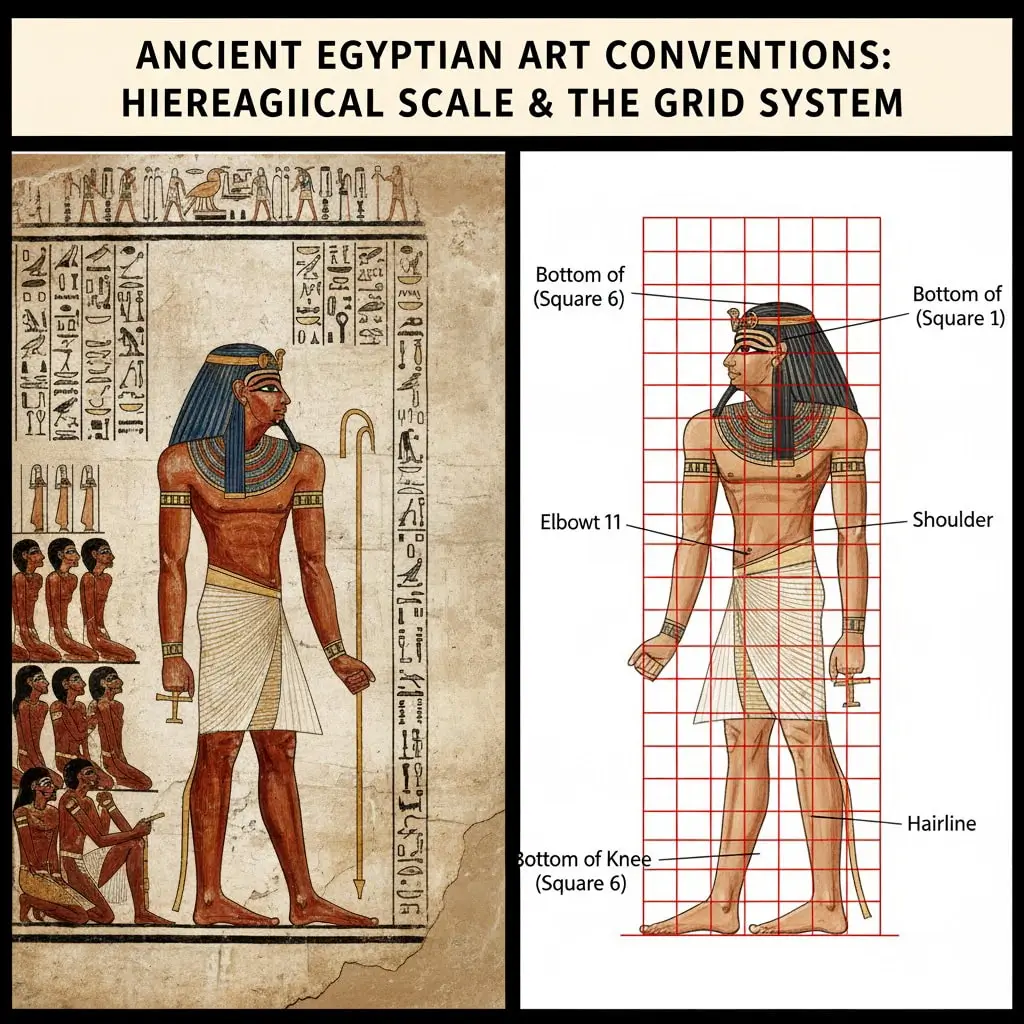
The Canon of Proportion: The Grid System

To ensure consistency across time, distance, and artists, the Egyptians invented a precise drawing method called the canon of proportion.

  • The Grid: Artists drew a grid of squares on the surface before beginning any work. The grid established specific points on the human body, such as the bottom of the knee, the elbow, and the hairline.
  • Measurement: By standardizing the measurements—with the body of a standing man typically measuring 18 squares from the soles of his feet to his hairline—the style remained immutable. This was essential, as it meant any artist, from any era, could accurately restore or complete a piece of Ancient Egyptian Art.

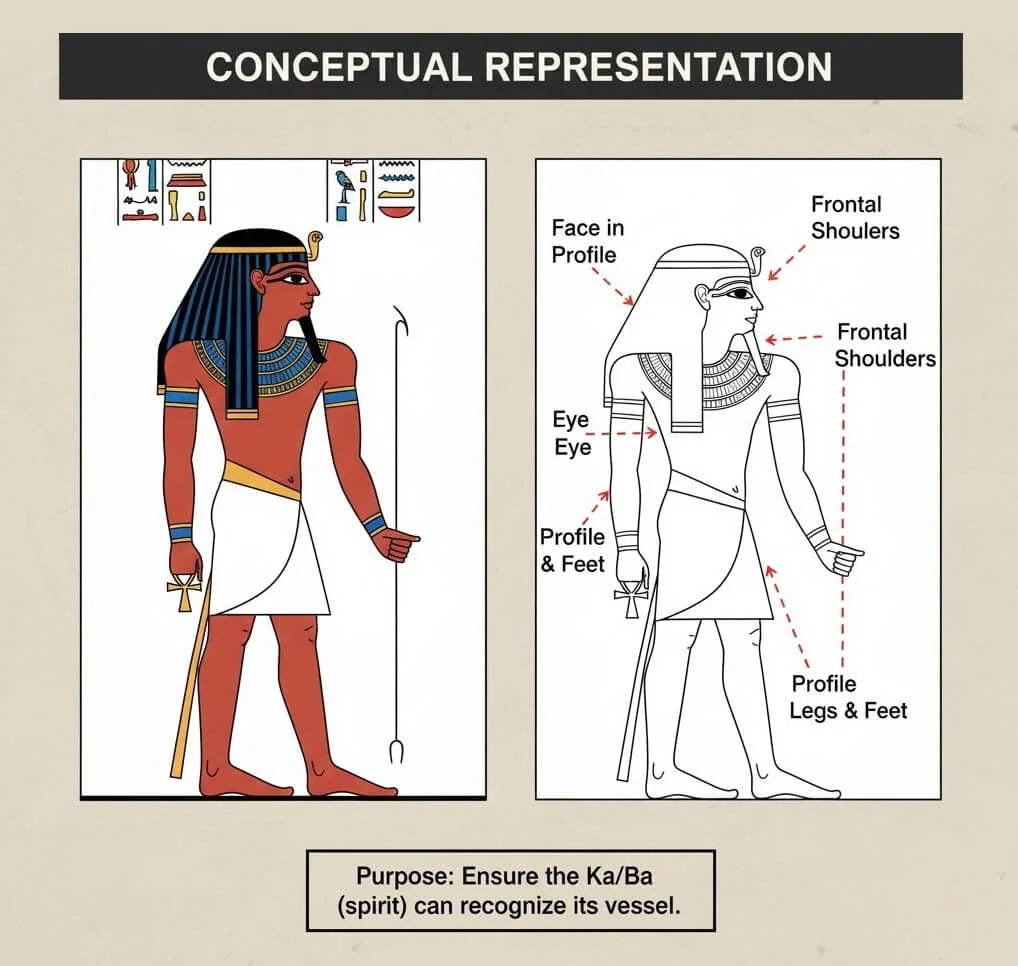
The Rule of Conceptual Representation

The Rule of Conceptual Representation - Ancient Egyptian Art

This is perhaps the most famous convention of Ancient Egyptian Art: figures were represented not as they appeared visually from one perspective, but as they were known conceptually to exist.

  • Composite View: Human bodies were rendered using a composite, or twisted, perspective: the face is shown in profile, the eye and shoulders are shown frontally, and the legs and feet return to profile. This convention ensures that the most recognizable part of the body is visible, guaranteeing the ka or ba could identify its vessel.
  • Relief Sculpture: Most carvings were shallow relief sculpture, which emphasized line and flatness. The focus remained on the symbolic clarity, not deep shadows or realistic depth.

The Profound Egyptian Influence on Greek Civilization

Egypt profoundly influenced ancient Greek civilization in various aspects. Key influences include religious syncretism, with...
Related post
FUN

A Visual Language: Key Symbols and Motifs

A Visual Language Key Symbols and Motifs-min

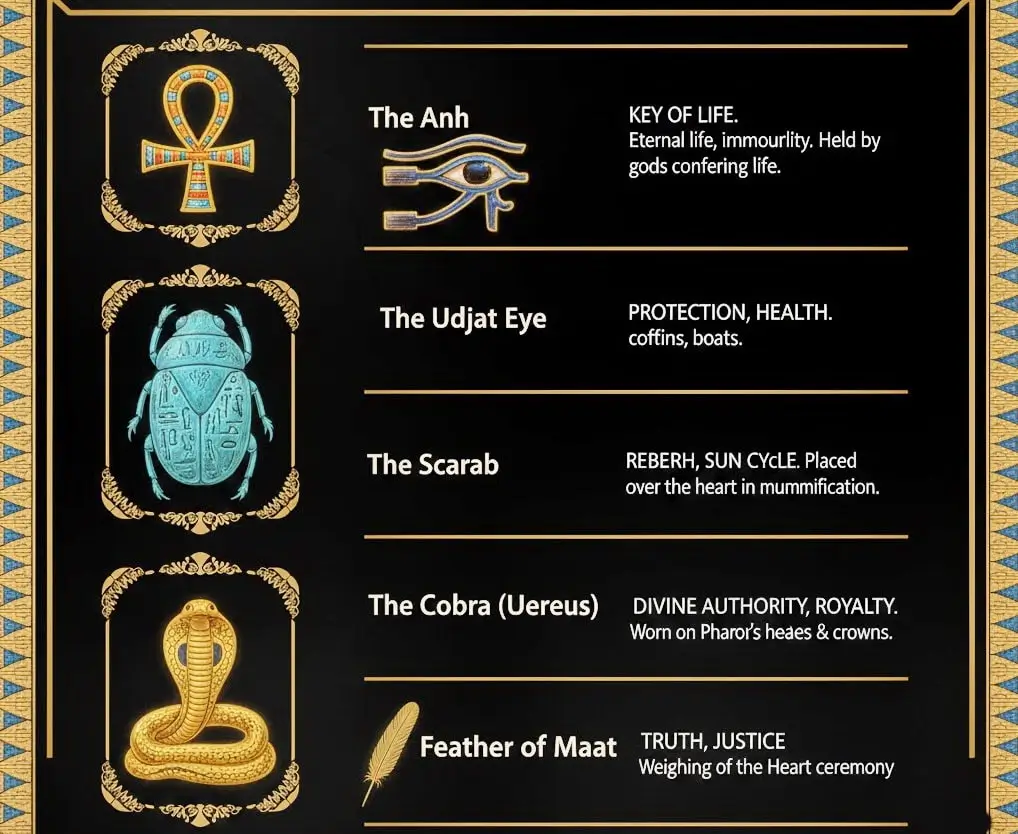
The visual consistency of Ancient Egyptian Art relies heavily on a deep and instantly recognizable vocabulary of powerful symbols. These symbols were not decorative choices; they were sacred components of the art’s magical and spiritual purpose.

Symbol Meaning and Purpose Context in Art
The Ankh The key of life. Represents eternal life, immortality, and the promise of the afterlife. Often held by gods (especially Osiris and Isis) as they confer life upon the Pharaoh or the deceased.
The Udjat Eye Known as the Eye of Horus or the Wedjat Eye. Represents protection, good health, and restoration. Found on amulets, coffins, and sometimes painted on the bows of boats for protection during travel.
The Scarab The dung beetle. Symbolizes rebirth, the cycle of the sun (Ra), and transformation. Often placed over the heart during mummification, it guaranteed the heart would speak favorably during judgment.
The Cobra (Uraeus) Represents divine authority, royalty, and protection. Always worn on the Pharaoh’s headdress (the Nemes) and on the crowns of deities.
Feather of Ma’at The single feather of the goddess Ma’at. Symbolizes truth, justice, and cosmic balance. Used in the Weighing of the Heart ceremony in the afterlife judgment scenes, ensuring the deceased lived correctly.

The Power of Hieroglyphics

The Power of Hieroglyphics

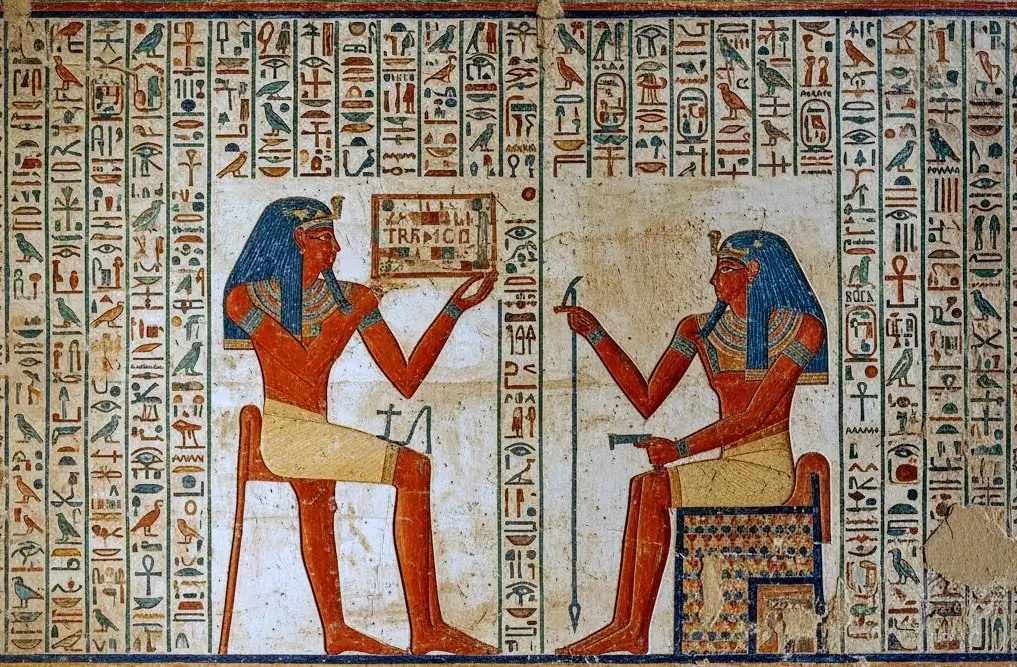
Written language was inseparable from Ancient Egyptian Art. Hieroglyphics were not just a writing system; they were integrated decorative elements with magical function.

  • Integrated Design: Scribes and artists designed the hieroglyphics to fill empty spaces in a composition, ensuring there were no gaps where chaos could creep in (again, adhering to Ma’at). They read vertically or horizontally, depending on the space, but always faced the direction from which the viewer should read.
  • The Magic of the Name: Writing the name of a person or deity in hieroglyphs was an act of creation itself. Ensuring the name was preserved on a statue or tomb wall meant the person existed eternally. This preservation of identity was a critical purpose of Egyptian art.
  • Narrative Function: The writing served as a visual explanation, labeling the individuals depicted, recording their titles, and recounting the events or spells necessary for the afterlife.

Abydos: Royal Tombs, City of Osiris, and the Birthplace of Egyptian Kingship

The Enduring Significance of Abydos Abydos holds a unique status in Egypt. Indeed, it is...

Related post
FUN

A Brief History: Periods of Change

A Brief History, Periods of Change - Ancient Egyptian Art

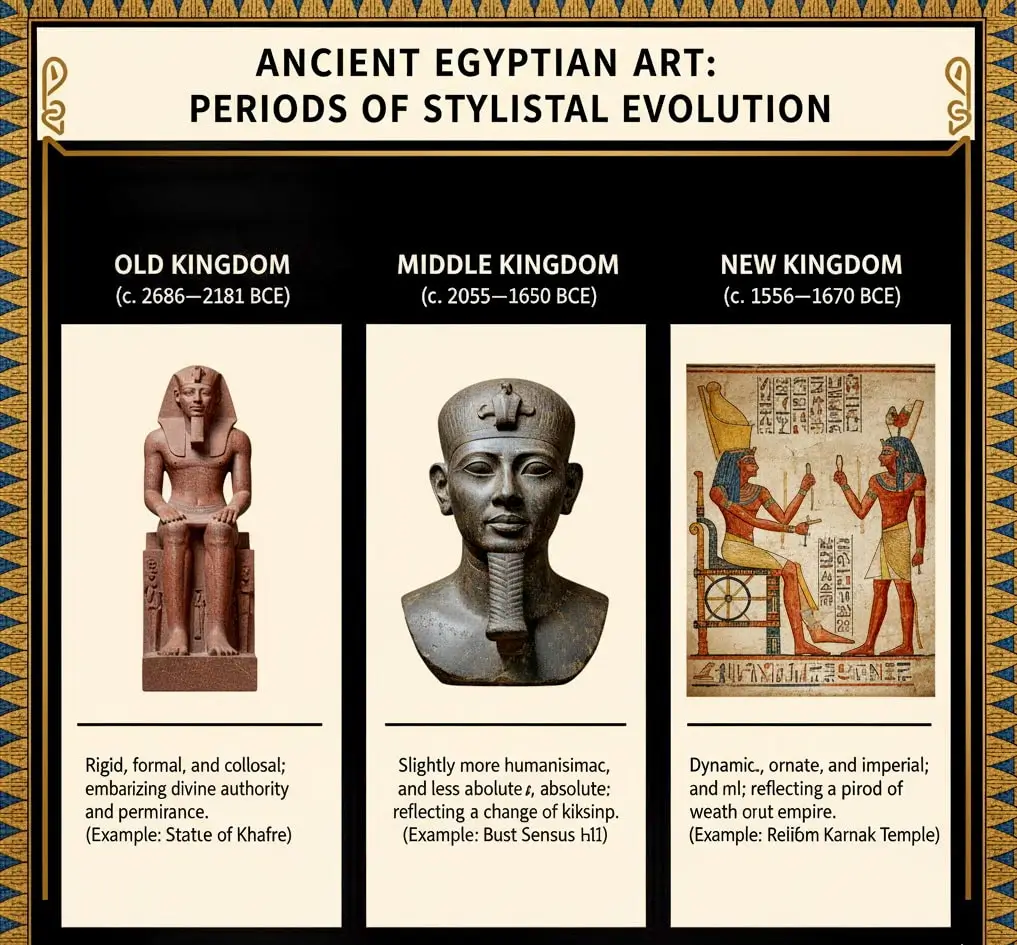
While the Egyptian art conventions remained stable across three millennia, art historians typically divide the history of Ancient Egyptian Art into distinct periods, mainly correlating with the stability of the ruling power.

Period Dates (Approx.) Key Art Characteristics
Old Kingdom 2686–2181 BCE Focus on monumental architecture (Pyramids), static royal portraits, and rigid use of the canon of proportion. Art served the Pharaoh’s absolute divinity.
Middle Kingdom 2055–1650 BCE Statues show slightly more realism and emotion, reflecting a less absolute and more human view of the pharaoh.
New Kingdom 1550–1070 BCE Imperial expansion and wealth led to massive temple complexes (Karnak) and the elaborate funerary art of the Valley of the Kings.
Late Period 664–332 BCE Revival of Old Kingdom styles, emphasizing tradition and stability.

The Amarna Revolution: A Break in Tradition

The Amarna Revolution A Break in Tradition

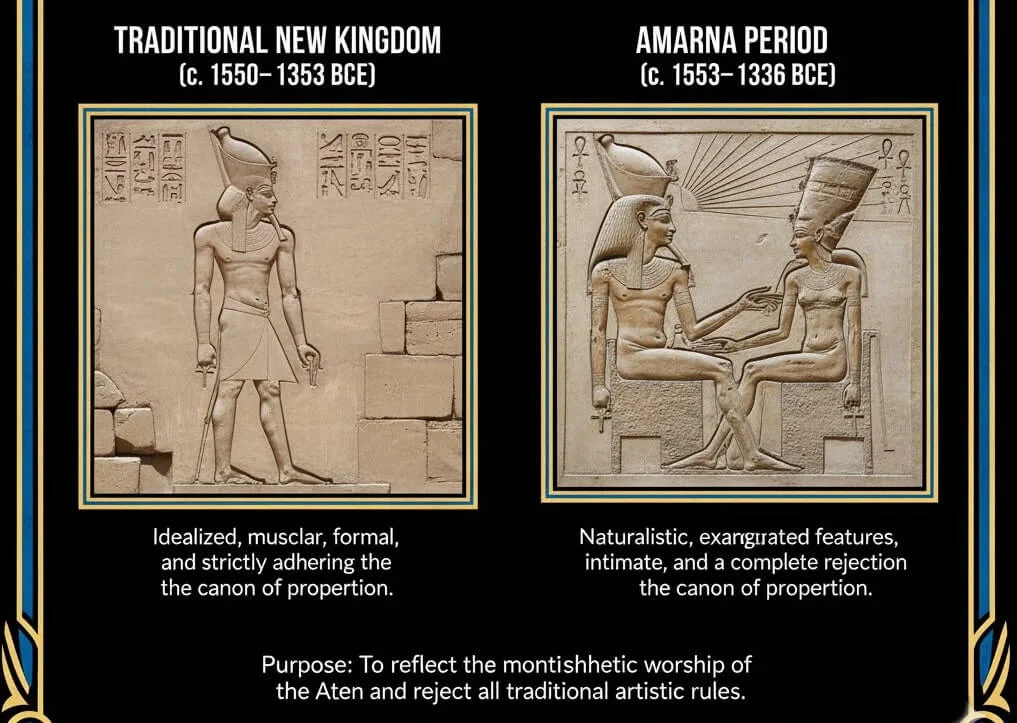
The most significant and shocking disruption to the purpose of Egyptian art occurred during the reign of Pharaoh Akhenaten (New Kingdom, c. 1353–1336 BCE).

  • Religious Shift: Akhenaten abandoned the traditional polytheistic religion in favor of a single deity, the sun disk Aten. This religious revolution instantly broke the spiritual purpose of Egyptian art.
  • Artistic Change: The corresponding Amarna Period art dramatically rejected the strict canon of proportion. Figures became highly naturalistic, featuring elongated skulls, drooping stomachs, and thin limbs—sometimes to the point of caricature. The Pharaoh and his wife Nefertiti were shown in intimate, relaxed family settings, breaking the rule of stiff, formal idealism.
  • Short-Lived: This period of radical artistic and religious freedom lasted only as long as Akhenaten’s reign. After his death, the traditional gods, Egyptian art conventions, and political stability were quickly restored by his successors (Tutankhamun), erasing almost all traces of the Amarna Period art.

Ennead of Heliopolis: Nine Deities at the Heart of Ancient Egyptian Creation

The Ennead of Heliopolis represents one of the most foundational concepts in ancient Egyptian religion:...
Related post
FUN

Conclusion: Art for Eternity

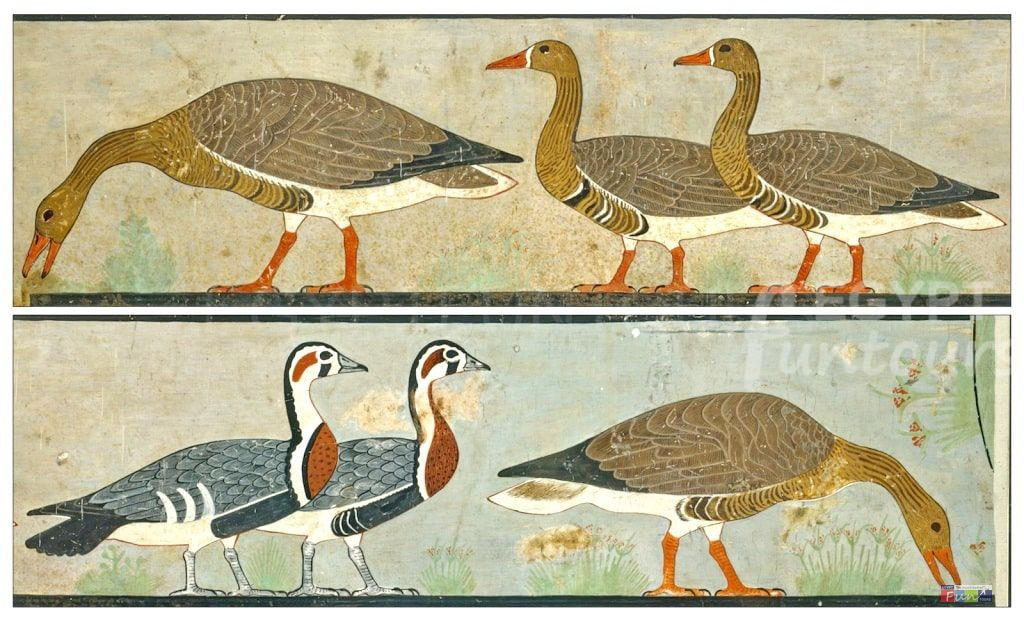
Maidum geese

Ancient Egyptian Art achieved an unmatched permanence because its purpose was not fleeting fashion, but functional eternity. Every element—from the strict adherence to the canon of proportion to the powerful Ancient Egyptian symbolism—served a single goal: to ensure the deceased achieved eternal life and to maintain the cosmic balance of Ma’at on Earth. When we study this art, we are not looking at portraits or landscapes created for living eyes, but at eternal forms meant for the gods and the spirit. The consistency of these Egyptian art conventions over millennia remains the civilization’s greatest visual testament to its unwavering belief system. By understanding the rules, we unlock the immortal code of Egypt’s artistic legacy.

Discover the magic of ancient Egypt and unravel the secrets of civilization....
Live the memories that make Egypt the ideal spot worthy of remembering....
13-day Egypt guided tour package - Egypt Fun Tours

Easily the best two days of the year!

We were doing the 14-day Mediterranean cruise and were in Egypt for two days. I was searching the internet for about 4 days and finally found Egypt Fun Tours as my guide in Egypt. It ended up being the best 2 days of the entire cruise trip. Since this is

More »
Memnon colossi of king amenophis III 4 min

Book with them, they are Professionals

It has always been my dream to visit Egypt. This was a beautiful tour, almost two years later, I can’t stop thinking about my time in Egypt, Valley of the Kings, Temple of Kom Ombo, Edfu, Luxor! I was able to add an eighth day to see Abu Simbel (a

More »

Amazing layover Tour

We had 12 hour layover in Cairo, and our guide Hani waited patiently for us when we had a few visa issues entering the country! We got on our tour, and had the best experience ever! We saw the pyramids, the sphinx, Islamic Cairo and rode through the city! We

More »
6 Days Luxury Tour {Egypt Treasures} - Cairo and Nile Cruise Affordable Tour Package

A trip of a lifetime in a 10 hour layover!

We recently scheduled a layover tour in Cairo through Egypt Fun Tours. Our layover was 10 hours and we scheduled the tour just about a day and a half before our arrival. When we arrived in Cairo we very easily made our way out of the airport (after getting our

More »
Isis with wings

Top-rated Tour Packages

Isis with wings