
Christian Monasticism in Egypt: From the Desert Fathers to the Modern Era

The history of Christian monasticism in Egypt is the history of a spiritual revolution that redefined the Christian world. Beginning in the late 3rd century, the vast Egyptian deserts—once considered the realm of chaos and demons—became the “City of God” as thousands of people retreated to the sands in search of divine solitude. Because Egypt served as the laboratory for both eremitic (solitary) and cenobitic (communal) living, it remains the spiritual motherland for all monastic traditions globally. Consequently, this guide explores how the “Desert Fathers” transformed the barren wilderness into a sanctuary of prayer, literacy, and community that continues to thrive in the modern Coptic Orthodox Church.

For the researcher and spiritual traveler, Egyptian monasticism offers a unique continuity of faith. Specifically, the monastic rules established by pioneers like Saint Anthony and Saint Pachomius over 1,700 years ago still dictate the rhythm of life in active monasteries today. Because these communities were instrumental in preserving ancient texts, developing Coptic literature, and resisting imperial pressures, they represent the resilient heart of Egyptian Christianity. Therefore, understanding Christian monasticism in Egypt is essential for anyone seeking to grasp the origins of organized religious life and the enduring legacy of the Nile Valley.

The Pillars of Egyptian Christian Monasticism

To achieve our authoritative depth, we categorize the evolution of this movement into three distinct developmental phases:

  • The Eremitic Foundation: The rise of the “Anchorites,” led by Saint Anthony the Great, who sought God through total isolation and spiritual warfare in the deep desert.
  • The Cenobitic Revolution: The transition to organized communal living under Saint Pachomius, who introduced the first formal “Rule” to manage labor, prayer, and discipline.
  • The Semi-Eremitic Synthesis: The development of “Laura” systems in regions like Wadi el-Natrun, where monks lived in separate cells but gathered for communal liturgy on weekends.

Consequently, these three models provided the structural blueprint for monasticism as it spread to Palestine, Syria, and eventually Western Europe. Specifically, the Egyptian model proved that the desert was not a place of death, but a fertile ground for the soul.
FUN

The Desert Fathers: Architects of the Spiritual Wilderness

The Ultimate Guide to Monasteries in Egypt History & Heritage

The foundation of Christian monasticism in Egypt rests upon the lives and teachings of the Desert Fathers. These were the pioneers who, beginning in the late 3rd century, sought a “martyrdom of the heart” by retreating into the harsh landscapes of the Eastern and Western Deserts. Their move was a direct response to the end of Roman persecutions; as the Church became more integrated into society, these ascetics sought to preserve the radical, uncompromising core of the faith.

Saint Anthony the Great: The Father of All Monks

Saint Anthony (c. 251–356 AD) is widely regarded as the founder of eremitic (hermit) monasticism. At the age of 20, he famously gave away his worldly possessions after hearing a Gospel reading and retreated to a tomb, then a fort, and eventually deep into the Red Sea mountains.

  • The Eremitic Model: Anthony’s life established the ideal of total solitude, or anachoresis. Specifically, he focused on spiritual warfare, believing that the desert was the literal battlefield where he would face and overcome internal and external demons.
  • The Role of the Teacher: Despite his quest for isolation, his spiritual reputation drew thousands. He eventually emerged to provide guidance, effectively creating the first loosely organized groups of hermits who lived separately but looked to him as an “Abba” (Father).
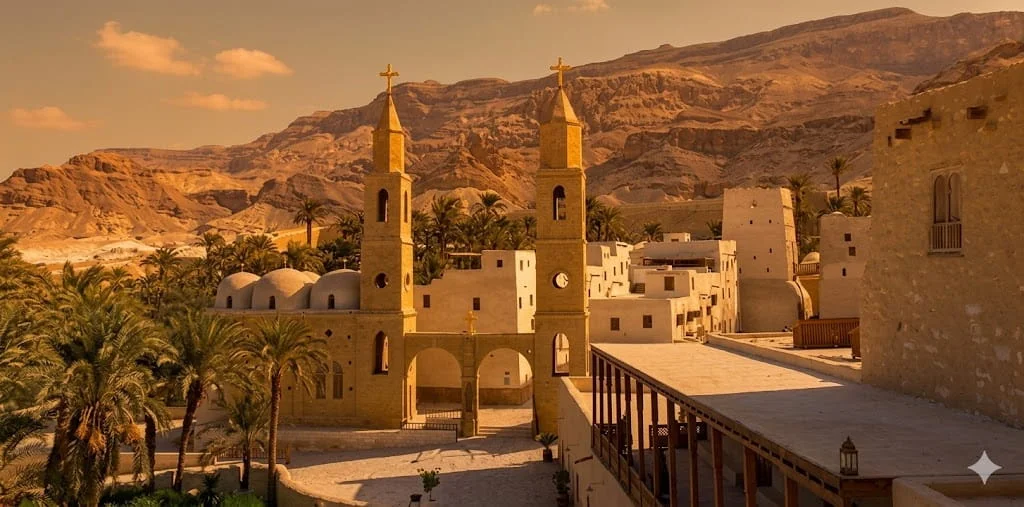
  • The Monastery of St. Anthony: His legacy is physically anchored at the foot of Mount Colzim, where the world’s oldest active monastery still bears his name.

Saint Pachomius: The Father of Communal Living

While Anthony sought the wilderness as a lone soldier, Saint Pachomius (c. 292–348 AD) realized that not everyone could survive the psychological toll of absolute solitude. A former soldier in the Roman army, Pachomius brought military discipline and organizational structure to the desert, founding cenobitic (communal) monasticism.

  • The Pachomian Rule: Pachomius established the first formal “Rule” for monastic life. This was a written constitution that governed everything from communal prayer and shared meals to manual labor and administrative hierarchy.
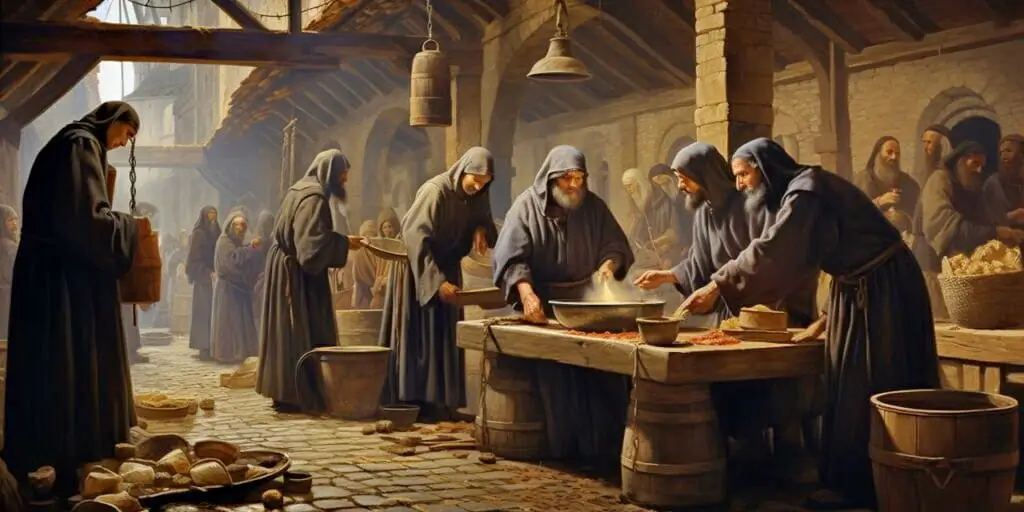
  • Economic Stability: Unlike the hermits who relied on charity or minimal basket-weaving, Pachomian monasteries were self-sufficient economic hubs. Specifically, monks worked as farmers, tailors, and scribes, with the surplus often used to feed the local poor.
  • Growth and Scale: By the time of his death, Pachomius had established nine monasteries for men and two for women, creating a network that could support thousands of practitioners under a single spiritual system.

Saint Macarius the Great: The Semi-Eremitic Middle Ground

In the region of Wadi el-Natrun (the Scetis), Saint Macarius developed a “third way” that combined the best of both worlds. This semi-eremitic style became the dominant model for the great monasteries of the Western Desert.

  • The Laura System: Under this model, monks lived in individual cells (hermitages) scattered across the desert during the week.
  • Communal Weekends: On Saturdays and Sundays, the monks would gather at a central church (the katholikon) for the Divine Liturgy and a communal meal (agape).
  • Discipleship: This allowed for the freedom of solitude while maintaining the safety net of a spiritual community and the guidance of an elder.
FUN

The Architecture of Survival: Desert Fortress Monasteries

Are there specific visiting hours for the monasteries in Wadi Al-Natrun

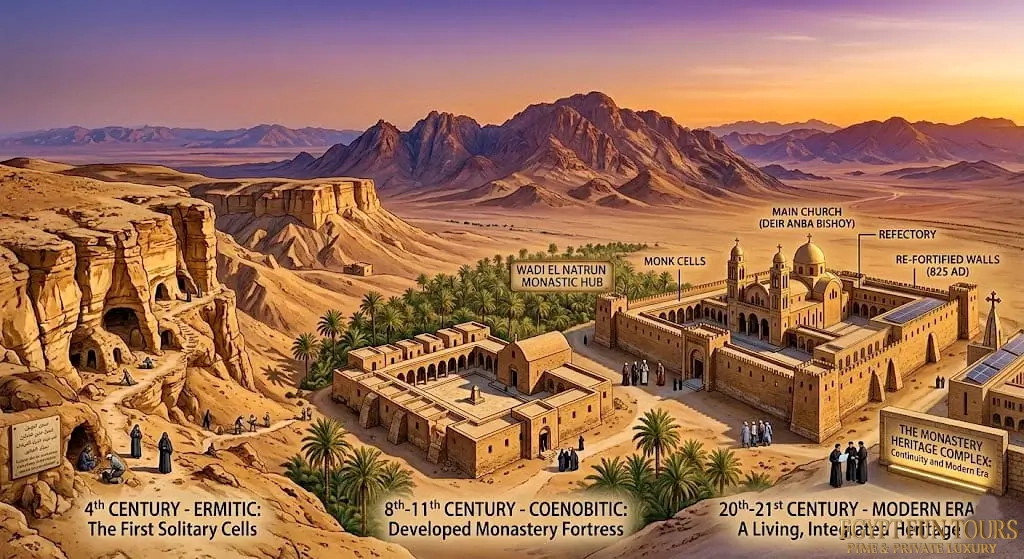
The architecture of Christian monasticism in Egypt reflects the desert’s dual nature. It provided spiritual peace while presenting physical danger. Early monks lived in simple, natural caves or small mud-brick cells. However, growing wealth and fame made these sites targets for nomadic raids. This threat forced a shift toward the “Fortress Monastery” style seen today.

Christian Monasticism: The Evolution of the Enclosure Wall

By the 5th and 6th centuries, monks began building massive walls to enclose their scattered cells.

  • Builders used limestone or sun-dried brick to create walls reaching 10 to 15 meters high.
  • Monasteries featured only one small, heavily fortified gate to ensure security.
  • Monks placed watchtowers strategically to survey the horizon for approaching raiders.

The monastery became a self-contained citadel. These enclosures held gardens, wells, and silos to help the community survive long sieges.

The Keep (Al-Hosn): The Last Line of Defense

The Keep, or Al-Hosn, is the most iconic feature of Egyptian monastic architecture. This freestanding tower stood inside the walls as a final refuge during breaches.

  • A drawbridge from a neighboring building provided access to the elevated second-floor entrance.
  • The keep maintained self-sufficiency with its own chapel, bakery, well, and food storage.
  • A small chapel dedicated to Archangel Michael typically sits at the top of the tower.
  • Monks viewed the Archangel as their celestial protector against desert threats.

The keep served as a sanctuary of last resort. For the 2026 visitor, these towers in Wadi el-Natrun symbolize monastic resilience.

Christian Monasticism: The Triconch Sanctuary and the Khurus

Interiors focused on liturgical beauty even as exteriors focused on defense. Two unique features define the Egyptian monastic church:

  1. The Triconch Sanctuary: This design uses three rounded lobes to create a cloverleaf shape representing the Holy Trinity.
  2. The Khurus: This transverse room sits between the nave and the sanctuary.
  3. It separated the monks from the laypeople during the liturgy.
  4. This layout reflects the specialized prayer life of the monastic community.

The Unification Battle by King Narmer

The Unification Battle by King Narmer The unification battle of King Narmer is shown on...

Related post
FUN

Wadi El-Natrun: The Gateway to the Soul

Architectural Wonders and Defenses in Wadi Al-Natrun - Christian monasticism

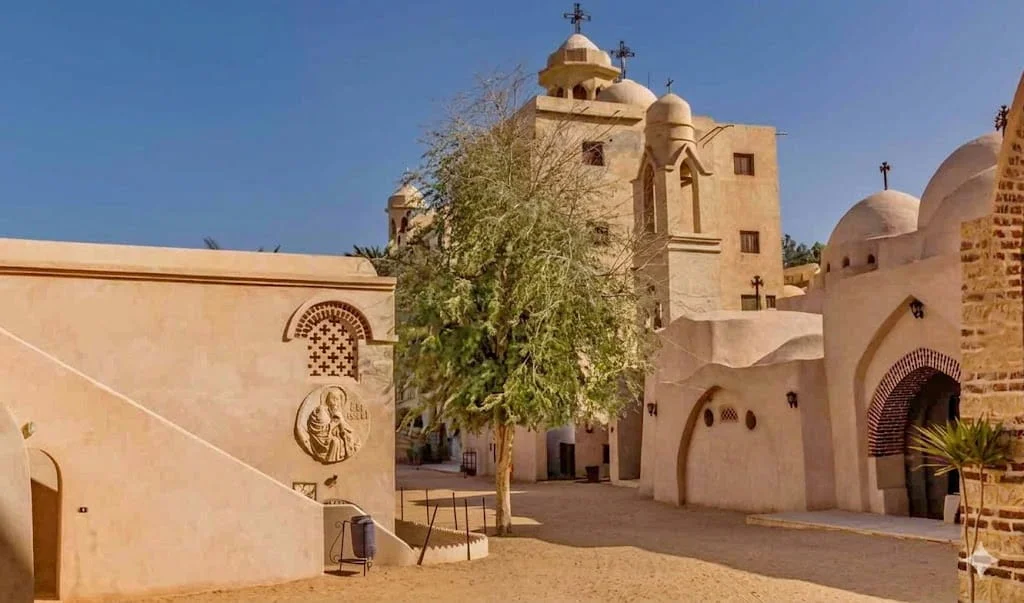
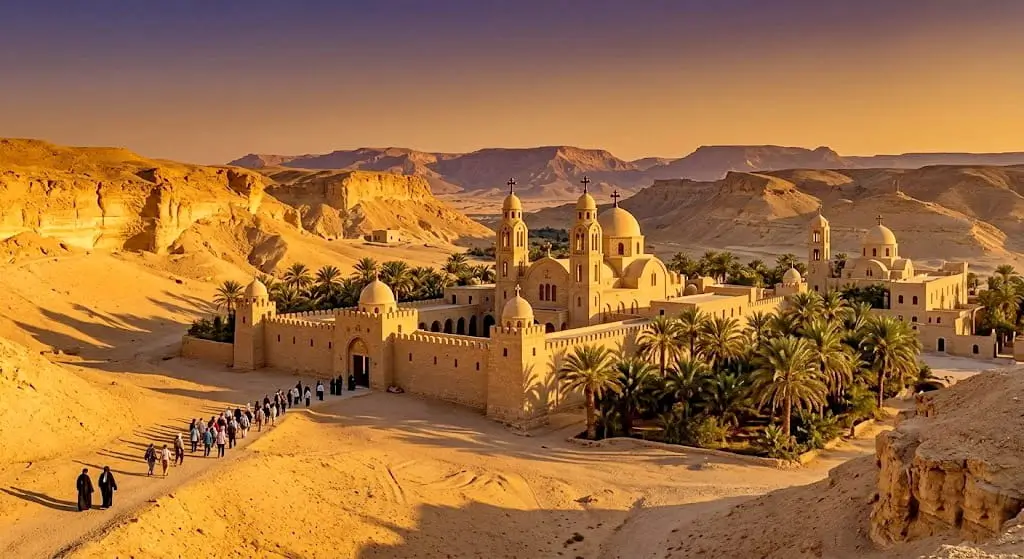
Wadi el-Natrun, historically known as Scetis, remains the most vital center of Christian monasticism in Egypt. This valley sits below sea level between Cairo and Alexandria. It became a hub for monks in the 4th century because of its remote, desert location. Today, it houses four active monasteries that have operated for over 1,600 years.

The Four Living Sanctuaries

The monasteries of Wadi el-Natrun survived centuries of desert raids and cultural shifts. Each site offers a unique perspective on the evolution of Coptic spirituality and architecture.

Monastery of Saint Macarius (Deir Abu Magar):

  • Saint Macarius the Great founded this site in the 4th century.
  • It served as the spiritual headquarters for the Coptic Church for centuries.
  • Many Coptic Popes were chosen from among their monks.
  • The monastery contains the relics of Saint Macarius and several other saints.

Monastery of Saint Bishoy (Deir Anba Bishoy):

  • Saint Bishoy, a contemporary of Macarius, established this community.
  • It features one of the most well-preserved defensive keeps (Al-Hosn) in Egypt.
  • The site became a center for modern monastic renewal under Pope Shenouda III.

The Syrian Monastery (Deir al-Surian):

  • Originally founded by Egyptian monks, it was later inhabited by Syrian monks for several centuries.
  • It is world-famous for its 10th-century frescoes and its massive library of Syriac and Coptic manuscripts.
  • The “Tree of Saint Ephrem” stands here, which legend says grew from the saint’s staff.

The Monastery of the Romans (Deir al-Baramus):

  • This is considered the oldest of the four monasteries in the valley.
  • Its name honors two Roman prince-saints, Maximus and Domitius, who became monks under Saint Macarius.
  • The site retains a stark, traditional desert atmosphere.

The Nilometer: Ancient Egypt’s Sacred Instrument of Power and Profit

The Nilometer stands as one of history's most brilliant examples of hydraulic engineering, religious theater,...
Related post
FUN

The Red Sea Monasteries: The Deep Desert

Overnight trip to Saint Catherine - Christian monasticism

While Wadi el-Natrun was accessible, other monks sought even greater isolation in the mountains near the Red Sea. These sites mark the transition from the “outer desert” to the “inner desert.”

Saint Anthony’s Monastery (Deir Mar Antonios)

This is the world’s oldest active Christian monastery. It sits at the foot of Mount Colzim.

  • The Cave of Saint Anthony: Visitors can climb 1,200 steps to reach the original cave where Saint Anthony lived.
  • A Self-Sustaining Oasis: The monastery features ancient springs and lush gardens that have supported monks for nearly two millennia.

Saint Paul’s Monastery (Deir Anba Bula)

Located further south, this site honors Saint Paul the Anchorite, the first hermit.

  • Solitude: It remains one of the most secluded and peaceful monastic sites in Egypt.
  • History: According to tradition, Saint Paul lived in his cave for over 80 years without seeing another human until Saint Anthony visited him.

The Desert Mothers: The Silent Architects of the Spirit

While the “Desert Fathers” often dominate historical narratives, the Desert Mothers, or Ammas, were equally vital to the birth of Christian monasticism in Egypt. These women sought a deeper spiritual life by rejecting the social and cultural expectations of their time. Their influence was so significant that early collections of monastic wisdom, like the Apophthegmata Patrum, include their specific teachings.

Leading Figures of the Female Desert

Several women became celebrated spiritual leaders, guiding both people in the desert.

  • Amma Syncletica of Alexandria: Born to a wealthy family, she sold her possessions and moved to a tomb after her parents died. She emphasized the “inner journey” and cautioned against wandering between different spiritual locations.
  • Amma Sarah: She lived alone in a cell near the Nile for sixty years. Known for her fierce independence, she famously told monks who tried to humiliate her that while she was a woman by nature, her thoughts were as resolute as any man’s.
  • Amma Theodora: A colleague of the Archbishop of Alexandria, she was frequently consulted by monastics for her wisdom on overcoming spiritual distractions and depression.

The Structure of Early Women’s Communities

Female monasticism in Egypt developed along several distinct lines.

  • Independent Monasteries: Some women lived in large, separate communities, such as the twelve monasteries found in the town of Antinoë.
  • Associated Communities: Many female monasteries existed in a “federation” with male sites, such as the women’s monastery at Atripe near your own White Monastery.
  • Cross-River Management: In some regions, women lived on one side of the Nile while men lived on the other. Monks would cross the river to assist with burials or specific liturgical needs, but the communities remained largely separate.

The Greco-Roman Period of Egypt: The Ultimate Historical Guide

The Greco-Roman Period (332 BCE – 641 CE) represents the final, spectacular chapter of ancient...
Related post
FUN

Christian Monasticism: Modern Revival (Coptic Nunneries)

Daily Life and Modern Relevance of Monasteries in Egypt - Christian monasticism

In 2026, female monasticism in Egypt is experiencing a massive spiritual revitalization. There are now more women in Coptic monasteries than men, reflecting a major shift in the Church’s demographic.

  • The Educated Generation: Since the 1960s, many college-educated women have joined monasteries, transforming them into centers for academic study and icon painting.
  • Increased Agency: For many modern Coptic women, convent life offers a path to status and spiritual leadership that is sometimes restricted in traditional family life.
  • Active Convents: Notable modern sites include the nunneries in Coptic Cairo, such as those near the Hanging Church and the Monastery of Saint Mercurius (Abu Seifein).
FUN
God_Anubis_Icon

Great one day tour in Cairo

My husband and I had a long layover in Cairo on our way to Kenya in 2010. Since we had never been to Egypt, we decided to sign up for a one-day tour with Egypt Fun Tours Day Trips. Our guide was there when we arrived and quickly guided us

More »

Layover tour of Cairo Pyramids

On a recent trip, I had 8 hours from the time I landed in Cairo to when my next flight was scheduled to leave. Luckily, I arrived in the morning and left in the afternoon, so, not being one to sit around an airport for 8 hours, I visited the

More »

Valley of the Kings, Hepchepsut

I never had a more positive experience and educational time than this tours. Learning about a variety of kings and queens was amazing! The tour guide was super nice and helped me and my friend every step of the way! Including bargaining for a few souvenirs! I will never forget

More »

Great guided tour of pyramids

We travelled to Cairo on Friday, May 3, 2019, from Toronto. We landed at 0530 and were met by a representative of Fun Tours at the departure gate. We were only on a layover of 6 hours, and the tour company came with a private van, water, a driver, and

More »

Absolutely the best

We visited Cairo over a 15-hour layover. Egypt Fun Tours organized a customized and wonderful experience for us. We could not be happier. The day included a visit to all the great sites, the marketplace, dinner, a boat ride on the Nile, and a host of other special requests. I

More »
God_Anubis_Icon

Top-rated Tour Packages

God_Anubis_Icon