The Mastaba of Mereruka: A Guide to Saqqara’s Grandest Noble Tomb

The Mastaba of Mereruka is the largest and most complex noble tomb in Saqqara, featuring a sprawling 32-chamber layout built for King Teti’s powerful Vizier. As a "palace for the afterlife," its energetic 6th-century reliefs provide a vivid documentary of Old Kingdom life, including famous scenes of hippopotamus hunts, tax collection, and craftsmanship. Today, it remains an architectural masterpiece, best known for the iconic life-sized statue of Mereruka stepping through a false door to join the living.

The Mastaba of Mereruka: Inside Saqqara’s “Palace of the Dead”

The royal pyramids of Saqqara showcase the Pharaohs’ divine ambitions, but the Mastaba of Mereruka reveals the vibrant reality of Egypt’s golden age. Egyptologists often call this monument a “palace for the afterlife.” It remains the largest and most sophisticated non-royal tomb in the entire Saqqara Necropolis.

Mereruka served as the Vizier (Prime Minister) and son-in-law to King Teti during the 6th Dynasty (c. 2345–2333 BCE). His immense political power and royal marriage earned him a rare privilege: the right to build a sprawling complex of 32 chambers. This massive scale far exceeds any other noble tomb of the era.

For modern travelers and historians, the Mastaba of Mereruka functions as a stone documentary. Its walls replace the “static” history of the pyramids with the energy of daily life. You see chaotic hippopotamus hunts in the Nile marshes and the stern administration of ancient justice. In 2026, new digital restoration projects are uncovering the original, vivid colors of these reliefs. This makes a visit to Mereruka’s tomb more essential today than ever before.

In this guide, we step inside the 32 chambers. We explore the life of the man who ran Egypt, the architectural genius of his family tomb, and the hidden details of the masterpieces that define the “Giza of Noble Tombs.”

FUN

The Man Behind the Monument: Who Was Mereruka?

The Man Behind the Monument; Who Was Mereruka

To understand the scale of this tomb, you must first understand the man. Mereruka did not just hold a job; he anchored the entire Egyptian state during the early 6th Dynasty. His career coincided with a period when the central government began to shift power toward high-ranking officials. Mereruka skillfully navigated this landscape to become the most powerful individual in Egypt, second only to King Teti himself.

The Power of the Vizier

Mereruka held over 80 distinct titles, a staggering number that confirms his control over nearly every aspect of Egyptian life. As the Vizier, he served as the Chief Justice and the head of the royal administration. He managed the “Two Treasuries,” oversaw the “Two Granaries,” and acted as the “Master of Secrets” for the Pharaoh. Essentially, no law was passed, and no grain was moved without Mereruka’s seal.

A Royal Marriage

Princess Hertwatet-khet

His political dominance grew even stronger through his marriage to Princess Hertwatet-khet. As the eldest daughter of King Teti, she brought royal blood into Mereruka’s household. This marriage transformed Mereruka from a high official into a member of the royal family. This unique status explains why his mastaba sits in the shadow of King Teti’s pyramid and why it features 32 rooms—a size usually reserved for the king’s own funerary complex.

The Political Landscape

The Old Kingdom was changing during Mereruka’s life. While the 4th Dynasty kings (the pyramid builders of Giza) held absolute, god-like control, the 6th Dynasty kings relied more on a complex bureaucracy. Mereruka represents the peak of this “Bureaucratic Golden Age.” His tomb serves as his final statement: a monument to a man who controlled the wealth of the Nile and the justice of the land.

FUN

Architectural Grandeur: Breaking Down the 32 Chambers

Architectural Grandeur; Breaking Down the 32 Chambers

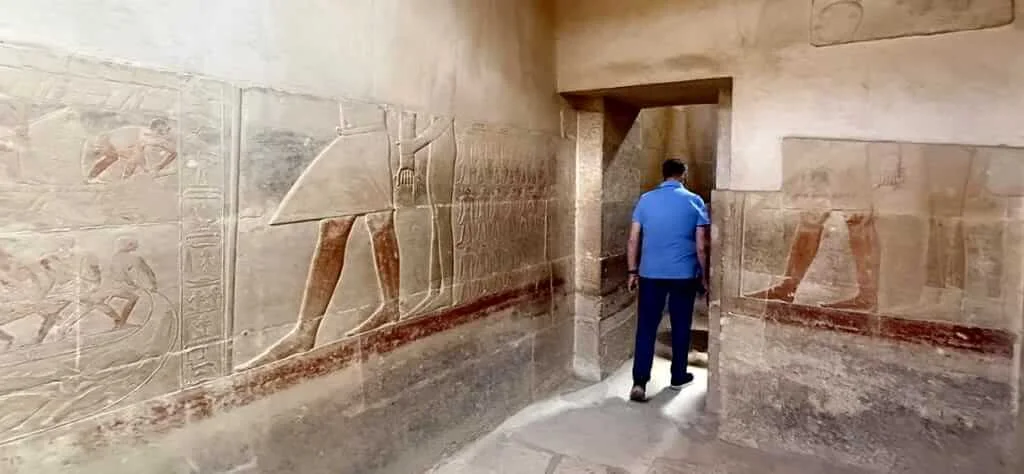
Mereruka’s mastaba defies the traditional rules of noble tomb construction. Most high officials of the Old Kingdom settled for three or four chambers; however, Mereruka built a sprawling 32-room complex. This architectural marvel functions as a family “funerary palace,” split into three distinct, interconnected sections.

Section A: The Realm of the Vizier (Chambers 1–21)

Section A; The Realm of the Vizier (Chambers 1–21)

The northern and largest portion of the tomb belongs exclusively to Mereruka. This section serves as the public face of his funerary cult.

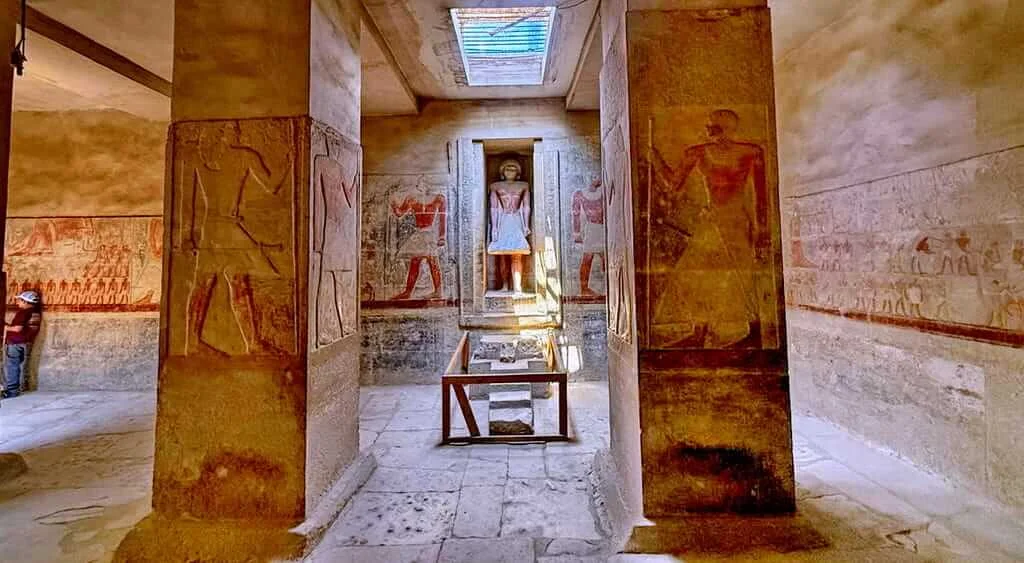
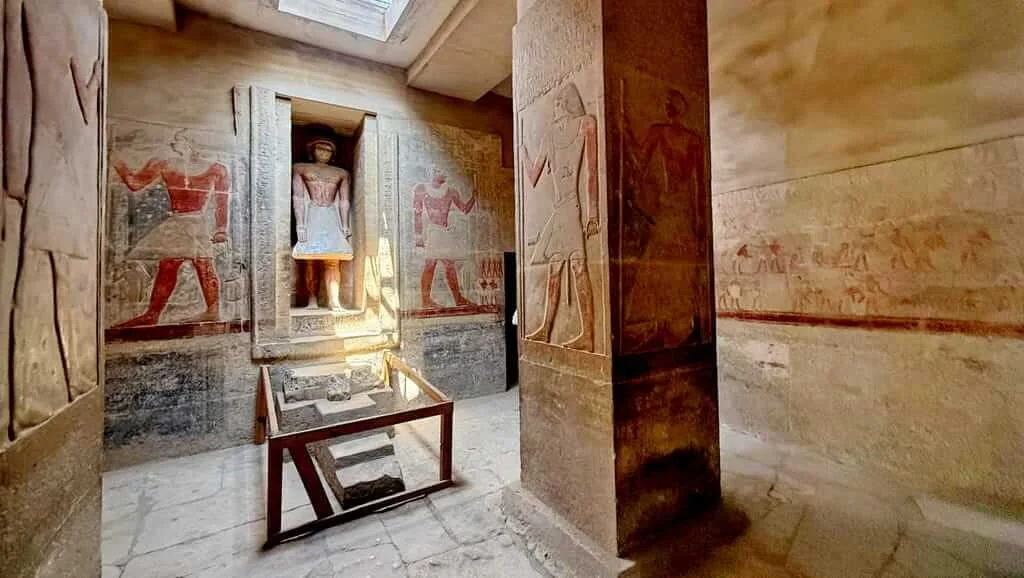
  • The Great Hall: Six massive square pillars support the ceiling of this grand offering room. The scale of this hall mimics the majestic hypostyle halls found in royal temples.
  • The Iconic Ka-Statue: At the northern end of the Great Hall, you will find the tomb’s most famous feature. A life-sized statue of Mereruka “steps out” from a recessed false door. This masterpiece of 6th Dynasty sculpture creates a physical bridge between the world of the living and the realm of the dead. It allows Mereruka to symbolically enter the hall to receive offerings from his priests.

Section B: The Princess’s Chambers (Chambers 22–26)

Section B; The Princess’s Chambers (Chambers 22–26)

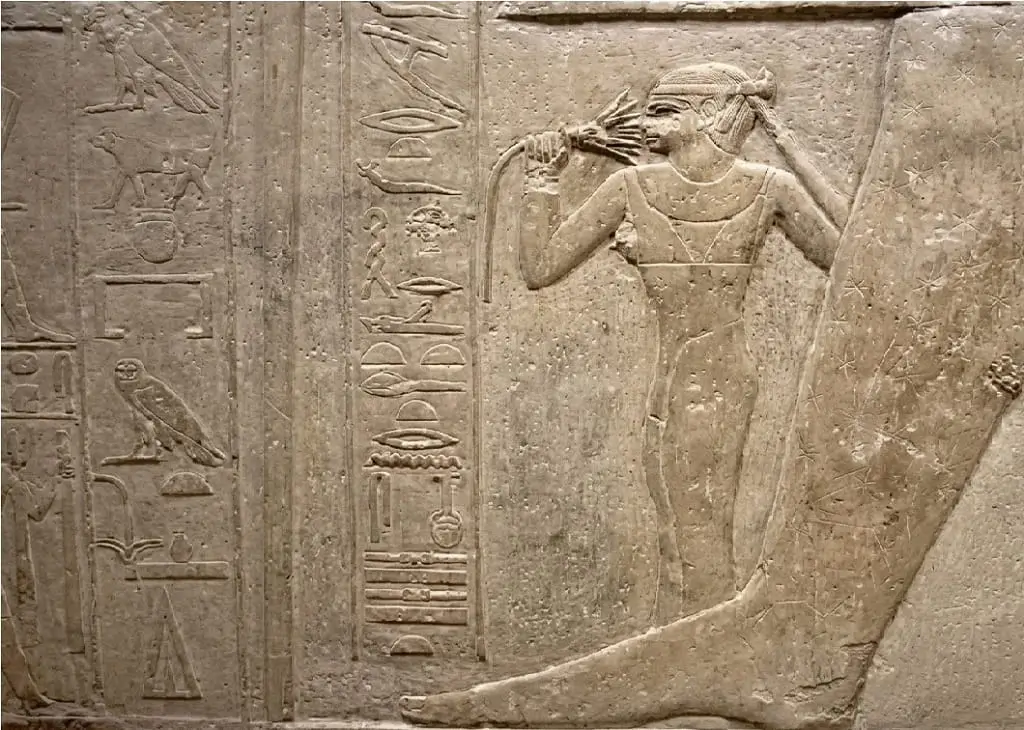
The central section belongs to his wife, Princess Hertwatet-khet. Although smaller than Mereruka’s wing, these rooms feature refined, delicate carvings that reflect her royal status as the King’s daughter. The scenes here move away from the bureaucracy of the state and focus on her role within the royal household and her priestly duties.

Section C: The Son’s Legacy (Chambers 27–32)

The final section belongs to their son, Meri-Teti. By including his son in the primary mastaba complex, Mereruka ensured the continuity of the family’s power. Meri-Teti eventually followed in his father’s footsteps, holding the title of Vizier under a later king. This section of the tomb allowed the family to share the same ritual space, centralizing their “Eternal House” in a single, massive limestone block.

Professional Observation: The layout of the Mastaba of Mereruka proves that by the 6th Dynasty, the Vizier had become so powerful that his funerary requirements mirrored those of a minor king. The inclusion of specialized rooms for different family members anticipates the complex royal tomb layouts we see later in the New Kingdom.

The Catacombs of Kom Esh-Shokafa: Roman-Egyptian Underworld

Descend into one of the "Seven Wonders of the Middle Ages" at the Catacombs of...
Related post
FUN

A Detailed Guide to the Mastaba of Mereruka Reliefs

The Industrial and Bureaucratic Record

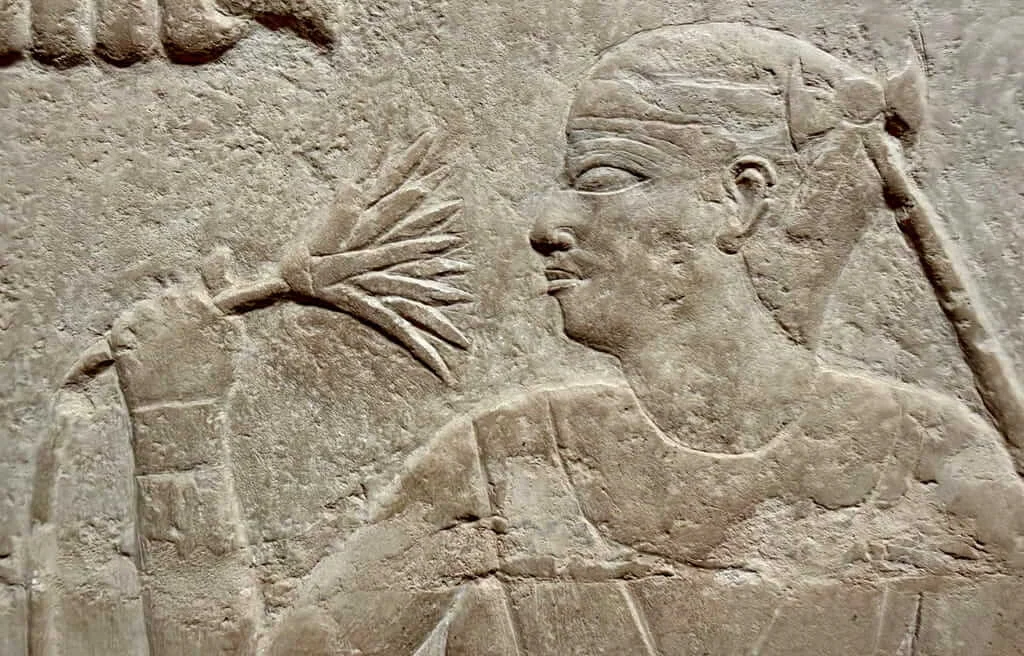
While the architectural scale of the complex is impressive, the true genius of the site lies in its wall carvings. The Mastaba of Mereruka reliefs act as a high-definition lens into the Old Kingdom. Consequently, they offer a level of detail that surpasses almost any other monument in Saqqara. To help you navigate this “stone library,” we have highlighted the most significant scenes found within the Mastaba of Mereruka.

The Industrial and Bureaucratic Record

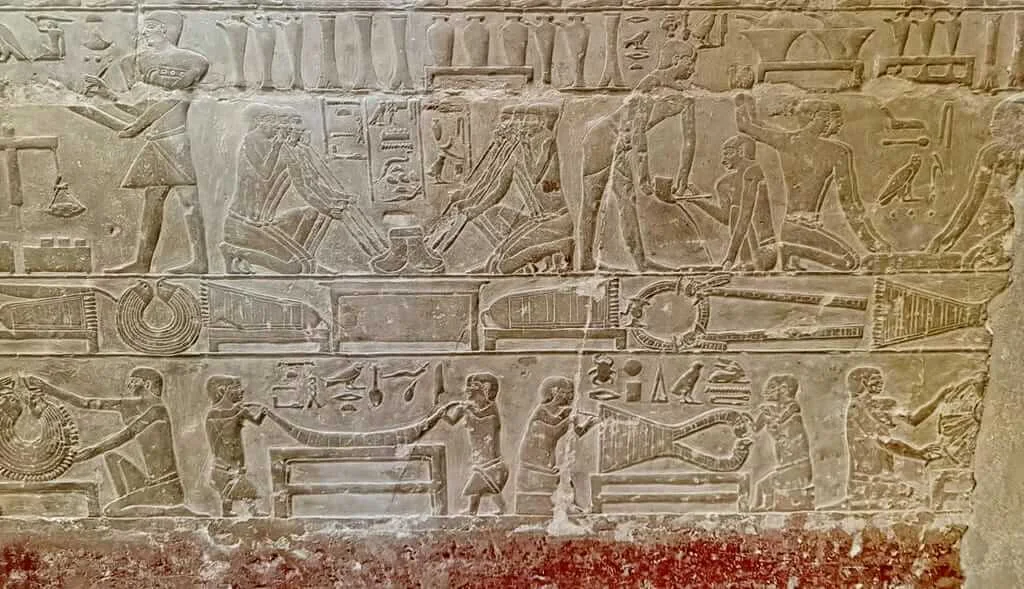
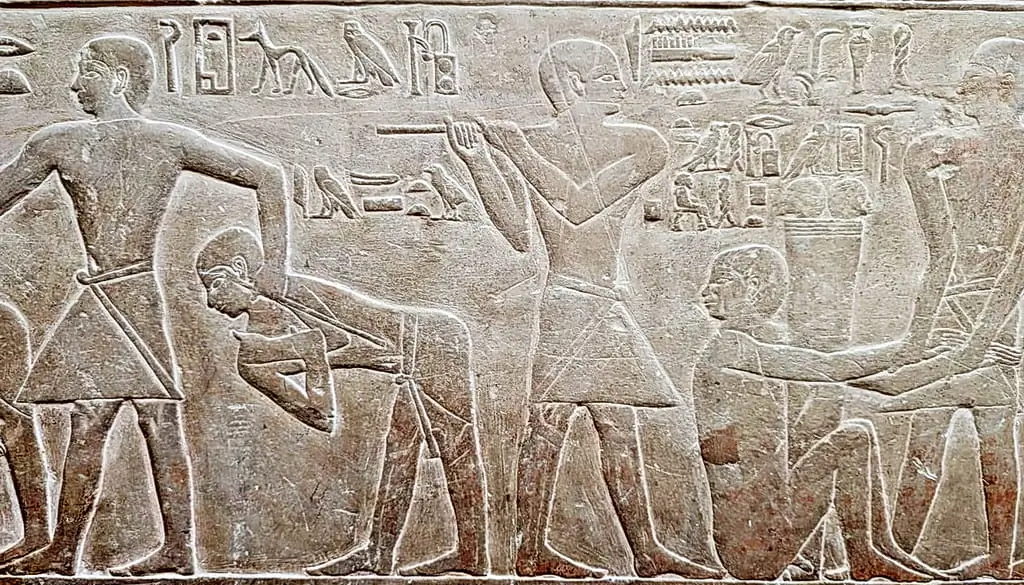
Because Mereruka managed the state’s finances, the Mastaba of Mereruka reliefs meticulously record the mechanics of the Egyptian economy. In the entrance corridors, you will find detailed depictions of various trades.

  • The Metalworkers: One famous scene shows craftsmen blowing into long tubes to stoke the fires for gold smelting. Meanwhile, others weigh the finished jewelry on precise scales.
  • The Scribes: Throughout these rooms, rows of scribes sit with their papyrus rolls, recording every grain of harvest. This emphasizes that, for Mereruka, documentation was the foundation of a successful afterlife.

The Stern Reality of Ancient Justice

The Stern Reality of Ancient Justice

One of the most remarkable—and somber—sections of the Mastaba of Mereruka reliefs is the “Tax Collection” scene. In this depiction, local governors and village elders appear before Mereruka to account for their taxes.

  • The Whipping Post: If the elders failed to meet their quotas, the consequences were severe. The relief clearly shows men being tied to a whipping post and beaten.
  • The Significance: This scene provides a rare, honest look at the harsh realities of ancient governance. Furthermore, it reinforces Mereruka’s absolute authority as the Chief Justice.

Nature and the Hunt in the Nile Marshes

Nature and the Hunt in the Nile Marshes

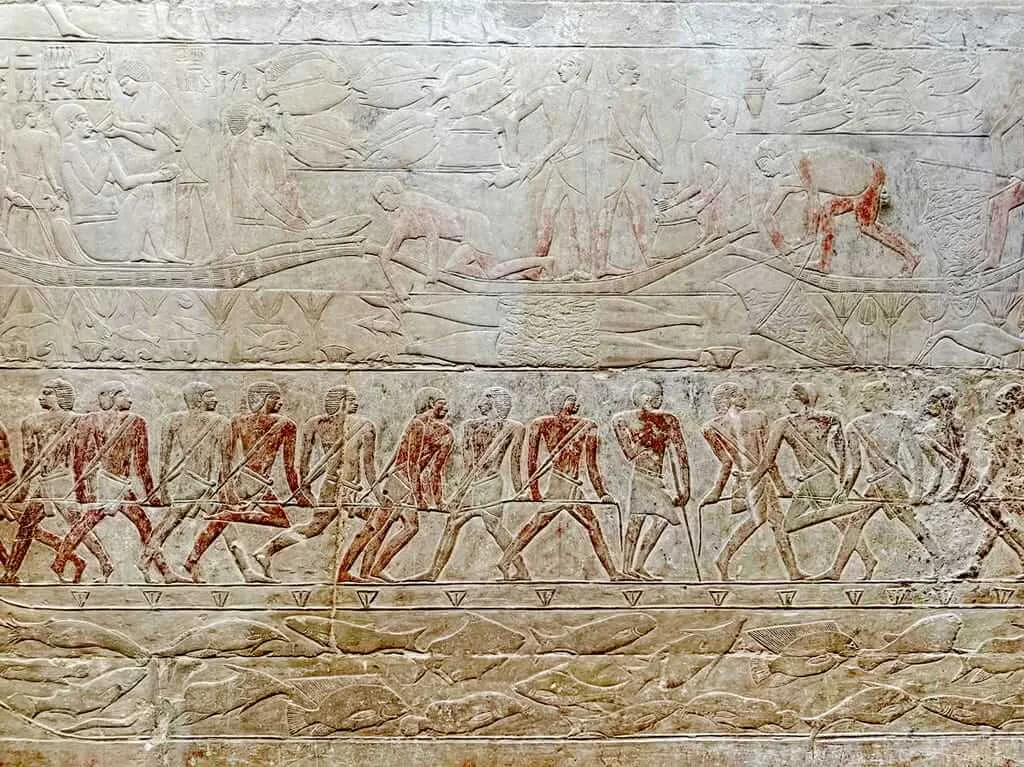
As you move into the inner chambers, the theme of the Mastaba of Mereruka reliefs shifts from the city to the wild marshes of the Nile Delta. These scenes are famous for their dynamic energy and biological accuracy.

  • The Hippopotamus Hunt: Men on papyrus skiffs engage in a violent battle with hippos and crocodiles. In a particularly famous “action shot,” a crocodile attacks a baby hippo while its mother attempts to defend it.
  • A Masterclass in Biodiversity: Moreover, the water beneath the boats is teeming with life. The carvings are so precise that modern scientists can identify the exact species of Nile fish, from tilapia to catfish, based on their fin structures.

Daily Life: Agriculture and Navigation

Daily Life Agriculture and Navigation

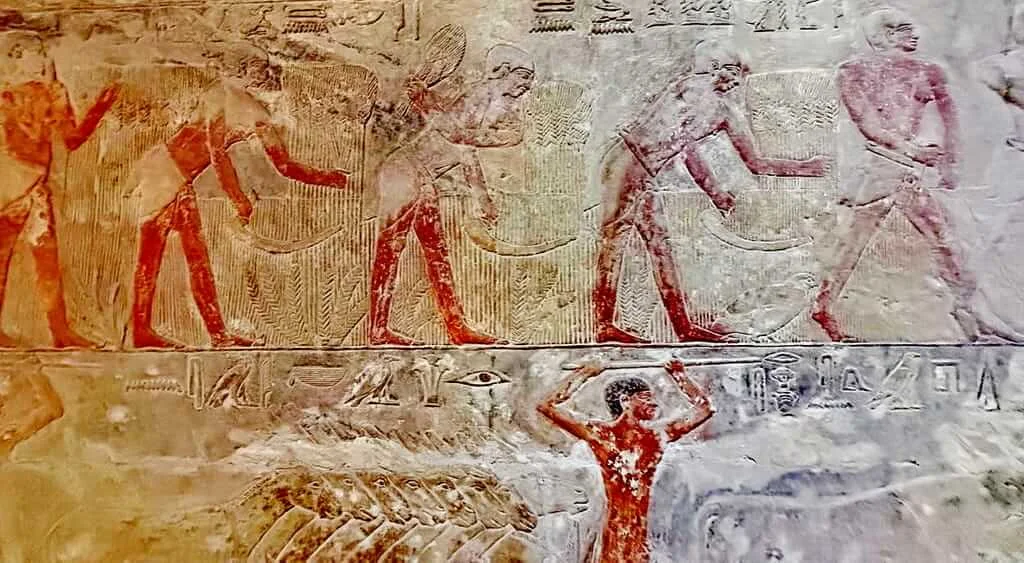
In addition to the hunt, the Mastaba of Mereruka reliefs celebrate the peaceful rhythms of the land.

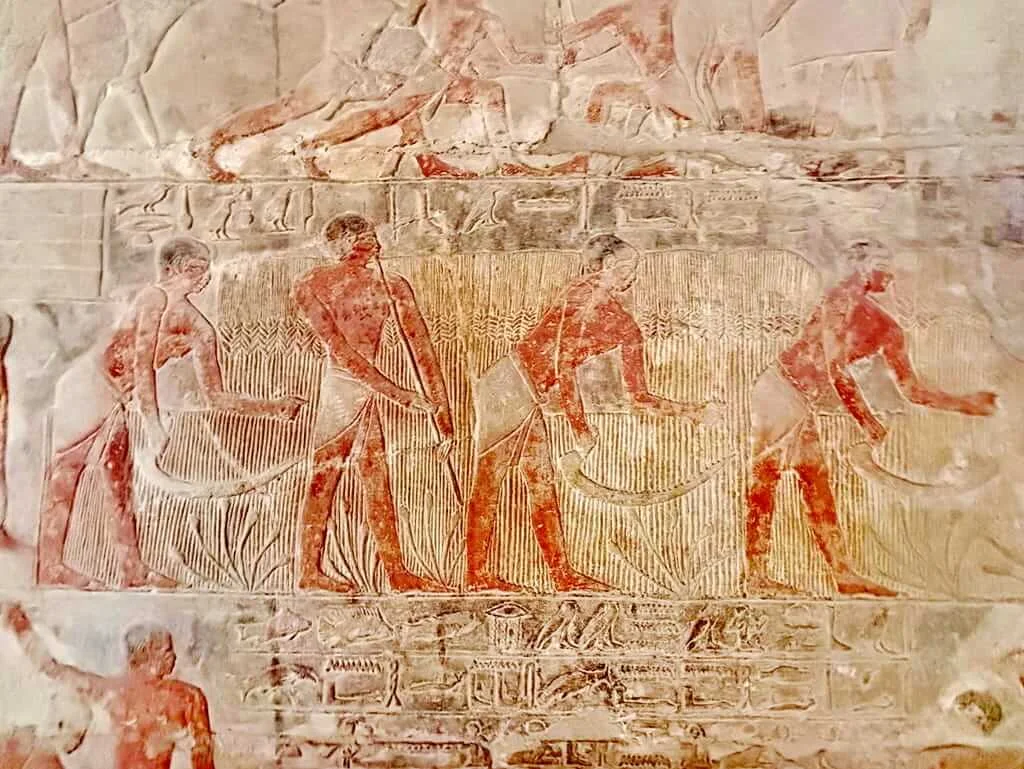
  • Farming and Harvest: You can observe farmers plowing fields with oxen and harvesting grain. Interestingly, some scenes even show the force-feeding of hyenas—a unique but documented practice of the 6th Dynasty.
  • Sailing the Nile: Large-scale reliefs of transport ships show the complex rigging and oars used to move goods. These scenes highlight the maritime logistics that Mereruka controlled as the head of the royal administration.

Saqqara: Guide to Egypt’s Eternal Necropolis and the Evolution of the Pyramid

Saqqara is a vast ancient necropolis near Cairo, serving as the burial ground for the...
Related post
FUN

Protecting the Mastaba of Mereruka

Research & Conservation; Update Protecting the Mastaba of Mereruka

As we move through 2026, the Mastaba of Mereruka remains a primary focus for international conservation teams. Because the tomb sits on the high desert plateau of Saqqara, it faces constant environmental threats from fluctuating humidity and shifting sands. Consequently, the Egyptian Ministry of Tourism and Antiquities has implemented several high-tech solutions to preserve these fragile 6th Dynasty treasures.

The “Digital Twin” Project (2025–2026)

In late 2025, researchers completed a full 3D laser scan of all 32 chambers.

  • Purpose: This “Digital Twin” creates a perfect millimetric record of every relief and inscription.
  • Result: This data allows conservationists to monitor even the smallest cracks or surface decay in real-time. Moreover, it powers a new Augmented Reality (AR) experience. Visitors can now use a mobile app to see the Mastaba of Mereruka reliefs as they appeared 4,300 years ago, restored to their original, vibrant colors.

Climate Control and Structural Reinforcement

In January 2026, engineers finalized the installation of a new subterranean ventilation system.

  • The Problem: For decades, the breath and body heat of thousands of tourists caused moisture to build up on the limestone walls. This led to salt crystallization, which can literally push the carvings off the stone.
  • The Solution: The new system maintains a constant temperature and humidity level without using noisy machinery that could vibrate the delicate structures. Furthermore, teams reinforced the massive limestone slabs over the Great Hall to ensure the six pillars could support the ceiling for another millennium.

New Color Discoveries

Perhaps most excitingly, non-invasive infrared imaging in early 2026 has revealed “hidden” sketches.

  • Artist Manuals: Scientists found grid lines and artist corrections beneath the final layers of plaster. These “ghost drawings” show how the ancient masters planned the complex layouts of the Mastaba of Mereruka reliefs.
  • Rare Pigments: The scans also identified traces of “Egyptian Blue,” one of the world’s first synthetic pigments. This proves that Mereruka spared no expense, importing the most expensive materials available to decorate his final home.

Aswan’s Tombs of the Nobles: The Ultimate View & Ancient Stories

Discover Aswan's best-kept secret: the Tombs of the Nobles. Carved high into the cliffs of...
Related post
FUN

Expert Travel Tip for Your Visit

Expert Travel Tip for Your Visit

Due to these new conservation measures, certain chambers within the Mastaba of Mereruka may occasionally close for maintenance. However, the Great Hall and the famous “walking” statue remain open to the public. We recommend checking with your Egypt Fun Tours guide for the most current access updates before you arrive at the Saqqara plateau.

Visitor Logistics: How to Experience the Mastaba of Mereruka

Visiting the Mastaba of Mereruka requires a bit of planning, as it sits within the massive 7-kilometer stretch of the Saqqara Necropolis. Because this tomb is a highlight of the “North Cemetery,” you should coordinate your visit with the nearby Pyramid of Teti and the Bubasteion catacombs.

Location and Access

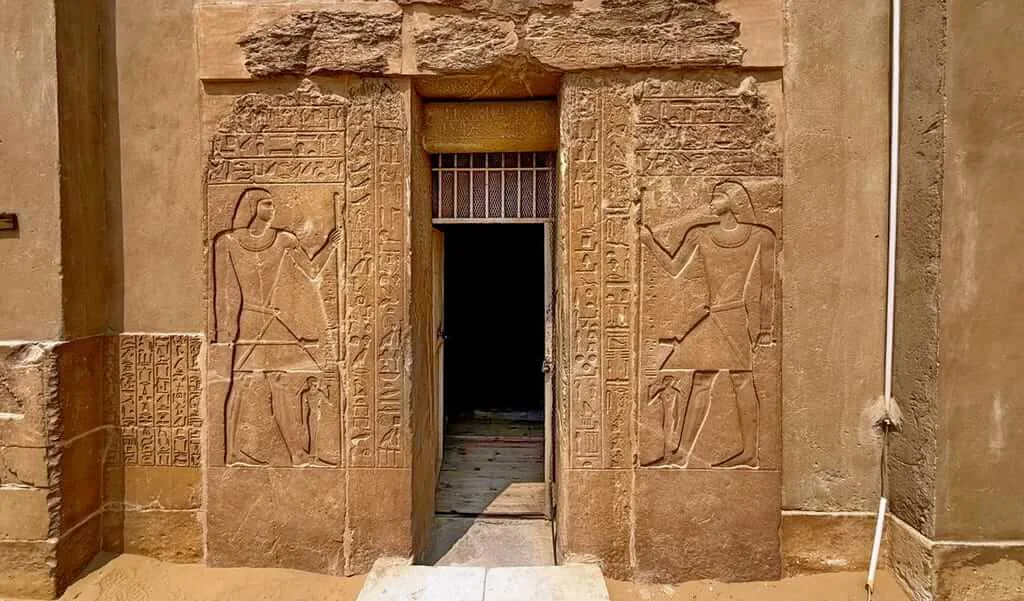
The tomb is located just a few meters north of the Pyramid of Teti.

  • The Walk: After you pass the main ticketing gate and the Imhotep Museum, follow the road toward the Teti complex. You will find the massive, low-slung limestone entrance of Mereruka’s mastaba directly facing the pyramid.
  • Finding the Entrance: Look for the modern wooden door and the official Ministry of Antiquities signage. In 2026, new digital kiosks near the entrance provide a quick overview of the tomb’s layout before you step inside.

Ticket Requirements

As part of the Ministry’s 2026 “Digital Egypt” initiative, ticketing for Saqqara has become more streamlined but also more strict.

  • Integrated Tickets: Most “General Site” tickets for Saqqara now include entry to the Mastaba of Mereruka. However, always verify this at the main ticket office, as some “Noble Tomb” bundles change seasonally.
  • Card Only: Remember that the ticket office no longer accepts cash. You must use a credit or debit card for all transactions.
  • Photography: In 2026, mobile phone photography is generally allowed for free. However, if you plan to use a professional DSLR or a tripod to capture the Mastaba of Mereruka reliefs, you must purchase a specific “Professional Photography” permit at the main gate.

Best Time to Visit

To avoid the large tour groups that arrive from Cairo, we recommend arriving at the site by 8:30 AM.

  • The Morning Light: The morning sun highlights the depth of the reliefs in the outer chambers.
  • Beat the Heat: Because the mastaba is a dense stone structure, it can become humid by midday. Visiting early ensures a much more comfortable experience.

Pro-Traveler Gear List

To fully appreciate the fine details of the Mastaba of Mereruka reliefs, bring the following:

  • A Small Torch: While the tomb has modern LED lighting, a small flashlight helps you see the “ghost lines” and fine chisel marks in the darker corners of the wife’s and son’s chambers.
  • Comfortable Shoes: The floors are original limestone and can be uneven in places.
  • The Egypt Fun Tours App: Use our digital guide to access the AR “Color Restoration” features we mentioned in the research section.

Why Mereruka is Unmissable

Why Mereruka is Unmissable

The Mastaba of Mereruka is more than just a burial site; it is a 4,300-year-old masterpiece of human history. From the towering Ka-statue in the Great Hall to the tiny, perfectly carved fish in the marsh scenes, it offers a level of immersion that you simply cannot find at Giza.

By following this guide, you aren’t just looking at old stones—you are stepping into the life and legacy of the man who helped shape the Old Kingdom. Whether you are a photography enthusiast or a history buff, Mereruka’s “Palace of the Dead” will undoubtedly be the highlight of your Saqqara journey.

Journey across the priceless wonders of Egypt....
Enjoy the charming atmosphere of Egypt....
God_Anubis_Icon

Valley of Whales – Wadi El Hitan and Wadi El Rayan

What a blast! It was an amazing day and a 5-star day trip. Everything was organised from A to Z by Hamada and Mohamed at Egypt Fun Tours in a timely manner. Pick up/drop off from/to the hotel, exquisite lunch and snacks, 4×4 jeep. Everything was as advertised. Also, the

More »

Day trip to Wadi el Hitan and Wadi el Rayan

We went on a full-day trip to Wadi el Hitan and Wadi el Rayan with Mohamed (Hamada). Mohamed was a wonderful guide, always making sure we had plenty of water and enough to eat, and providing us with information about the area and Egypt more generally. He also gave us

More »

AMAZING Layover Tour

We had the MOST amazing layover tour with Egypt Fun Tours. Hanni was amazing, and we loved every moment. Pyramids, authentic food, and Islamic Cairo – amazing!

More »

Cairo Day Trip

Great trip organised. I had a 12-hour layover in Cairo and had a great time with Sherif, who answered every question I had on ancient Egypt. Highly recommend.

More »

Outstanding layover tour

I had the opportunity to do a layover tour with Egypt Fun Tours this Friday, and it was amazing. I had a 10-hour layover tour in Cairo, and I was met by Mohamed on time at the airport. He picked me up in a clean, new, safe, and comfortable van.

More »
God_Anubis_Icon

Top-rated Tour Packages

God_Anubis_Icon