A Vision of Stability
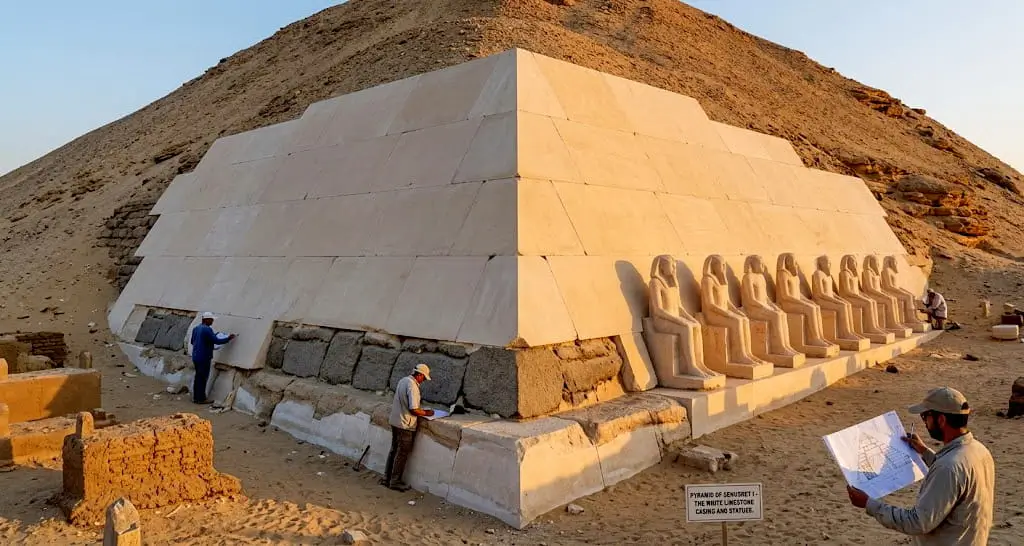
Senusret I did not just inherit a throne; he inherited a mission to solidify the 12th Dynasty. Following his father’s assassination, Senusret I chose a site just two kilometers south of Amenemhat I’s monument. However, he abandoned the “recycled” aesthetic of the previous generation. Instead, he commissioned a masterpiece of precision and symmetry. The Pyramid of Senusret I stands as the best-preserved monument of the Middle Kingdom. It showcases a radical new internal skeleton designed to withstand the weight of the ages. While the outer casing has long since vanished, the remaining core reveals a level of planning that rivals the Great Pyramids of Giza. This pillar examines how Senusret I transformed the desert at Lisht into a high-tech center of religious and political power.
The Grid-Wall Innovation: A Skeleton of Stone
Architects for the Pyramid of Senusret I introduced a revolutionary “skeleton” technique. They moved away from the chaotic fill of earlier Middle Kingdom cores. Instead, they built a rigid internal frame.
Workers constructed eight massive stone walls that radiated from the center to the corners and the middle of each face. They then connected these with cross-walls, creating 16 distinct compartments. Finally, they packed these cells with limestone rubble and sand. This grid acted like a modern skyscraper’s steel frame. It prevented the internal pressure from shifting or collapsing. Therefore, the Pyramid of Senusret I serves as a primary example of Middle Kingdom engineering ingenuity.
The Ten Satellite Pyramids: A Family Legacy
Senusret I surrounded his monument with an unprecedented number of satellite structures. He built ten smaller pyramids for his wives and daughters within the inner and outer enclosure walls.
- Symmetry: These smaller tombs demonstrate a level of planning rarely seen in funerary complexes.
- Ritual Power: Each satellite pyramid had its own small mortuary temple and offering chapel.
- Legitimacy: By placing his family in such prominent structures, Senusret I reinforced the divine status of the entire 12th Dynasty bloodline.
These structures offer vital clues about the roles of royal women during the Middle Kingdom. Archaeologists have recovered exquisite jewelry and ritual items from these sites, proving that the Lisht Necropolis functioned as a high-status artistic hub.