The Logic of Immortality: The Evolution of Egyptian Afterlife Beliefs

Interpretation by: Mr. Muhammed Hussein (Professional Egyptologist & Tour Guide). Uncover the logical, step-by-step evolution of Egyptian afterlife beliefs, starting with the core discovery by Atum (Adam): The Creator is the Sun, Ra. This simple truth led to a pragmatic system where sleep was death, and resurrection meant physically waking up everyday in the Nile Valley at sunrise. This guide strips away mythology to reveal how every complex Egyptian practice—from mummification and burying massive gold reserves to writing the Book of the Dead ("Spells for Coming Forth by Day")—was a rational, architectural, and magical solution to the practical problem of securing an eternal life on Earth.

The Simple Truth of Resurrection

Did ancient Egyptians believe the afterlife was in the Nile Valley? Yes, absolutely. Forget complicated, abstract theories. Their belief system began with self-consciousness. When Homo Sapiens first gained the ability to ask profound questions, they focused on existence itself: Who are we? Why are we here? This line of questioning initiated the entire evolution of Egyptian afterlife beliefs.

Atum (Adam) observed the simple cause and effect of existence: Day brings life because the Sun is present; night brings death because it vanishes. Therefore, the Sun is the undeniable Creator.

The funeral rites of ancient Egypt are not mystical mysteries; they form a logical, pragmatic chain of actions. The entire complex process—mummification, the burial of massive gold, and the use of powerful spells—had one singular, driven goal: waking up again on this Earth when the sun god decides to after sunrise. Every subsequent complex action directly solved a previous practical problem. This is the simple, powerful evolution of Egyptian afterlife beliefs, a process that grew organically from the first logical answer into a monumental, enduring civilization.

FUN

The Origin Point: The Smart Man Atum and the Creator Ra
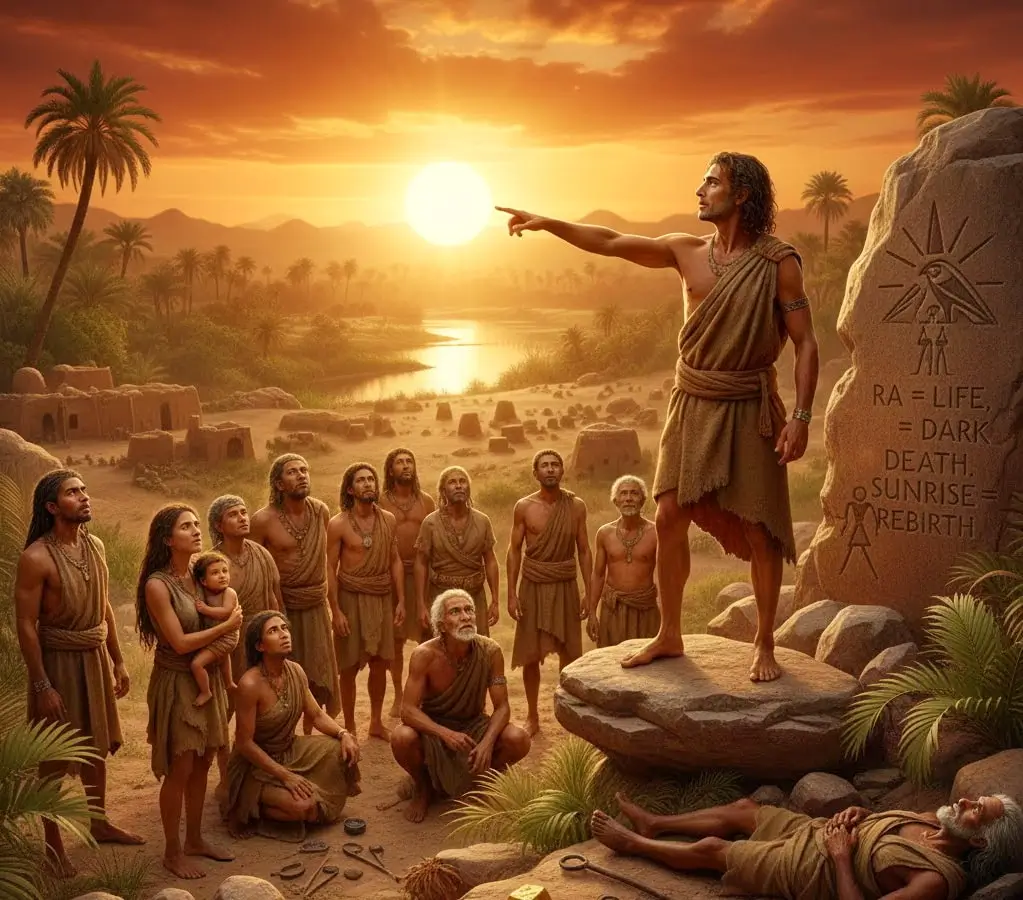
The Origin Point; The Smart Man Atum and the Creator Ra - Evolution of Egyptian afterlife beliefs

First, the entire religious system originated with the birth of human sanity. Homo Sapiens looked at the observable world and began to ask rational questions. This essential difference between humans and animals immediately started the evolution of Egyptian afterlife beliefs.

The earliest questions were fundamental, focused on survival: Who created us? Who are we?

The smart man, Atum, provided the first logical, actionable answer. Day meant life; when the Sun was visible, they were active and alive. Conversely, when the Sun disappeared, it became dark, and they slept (died).

Therefore, the Sun’s predictable return constituted the daily miracle. It made them alive again (resurrection). Consequently, Atum identified the Sun as the undeniable Creator, naming him Ra. Ra brought life back every morning. Atum became the first man to grasp and articulate this simple, essential truth, so everybody considered him a messenger of the creator (The Sun). Crucially, this established the simple, non-negotiable rule: The Creator Ra will make the dead alive again. This initial observation formed the fundamental starting point for the complex evolution of Egyptian afterlife beliefs.

The Core Equations of Eternity
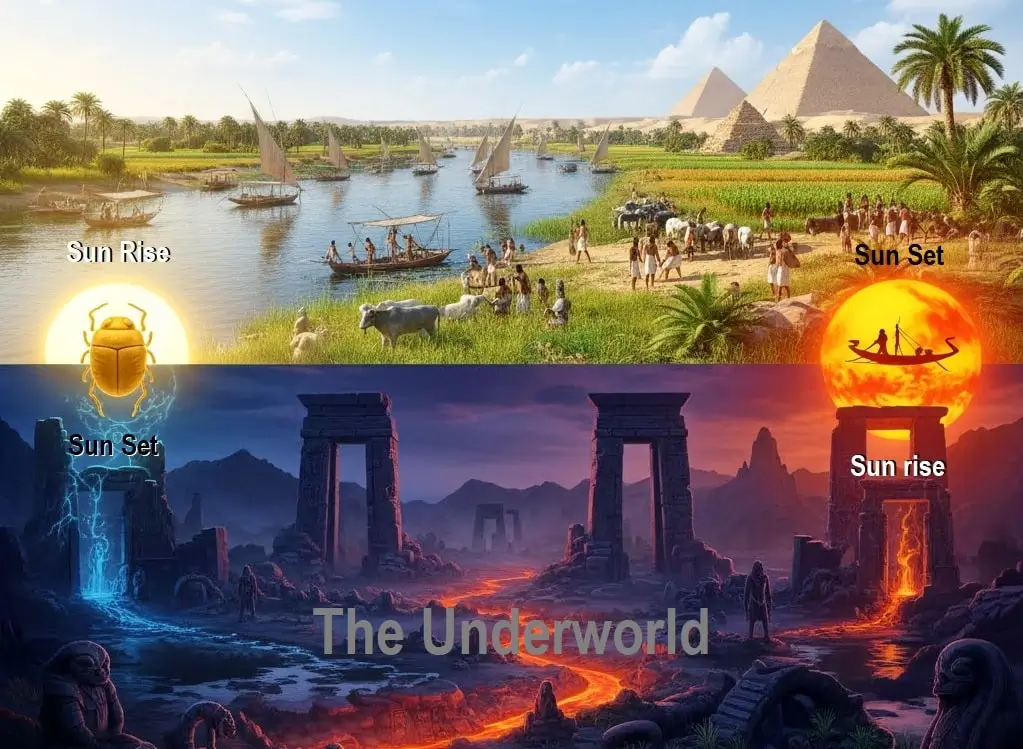
Exploring Duat; The Geography of the Egyptian Afterlife

Building upon this clear observation, the Egyptians established four simple yet profound facts about existence that guided all subsequent development and monumental construction:

  • Sleep = Death: Night is the period when consciousness stops; it is the observable form of death.
  • Resurrection = Waking Up in the Morning: Sunrise brings them back; it is the guaranteed return of life.
  • Afterlife = Tomorrow After Sunrise: Anew life is given by the creator every morning because the Sun appears in the sky and gives light.
  • Underworld = Where the Sun Goes and Comes From: This is the path Ra travels beneath the earth (the Duat) to restart the cosmic cycle.

These literal interpretations dictated every massive step the civilization took. Ultimately, the entire massive effort became a logical, dedicated investment in a perpetually recurring sunrise.

The First Necessity: Mummification to Wait for the Sun
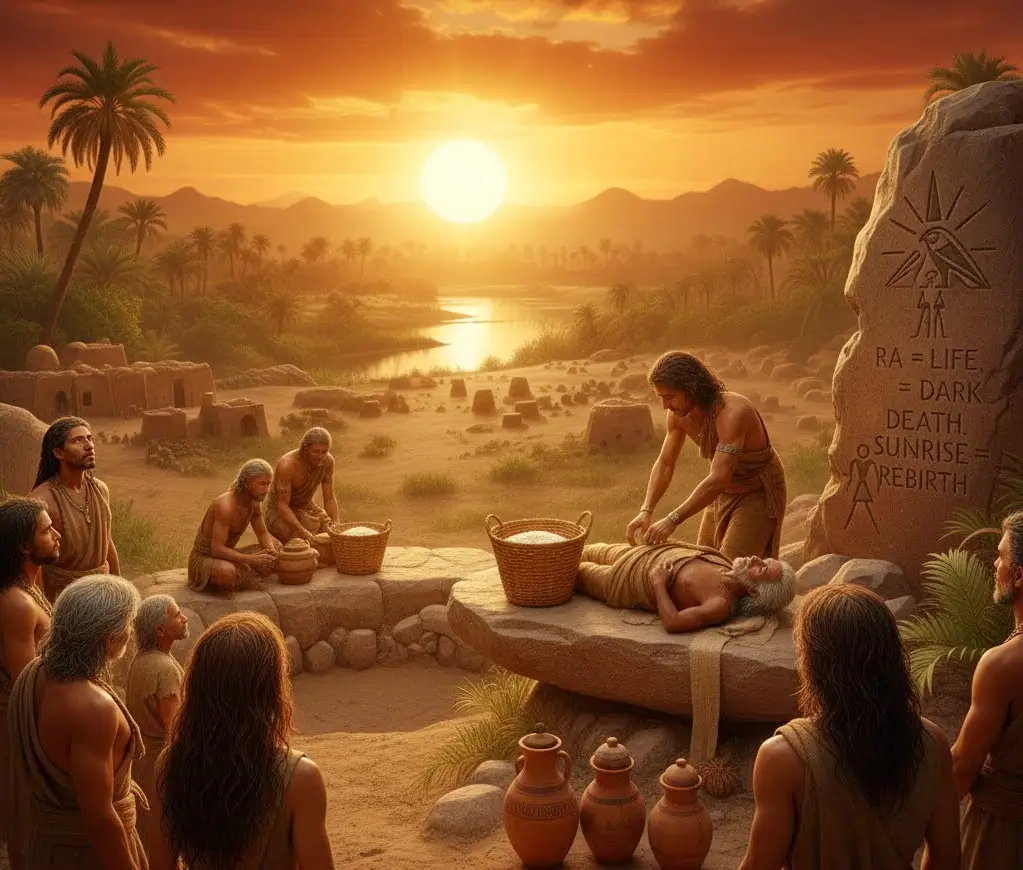
The First Necessity Mummification to Wait for the Sun - Evolution of Egyptian afterlife beliefs

Next, they faced a crucial, unsettling practical problem: some people did not wake up in the morning. They were not gone forever; they were simply waiting. They waited for the Creator Ra to choose their specific sunrise for resurrection. However, the body had to be ready for that specific, unpredictable day. The physical container needed to remain whole and instantly recognizable to the invisible life-force returning.

The fundamental requirement, then, was to keep the physical body ($Khat$) whole and preserved while it waited. Consequently, they realized they needed a preservation method. They initially observed the naturally mummified bodies in the desert sand and recognized this as the desired state. Observing this natural process, they discovered a crucial, surprising agent: the wild jackal. They noticed that when the jackals came to consume the fresh deceased’s body, the animal’s powerful saliva acted as an antiseptic, killing the bacteria that caused decomposition. Furthermore, the jackals would remove the internal organs and leave the body cavity coated with the preservative saliva. This gave the Egyptians the blueprint for artificial preservation: they started mimicking the jackal’s actions to preserve the body, which they named mummification. This direct observation and practical imitation is precisely why the Jackal God, Anubis, became the deity of embalming and the protector of the deceased.

The Mummification Process: A Preservation Checklist

The elaborate, time-consuming steps of mummification served as a detailed checklist to achieve maximum preservation for the long wait:

  • Drying is Key: They packed the body and covered it completely in Natron salt for up to 40 days. This step proved crucial. It removed all moisture, which causes immediate decay, thereby preserving the physical container against the harsh desert elements.
  • Organ Removal: They removed vital internal organs—the parts that decay fastest. They preserved these separately and stored them in special Canopic Jars. This was a highly practical step, eliminating the quickest sources of internal corruption.
  • Stuffing and Shaping: They stuffed the body and wrapped it tightly with hundreds of meters of linen bandages. This restored the person’s shape and provided necessary external protection. This was essential because the returning Ba (personality) absolutely had to recognize its original body immediately upon its return.

The goal remained simple: keep the physical body stable and whole until the sun made it alive again. Therefore, mummification formed a core pillar in the evolution of Egyptian afterlife beliefs. It was, plainly, a necessary piece of life-readiness infrastructure.

FUN

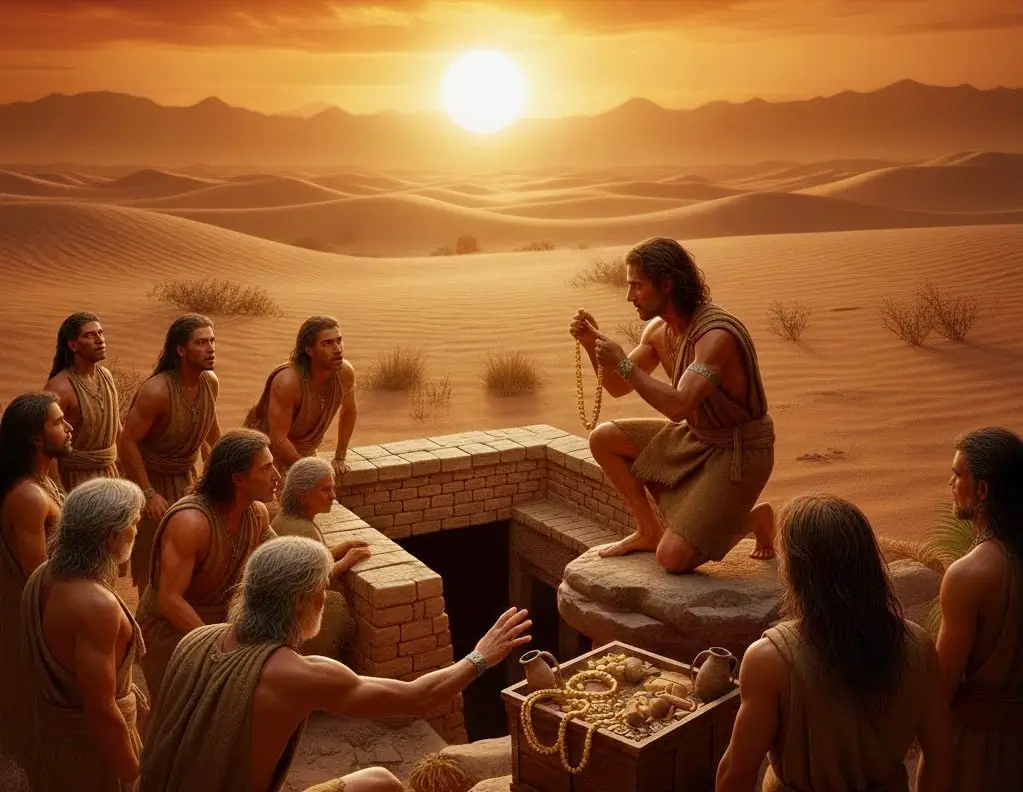
The Desert’s Challenge: Tombs and the Need for Gold

The Desert's Challenge; Tombs and the Need for Gold - Evolution of Egyptian afterlife beliefs

However, simple burial in the desert created major, dual problems: decay and robbery. The elements and animals still ruined the body. Furthermore, once possessions were buried, people immediately started stealing the gold and goods. The body and the economic resources for the afterlife were left unprotected. This environmental and human failure urgently demanded effective protection.

Consequently, Egyptians built tombs. These structures started as simple subterranean graves but quickly grew into structures called Mastabas. These closed structures were explicitly designed to protect the mummy. The tomb functioned as a safe storage unit, not just a resting spot.

The Resurrection Investment: Gold and Capital

Critically, the resurrected person would wake up on Earth. They would need immediate capital to resume their life. Therefore, the dead person’s gold, furniture, clothing, and food went into the tomb with them. This wealth became a mandatory investment for their future. Ultimately, it ensured the person could buy a house, a field, or whatever was needed for a good life upon waking up. The tomb effectively served as a secure bank vault for eternity. This direct link between earthly wealth and eternal survival is vital to understanding the evolution of Egyptian afterlife beliefs.

Scaling Up Security: The Mastaba and Tomb Security

As wealth and theft increased, simple graves failed. Therefore, the nobility built larger, more robust structures (Mastabas). These substantial structures housed the burial chamber deep underground, offering better protection against theft and decay. This relentless focus on security and wealth defined a clear line in the evolution of Egyptian afterlife beliefs. The tomb’s size became a direct indicator of the deceased’s security and future economic spending power.

Forming the First Definitions: Soul and Spirit

Forming the First Definitions; Soul and Spirit - Evolution of Egyptian afterlife beliefs

Subsequently, the Egyptians sought to understand how the Creator Ra actually gave life back. They needed to explain the physical mechanism. They concluded that Ra must send an invisible part of the person back into the preserved body. This invisible part joined the body, and the person lived again. This necessity led directly to the formation of the idea of the Soul and Spirit.

Defining the Five Parts of the Self

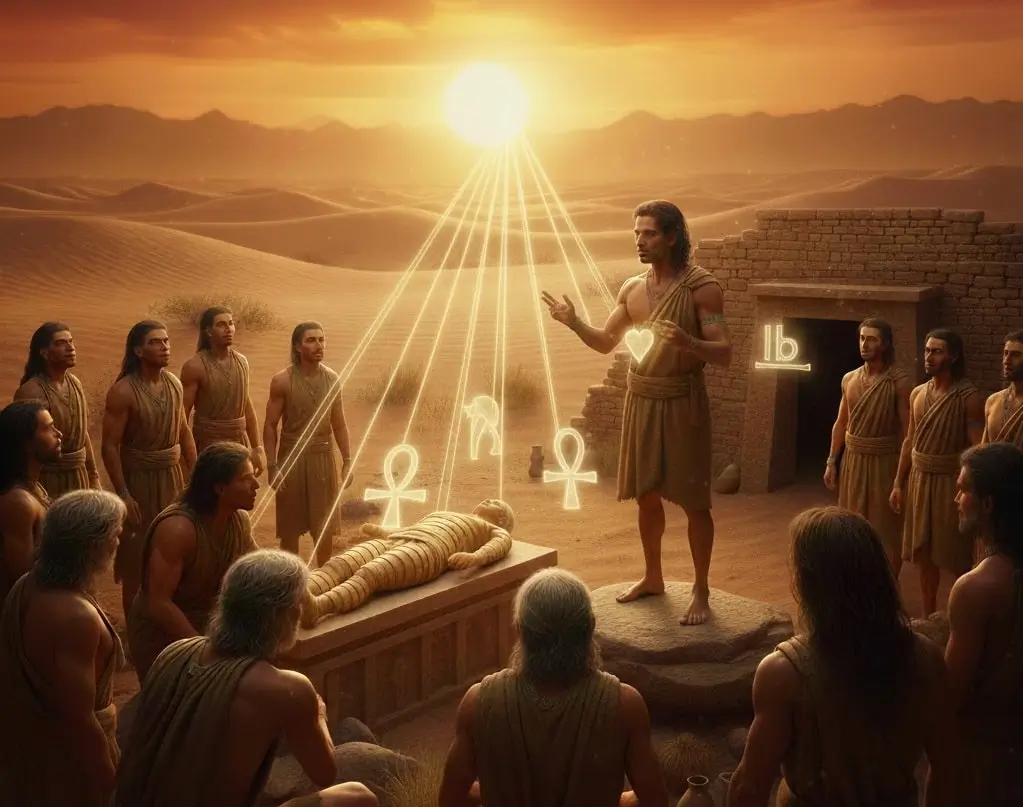
The simple belief in an invisible part expanded into a system of five distinct spiritual components, all needed for a successful, physical resurrection. This constituted a logical categorization of the elements required to fully restart life:

  • The Khat (The Body): The physical container. It absolutely had to be preserved for the other parts to function.
  • The Ka (Life Force): The person’s vital energy. It remained strictly in the tomb with the body. It required the body to be whole and needed food offerings to stay perpetually strong.
  • The Ba (Personality): The person’s mobile spirit. It traveled between the tomb (to check on the body) and the outside world. It was the crucial part that could actually see the sun Ra.
  • The Ib (The Heart): The seat of intelligence and emotion. It was required for judgment to ensure the resurrected person was worthy of continued life.
  • The Akh (The Transfigured Self): This was the successful union of the Ba and the Ka with the preserved Khat. This final union allowed the person to become fully alive and effective.

The overriding goal was simple: ensure the Ba could find the Khat, and the Ka had a stable home. These parts were logical categories needed for the person to start living again. Ultimately, this complex system marked a sophisticated logical step in the evolution of Egyptian afterlife beliefs.

The Profound Egyptian Influence on Greek Civilization

Egypt profoundly influenced ancient Greek civilization in various aspects. Key influences include religious syncretism, with...
Related post
FUN

Protecting the Asset: The Sarcophagus and the Birth of Spells

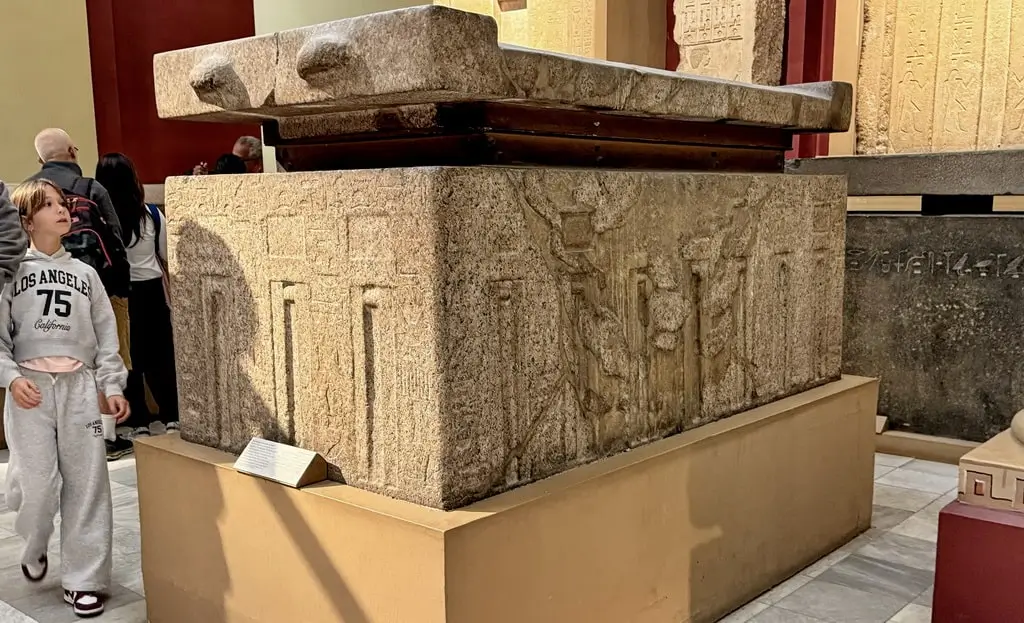
Ancient Egyptian Sarcophagus

Despite the tombs, the gold and the mummy were persistently being stolen. Robbers found ways to break through the structures. This sustained, existential threat demanded a final, overwhelming physical solution. Consequently, Egyptians used heavy stone sarcophagi. This represented the ultimate physical security upgrade. It protected the body and the gold inside a massive, heavy stone box.

The Security Problem of the Pyramid

This focus on physical security started with early large tombs and reached its peak with the construction of the Pyramids. The massive structures were designed to be impregnable bank vaults. However, the very scale of the pyramid posed a practical challenge. Royal mummies were placed deep inside. This meant the resurrected body would have to travel through long, dark passages to reach the sun (Ra). Protection and spells needed to increase dramatically in complexity and number.

But the heavy lid of the sarcophagus created a major new mechanical problem. Namely, how could the newly awakened person get out? The stone lid was far too heavy for a single person to push manually.

This practical challenge forced a necessary leap into magical solutions. The next stage in the evolution of Egyptian afterlife beliefs required the written word to gain power.

The Magic Solution: Coffin Texts

Thus, they created the Coffin Texts. These were not simple prayers for heaven. They were spells written inside the inner coffins and on the tomb walls. They were literal instructions and magical formulas. The dead person would read them when they woke up. The spell would magically illuminate and make the heavy lid open, allowing the person to escape the box and navigate the tomb’s passages. This solution successfully fixed the security problem while simultaneously ensuring the resurrected person could escape and reach the sun. The magic served as a purely practical tool to overcome a mechanical barrier.

Recording the First Life: Identity and Property

Saqqara step pyramid nobles tombs 13

Finally, the Egyptians addressed the problem of memory and identity—a final, psychological barrier. Imagine waking up centuries later, disoriented in a dark tomb. The resurrected person urgently needed to know their identity. Specifically, they needed to remember their family, their job, and their property to resume their life immediately in the new sunrise.

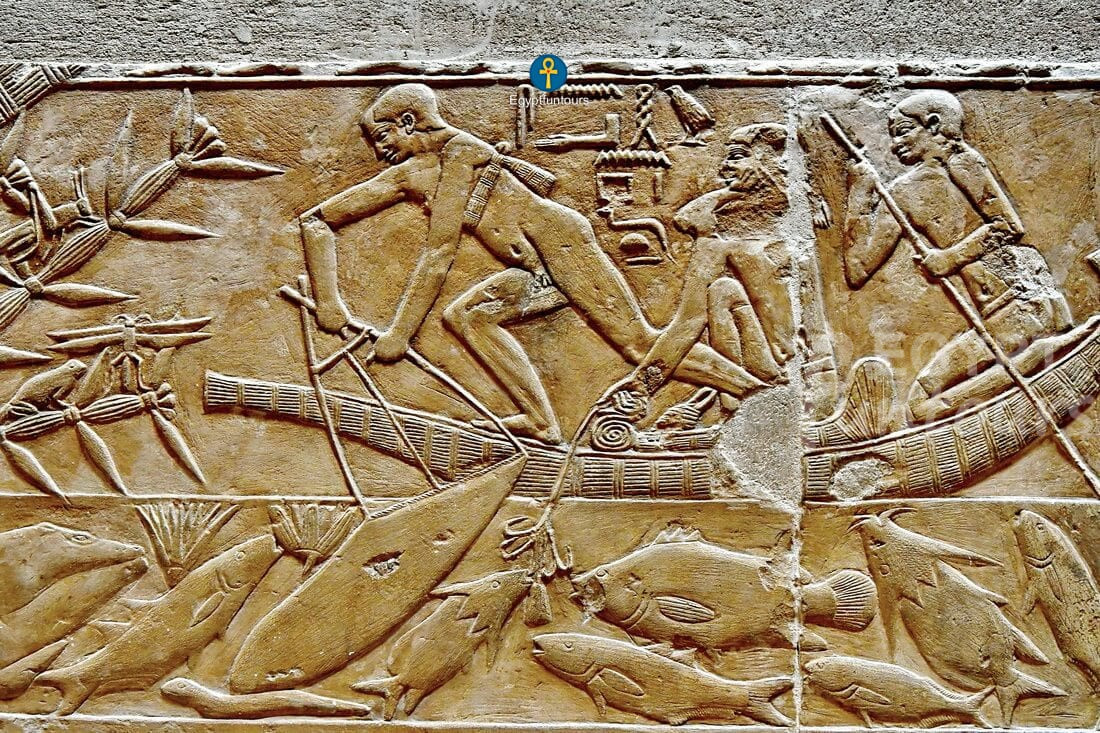
Therefore, they decided to record every detail of the deceased’s life on the tomb walls. This practice was not merely decoration. Rather, the elaborate tomb walls functioned as the deceased’s personal archive and legal proof of ownership.

The Wall as Legal Blueprint

  • Identity Record: The texts meticulously detailed their children, titles, and lineage. This information helped the person quickly restart their social life and prove their rank. It functioned as a fast-track back to their former life and status.

  • Magical Supply Chain: The drawings of food preparation, harvesting, and cattle raising were not memories. They served as magical blueprints. The deceased would read the formulas written nearby. Consequently, the images would magically become real food and real possessions when needed. This guaranteed a supply of sustenance and eliminated the dependency on descendants to leave offerings.

This final step guaranteed the deceased’s secure, prosperous life after waking up in the physical world. This practical need for identity fueled the late stages of the evolution of Egyptian afterlife beliefs.

Ancient Egyptian Mummies: From Pharaohs to Powdered Medicine

This article explores the dark, two-sided history of Ancient Egyptian Mummies. Discover the staggering scale...
Related post
FUN

The Royal Escalation: Kings’ Valley and The Ultimate Bank Vault

Tour to Luxor - 4-Night Movenpick Darakum

The entire logical system had to be scaled up exponentially for the Pharaoh. The King’s resurrection was vital for the entire country because Egyptians believed Egypt was a direct reflection of the cosmic order. The constant tomb robbery, even of the massive Pyramids, forced a new, radical solution: The Valley of the Kings.

The Ultimate Security Protocol

  • Concealment: They cut the tombs deep into the earth in a hidden valley, away from any monumental markers. The security now relied entirely on secrecy, not sheer size. This represented the most advanced anti-theft strategy the civilization developed.
  • Gold Reserve: The amount of gold buried with the Pharaoh (for example, Tutankhamun’s vast treasure) became the ultimate expression of the economic premise. If the afterlife is a physical return, the King must be richer than anyone to lead the resurrected Egypt. The gold acted as the nation’s reserve for the new cosmic age.
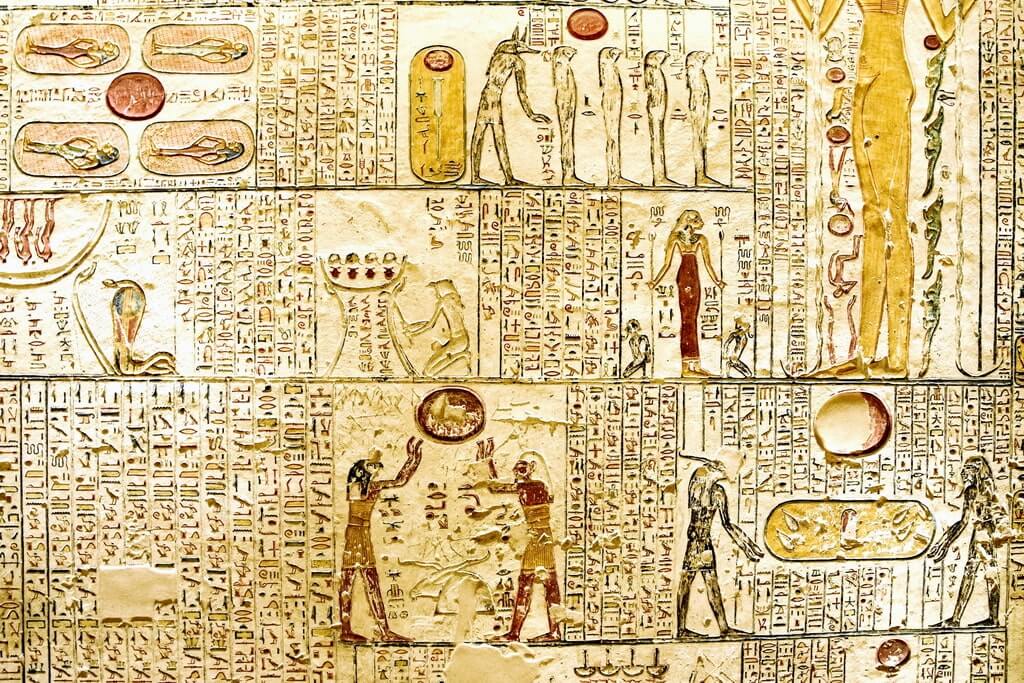
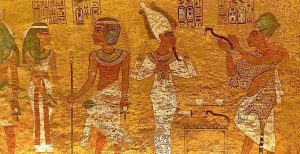
  • The Royal Map: They covered the walls of the Valley of the Kings tombs not just with simple spells, but with vast, detailed maps of the Underworld (Duat). These maps showed the precise routes Ra took every night. The King needed these maps to join Ra and guarantee his synchronized return with the sun. His resurrection became synchronized with the rising of Ra.

This royal practice ultimately solidified the basic premise: the afterlife remains a highly prepared, physically grounded return to Earth.

The Manual: Book of the Dead “Coming Out to the Daytime”

THe pyramids text ancient egyptian book of dead egypt fun tours

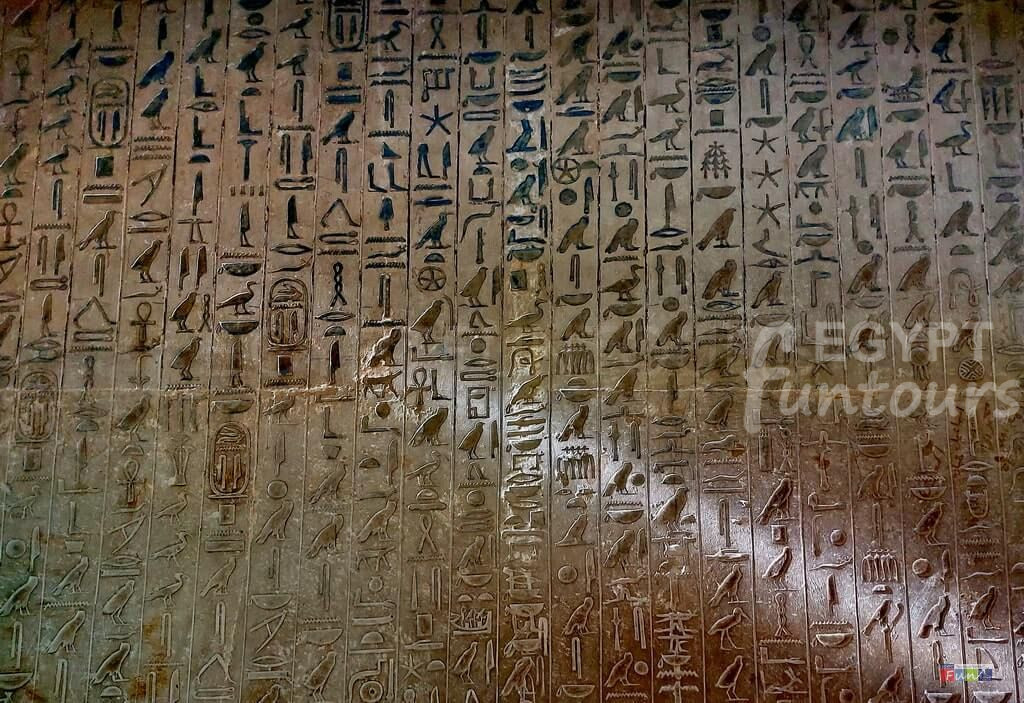
As the religion became popular and the need for personalized instruction grew, they compiled and standardized the magical spells (which started as Coffin Texts for nobles) into a single, accessible manual: The Book of the Dead.

  • The Title’s Meaning: The original Egyptian title was Reu\ nu\ peret\ em\  heru, which translates to: “Spells for Coming Forth by Day.”
  • The Goal: This title decisively confirms the entire premise of your argument. The ultimate goal was simply to escape the tomb and “Come Out to the Daytime”—to wake up and live again on Earth under the sun. The book served as a guarantee of a new sunrise.
  • The Final Escape: The Book of the Dead contained specific spells to ward off dangers, ensure the heart passed judgment (to prove one was a good citizen in their first life), and, most importantly, provide the magical knowledge to physically open the tomb door and walk out into the sunlight. It was the required magical license for resurrection.

The Book of the Dead is the final, standardized instruction manual for the final, physical resurrection.

Adam and Eve in Egypt: Atum and the First Divine Family

In Ancient Egyptian mythology, Atum (the first man/creator) fathered four major deities, two male and...
Related post
FUN

The Ultimate Practicality

The story of the Egyptian afterlife is fundamentally a story of pure logic. It represents a continuous, practical effort driven by an unwavering belief in a physical resurrection on Earth by the Creator Ra. Every major Egyptian practice was a direct, pragmatic solution to a simple problem:

  • Problem: The body decays. Solution: Mummification (Preservation).
  • Problem: The body and goods are stolen. Solution: The Stone Tomb and Sarcophagus (Security).
  • Problem: The resurrected person cannot escape the heavy lid. Solution: Coffin Texts (Magical Access).
  • Problem: The resurrected person has no memory or money. Solution: Wall Records and Gold (Identity and Capital).
  • Problem: The resurrected person needs a guide to join Ra. Solution: The Book of the Dead (Instruction Manual).

This logical, step-by-step evolution of Egyptian afterlife beliefs—starting with the first question asked by the smart man Atum and ending with the desire to “Come Out to the Daytime”—offers the simplest, most complete explanation for the world’s most enduring civilization.

❓ Frequently Asked Questions (FAQs)

Q1. What is the fundamental difference between the Egyptian afterlife and other religions?

The fundamental difference lies in location. Ancient Egyptian beliefs demanded a physical resurrection on Earth, specifically in the Nile Valley. Their elaborate preparations were not for reaching a distant, spiritual heaven, but for physically waking up under the Sun ($Ra$) in the tomb, which functioned as their eternal home and bank vault.

Q2. Why was the Sun (Ra) considered the Creator, according to Atum?

According to the observation made by the smart man Atum, the answer was simple logic. The Egyptians saw that the Sun gave them life and warmth during the day, and when the Sun disappeared, they experienced cold and unconsciousness (death). Therefore, the Sun’s guaranteed return every morning proved it was the source of life and resurrection. They named this Creator force Ra.

Q3. Why did Egyptians practice mummification? Was it magic?

Mummification was not magic; it was a highly practical preservation method. Because the deceased was simply waiting for their specific sunrise to be resurrected, the body (Khat) had to be kept whole and recognizable. If the body decayed, the returning life-force (Ka and Ba) would have nowhere to anchor, and the resurrection would fail.

Q4. What was the purpose of burying massive amounts of gold with the dead?

The gold was a mandatory investment and security reserve. The deceased would wake up in the physical world (the Nile Valley) and would immediately need money to resume their life—to buy land, hire servants, and sustain themselves. The tomb served as a bank vault, ensuring the resurrected person had the necessary capital to live prosperously.

Q5. What is the true meaning of the title “Book of the Dead”?

The original Egyptian title was Reu\ nu\ peret\ emheru, which translates to: “Spells for Coming Forth by Day.” This confirms the entire premise of the evolution of Egyptian afterlife beliefs. The goal of the book was not to guide the soul to heaven, but to provide the magical instructions and passwords necessary for the deceased to physically escape the tomb and “Come Out to the Daytime”—to wake up on Earth.

Q6. Why did the Egyptians develop the concepts of the Ka and Ba (Soul and Spirit)?

They developed the concepts of the Ka and Ba to logically explain how the resurrection process worked. The invisible parts were necessary mechanics:

  • The Ka (Life Force): Needed to stay with the body in the tomb.
  • The Ba (Personality): Needed to travel outside to see the Creator Ra and report back to the tomb.

The resurrection required the preserved body (Khat) to successfully unite with these invisible elements.

Adhere to your religious obligations, as you visit Cairo and Luxor...
Witness the magical attractions in Cairo and Luxor accompanied by a private expert tour guide....

Valley of Whales – Wadi El Hitan and Wadi El Rayan

What a blast! It was an amazing day and a 5-star day trip. Everything was organised from A to Z by Hamada and Mohamed at Egypt Fun Tours in a timely manner. Pick up/drop off from/to the hotel, exquisite lunch and snacks, 4×4 jeep. Everything was as advertised. Also, the

More »

Amazing one day tour

Fantastic tour. We were picked up at the airport early in the morning (6 am), and were dropped off in the evening after discovering amazing Cairo. The guide was knowledgeable and took us to many hidden places, which we wouldn’t have found without him. Thank you!

More »
4-day-christmas-nile-cruise

Hossam Rashwan Tour Guide

We took this trip with Hossam Rashwan as our tour guide, and I must say that Hossam was the greatest tour guide in Luxor who showed us around. Our tour guide’s tales transported us to Luxor’s past, and we felt as if we were living in ancient Egypt. We really

More »

Alexandria! Wow!

Muhammad is the best! He showed me a world I never thought possible! The tombs in Alexandria, by far, were my favorite! I never knew there was a place on earth that contained both Greek and Egyptian carvings in the same tombs! The history and culture of Egypt is so

More »
Isis with wings

Top-rated Tour Packages

Isis with wings