The Enigma of Meidum Pyramid: Egypt’s Forgotten Stairway to the Stars

The Meidum Pyramid stands as Egypt's most significant "missing link," documenting the daring transition from jagged step pyramids to the iconic smooth-sided structures of the Old Kingdom. This comprehensive guide explores the architectural evolution under Pharaohs Huni and Sneferu, detailing the three-stage construction of the "False Pyramid" and the enduring mystery of its partial collapse. Beyond the central monument, the guide takes readers into the depths of the enigmatic Mastaba 17 and showcases the world-famous "Meidum Geese" painting, offering a masterclass in ancient engineering and art. Designed for travelers seeking an authentic, crowd-free encounter with history, this resource provides the essential logistics and expert insights needed to master a day trip to this hauntingly beautiful desert site with Egypt Fun Tours.

Rising like a lonely sentinel from the desert sands, the Meidum Pyramid is one of the most striking sights in Egypt. Most travelers flock to the Great Pyramids of Giza. They stand in long lines to see the Sphinx. However, those who venture just 100 kilometers south of Cairo discover a different kind of magic. Here, the desert is silent. The air is still. In the center of this vast emptiness stands a structure that looks less like a tomb and more like a medieval fortress.

Locals call it El-Haram el-Kaddab, or the “False Pyramid.” Its bizarre, tower-like shape defies the classic triangular silhouette we associate with ancient Egypt. Yet, this crumbling giant holds the secrets to the greatest architectural evolution in human history. It is the bridge between the experimental Step Pyramid of Djoser and the perfection of the Great Pyramid of Khufu.

In this ultimate guide, we will peel back the layers of mystery surrounding this Fourth Dynasty masterpiece. Whether you are a history enthusiast or a curious traveler planning your next Egypt Fun Tours adventure, this is the definitive story of Meidum.

The History: Who Built the Meidum Pyramid?

To understand the Meidum Pyramid, we must first understand the ambition of the Old Kingdom pharaohs. They did not just want to build tombs. They wanted to build stairways to the heavens. Before Meidum, pyramids were built in steps. After Meidum, they were smooth and majestic.

But who exactly was the mastermind behind this transition? This remains one of the most debated topics in Egyptology.

The Duel of Two Kings: Huni vs. Sneferu

History is often written by the victors, but in the case of Meidum, the signatures are blurry. For decades, scholars believed that Pharaoh Huni—the last king of the Third Dynasty—commissioned the project. It makes sense chronologically. Huni likely wanted a grand monument to cement his legacy.

However, there is a catch. No contemporary inscriptions within the pyramid mention Huni’s name. Instead, many archaeologists now credit Pharaoh Sneferu, the founder of the Fourth Dynasty. Sneferu was a prolific builder. He was the “King of Pyramids.” In addition to Meidum, he built the Bent Pyramid and the Red Pyramid at Dahshur.

Why the confusion? Huni probably began the construction as a traditional step pyramid. When Sneferu took the throne, he did something radical. He decided to fill in the steps with limestone casing. He wanted to turn a jagged staircase into a smooth-sided “true” pyramid.

Expert Note: This transition marks the exact moment when Egyptian architecture changed forever. Sneferu wasn’t just building a grave; he was inventing a new way to reach the gods.

FUN

The Architecture of the Meidum Pyramid “False Pyramid”

The Architecture of the Meidum Pyramid “False Pyramid”

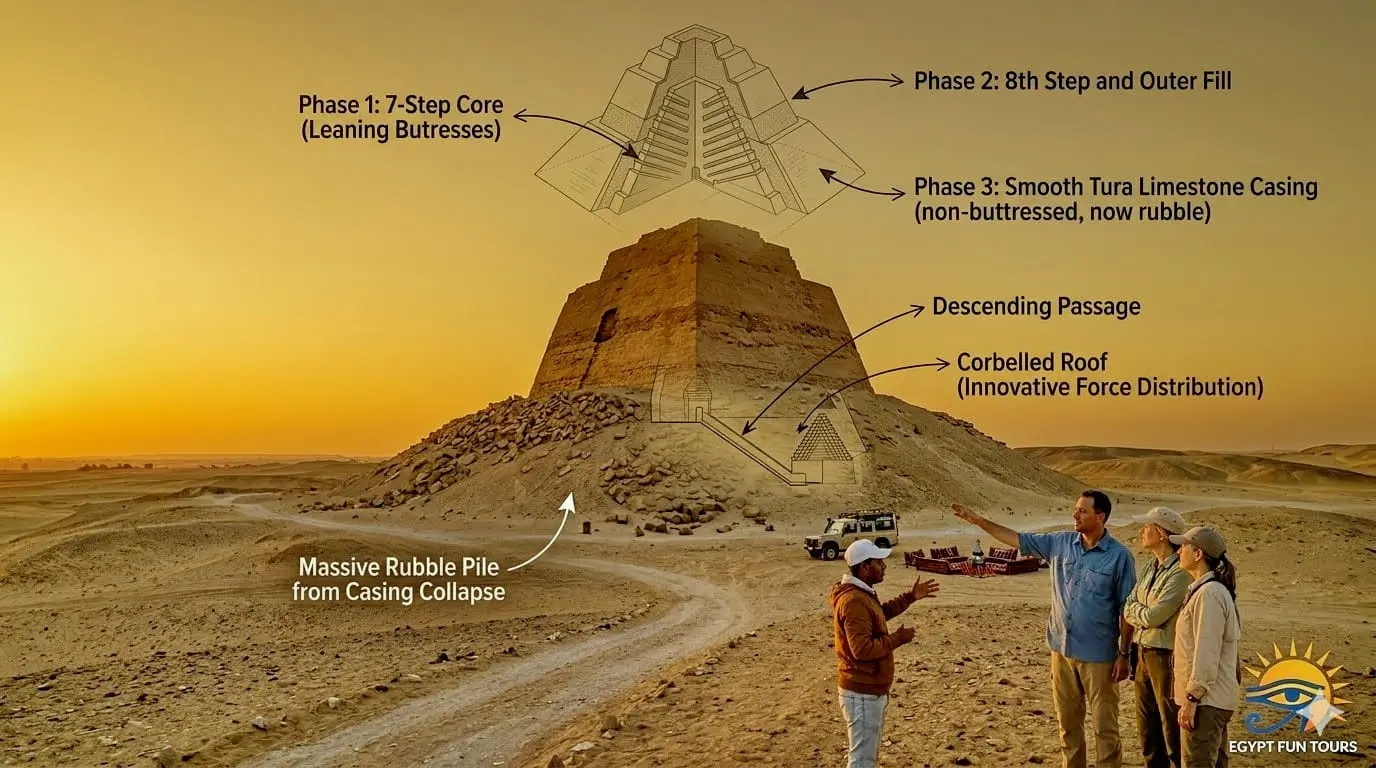
When you first approach the Meidum Pyramid, you notice something strange. It does not look like the sharp, triangular peaks of Giza. Instead, it looks like a three-stepped tower sitting atop a massive mountain of golden rubble. This unique silhouette is why the locals call it the “False Pyramid.”

But this was not the original plan. The architecture of Meidum is a story of three distinct construction phases. It was an evolving project that spanned decades.

Phase 1: The Seven-Step Pyramid (E1)

The project began as a traditional step pyramid, similar to the famous Step Pyramid of Djoser at Saqqara. The architects built a central core. Then, they leaned six layers of limestone against it. This created a seven-step structure. Each layer was tilted inward at an angle of about 75 degrees. This “inward-leaning” technique provided the necessary stability for the height.

Phase 2: The Eight-Step Expansion (E2)

While the first pyramid was still being finished, the builders decided to go bigger. They added an eighth step. They encased the original structure in even more limestone. At this stage, Meidum was a massive, jagged staircase reaching toward the sun. It was an impressive feat for the early Fourth Dynasty.

Phase 3: The Transformation into a “True” Pyramid (E3)

Toward the end of the project—likely during the reign of Pharaoh Sneferu—the architects attempted something never done before. They decided to fill in the steps.

They used local limestone to pack the horizontal steps. Then, they covered the entire structure with a smooth, polished casing of fine Tura limestone. This turned the jagged “stairway” into a smooth-sided “true” pyramid.

FUN

The Great Collapse: What Went Wrong?

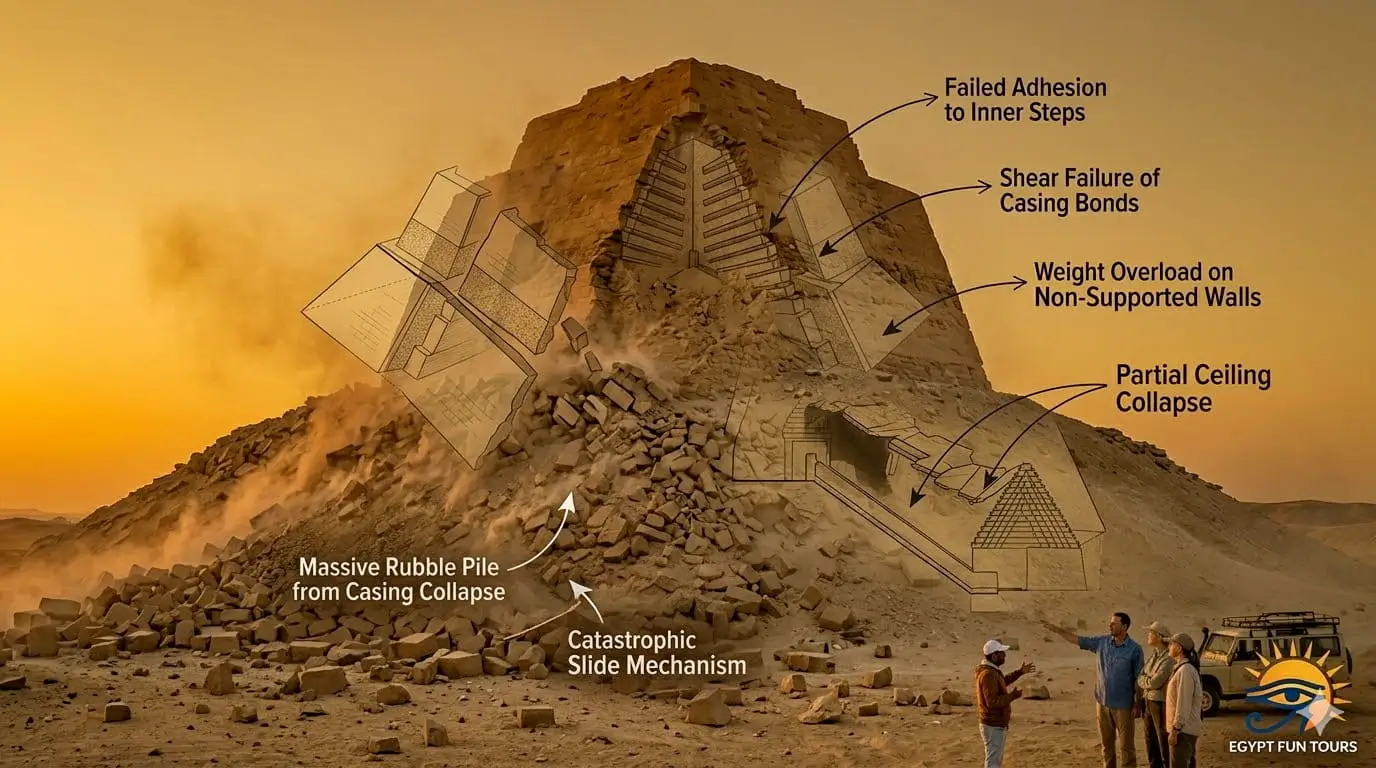
The Great Collapse What Went Wrong with the meidum Pyramid

One of the most captivating mysteries for travelers on an Egypt Fun Tours excursion is the massive pile of debris surrounding the pyramid. Why did the smooth casing fall off?

1. The Catastrophic Collapse Theory

In the 1970s, physicist Kurt Mendelssohn proposed a dramatic theory. He argued that the pyramid collapsed during construction. According to Mendelssohn, the smooth outer casing was built on top of the earlier steps without proper bonding. When a heavy rainstorm hit or a slight tremor occurred, the outer casing supposedly slid down the sides like an avalanche.

2. The Slow Decay and Quarrying Theory

Most modern archaeologists believe the collapse was much slower. They argue that the pyramid stood intact for centuries. Evidence suggests that the “collapse” was actually caused by human hands. During later periods, builders needed high-quality limestone. They stripped away the casing from the bottom up. Once the support was gone, the upper layers crumbled.

Discovering Gabal Qatrani: Fayoum’s 35-Million-Year-Old Fossil Mountain

Discover Gabal Qatrani in Fayoum, a 350-meter-high mountain and UNESCO-listed site just north of Lake...
Related post
FUN

Inside the Pyramid: A Journey to the Corbelled Core

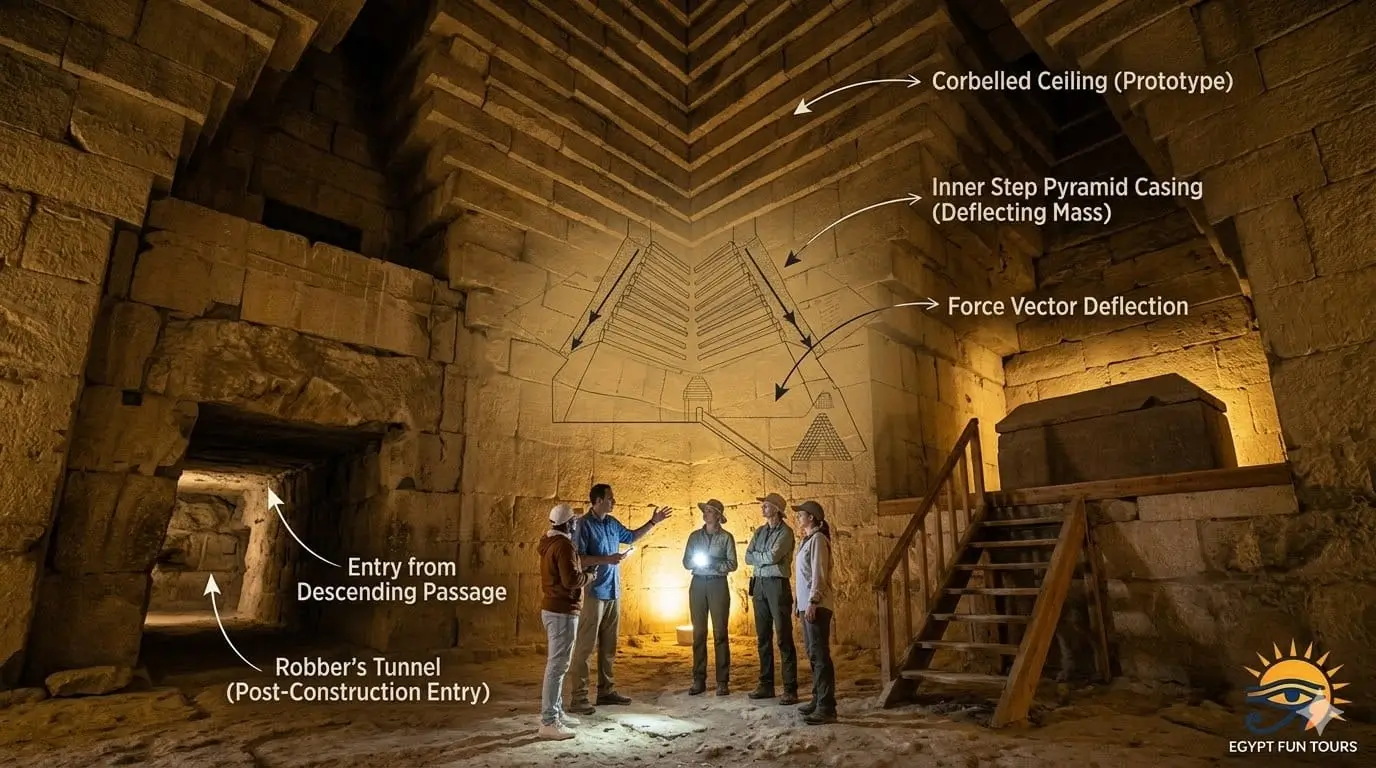
Inside the Pyramid, A Journey to the Corbelled Core

For many visitors, the highlight of a trip to Meidum is going inside. Unlike the Great Pyramid, which can feel crowded, Meidum offers an intimate experience with ancient engineering.

The Descending Passage

The entrance is located on the north face, about 15 meters above the ground. You enter a narrow, steep passage that descends for nearly 60 meters. The air grows cool. The sounds of the desert fade away.

The First Corbelled Ceiling

At the end of the passage, you reach the burial chamber. This room is a milestone in human history. It features the first-ever corbelled roof in an Egyptian pyramid. The builders stepped the stones inward, layer by layer, until they met at the top. This design distributed the immense weight of the pyramid above.

The Surrounding Necropolis: Exploring the Hidden Treasures

A visit to Meidum is not complete just by seeing the pyramid. The surrounding desert is home to a massive necropolis. These are the tombs of the high-ranking officials and royal family members who lived during the Third and Fourth Dynasties. Among these, two discoveries stand out as the most significant in Egyptian archaeology.

Mastaba 17: An Explorer’s Hidden Gem

Located just northeast of the Meidum Pyramid is Mastaba 17. A “mastaba” is a type of ancient Egyptian tomb that takes the form of a flat-roofed, rectangular structure with outward sloping sides. While the pyramid was for the King, the mastaba was for the elite.

The Mystery of the Owner. Interestingly, we do not know exactly who is buried in Mastaba 17. There are no inscriptions on the walls to give us a name. However, the size and quality of the construction suggest it belonged to a royal prince, possibly a son of Huni or Sneferu.

The Adventure of Entering For travelers with Egypt Fun Tours, Mastaba 17 offers a true “Indiana Jones” experience. Unlike the pyramid, you do not enter through a formal doorway. Instead, you enter through a robber’s tunnel. This tunnel was dug by ancient tomb raiders centuries ago.

  • The Descent: You will need to crawl through a narrow, dark passage. It is a bit dusty and tight, but perfectly safe.
  • The Reward: Once inside, you reach the burial chamber. Here, you will see a massive, monolithic red granite sarcophagus. It is one of the oldest ever discovered in Egypt.
  • The Feeling: Because this tomb is unlit and rarely visited, the atmosphere is incredibly powerful. You can see the hammer marks left by the original builders thousands of years ago.

The “Mona Lisa” of Ancient Egypt: The Meidum Geese

While the architecture of Meidum is rugged and grand, it also produced some of the most delicate art in human history. In 1871, archaeologist Auguste Mariette discovered the tomb of Nefermaat and his wife, Itet.

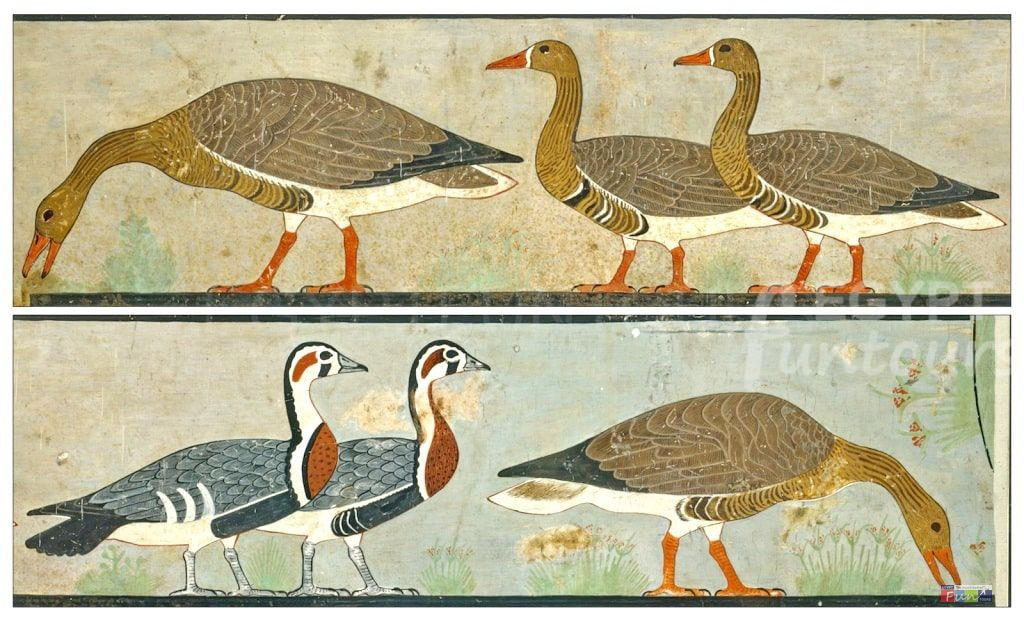
Nefermaat was the son of Sneferu and a high-ranking vizier. Inside their tomb, researchers found a masterpiece: a painting known as the “Meidum Geese.”

Why is it famous? The painting depicts six geese feeding on grass. The level of detail is extraordinary. You can see the individual feathers and the natural colors of the birds. It is so realistic that it is often called the “Mona Lisa of Ancient Egypt.”

Where can you see it? Today, the original painting is a centerpiece of the Egyptian Museum in Cairo. However, visiting the site of the tomb in Meidum gives you a sense of the luxury that once surrounded this desert outpost. It proves that the builders of the pyramids were not just engineers; they were masters of fine art.

The Tomb of Nefermaat: Innovation in Art

The tomb of Nefermaat is also famous for a unique artistic experiment. Nefermaat wanted his tomb decorations to last forever. He feared that traditional painted plaster would eventually peel off.

The Technique: His artists carved deep outlines into the stone and filled them with colored paste. This “inlay” technique was meant to be permanent. However, the process was incredibly difficult and time-consuming. As a result, it was rarely used in later Egyptian history. This makes the tombs at Meidum truly unique in the world.

Wadi El Rayan National Park: An Oasis of Adventure in the Egyptian Desert

Discover Wadi El Rayan, a stunning desert oasis in Fayoum where adventure and ancient history...
Related post
FUN

What to See in the Meidum Necropolis (Quick Checklist)

maidum geese ancient egyptian arts egypt fun tours

When you book your trip with Egypt Fun Tours, make sure your guide takes you to these specific spots:

  1. Mastaba 17: For the granite sarcophagus and the robber’s tunnel adventure.
  2. The Mastaba of Nefermaat: To see the unique “paste-inlay” artwork.
  3. The Mortuary Temple: A small, simple building on the east side of the Meidum Pyramid. It remains almost perfectly preserved.
  4. The Enclosure Wall: Walk along the remains of the limestone wall that once protected the sacred site.

Planning Your Visit: Logistics and Insider Tips

Visiting the Meidum Pyramid is a rewarding experience, but it requires more planning than a standard trip to Giza. Because it is located away from the main tourist hubs, having the right information is key to a stress-free day.

How to Get to Meidum from Cairo

Meidum is located in the Beni Suef Governorate, approximately 100 kilometers (62 miles) south of Cairo.

  • By Private Car (Recommended): The most efficient way to visit is via a private tour with Egypt Fun Tours. The drive takes about 1.5 to 2 hours, depending on traffic. This allows you to combine the site with other nearby attractions like Dahshur or the Fayoum Oasis.
  • By Train: You can take a train from Cairo’s Ramses Station to El Wasta. From there, you will need to hire a local taxi to take you the remaining 15 minutes to the pyramid site.
  • By Ride-Share: While apps like Uber work well within Cairo, they are not reliable for long-distance trips to Meidum, as finding a return ride can be difficult.

Wadi El Rayan National Park: An Oasis of Adventure in the Egyptian Desert

Discover Wadi El Rayan, a stunning desert oasis in Fayoum where adventure and ancient history...
Related post
FUN

Visitor Information

To ensure your trip goes smoothly, keep these updated details in mind:

Category Information (Updated)
Opening Hours 8:00 AM – 5:00 PM Daily
Adult Ticket (Foreigner) 150 EGP
Student Ticket (Foreigner) 75 EGP (Valid ISIC card required)
Best Time to Visit October to April (Cooler temperatures)
Physical Difficulty Moderate (Requires climbing/crawling for interior)

Pro Tip: Most archaeological sites in Egypt now require credit or debit cards for ticket purchases. Cash is rarely accepted at the official gates, so ensure your card is ready.

Why Choose a Private Tour with Egypt Fun Tours?

While it is possible to reach Meidum on your own, a private guided tour transforms the experience. Here is why travelers choose Egypt Fun Tours:

  1. Expert Egyptologists: Our guides don’t just give you dates; they tell the stories of the pharaohs. They will explain the architectural “failures” of Meidum in a way that makes history come alive.
  2. Seamless Transport: Avoid the hassle of negotiating with local taxis. Our modern, air-conditioned vehicles provide a comfortable sanctuary from the desert heat.
  3. Safety and Comfort: We handle all the logistics, from entrance fees to bottled water and local lunch stops, so you can focus entirely on the ancient wonders.
  4. The “Hidden” Sites: Many solo travelers miss the entrance to Mastaba 17 or the specific details of the Mortuary Temple. We ensure you see every corner of the necropolis.

Meidum Pyramid: The Soul of the Old Kingdom

The Meidum Pyramid is more than just a “False Pyramid.” It is a testament to human ambition, a monument of transition, and a quiet witness to the birth of the Fourth Dynasty. Standing in its shadow, away from the bustling crowds of Cairo, you feel a direct connection to the ancient world that is hard to find anywhere else.

Whether you want to crawl through the robber’s tunnel of Mastaba 17 or stand inside the world’s first corbelled chamber, Meidum offers an adventure like no other.

Ready to Explore the Secrets of Meidum?

Don’t just read about history—walk through it. Join Egypt Fun Tours for a private, expertly guided journey to the Meidum Pyramid and beyond. Book Your Private Meidum & Dahshur Tour Today

Meidum Pyramid FAQs

  • Is it safe to go inside the Meidum Pyramid? Yes, the passage is reinforced and safe, though it is steep and narrow.
  • Can I visit Meidum and Giza in one day? It is physically possible, but very rushed. We recommend pairing Meidum with the Dahshur pyramids (the Red and Bent Pyramids) for a perfect “Pyramid Evolution” day trip.
  • What should I wear? Wear comfortable walking shoes and breathable clothing. A hat and sunscreen are essential as there is very little shade at the site.
Discover the wonders of ancient and modern Egypt....
Enjoy comfort, harmony, and bliss....
6 Days Luxury Tour {Egypt Treasures} - Cairo and Nile Cruise Affordable Tour Package

A trip of a lifetime in a 10 hour layover!

We recently scheduled a layover tour in Cairo through Egypt Fun Tours. Our layover was 10 hours and we scheduled the tour just about a day and a half before our arrival. When we arrived in Cairo we very easily made our way out of the airport (after getting our

More »

Big tick off our bucket list!

Booked the evening before and were able to do everything we hoped to in a day, with a knowledgeable guide & at a reasonable price! Lunch was included and absolutely delicious! Learnt about the history of Egypt, which was the most important part of sightseeing in Cairo/Giza. Hamada also gave

More »

2 week group private tour – Egypt and Jordan

Our US-based agency takes small groups of experienced travelers to the most beautiful and exotic places in the world. In Dec ’19 – Jan ’20, we used the services of Egypt Fun Tours to plan, organize, and conduct an amazing trip to Cairo, Giza, Saqqara, Luxor, and Aswan. The New

More »
13-day Egypt guided tour package - Egypt Fun Tours

Easily the best two days of the year!

We were doing the 14-day Mediterranean cruise and were in Egypt for two days. I was searching the internet for about 4 days and finally found Egypt Fun Tours as my guide in Egypt. It ended up being the best 2 days of the entire cruise trip. Since this is

More »

Amazing one day tour

Fantastic tour. We were picked up at the airport early in the morning (6 am), and were dropped off in the evening after discovering amazing Cairo. The guide was knowledgeable and took us to many hidden places, which we wouldn’t have found without him. Thank you!

More »
Isis with wings

Top-rated Tour Packages

Isis with wings