The Twenty-Fourth Dynasty of Egypt: The Rise and Fall of Saite Power

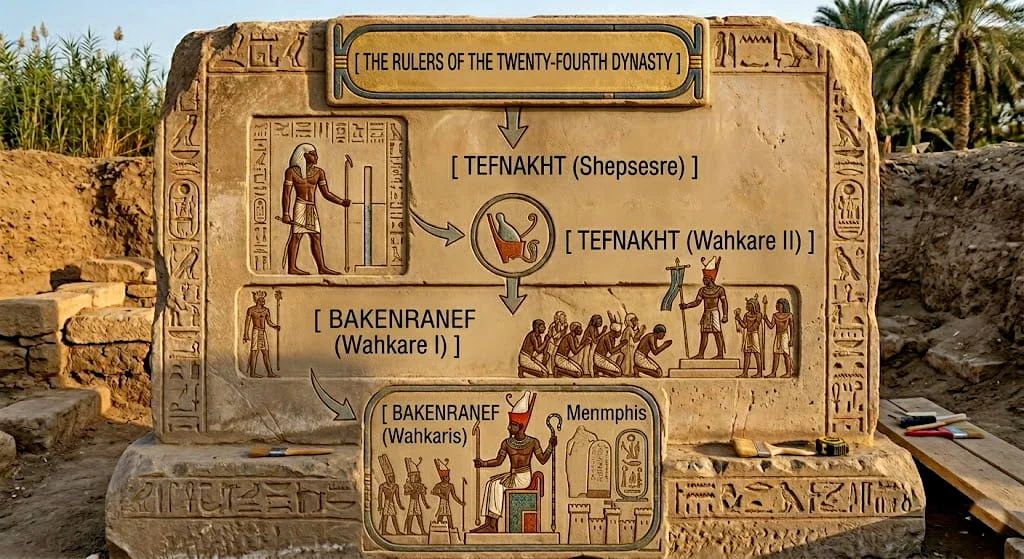
The Twenty-fourth Dynasty of Egypt (c. 732–720 BCE) was a brief but highly volatile twelve-year lineage of Libyan origin based in the western Delta city of Sais. Founded by Tefnakht, the "Great Chief of the West," the dynasty successfully united the fractured northern principalities into a powerful military confederation that aggressively marched south to capture Memphis and claim Middle Egypt. This expansion triggered a holy war with King Piye of the Kushite 25th Dynasty, who temporarily crushed the alliance, though Tefnakht preserved his local rule by retreating into the Delta marshes. The dynasty reached its tragic end under Tefnakht's successor, Bakenranef (celebrated in classical tradition as a wise legal reformer), who was captured and reportedly burned alive by the next Kushite pharaoh, Shabaka. Despite its short lifespan, this dynasty permanently shattered the old political order and established the strategic blueprint for the future 26th Dynasty Saite Renaissance.
The eye of Horus
WhatsApp
Email
Print

The Third Intermediate Period breakdown represents a highly volatile, fragmented era in the history of the Nile Valley. However, no single phase during this time matches the intense focus and rapid geopolitical drama of the Twenty-fourth Dynasty of Egypt (c. 732–720 BCE). While other contemporary royal lines claimed sprawling territories over decades, this short-lived lineage operated within a narrow historical window. Based entirely in the western Nile Delta at the strategic city of Sais, the dynasty fundamentally altered the political landscape of northeastern Africa.

To understand this crucial era, we must look past its brief duration. Despite its short lifespan, the 24th Dynasty produced an ambitious line of Saite rulers who challenged the established status quo. They successfully united the fractured northern principalities into a massive military confederation. Consequently, they stepped forward to lead the ultimate northern resistance against the unstoppable expansion of the Nubian Kushite Empire.

Divider

Twenty-fourth Dynasty of Egypt: The Saite Dawn in a Divided Delta

The Geopolitical Context of Sais

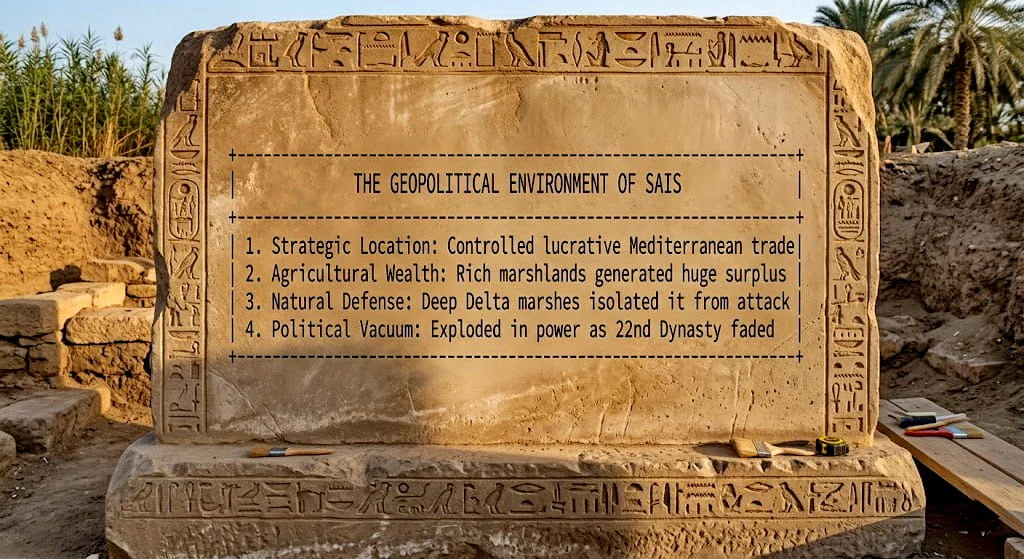
We cannot understand the emergence of the Twenty-fourth Dynasty of Egypt without analyzing the collapse of centralized power in the north. By the late eighth century BCE, the traditional authority of the 22nd Dynasty and 23rd Dynasty had completely disintegrated into a patchwork of competing chiefdoms. Seizing upon this political vacuum, the western Delta city of Sais (known anciently as Sau) rapidly transformed from a local administrative hub into a dominant geopolitical power center.

Sais possessed an exceptional strategic advantage. Situated on the Canopic branch of the Nile, the city controlled lucrative Mediterranean trade routes and held immense agricultural wealth. Furthermore, its geographical isolation in the western marshes protected it from immediate military threats coming from the eastern Delta or the south. Therefore, the ambitious rulers of this city found themselves perfectly positioned to launch a campaign of total regional consolidation.

The Saite Dawn in a Divided Delta

The Chieftains of the West

The foundational elite of this new Saite state trace their ancestry directly back to the Libyco-Berber military classes. Specifically, these leaders emerged from the powerful Libu and Meshwesh tribal aristocracies. Over several centuries, these groups had integrated fully into Egyptian society, adopting pharaonic titles and traditional religious customs. However, they retained a highly decentralized, martial ruling ethos that favored competitive local autonomy over submissive central rule.

As a result, when the Saite princes began asserting their dominance, they did not rely on ancient royal bloodlines. Instead, they leveraged sheer military merit and strategic family alliances. These Saite rulers of the Third Intermediate Period viewed the fragmented state of the country not as a disaster, but as an unprecedented opportunity. By organizing the highly trained, localized Libyan garrisons under a single banner, they created a formidable war machine capable of projecting power deep into Middle and Upper Egypt.

Golden Scarab

The Core Monarchs: A Dynasty of Two Kings (Twenty-fourth Dynasty of Egypt)

The 24th Dynasty King List

Unlike the crowded and confusing family trees of previous eras, the Twenty-fourth Dynasty of Egypt features a streamlined succession. The entire dynasty consisted of just two primary pharaohs who ruled from the western Delta city of Sais. To help researchers and students easily track this compact timeline, the following table maps the consensus timeline, titles, and major historical achievements of these Saite monarchs.

Pharaoh Est. Regnal Dates (BCE) Royal Titulary Key Historical Significance
Tefnakht I (Tefnakhte) c. 732–725 Shepsesre The brilliant “Great Chief of the West.” He united the fractured Delta warlords into a massive military confederation and marched south to claim Middle Egypt.
Bakenranef (Bocchoris) c. 725–720 Wahkare The son and successor of Tefnakht. Famous in classical Greek traditions as a legendary, wise lawmaker, his reign ended tragically with the second Kushite invasion.

Tefnakht: The Great Chief of the West

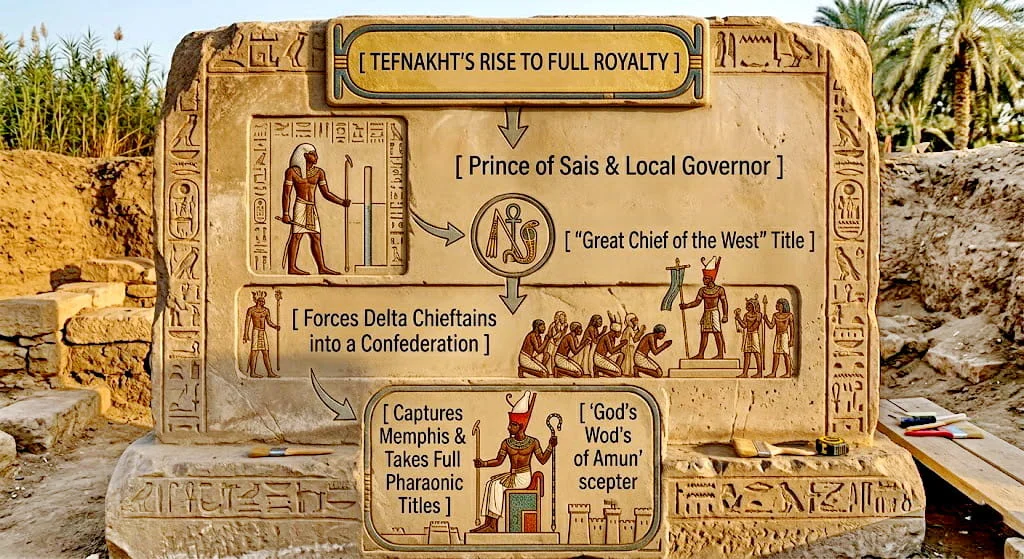
We cannot understand the true force of the 24th Dynasty without analyzing its extraordinary founder, King Tefnakht. He did not inherit a grand empire. Instead, he began his career as a local military governor and prince of Sais. Through a series of rapid, aggressive campaigns, he seized control of the entire western Delta. Recognizing his growing authority, contemporary inscriptions initially gave him the title “Great Chief of the West.”

Tefnakht possessed immense diplomatic and military skill. He realized that the scattered, squabbling Delta lords could never survive individually. Therefore, he forced the various Libyan rulers of the north to swear allegiance to his banner. By combining these regional armies, he formed a formidable coalition. He then marched south, capturing the vital fortress city of Memphis and officially declaring himself Pharaoh of a newly energized northern kingdom.

The Core Monarchs A Dynasty of Two Kings

Bakenranef: The Lawmaker and the Legend

Following the death of Tefnakht, his son Bakenranef ascended the throne at Sais. In classical Greek historical traditions, written centuries later by historians like Diodorus Siculus and Plutarch, this king is celebrated under the name Bocchoris. These ancient writers do not focus on his military campaigns. Instead, they paint a fascinating portrait of a brilliant, exceptionally wise legal reformer.

According to these classical accounts, Bakenranef revolutionized the civic fabric of Egypt by introducing sweeping land and debt reforms. He reportedly outlawed the practice of selling citizens into slavery to pay off personal debts. Furthermore, he established new judicial guidelines that protected small landowners from corrupt royal officials. Consequently, while his father built the dynasty through conquest, Bakenranef secured his legacy in world history as an enlightened, visionary judge.

The eye of Horus

Geopolitical Ambition: The Great Northern Coalition

Twenty-fourth Dynasty of Egypt: Consolidating the Delta Basin

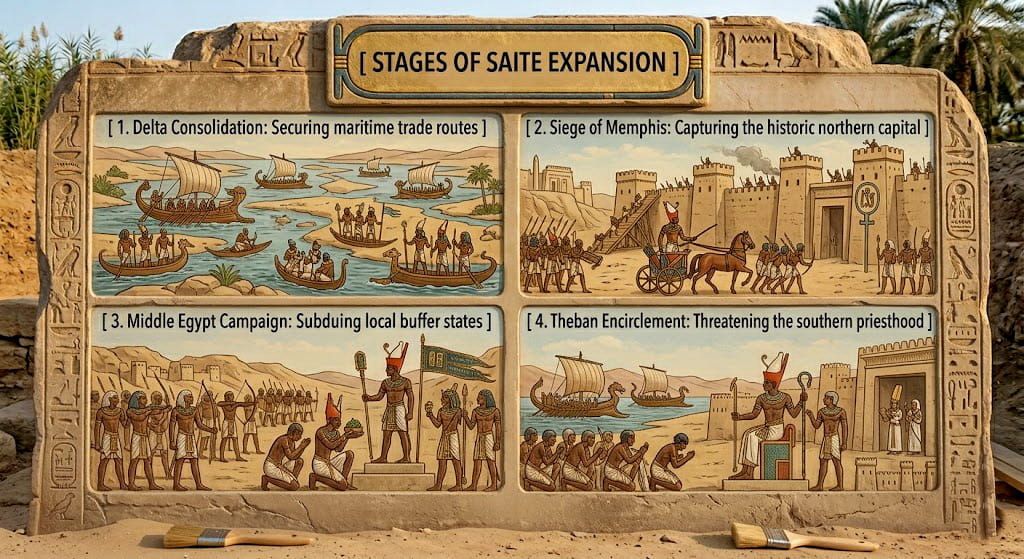
Tefnakht understood that true security required absolute geographic control. Therefore, after stabilizing Sais, he launched an aggressive campaign to absorb neighboring territories. He rapidly extended his influence over the western and central Nile Delta, subduing rival chieftains through strategic marriages and overwhelming military pressure. Consequently, he established an airtight administrative block. This northern network allowed the Saite state to exploit the full economic wealth of the Mediterranean maritime trade.

Geopolitical Ambition The Great Northern Coalition

The Southern Blitzkrieg

With the Delta fully unified, Tefnakht turned his sights toward the south. He recognized that the decaying 22nd and 23rd Dynasties could no longer field a unified army. Therefore, he marched a massive, combined northern fleet and infantry force up the Nile River.

This campaign was not a mere raid; rather, it was a systematic conquest. He successfully captured the historic northern capital of Memphis. Furthermore, his advancing forces swept through Middle Egypt, enveloping the strategic fortress town of Itjtawy.

As a result of this rapid offensive, local governors panicked. Powerful independent rulers, including King Nimlot of Hermopolis and King Iuput II of the 23rd Dynasty, realized they could not resist the Saite war machine alone. They chose survival over conflict. They threw open their city gates, swore binding oaths of allegiance to Tefnakht, and officially integrated their standing armies into his expanding northern coalition.

Divider

The Clash of Empires: Sais vs. Napata (Twenty-fourth Dynasty of Egypt)

The Threat to the Holy Heartland

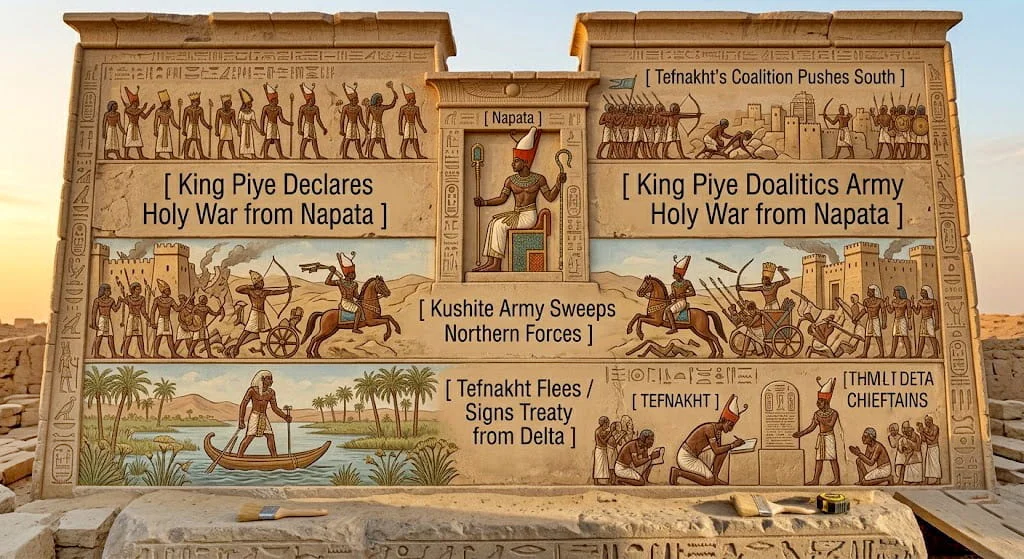
The rapid southern expansion of the Twenty-fourth Dynasty of Egypt triggered a major geopolitical crisis. By marching his coalition past Hermopolis, Tefnakht directly threatened Upper Egypt. This aggressive movement deeply alarmed the Kushite rulers of the 25th Dynasty, based at Napata in modern-day Sudan.

The Kushite King, Piye, viewed the rise of the secular, Libyan-led northern coalition as a direct insult to the supreme god Amun-Ra. He believed that Tefnakht was an ambitious upstart trying to destroy the ancient religious fabric of the land. Therefore, Piye declared a holy war to liberate Egypt from the northern invaders.
The Clash of Empires Sais vs. Napata

The Counter-Offensive and the Marshland Treaty

Piye acted with devastating speed and precision. He mobilized a massive Kushite fleet and army, sending them charging northward down the Nile. The two massive military forces clashed in a series of brutal river engagements and land battles across Middle Egypt.

Ultimately, Piye’s highly disciplined Kushite troops shattered Tefnakht’s alliance. They broke the siege of Herakleopolis and recaptured the city of Memphis after a bloody assault.

Tefnakht recognized that he could not win a direct war of attrition against the Nubian empire. Consequently, he retreated deep into the inaccessible, fog-covered marshes of the western Delta. From this hidden stronghold, he sent an embassy to Piye to negotiate terms. He offered a formal surrender and valuable tribute, but he refused to travel south to bow in person.

Piye accepted this compromise because hunting the Saite leader through the treacherous Delta swamps was too risky. As a result, the Kushite army marched back to Nubia, allowing Tefnakht to preserve his localized kingship at Sais.

The Tragic Climax: Shabaka and the Fate of Bocchoris

The Second Nubian Wave

The fragile peace between Sais and the Kushite Empire did not last long. Following the deaths of King Tefnakht and King Piye, a new generation of leaders took power. Bakenranef assumed the throne at Sais, while Piye’s successor, King Shabaka, grabbed the reins of the 25th Dynasty.

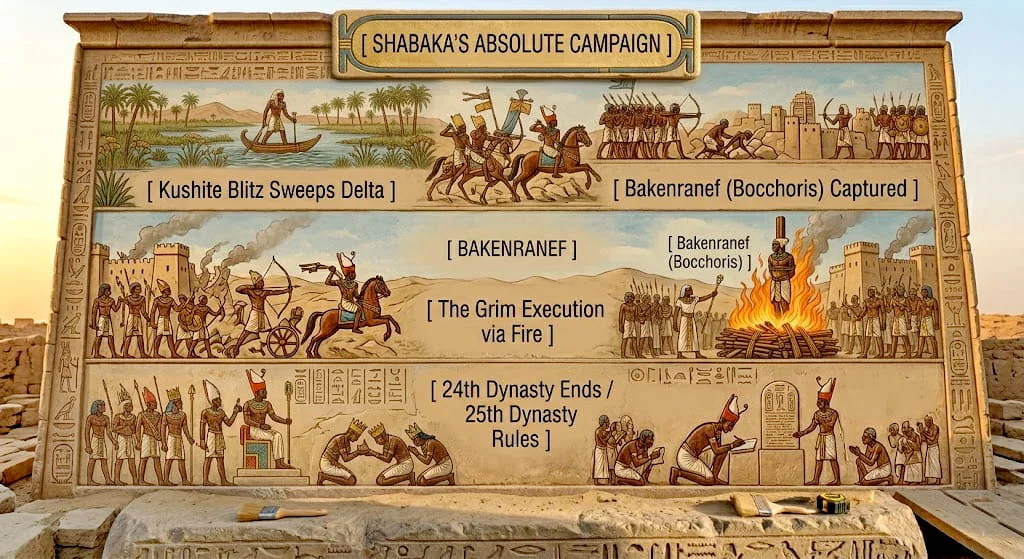
Unlike his predecessor, Shabaka abandoned the policy of allowing northern rulers to remain as loose vassals. He recognized that as long as the Saite monarchy existed, Egypt would remain vulnerable to rebellion. Therefore, around 720 BCE, Shabaka mobilized a massive, highly disciplined Kushite army and launched a definitive invasion to unify the entire country by force.
The Tragic Climax Shabaka and the Fate of Bocchoris

Twenty-fourth Dynasty of Egypt: The Grim Fate of King Bocchoris

The Kushite forces swept northward with unstoppable momentum, bypassing traditional buffer states and punching straight into the Delta heartland. They quickly overwhelmed the local defenses of Sais, trapping Bakenranef within his own capital.

What followed became one of the most dramatic and shocking tales in ancient historiography. According to the third-century BCE Egyptian priest and historian Manetho, Shabaka captured Bakenranef alive. To send a terrifying message to any future rebels, the Kushite king ordered Bakenranef to be burned alive at the stake.

While some modern Egyptologists debate whether this execution was a literal burning or a symbolic destruction of his mummy, the political result was absolute. This brutal act permanently extinguished the independent 24th Dynasty line.


The eye of Horus

The Legacy of the Twenty-fourth Dynasty of Egypt

The Seeds of a Renaissance

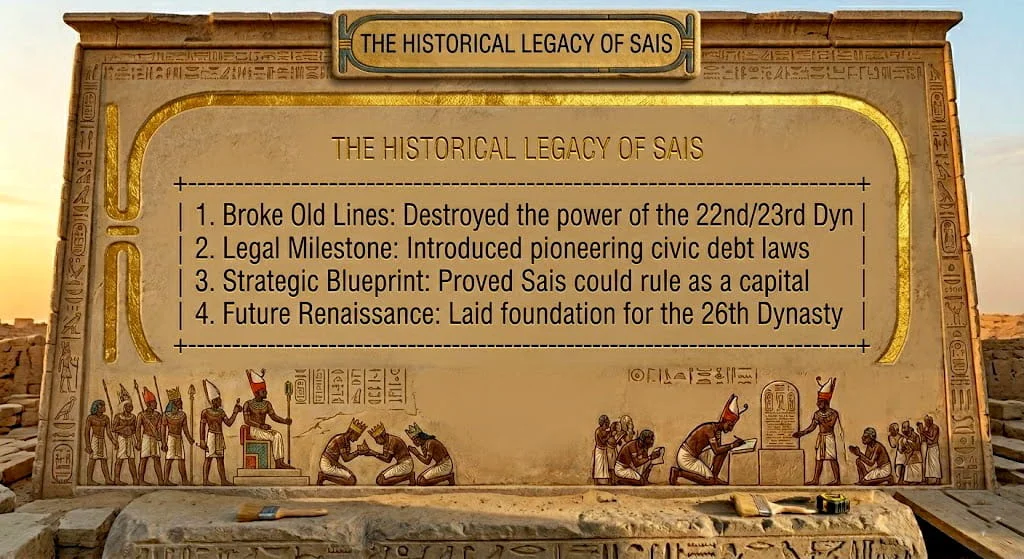
Although the Twenty-fourth Dynasty of Egypt ended in fire and submission, its historical impact outlived its short, twelve-year existence. By aggressively pushing to unite the Delta, Tefnakht and Bakenranef broke the century-long political stranglehold of the 22nd and 23rd Dynasties. Furthermore, they proved that Sais possessed the strategic, economic, and military capability to act as the primary capital of a unified Egypt.

The Legacy of the 24th Dynasty

Consequently, the 24th Dynasty served as a direct structural blueprint for the future. Nearly a century later, another line of princes from Sais would rise up to expel foreign occupiers and initiate the glorious 26th Dynasty (Saite Renaissance). Therefore, the brief, chaotic reigns of the 24th Dynasty kings were not a historical failure. Instead, they planted the vital seeds for the final great era of native Egyptian independence.

Divider
Premium Cairo Tour Package Egypt Fun Tours

THE MOST AMAZING TRIP

Hi Hamada! Sorry, we were so quick to say goodbye—my mom was fading 🙂 I just wanted to say thank you for THE MOST AMAZING trip… You thought of every detail, improvised, adapted, overcame every challenge, multitasked personalities, and did it all with grace, intelligence, and kindness. From the bottom

More »

Egypt Fun Tours makes the most out of your layover!

I had a really short layover in Cairo and didn’t want to be stuck in the Cairo Airport for several hours. It was like Mission Impossible: Egypt Fun Tours’ mission was to show me around Cairo during my short 5 hour layover which was made even shorter because my plane

More »

Egypt Fun Tours – Does it All!

My husband and I visited Egypt in March 2013. First, let me say, ‘Go, go, go!’ – it’s safer and definitely friendlier than many places we’ve visited. Tourism is drastically down – thanks mostly to media misinformation – so it’s a great time to visit to avoid line-ups and crowds

More »

Great shore excursion of Cairo & Giza

We are glad that we arranged our private shore excursion with Egypt Fun tours in last week of October 2012. Booking process was very easy with Hamada and she took care of all our questions promptly just via E-mail. Our group was little worried about safety in Egypt especially because

More »
God_Anubis_Icon

Top-rated Tour Packages

God_Anubis_Icon
WhatsApp
Email
Print