Merchants and Traders: How Ancient Egyptian Trade Thrived on Barter

Discover how ancient Egyptian trade flourished without a single coin. Learn about the deben, the unit of weight they used as a "price tag," and how merchants operated a complex barter system along the Nile. Explore the massive, state-sponsored expeditions that brought back gold, incense, and ebony from foreign lands like Punt.

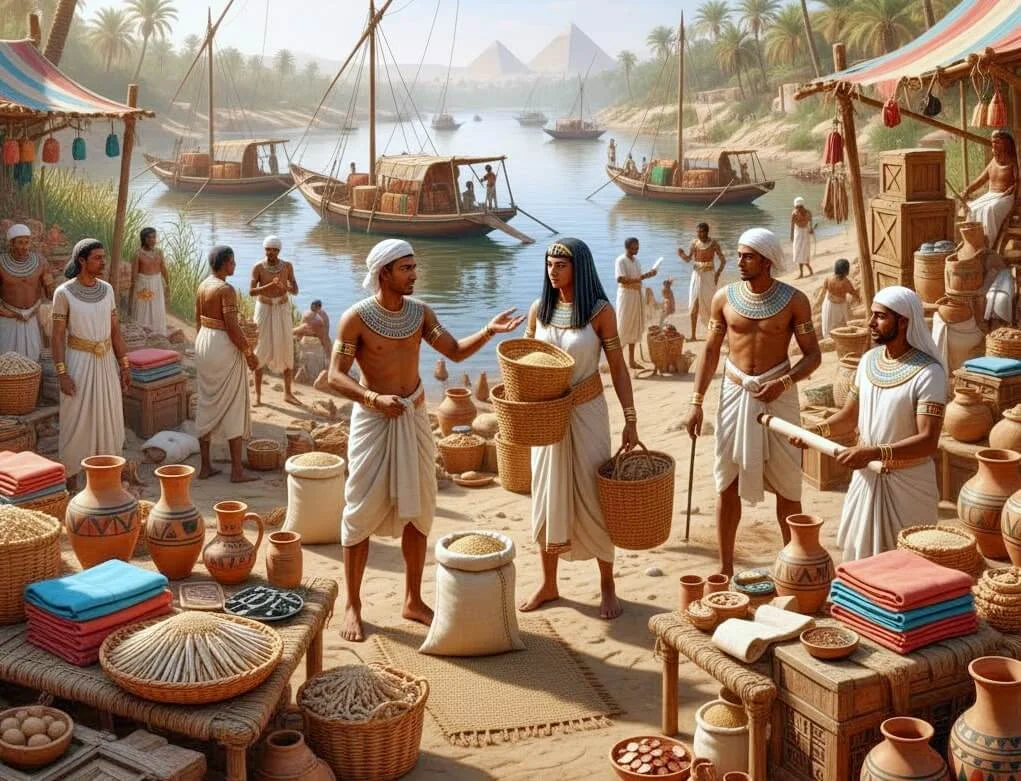
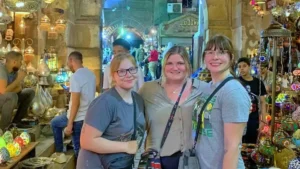
Imagine a bustling Cairo market, alive with the sounds of people haggling over goods. You see pottery, grain, linen, fish, and jewelry. Now, imagine this entire market operating without a single coin changing hands. This was the reality of ancient Egyptian trade.

For thousands of years, the ancient Egyptian economy functioned entirely without minted currency. Yet, it was one of the most powerful economies in the ancient world. So, how did they do it? The answer lies with the skilled ancient Egyptian merchants and a sophisticated ancient Egypt barter system. This system was so effective it powered domestic trade and fueled massive international expeditions.

FUN

The Deben: A “Price Tag” Without Coins

The Deben; A Price Tag Without Coins

The biggest challenge of barter is fairness. How do you know a bag of wheat is a fair trade for a pair of sandals?

The Egyptians solved this problem with the deben.

The deben was not a coin. It was a standardized unit of weight. One deben equaled about 91 grams (roughly 3.2 ounces). Early in Egyptian history, this unit was measured in copper. Later, silver and gold were also used for high-value items.

This system gave every item a “price tag”:

  • A pair of sandals might be worth 1 deben of copper.
  • A simple linen shirt might cost 5 deben.
  • A cow could be valued at 140 deben.
  • A female servant’s price was often 20 deben of silver.

This meant everyone understood an item’s value, which was the first and most important step in successful ancient Egyptian trade.

FUN

The Ancient Egypt Barter System in Action

The Ancient Egypt Barter System in Action

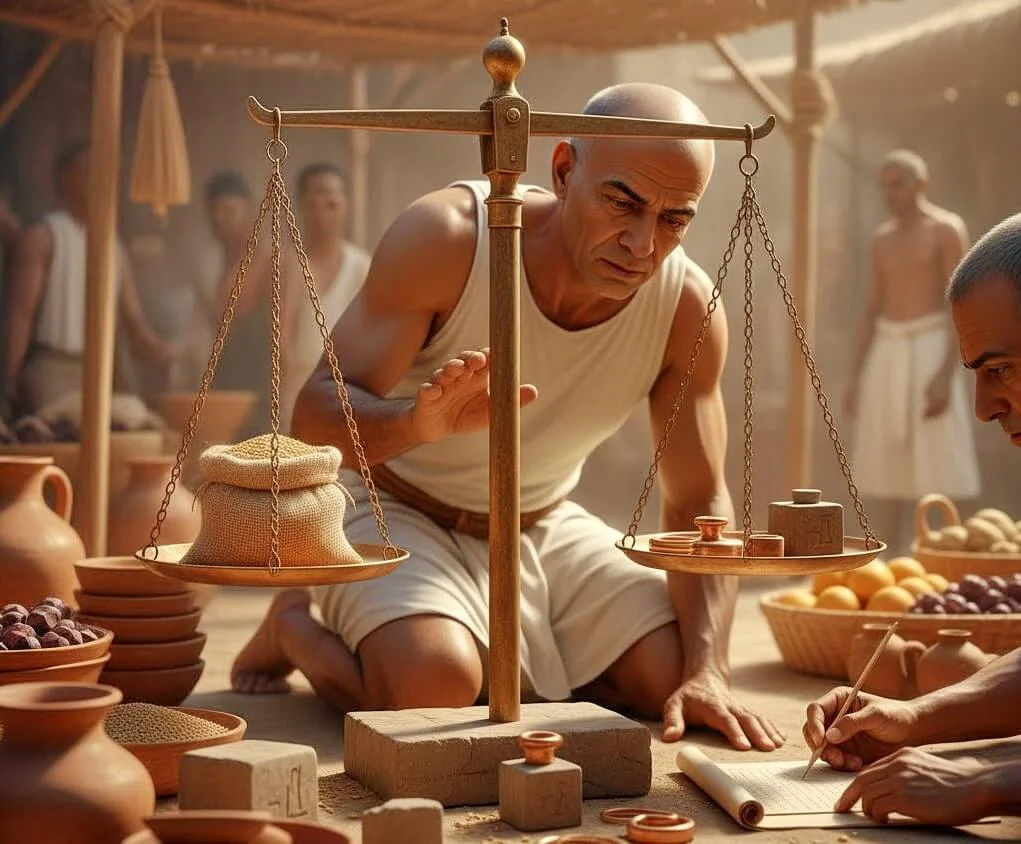
With the deben as a guide, merchants and commoners could trade. The deben was the value, but the barter was the transaction.

Let’s see how this worked for an ancient Egyptian merchant:

  1. A craftsman wants to buy a bag of grain from a farmer.
  2. The farmer’s grain is valued at 2 deben.
  3. The craftsman has a finely made pot, also valued at 2 deben.
  4. They make a simple, direct swap: pot for grain.

No copper weights actually exchanged hands. The deben was just the standard of value that made the swap fair.

But what if the items didn’t match? This is where ancient Egyptian trade got creative.

Imagine the craftsman’s pot was worth 3 deben, but the grain was only 2 deben. The farmer “owed” the craftsman 1 deben. The farmer could “make change” by adding a small jug of beer, a piece of linen, or some fish, which everyone agreed was worth that final deben.

This flexible system allowed for complex transactions for all kinds of goods.

The Unification Battle by King Narmer

The Unification Battle by King Narmer The unification battle of King Narmer is shown on...

Related post
FUN

Domestic Trade: The Merchant and the Nile Highway

Domestic Trade; The Merchant and the Nile Highway

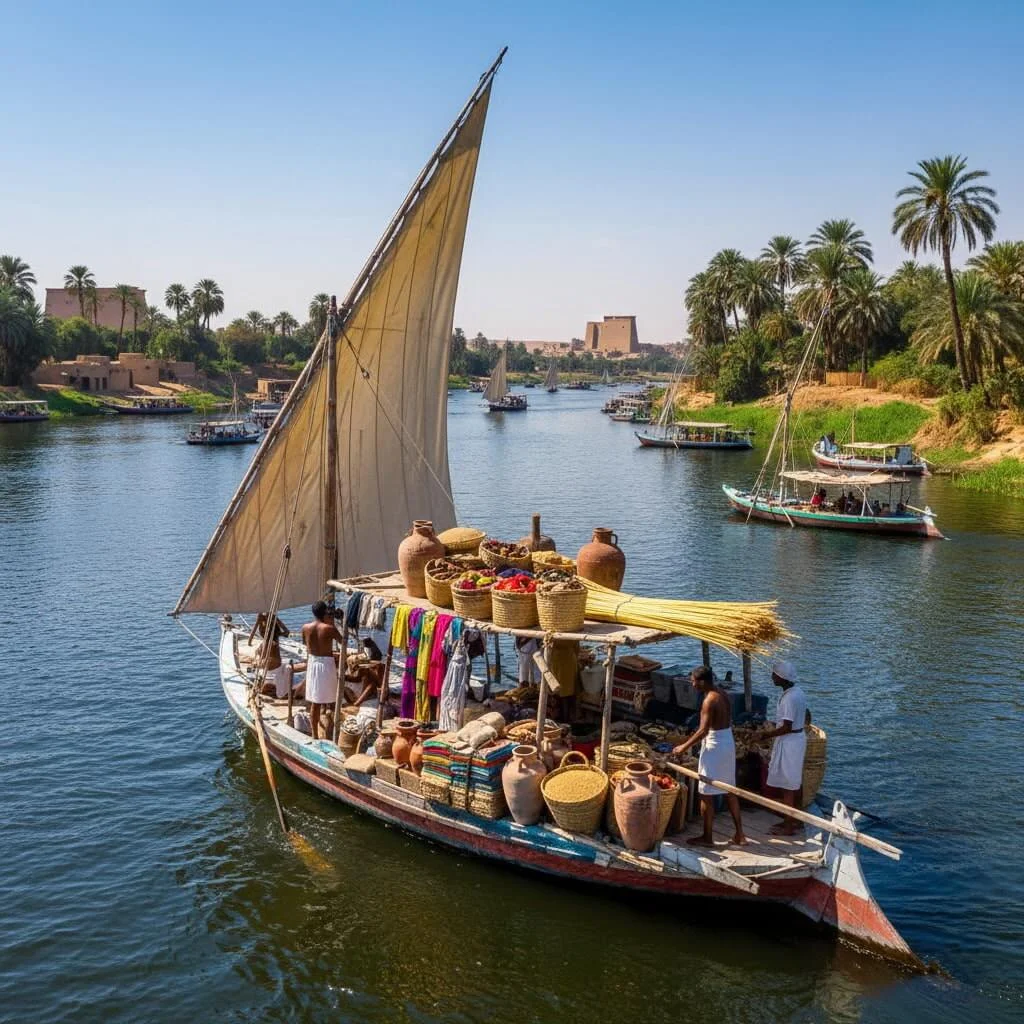
For the average ancient Egyptian merchant, life revolved around the Nile. The river was the national highway, the economic artery of the entire civilization.

Trade on the Nile was constant. Merchants would load their wooden boats with goods from one town and trade them in another.

Common goods traded along the Nile included:

  • Food: Grain (wheat and barley), beer, wine, fish, and vegetables
  • Crafts: Pottery, baskets, and rope
  • Textiles: Linen (Egypt’s most famous export)
  • Materials: Papyrus (for writing) and local woods

These merchants were not all one group. Some were independent craftsmen selling their own wares at a local market. Others were skilled agents working for a high-status noble or a powerful temple, managing their vast estates and moving their surplus goods.

Legend of Westcar Papyrus: Royal Magic and the Prophecies of Khufu

The Westcar Papyrus is a masterpiece of Ancient Egyptian literature that weaves together historical legend,...
Related post
FUN

State-Sponsored Expeditions: Egypt’s Global Reach

State-Sponsored Expeditions; Egypt's Global Reach

While local merchants handled domestic trade, the Pharaoh controlled all major international ancient Egyptian trade.

The Nile Valley was rich in food but poor in other key resources. It lacked quality timber, precious metals, and the unfamiliar goods the gods demanded.

To get them, the state-sponsored massive, dangerous expeditions. These were not jobs for a simple merchant. The Pharaoh sent his most trusted high officials—often bearing titles like “Royal Sealbearer”—to lead these missions.
The Legendary Land of Punt

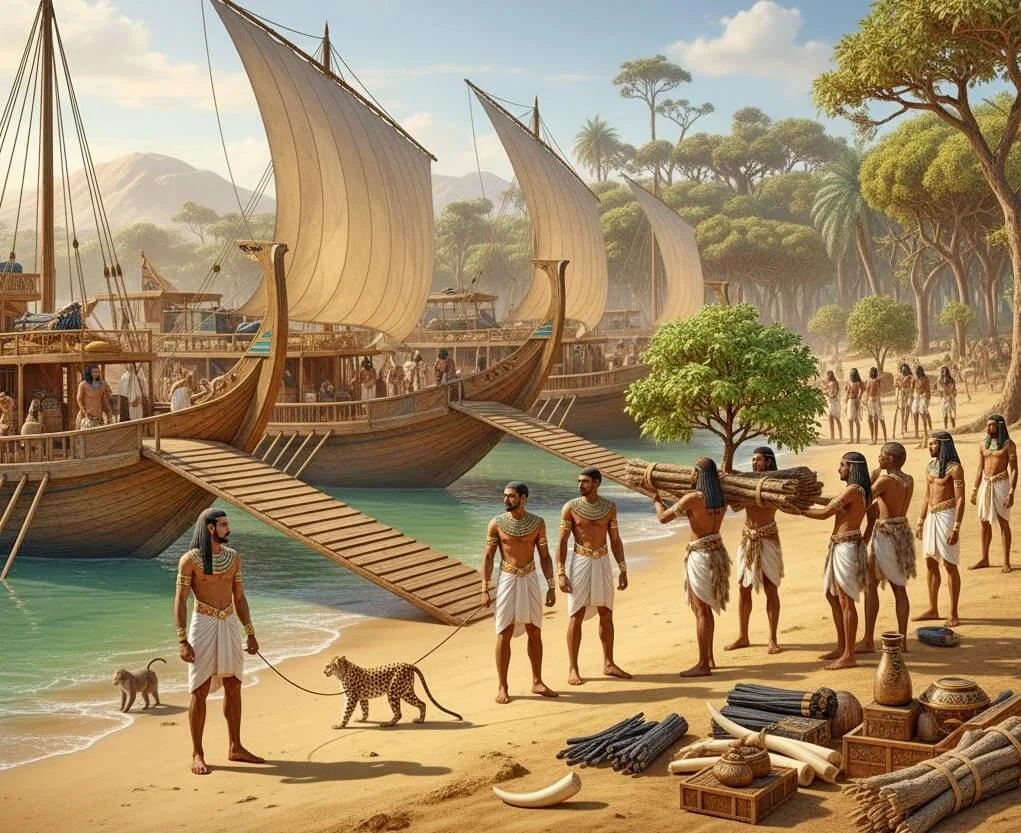
The most famous of all state-sponsored expeditions in Egypt were to the Land of Punt. Historians believe Punt was in modern-day Eritrea or Somalia. These missions were huge naval operations. Queen Hatshepsut’s expedition, famously carved on her temple walls, involved five massive ships.

These ships returned with the most prized goods in Egypt:

  • Myrrh and Frankincense: Aromatic resins essential for temple incense and mummification. They even brought back live incense trees to plant in Egypt.
  • Gold and Electrum: Precious metals for jewelry and statues.
  • Unfamiliar Animals: Baboons, leopards, and giraffes for royal parks.
  • Ebony and Ivory: Used for crafting luxury furniture.

Trading with Neighbors

Egypt’s trade network extended in every direction:

  • To Nubia (South): This was the “Land of Gold.” Egyptian expeditions traveled deep into Nubia (modern Sudan) to acquire gold, ebony, ivory, and unfamiliar animal skins.
  • To Byblos (North): This port city in modern-day Lebanon was Egypt’s source for cedar wood. Egypt had few large trees, so they needed cedar for building strong ships, temple doors, and high-quality coffins.
  • To Sinai (East): Expeditions crossed the desert to mine for turquoise and copper.

These traders were the Pharaoh’s agents, securing the raw materials that fueled the royal workshops, adorned the temples, and guaranteed the king’s divine status.

Hathor: The Ancient Egyptian Cow Goddess of Love, Joy, and Motherhood

Meet Hathor, the Golden Goddess who embodied the joy of life itself. This guide explores...
Related post
FUN

See the Treasures of Ancient Egyptian Trade Today

The ancient Egyptian trade routes brought the world’s greatest treasures to the Pharaohs. Today, you can see the stunning results of this ancient economy for yourself.

The gold in Tutankhamun’s mask came from Nubia. The incense burners in the temples were filled with resins from Punt. The massive wooden boats buried beside the pyramids were built with cedar from Byblos.

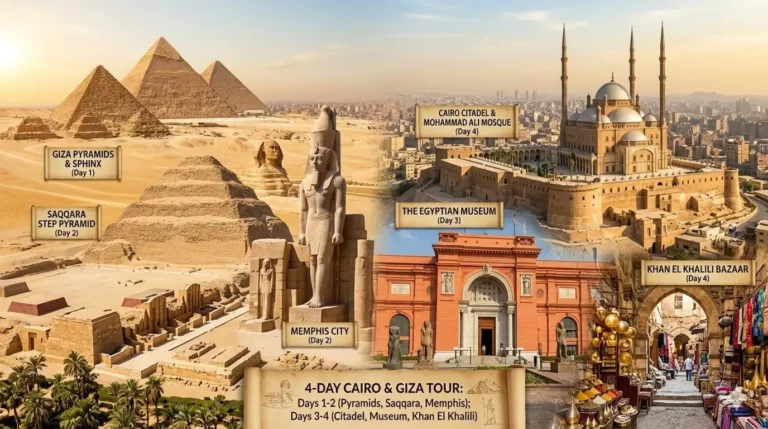
Egypt Fun Tours brings this ancient world to life. Let us guide you to the tombs and museums where this incredible wealth is on display. We can walk through the Khan el-Khalili bazaar, a center of trade for centuries, and then show you the very treasures ancient Egyptian merchants and royal agents risked their lives to bring home.

Discover the wonders of ancient and modern Egypt through this magical Dahabiya The Orient from Aswan to Esna for 3 nights....
Book now 5 days Dahabiya Nile cruise Luxor to Aswan to visit the ancient Egyptian attractions in upper Egypt joining an expert tour guide....
Top 10 restaurants in cairo Egypt Fun Tours 2

Tour & Overnight camping with Mohamed

The breathtaking views and the isolation with a night under the stars! The trip was memorable with Mohamed, our tour guide, who drove us to all the sites on the way to the White Desert, and is clearly someone who knows the desert inside out. He also cooked a delicious

More »

Pyramids in the Mist, Egypt Adventure

Our long drive from Cairo turned into a terrifying flight through Alexandria’s impossibly crowded streets. Our minivan miraculously avoided hitting pedestrians, donkey carts, and old Lada cars. We arrived at the port gates with only 10 minutes to spare. But the guards ignored our U.S. passports, and they refused to

More »

Transit Stopover in Cairo

We have just returned from a two week holiday in Cape Town. On the way out our airline schedule meant that we had a 15 hour stop in Cairo. We decided to arrange a tour of the city and after asking for quotes/itineraries we chose Egypt Fun Tours. This worked

More »

Day Trip to Alexandria

An enjoyable drive from Cairo to Alexandria. It was an enriching trip. I learnt so much history about the ancient civilisation. The tour guide explained the history of each site we visited. There is so much to see. I would definitely highly recommend visiting Alexandria. It’s rich in history. The

More »

Excellent Adventure

These guys put together an amazing itinerary that allowed me see the sunrise at the sun festival in Abu Simbel, King Tut’s tomb, and mask! That was just the tip of the iceberg. Aswan, Kom Ombo, Edfu and Luxor. So much visited with plenty of rest time. An amazing trip

More »
Isis with wings

Top-rated Tour Packages

Isis with wings