The Tomb of Hekashepes: Unveiling the Golden Secret of Saqqara

The Tomb of Hekashepes is a landmark 2023 discovery in Saqqara’s Gisr el-Mudir, revealing a 4,300-year-old limestone sarcophagus that remained sealed since the Old Kingdom. Inside, archaeologists found what is considered the oldest and most complete non-royal mummy ever discovered, remarkably preserved in layers of genuine gold leaf. This find shatters previous timelines of advanced mummification and provides an untainted look into the immense wealth and religious sophistication of Egypt’s elite bureaucracy.

The Golden Secret of Gisr el-Mudir: Opening the Tomb of Hekashepes

The sands of Saqqara have long served as a silent archive of Egypt’s most profound transitions, but few discoveries in the 21st century have matched the sheer, visceral impact of the unveiling of the Tomb of Hekashepes. In January 2023, amidst the windswept expanse of Gisr el-Mudir—the “Great Enclosure” that predates even the earliest pyramids—an Egyptian-led mission reached the base of a grueling 15-meter shaft. What they found was not merely another burial chamber, but a time capsule that had remained hermetically sealed for over 4,300 years.

A Provocative Glimpse into the Old Kingdom

As the team pried away the original mortar from the massive limestone sarcophagus, they were greeted by a sight that challenged established timelines of Egyptian mummification: a man, preserved in a radiant layer of pure gold leaf, resting exactly as he had been placed during the Old Kingdom. This discovery immediately shifted the narrative regarding the technical capabilities of non-royal burials during the pyramid age.

The Man Who Slept in Gold

The Man Who Slept in Gold

This was Hekashepes. He was not a king, yet he was buried with a level of opulence that suggests a bureaucracy as wealthy and sophisticated as the monarchs they served. His discovery is more than a headline-grabbing find; it is a vital piece of the archaeological puzzle that connects the Fifth and Sixth Dynasties to our modern understanding of funerary theology and social hierarchy. In this comprehensive exploration, we delve into the heart of the Saqqara necropolis to examine the following:

  • The meticulous archaeological process that led to this breakthrough.
  • The revolutionary mummification techniques revealed by the “Golden Mummy.”
  • The significance of the surrounding statues and tombs found within the Hekashepes complex.
  • This discovery marks a new era for Egyptian-led excavations at one of the world’s most sacred sites.

Join us as we descend into the shaft, break the ancient seals, and meet the man who slept in gold while empires rose and fell above him.

FUN

The Descent into Antiquity: Excavating the 15-Meter Shaft

The Descent into Antiquity Excavating the 15-Meter Shaft

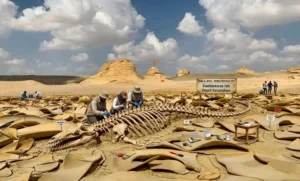
Archaeologists did not simply stumble upon Hekashepes; they reclaimed him from the deep earth through months of systematic excavation. The mission focused its efforts on Gisr el-Mudir, a massive limestone enclosure that remains one of the most enigmatic structures in the Saqqara necropolis. Beneath the weathered surface of the desert, the team identified a vertical burial shaft—a common feature of Old Kingdom tombs, yet this one promised something far more significant than the plundered pits typically found in the region.

Reaching the Burial Chamber

The excavation required precision and physical endurance. As workers cleared centuries of debris, the shaft descended to a depth of 15 meters (approx. 50 feet). At this level, the environmental conditions shifted. The deep burial provided a natural cooling effect and protection from the humidity that often destroys organic material in shallower graves.

Upon reaching the bottom, the team encountered a rectangular limestone chamber. Dominating the small space stood a massive, five-ton sarcophagus. Unlike the vast majority of Old Kingdom burials, which grave robbers disturbed in antiquity, this lid remained firmly in place. The original mortar, applied by priests and laborers over four millennia ago, still sealed the edges.

Breaking the 4,300-Year-Old Seal

The moment of discovery carried immense tension. Dr. Zahi Hawass and his team used heavy tools to break the ancient plaster and lift the limestone slab. When the lid finally moved, it revealed a sight that surpassed all expectations. Instead of skeletal remains or a decayed wooden coffin, the team found a mummy meticulously wrapped and gleaming with gold.

The state of the burial chamber suggested that the funeral party had left the site in haste or with extreme reverence, leaving the inhabitant undisturbed while the dynasties above him collapsed and the sands reclaimed the entrance. By reaching the bottom of this shaft, the mission did more than find a mummy; they bypassed four thousand years of human interference to document a “pure” funerary context.

FUN

The Golden Mummy: Revolutionizing Old Kingdom Science

The Golden Mummy Revolutionizing Old Kingdom Science

When the heavy limestone lid finally moved, it unveiled a find that stunned the global archaeological community. Inside lay a man named Hekashepes, encased in a shell of history that defied previous scientific assumptions. This was not a simple burial; it was a masterpiece of ancient preservation that forced experts to reconsider the timeline of high-level mummification in Egypt.

The Radiance of the Golden Leaf

The most striking feature of the mummy remains its outer layer. Unlike the darkened, resin-soaked wrappings typical of many Old Kingdom finds, Hekashepes gleamed. Ancient embalmers had meticulously applied thin sheets of gold leaf over his entire body.

This use of gold served a dual purpose:

  • Symbolic Deification: In Egyptian theology, the flesh of the gods consisted of gold. By “gilding” the deceased, the priests effectively transformed Hekashepes into an eternal, divine being.
  • Structural Integrity: The gold leaf, combined with high-quality linen bandages, created a rigid, protective cocoon that helped maintain the physical form of the body for over four millennia.

An Unprecedented State of Preservation

Archaeologists often describe this find as the “most complete” non-royal mummy from the Old Kingdom. Usually, mummies from the 5th and 6th Dynasties suffer from significant decay, often leaving only skeletal remains behind. Hekashepes, however, retains his bandages, his protective padding, and even his decorative accessories.

He wore a band on his head and a faience collar across his chest, indicating that he went to the afterlife dressed in the finery of his office. The presence of a belt and tunic over the wrappings provides a rare, tactile look at the actual garments worn by the Egyptian elite during the age of the pyramids.

Rewriting the Embalming Timeline

For decades, many scholars believed that elaborate, decorative mummification reached its peak only during the Middle and New Kingdoms. The Tomb of Hekashepes shatters this narrative.

His burial proves that by the 23rd century BC, Egyptian embalmers had already mastered the art of “golden” mummification for individuals outside the royal family. This suggests that the technology and wealth required for such an expensive process were more widely available to the high-ranking bureaucracy than previously thought. The discovery moves the clock back on complex funerary arts, showing that the priests of Saqqara were already performing “miracles” in the shadow of Djoser’s Step Pyramid.

Beyond the Sarcophagus: Treasures of the Hekashepes Complex

While the golden mummy captures the world’s imagination, the Tomb of Hekashepes does not exist in isolation. The surrounding area, known as Gisr el-Mudir, serves as a crowded neighborhood for the Old Kingdom’s elite. Excavations within this complex have unearthed a “silent congregation” of statues and secondary burials that provide a vivid backdrop to the life and times of Hekashepes himself.

The Statues of Khnumdjedef and Meri

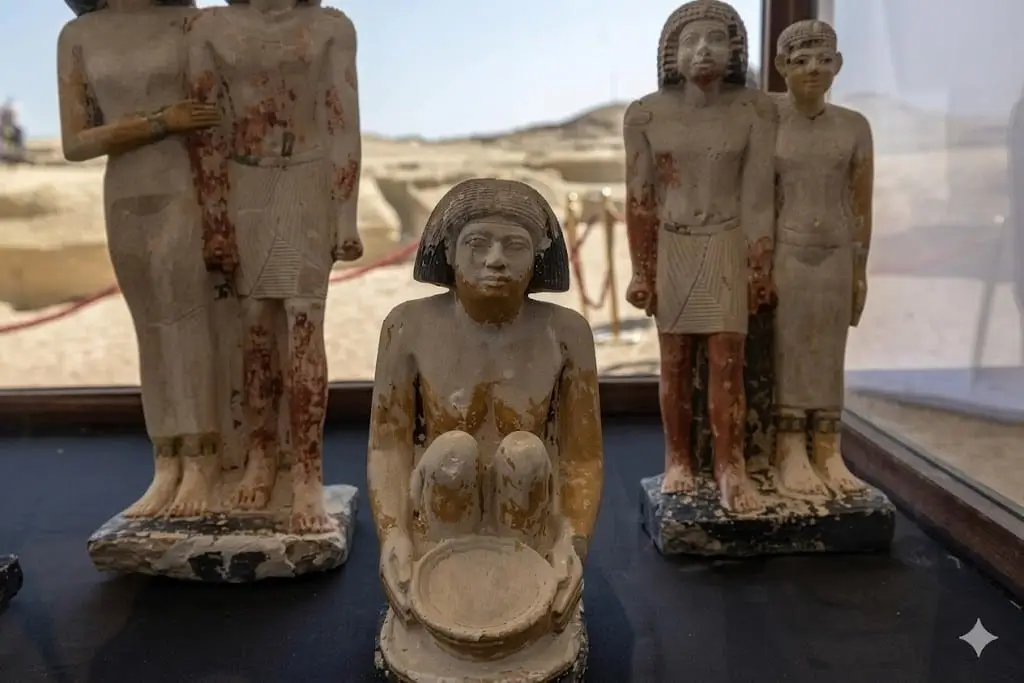
Near the primary shaft of the Tomb of Hekashepes, archaeologists discovered a group of nine magnificent statues. These limestone and wooden figures represent the high society of the 5th and 6th Dynasties.

  • Khnumdjedef: A priest serving in the pyramid complex of Unas. His statues show a man of authority, meticulously carved to ensure his soul had a physical vessel should his mummy perish.
  • Meri: A palace official holding the title of “Keeper of the Secrets.” The proximity of his burial to the Tomb of Hekashepes suggests a close-knit circle of administrative power residing in Saqqara.

Funerary Architecture and Daily Bread

The architectural layout of the Tomb of Hekashepes reflects the transition from the grand scales of the 4th Dynasty to the more refined, detail-oriented burials of the 6th Dynasty. Surrounding the main burial chamber, researchers found:

  1. Offering Tables: Stone slabs where priests placed food and drink to nourish the spirit of Hekashepes.
  2. Stone Vessels: Dozens of beautifully polished alabaster and limestone jars that once held oils and ointments.
  3. Amulets and Jewelry: Small, intricate protective charms intended to ward off malevolent spirits during the journey through the Duat (the underworld).

The Significance of the “Great Enclosure”

The location of the Tomb of Hekashepes within Gisr el-Mudir is strategically significant. This limestone “Great Enclosure” is one of the oldest stone structures in Egypt, possibly predating the Step Pyramid. By choosing this site, Hekashepes and his contemporaries linked themselves to the very foundation of Egyptian monumental architecture.

Finding such a well-preserved, unlooted context within this ancient enclosure allows historians to map the social geography of Saqqara. It proves that even centuries after the Great Pyramids were built, this ground remained the most prestigious “real estate” for those who ran the Egyptian state. Each artifact recovered from the Tomb of Hekashepes complex acts as a thread, weaving together the daily duties of a palace official with the eternal aspirations of an ancient soul.

The Catacombs of Kom Esh-Shokafa: Roman-Egyptian Underworld

Descend into one of the "Seven Wonders of the Middle Ages" at the Catacombs of...
Related post
FUN

Saqqara’s Modern Renaissance: The Global Impact of the Discovery

Saqqara’s Modern Renaissance The Global Impact of the Discovery

The unsealing of the Tomb of Hekashepes does not merely add another name to the list of Egyptian nobles; it marks a turning point in modern archaeology. As one of the most significant finds in the Saqqara necropolis in recent decades, it has validated the expertise of Egyptian-led missions and reignited global interest in the “Age of the Pyramids.”

A Victory for Local Archaeology

For over a century, foreign institutions led the majority of high-profile excavations in Egypt. However, the mission that cleared the 15-meter shaft and opened the Tomb of Hekashepes was an entirely Egyptian endeavor. This success demonstrates the world-class capabilities of local teams in managing sensitive, high-stakes discoveries. The precision used to document the “Golden Mummy” without damaging its fragile leafing sets a new standard for field conservation.

Tourism and the Future of Saqqara

The buzz surrounding the Tomb of Hekashepes has transformed the visitor experience at Saqqara. While the Step Pyramid of Djoser remains the primary draw, the news of the “Golden Mummy” has shifted the spotlight toward the lesser-known sectors like Gisr el-Mudir.

For travelers planning a visit in 2026, the area around the discovery offers:

  • Enhanced Interpretive Centers: New signage and digital displays that explain the significance of the Fifth and Sixth Dynasty officials.
  • Active Excavation Views: Opportunities to see active sites where teams continue to sift through the sands of the Great Enclosure.
  • Proximity to New Discoveries: The site sits near the recently opened “Tombs of the Nobles,” allowing for a comprehensive day-trip through the evolution of Egyptian burial styles.

Conclusion: The Eternal Sleeper

Hekashepes spent 4,300 years in total darkness, shielded by five tons of limestone and fifteen meters of desert sand. His “awakening” in 2023 serves as a powerful reminder that Egypt never truly reveals all its secrets at once. By examining the Tomb of Hekashepes, we don’t just see a mummy; we see the face of an era characterized by immense wealth, religious devotion, and an artistic mastery that has survived the rise and fall of entire civilizations.

Today, Hekashepes stands as a bridge between the ancient past and our modern quest for knowledge. As researchers continue to analyze his remains and the artifacts from his burial chamber, the story of the man who slept in gold will continue to evolve, ensuring that the legacy of Saqqara remains as vibrant as the day the original mortar was applied.

The Tomb of Pay and Raia: A Masterpiece of New Kingdom Art at Saqqara

The Tomb of Pay and Raia is a remarkable "temple-tomb" located in the New Kingdom...
Related post
FUN

Visiting Saqqara: How to See the Site of the Hekashepes Discovery

Visiting Saqqara How to See the Site of the Hekashepes Discovery

For travelers and history enthusiasts, the discovery of the Tomb of Hekashepes has made the southern sector of Saqqara a “must-see” destination. While the mummy itself is often moved to specialized conservation labs or museums (such as the Grand Egyptian Museum), the site of the find at Gisr el-Mudir offers a profound sense of the scale of Old Kingdom ambition.

Navigating to Gisr el-Mudir

Gisr el-Mudir, or the “Great Enclosure,” sits to the west of the Step Pyramid of Djoser. When visiting, you are standing on what many archaeologists believe is the oldest monumental stone structure in Egypt.

  • Location: South Saqqara, approximately 30 kilometers south of Cairo.
  • Access: Most visitors include this as part of a broader Saqqara day trip. It is best reached via private car or a specialized tour guide who can point out the specific location of the 2023 excavations.
  • What to Look For: Unlike the towering pyramids, this area is a vast, rectangular space defined by massive limestone walls. Look for the active excavation markers where the shaft of Hekashepes was cleared.

Essential Tips for Your Visit

  1. Arrive Early: The desert heat at Saqqara can be intense by noon. Aim to arrive at the site opening (usually 8:00 AM) to explore the open-air enclosure of Gisr el-Mudir comfortably.
  2. Combine Your Ticket: Use your Saqqara entrance ticket to visit the Imhotep Museum first. It provides excellent context on the 5th and 6th Dynasty officials who were contemporaries of Hekashepes.
  3. Hire a Specialist: Because the Tomb of Hekashepes is a recent discovery, not all general guides will have the latest data on the find. Ask for a guide specifically knowledgeable in the “New Discoveries” sector.

The Tomb of the Butchers: A Masterpiece of Daily Life in Saqqara

The Tomb of the Butchers stands as a vibrant masterpiece of 5th Dynasty art, offering...
Related post
FUN

Frequently Asked Questions (FAQ)

Frequently Asked Questions (FAQ)

Is the Tomb of Hekashepes open to the public?

Currently, the 15-meter burial shaft is not open for internal descent by the general public due to safety and conservation protocols. However, visitors can view the Gisr el-Mudir enclosure and the exterior of the excavation site.

Where is the “Golden Mummy” now?

Following its discovery in 2023, the mummy was transferred for stabilization and study. It is intended to be a centerpiece of future displays focusing on Old Kingdom mummification techniques, likely within the Grand Egyptian Museum (GEM) or the National Museum of Egyptian Civilization (NMEC).

Why was Hekashepes buried in gold if he wasn’t a King?

His burial reflects the immense wealth of the Egyptian bureaucracy during the 5th and 6th Dynasties. While gold was the “flesh of the gods,” high-ranking nobles who served the king closely were often granted the privilege of lavish burials to ensure their status in the afterlife.

How does this find compare to King Tutankhamun?

While King Tutankhamun’s tomb is more famous for its solid gold mask and quantity of treasure, the Tomb of Hekashepes is arguably more significant scientifically. It is nearly 1,000 years older than Tutankhamun, providing a rare look at a much earlier stage of Egyptian civilization.

Final Takeaway

The Tomb of Hekashepes remains a testament to the enduring mystery of Egypt. It proves that even in a site as thoroughly explored as Saqqara, there are still “golden” secrets waiting just a few meters beneath the sand. Whether you are a digital researcher or a traveler standing on the edge of the Gisr el-Mudir, Hekashepes reminds us that the past is never truly dead—it is only waiting to be found.

8 Days Tour to the Treasures of Egypt in Cairo and Luxor...
Explore UNESCO world's heritage sites in Egypt with expert Egyptlogist Tour guides....
God_Anubis_Icon

One of the best tours I have ever had!

I was thoroughly impressed by the professionalism of this tour company. I emailed to inquire about the Cairo layover tour about 30 hours before my flight was scheduled to leave from New York. I was pleasantly surprised to get a quick response confirming the tour and assuring that a guide

More »

Alexandria! Wow!

Muhammad is the best! He showed me a world I never thought possible! The tombs in Alexandria, by far, were my favorite! I never knew there was a place on earth that contained both Greek and Egyptian carvings in the same tombs! The history and culture of Egypt is so

More »

Valley of the Kings, Hepchepsut

I never had a more positive experience and educational time than this tours. Learning about a variety of kings and queens was amazing! The tour guide was super nice and helped me and my friend every step of the way! Including bargaining for a few souvenirs! I will never forget

More »

HANDS DOWN, the best cultural experience I’ve ever had

Thank you, Egypt Fun Tour, for a most memorable trip. I admit I didn’t do any of the planning (it was all done by my boyfriend), but as you can read in the reviews below, Hani (the owner of Egypt Fun Tours) is superbly organized and accommodating with scheduling. My

More »
God_Anubis_Icon

Top-rated Tour Packages

God_Anubis_Icon