The Pyramid of Amenemhat I: The Architectural Rebirth of the Middle Kingdom

Ultimately, the Pyramid of Amenemhat I serves as the perfect bridge between two eras. It lacks the physical height of the Giza giants, but it possesses a far more complex political story. By recycling the past to build his future, Amenemhat I ensured that the "Pyramid Age" would live on for another four centuries. This monument proves that innovation often involves looking backward as much as looking forward.

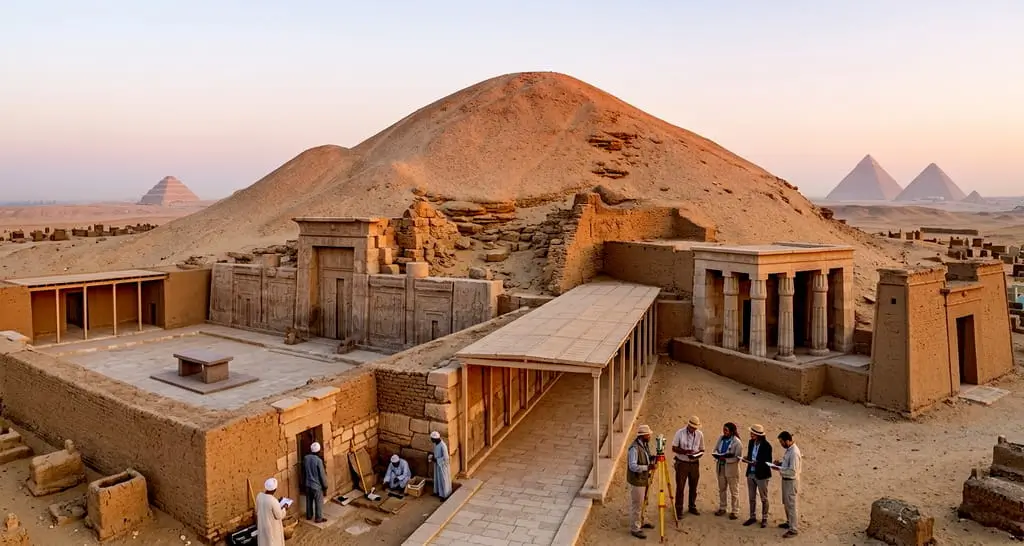
After the chaos of the First Intermediate Period, Amenemhat I sought to legitimize his rule by looking backward. He moved the royal capital from Thebes to Itj-tawy (near modern Lisht) and revived the tradition of pyramid building that had lain dormant for centuries. However, the Pyramid of Amenemhat I is not a mere copy of the Giza giants. Instead, it serves as a fascinating hybrid—a structure that blends the massive stone traditions of the past with the cost-effective mud-brick innovations of the future.

While the core of the structure has suffered significantly from time and erosion, its historical value remains unparalleled. Today, the pyramid offers a “time capsule” effect. Because Amenemhat I recycled stone blocks from the Giza and Saqqara complexes, his pyramid physically contains the DNA of Khufu and Khafre. This pillar explores how this strategic ruler reclaimed the landscape of the Nile to establish one of Egypt’s most enduring dynasties.

The Strategy of “Spolia”: Recycling the Greats

The most intriguing aspect of the Pyramid of Amenemhat I lies in its hidden ingredients. During excavations, archaeologists discovered that many of the limestone blocks within the pyramid core bore the names and reliefs of Old Kingdom pharaohs like Khufu, Khafre, and Unas.

This practice, known as spolia, was not an act of desperation or laziness. Rather, it was a profound political statement. By literally building his tomb from the stones of his ancestors, Amenemhat I physically anchored his new dynasty to the “Golden Age” of the 4th Dynasty. This reuse of materials allows modern researchers to find “lost” fragments of Giza monuments tucked inside the walls of Lisht. Consequently, the Pyramid of Amenemhat I serves as a giant stone library, preserving fragments of history that might otherwise have been lost.

Pyramid of Amenemhat I: Stone and Mud-Brick

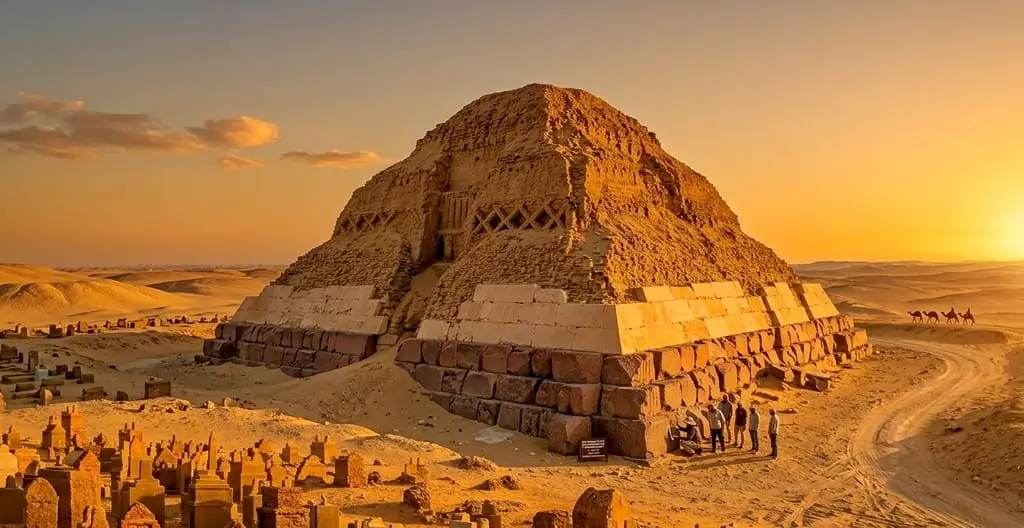
Architecturally, Amenemhat I introduced a construction technique that would define the Middle Kingdom. Instead of the solid stone masonry seen at Giza, his architects utilized a core of rough limestone fragments, sand, and mud-brick, held together by a framework of stone walls.

  1. The Core: A mixture of local materials provided a faster, more efficient build.
  2. The Casing: High-quality Tura limestone originally covered the entire structure, giving it the appearance of a traditional Old Kingdom pyramid.
  3. The Result: While the pyramid looked identical to those of the 4th Dynasty from the outside, the core was far more susceptible to the elements.

As a result, when the outer casing was stripped away in later centuries, the internal mud-brick and sand collapsed. This is why the Pyramid of Amenemhat I today resembles a rounded hill rather than a sharp geometric peak.

FUN

The Submerged Secret: A Flooded Burial Chamber

Modern explorers face a unique and frustrating barrier at the Pyramid of Amenemhat I. Unlike the dry, accessible shafts of Giza, groundwater completely floods the lower levels of this monument. Consequently, no archaeologist in the modern era has set foot inside the actual burial chamber.

The water table in the Lisht region rose significantly over the millennia. Therefore, the internal granite chamber remains an underwater time capsule. Early excavators like Gaston Maspero and the Metropolitan Museum of Art attempted to pump the water out. However, the surrounding water table replenished the shafts faster than the pumps could drain them. Because of this, the final resting place of the first 12th Dynasty king remains a legendary, unexplored frontier in 2026.

The Master of “Spolia”: Building with the Bones of Giants

The Master of Spolia

Amenemhat I did not just build a tomb; he executed a brilliant political maneuver through “spolia.” This term describes the reuse of stone from older monuments for new construction. While some view this as simple recycling, the Pharaoh used it to claim the prestige of his ancestors.

Architects integrated massive limestone blocks from the complexes of Khufu and Khafre into the core of the Pyramid of Amenemhat I, thereby physically connecting his reign to the “Golden Age” of the 4th Dynasty. Today, these recycled blocks provide a gold mine for researchers. When the outer casing collapsed, it revealed inscriptions and reliefs belonging to the Giza kings. Consequently, the Pyramid of Amenemhat I preserves fragments of Giza’s history that no longer exist at the original site.

FUN

The Mortuary Complex: A Fusion of Styles

The Mortuary Complex, A Fusion of Styles

The surrounding complex also reflects a blend of Old and Middle Kingdom philosophies. Amenemhat I abandoned the traditional Theban style of his predecessors in favor of the Memphite tradition.

  • The Upper Temple: Builders constructed a mortuary temple on the eastern side, mimicking the layouts found at Saqqara.
  • The Causeway: A long, enclosed path connected the pyramid to a valley temple, though little of this structure survives today.
  • The Royal Court: High-ranking officials built their own tombs near the King, reinforcing the centralized power of the new dynasty.

Furthermore, the pyramid’s location at Lisht served a strategic purpose. It sat at the gateway to the Faiyum Oasis. Therefore, the Pyramid of Amenemhat I acted as both a spiritual beacon and a physical fortress for the new capital, Itj-tawy.

Pyramid of Amenemhat I: The Evolution of the Core

The internal structure of this monument represents a significant shift in engineering. Instead of using solid stone throughout, the 12th Dynasty introduced a more economical “cellular” core.

  1. Skeleton Walls: Workers built a framework of stone walls radiating from the center.
  2. Internal Fill: They filled the resulting “cells” with a mixture of mud-brick, sand, and limestone rubble.
  3. Protective Casing: Finally, they wrapped the entire structure in a smooth layer of Tura limestone.

This method allowed for rapid construction and lower costs. However, it also made the structure vulnerable to tomb robbers and the elements. Once thieves stripped the limestone casing, the soft core quickly eroded into the mound we see today. Consequently, the Pyramid of Amenemhat I serves as an authoritative example of the transition from the “Stone Age” of the Old Kingdom to the “Mud-Brick Age” of the Middle Kingdom.

Dahshur Pyramids: Where Pyramids Were Perfected

Escape the crowds at the Dahshur Pyramids, a true "hidden gem" just south of Saqqara....
Related post
FUN

The Assassination of Amenemhat I: A Dynasty in Crisis

The Assassination of Amenemhat I A Dynasty in Crisis

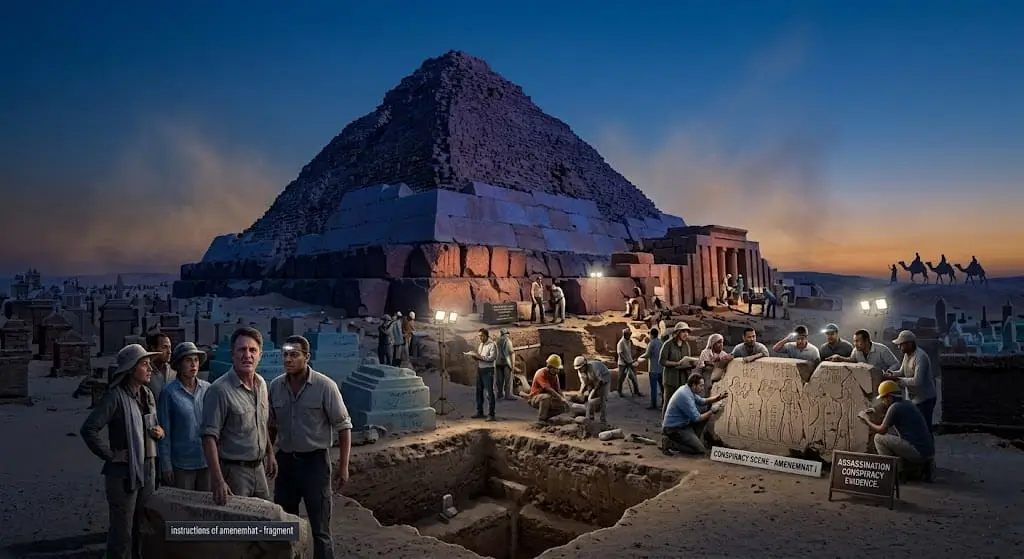
The story of the Pyramid of Amenemhat I ends with a dark historical mystery. Ancient texts, specifically the Instructions of Amenemhat, suggest the King fell victim to a palace conspiracy. Guards supposedly assassinated him in his bed while his son, Senusret I, campaigned in Libya.

This internal violence nearly derailed the 12th Dynasty. However, Senusret I raced back to the capital of Itj-tawy to secure the throne. He immediately prioritized the completion of his father’s funerary complex. Consequently, the Pyramid of Amenemhat I serves as a monument to a transition of power under extreme duress. The urgency of this transition likely influenced the mix of high-quality stone and rapid mud-brick construction seen at the site.

The Valley Temple and the Cult of the King

Beyond the pyramid itself, the broader complex reflects the King’s desire for eternal worship. Designers laid out a sophisticated system of temples to maintain the royal cult.

  • The Upper Temple: Architects built this structure against the pyramid’s eastern face. It featured a granite altar for daily offerings.
  • The Causeway: This long, limestone-walled corridor protected the priests during processions.
  • The Valley Temple: This structure sat at the edge of the Nile’s flood plain. It welcomed the royal funeral barge after its journey from the capital.

Therefore, the Pyramid of Amenemhat I functioned as the heart of a massive spiritual machine. It provided jobs for thousands of laborers and priests long after the King’s death. By examining the remains of these temples, archaeologists have reconstructed the daily life of the Middle Kingdom “pyramid city.”

The Pyramid of Teti: A Gateway to the Pyramid Texts of Saqqara

The Pyramid of Teti serves as the spiritual gateway to Egypt's 6th Dynasty and a...
Related post
FUN

The Legacy of Lisht: Why It Matters

Today, the Pyramid of Amenemhat I remains an authoritative case study for several reasons. It bridges the gap between the monumental 4th Dynasty and the innovative 12th Dynasty. Furthermore, it demonstrates how a ruler uses the past to build the future.

  1. Cultural Anchor: It physically preserved the stones of Khufu and Khafre for modern study.
  2. Engineering Pivot: It introduced the “cellular” mud-brick core that became the standard for Middle Kingdom kings.
  3. Historical Record: It anchors the literature of the era, such as the Story of Sinuhe, to a physical location.

Consequently, no study of the Egyptian “Renaissance” is complete without analyzing the Pyramid of Amenemhat I. It proves that even when a monument erodes into a hill, its historical impact remains indestructible.

The Archaeological Timeline (1882–2026)

We can detail the specific excavations that shaped our understanding of Lisht.

  • Gaston Maspero (1882): He first identified the pyramid but struggled with the flooded interior.
  • The J.E. Gautier Mission (1894): They discovered the “spolia” from the Old Kingdom.
  • The Metropolitan Museum of Art (1906–1934): This team conducted the most thorough mapping of the site.
  • Modern Analysis (Current): Researchers now use non-invasive satellite imagery and ground-penetrating radar to map the unexcavated areas of the “Lost City” of Itj-tawy.

Lahun Pyramid: The Revolutionary Mudbrick Masterpiece of Senusret II

Kahun (or El-Lahun), established during the Middle Kingdom reign of Senusret II around 1895 BCE,...
Related post
FUN

The Evolution of the Pyramid City

A pyramid was never a lonely monument. We can describe the Pyramid City that housed the builders, priests, and administrators.

  • Logistics: How did Amenemhat I feed thousands of workers in the Middle Kingdom?
  • The Layout: Evidence shows a grid-like urban plan, a precursor to the famous Kahun workers’ village.
  • The Economy: The pyramid functioned as a massive redistribution center for grain and resources.

Comparative Analysis: Giza vs. Lisht

To provide an authoritative “Deep Dive,” we can create a technical comparison table. This helps readers visualize the transition from the 4th Dynasty to the 12th Dynasty.

Feature Pyramid of Menkaure (Giza) Pyramid of Amenemhat I (Lisht)
Core Material Solid Limestone blocks Mud-brick & Limestone rubble
Casing Tura Limestone & Red Granite Tura Limestone
Internal Design Complex granite chambers Linear shaft to flooded chamber
Political Goal Divine Monumentality Dynastic Legitimacy (via Spolia)
Enjoy the scenic and historic Egypt treasures during Easter holidays...
4 Days Wheelchair Accessible Tour of Cairo and Luxor....
God_Anubis_Icon

Excellent Layover Tour

I would recommend Egypt Fun Tours to everyone who is looking for either a cultural or relaxing trip in Egypt. I was recently on a private layover tour and could not have been any happier with my day in Cairo. My tour guide, Hani was waiting just outside immigration and

More »

Lenka Traverlers

Egypt Fun Tours was contracted by our travel agency, Lenka Travelers, to arrange and guide us through parts of Egypt and Jordon. They did a fabulous job. The hotels, restaurants, places we visited, and transportation were the best. Our guide in Egypt, Mohammad, was very knowledgeable, spoke perfect English, and

More »

Valley of the Kings, Hepchepsut

I never had a more positive experience and educational time than this tours. Learning about a variety of kings and queens was amazing! The tour guide was super nice and helped me and my friend every step of the way! Including bargaining for a few souvenirs! I will never forget

More »

Valley of Whales – Wadi El Hitan and Wadi El Rayan

What a blast! It was an amazing day and a 5-star day trip. Everything was organised from A to Z by Hamada and Mohamed at Egypt Fun Tours in a timely manner. Pick up/drop off from/to the hotel, exquisite lunch and snacks, 4×4 jeep. Everything was as advertised. Also, the

More »
Top 10 restaurants in cairo Egypt Fun Tours 2

Tour & Overnight camping with Mohamed

The breathtaking views and the isolation with a night under the stars! The trip was memorable with Mohamed, our tour guide, who drove us to all the sites on the way to the White Desert, and is clearly someone who knows the desert inside out. He also cooked a delicious

More »
God_Anubis_Icon

Top-rated Tour Packages

God_Anubis_Icon