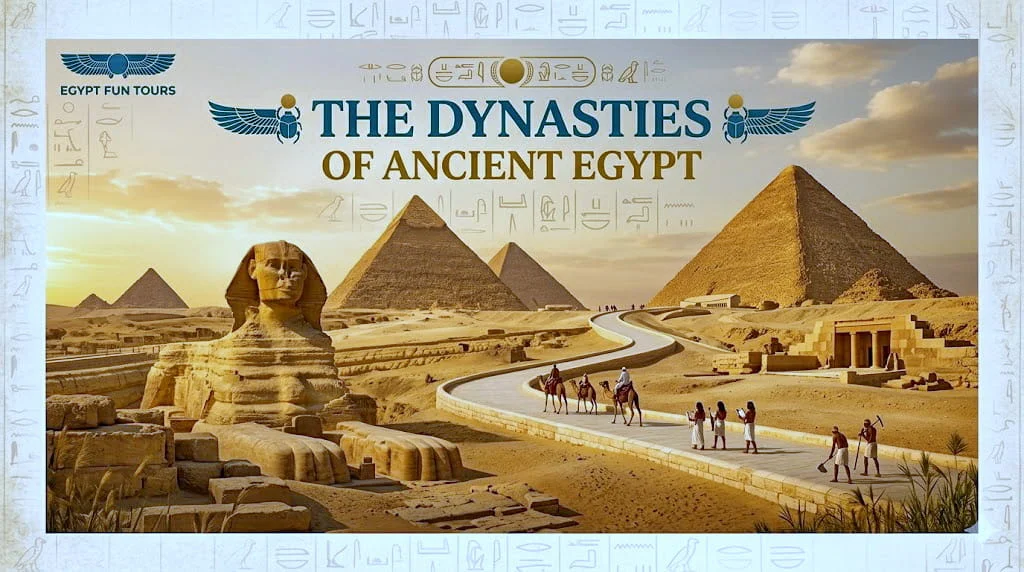
Dynasties of Ancient Egypt: Anatomy, Evolution, and Continuity of Power

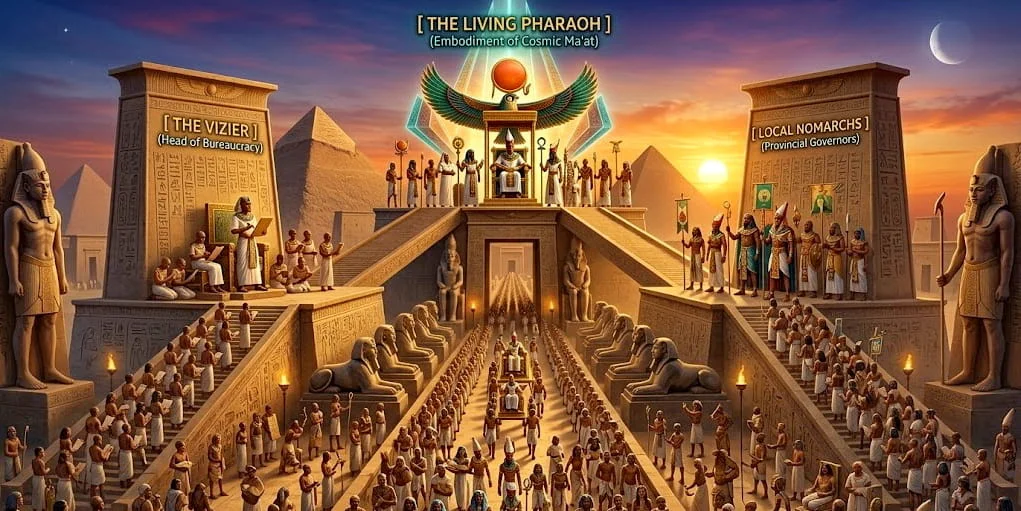
This comprehensive guide tracks the micro- and macro-cycles of ancient Egyptian history across more than 3,000 years and 30 dynasties. It details the structural evolution of pharaonic power—from the divine authority of the living king protecting Ma'at over Isfet, down through the state bureaucracy managed by the vizier and regional nomarchs. Additionally, the text explores the architectural shift in royal tombs from Old Kingdom mega-pyramids to hidden New Kingdom rock-cut tombs, while analyzing how foreign conquerors consistently assimilated into Egyptian culture by adopting traditional titles and artistic styles to secure political legitimacy.
The eye of Horus
WhatsApp
Email
Print

The Nile Valley witnessed one of history’s most resilient political experiments. For over three millennia, a dazzling civilization flourished. Modern historians categorize this vast timeline through a structured framework: The Dynasties of Ancient Egypt. These ruling houses formed the backbone of an empire that refused to die, from King Narmer to Cleopatra VII. What did a dynasty actually mean to the ancient Egyptians? It meant far more than an unbroken biological bloodline. To the ancient mind, a dynasty signified cosmic balance, profound theology, and deep bureaucratic organization. We must look beyond a simple list of kings to understand how this culture endured. Instead, we must examine how the system of pharaonic succession functioned. We need to look at how it survived crises and preserved divine kingship when bloodlines failed.

Looking for a complete chronological sequence of rulers, dates, and historical events? Read our comprehensive Timeline of Ancient Egypt.

Divider

The Origin of the System: The Manetho Problem

A Greco-Egyptian priest named Manetho of Sebennytos created our modern system of 30 or 31 distinct dynasties. In the 3rd century BCE, Pharaoh Ptolemy I Soter commissioned Manetho to compile a comprehensive history of Egypt. Manetho wrote his book, the Aegyptiaca, in Greek. He grouped Egypt’s vast timeline into consecutive blocks. Manetho’s framework remains the bedrock of modern Egyptology. However, his system introduces several critical challenges for historians:

  • The Myth of Linear Succession: Manetho implied a neat, consecutive timeline. In reality, multiple rival dynasties often ruled simultaneously from different capital cities during times of political collapse.
  • Arbitrary Divisions: Manetho created new dynasties simply because a king moved the royal court. He did this even when the biological lineage remained unbroken.
  • Fragmented Records: Time destroyed the original text of the Aegyptiaca. Today, we only possess fragments, summaries, and heavily distorted extracts from later Roman, Jewish, and Christian historians.

To build an accurate picture, modern historians balance Manetho’s accounts with authentic records found in the archaeological record.

Indigenous Royal Chronologies

The ancient Egyptians kept their own sacred records of kingship long before Manetho. These stone inscriptions served a specific ritual purpose. They justified the living king’s right to rule by linking him to a pristine line of divine ancestors.

  • The Palermo Stone (5th Dynasty): This dark basalt fragment records the annals of early kings. It carefully notes the specific heights of the annual Nile floods.
  • The Abydos King List (19th Dynasty): Carved into the limestone walls of the Temple of Seti I, this list shows Seti and a young Ramesses II honoring 76 predecessors. The carvers intentionally erased “illegitimate” or chaotic rulers like Hatshepsut and Akhenaten to present an idealized timeline.
  • The Turin King List (19th Dynasty): Scribes wrote this unique papyrus document in hieratic script. It records the exact duration of each king’s reign down to the months and days, proving that Egyptian administration kept meticulous archives.

Defining an Egyptian Dynasty: Bloodlines vs. Divine Right

In Western history, a “dynasty” implies strict biological inheritance through the eldest son. If the lineage breaks, the dynasty dies. In contrast, the dynasties of ancient Egypt operated on a far more fluid, theological concept. The throne was a divine office rather than a secular seat of government. The living king embodied Horus, the falcon god of order. Upon death, the king became Osiris, the lord of the underworld. The royal successor then stepped into the role of the living Horus.

Because the office itself was divine, the human occupant simply had to fit the cosmic template. A break in the biological bloodline did not signal the end of a dynasty, provided the new ruler claimed the divine right of succession through specific mechanisms.

The Five-Fold Titulary: The Blueprint of Legitimacy

Every new ruler took on five distinct names upon ascending the throne. This Five-Fold Titulary acted as a powerful political manifesto. It declared the king’s programmatic goals and cosmic alignment.

  1. The Horus Name: This ancient title established the king as the earthly manifestation of Horus. Artists usually enclosed it in a serekh, a stylized representation of a palace facade topped by a falcon.
  2. The Two Ladies Name (Nebty): This name placed the ruler under the protection of the twin patron goddesses of Egypt: Nekhbet (the vulture of Upper Egypt) and Wadjet (the cobra of Lower Egypt).
  3. The Golden Horus Name: This title features the god Horus standing atop the hieroglyph for gold. It signified eternal life and military triumph.
  4. The Throne Name (Prenomen): This crucial political name was assumed at coronation. It almost always invoked the sun god, Ra. Scribes enclosed this name in a protective loop of rope called a cartouche.
  5. The Birth Name (Nomen): This was the personal name given at birth, such as Thutmose or Ramesses. It was preceded by the title Sa-Ra, which translates to “Son of Ra.”

By adopting these sacred titles, a new king neutralized questions about his birthright. He became the legitimate link in an eternal chain of cosmic order.

Golden Scarab

The Structural Anatomy of the Dynasties of Ancient Egypt

The Structural Anatomy of the Dynasties of Ancient Egypt

To understand how these ruling houses maintained control, we must look at their administrative machinery. Power did not exist in a vacuum. Instead, a complex network of capital cities, royal women, and elite officials supported the dynasties of ancient Egypt.

The Royal Court and Shifting Capitals

The political heart of Egypt moved frequently throughout its history. When a new dynasty took power, the ruling family often established a new capital city. These shifts allowed kings to distance themselves from old power structures and reward loyal local elites.

  • Memphis: Located at the apex of the Nile Delta, this city served as the administrative hub for the Old Kingdom dynasties. It provided strategic control over both Upper and Lower Egypt.
  • Thebes: This southern city became the religious powerhouse during the Middle and New Kingdom periods. The vast temple complex of Karnak grew alongside the wealth of these dynasties.
  • Itjtawy: The rulers of the 12th Dynasty founded this fortified city south of Memphis. It allowed them to centralize control and oversee massive agricultural projects in the Faiyum Oasis.
  • Pi-Ramesses: Ramesses II built this glittering Delta city during the 19th Dynasty. It placed the royal court closer to Egypt’s vital military campaigns in the Levant.

Institutional Pillars Supporting the Dynasties of Ancient Egypt

Institutional Pillars Supporting the Dynasties of Ancient Egypt

No single king could govern thousands of miles of farmland and desert alone. Every dynasty relied on two critical institutions to maintain stability and project power: the Vizierate and the provincial Nomarchs.

The Bureaucracy and the Vizierate

The Vizier acted as the prime minister and the chief justice of the land. This official managed the royal treasury, oversaw tax collection, and directed the vast army of scribes. While kings came and went, the scribal bureaucracy remained stable. Often, a powerful family of viziers served multiple consecutive kings. This administrative continuity preserved the state’s infrastructure during weak reigns or sudden transitions.

The Provincial Governors (Nomarchs)

Egypt was divided into 42 administrative districts called nomes (22 in Upper Egypt and 20 in Lower Egypt). Each province was governed by a nomarch. During peak dynastic strength, the king appointed these governors directly. However, during periods of economic decay, these positions became hereditary. Local nomarchs would stockpile wealth, build private armies, and openly challenge the centralized authority of the ruling pharaoh.

The eye of Horus

The Dynasties of Ancient Egypt: The Pivotal Power of Royal Women

We often picture the dynasties of ancient Egypt as a succession of patriarchal kings. However, royal women played an indispensable role in maintaining the legitimacy of the throne.

The Great Royal Wife and the Queen Mother

The Great Royal Wife held immense religious and political status. Because the king represented the male principle of creation, the queen represented the essential female counterpart. This duality mirrored the balance of the gods. Furthermore, the Queen Mother (Mut Nesut) often held even greater influence. When a king died leaving a minor child as heir, the Queen Mother stepped in as regent. She governed the empire, commanded the military, and protected the young king’s throne from ambitious court officials.

Divine Adoratrix of Amun

During the Later Dynasties, the office of the Divine Adoratrix of Amun in Thebes became a critical political tool. Rulers appointed their unmarried daughters to this high celibate priesthood. This strategic move allowed the northern pharaohs to control the vast wealth and land holdings of the southern temples without fighting a civil war.

The Macro-Cycle of the Dynasties of Ancient Egypt

The Macro-Cycle of the Dynasties of Ancient Egypt

The history of the dynasties of ancient Egypt does not follow a straight path of endless prosperity. Instead, it moves through a predictable, cyclical rhythm. Historians divide this vast timeline into two alternating phases: stable, centralized Kingdoms and fractured, chaotic Intermediate Periods.

Understanding this macro-cycle reveals the true resilience of Egyptian civilization. The system always rebuilt itself using the same structural blueprint, even after complete societal collapse.

The Centralization Phase: Characteristics of Peak Dynastic Power

During the Old, Middle, and New Kingdoms, the dynasties of ancient Egypt achieved absolute control over the state. These eras share several distinct hallmarks that define peak pharaonic success:

  • Monumental Architecture: Strong dynasties marshaled vast labor forces to build eternal monuments. They constructed the Old Kingdom pyramids, Middle Kingdom irrigation networks, and New Kingdom rock-cut tombs.
  • Unified State Theology: The royal court tightly controlled the national religion. The king aligned himself with dominant state deities like Ra or Amun to reinforce his absolute authority.
  • Aggressive Trade and Resource Extraction: Unified dynasties secured Egypt’s borders. They launched heavily guarded mining expeditions into the Sinai for turquoise and into the Eastern Desert for gold.

The Fragmentation Phase: Why the Dynasties of Ancient Egypt Collapsed

Eventually, every great Kingdom fractured, sliding into an Intermediate Period. These periods of decay were rarely caused by foreign invasion alone. Instead, systemic internal vulnerabilities tore the dynasties of ancient Egypt apart from within.

1. Environmental Failure and the Nile

The Egyptian economy relied entirely on the annual Nile flood to irrigate crops. If the floods failed for several consecutive years, famine gripped the country. When the pharaoh could no longer feed his people, the populace lost faith in his divine ability to maintain Ma’at (cosmic balance). This environmental stress rapidly triggered political rebellion.

2. Economic Exhaustion from Over-Building

Building colossal pyramids and maintaining massive temple estates demanded immense wealth. Over centuries, kings routinely gifted tax-exempt land to the priesthoods and high-ranking officials to secure their loyalty. This practice slowly drained the royal treasury, leaving later kings in the dynasty financially disabled and politically weak.

3. The Ambition of Local Nomarchs

As the central government lost its financial leverage, local provincial governors (nomarchs) grew fiercely independent. They stopped sending tax revenues to the royal capital. Instead, they kept the wealth to build private armies and establish local rival dynasties, splitting the unified nation into warring regional factions.

The Inevitable Reification of Unity

The most remarkable feature of the dynasties of ancient Egypt is that fragmentation was never permanent. Even during the darkest civil wars, regional warlords did not try to invent a new system of government.

Instead, rival factions fought specifically to conquer the others, reunite the two lands, and crown a single pharaoh. The cultural ideal of a unified Egypt, ruled by a living Horus, remained the only acceptable form of civilization for over 3,000 years.

Divider

Ideological and Cultural Continuity Across the Dynasties of Ancient Egypt

While capitals shifted and bloodlines failed, the underlying cultural fabric of Egypt remained remarkably unbroken. Every ruling house had to adapt to a specific spiritual framework. To maintain control, the dynasties of ancient Egypt relied on deep ideological continuity, anchored by the concept of Ma’at and a shared vision of the afterlife.

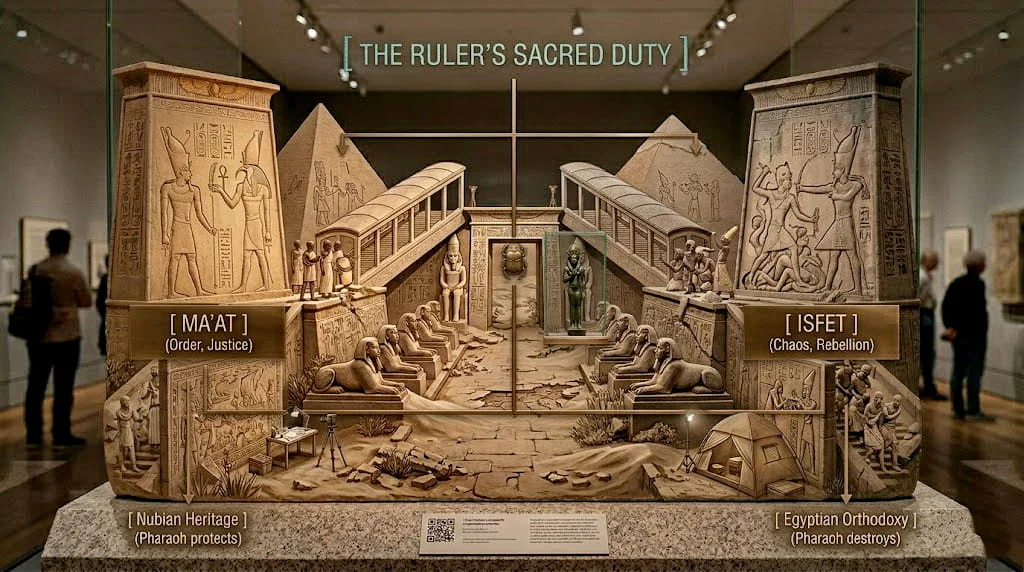
The Ultimate Test of Royalty: Upholding Ma’at

No king could rule purely through military force. The primary duty of the pharaoh was to uphold Ma’at—the cosmic principle of truth, justice, balance, and order.

The Ultimate Test of Royalty Upholding Ma'at

The ancient Egyptians viewed the universe as a delicate mechanism threatened constantly by Isfet (chaos, destruction, and lawlessness). The pharaoh stood as the sole shield between humanity and cosmic annihilation.

  • The Ritual Contract: The king offered pristine rituals, built grand temples, and maintained strict social laws to satisfy the gods. In return, the gods granted Egypt fertile Nile floods, military triumphs, and national health.
  • A Justification for Coups: When an ambitious general or noble overthrew a weak king, they always justified the rebellion through Ma’at. The usurper claimed the previous ruler allowed Isfet to poison the land, making a change in the dynasties of ancient Egypt a holy act of cosmic restoration.

The Dynasties of Ancient Egypt: The Evolution of the Royal Afterlife

The Dynasties of Ancient Egypt The Evolution of the Royal Afterlife

The grand funerary monuments lining the western bank of the Nile reveal how royal spiritual beliefs adapted across the centuries. As power shifted between different ruling houses, the architecture of eternity evolved dramatically.

1. Old Kingdom Mastabas and Pyramids

The early dynasties of ancient Egypt built mud-brick benches called mastabas. By the 3rd Dynasty, King Djoser stacked these benches to create the Step Pyramid at Saqqara. This architectural leap evolved into the smooth-sided Great Pyramids of Giza during the 4th Dynasty. These colossal stone structures acted as cosmic resurrection machines, launching the king’s soul directly into the northern circumpolar stars to join the sun god, Ra.

2. Middle Kingdom Shaft Tombs and Democratization

Following the collapse of the Old Kingdom, the concept of the afterlife shifted. Survival after death was no longer exclusive to the pharaoh. High-ranking nobles and wealthy citizens began carving elaborate shaft tombs into provincial cliffs. They used their own funerary texts, once reserved only for royalty, to guarantee safe passage into the realm of Osiris.

3. New Kingdom Rock-Cut Tombs

The military pharaohs of the New Kingdom abandoned highly visible pyramids, which invited grave robbery. Instead, they hid their final resting places deep within the desolate limestone cliffs of the Valley of the Kings.

Scribes covered these subterranean rock-cut tombs with complex theological maps. These texts, such as the Amduat and the Book of Gates, guided the deceased king through the dangerous twelve hours of the night, ensuring his daily rebirth at dawn.

By examining these architectural shifts, we see that the dynasties of ancient Egypt did not merely build tombs out of vanity. They constantly refined their engineering and spiritual art to protect the divine spark of kingship, keeping the cosmic engine of the state running for eternity.

The eye of Horus

Foreign Conquest and Assimilation within the Dynasties of Ancient Egypt

Foreign Conquest and Assimilation within the Dynasties of Ancient Egypt

An extraordinary feature of Egyptian civilization was its ability to conquer its conquerors. Over three thousand years, foreign invaders repeatedly breached Egypt’s borders, seized the capital, and took the throne. However, these foreign rulers did not replace Egyptian culture with their own. Instead, they quickly adopted traditional pharaonic customs to legitimize their rule, becoming authentic links within the dynasties of ancient Egypt.

The Hyksos: The First Foreign Pharaonic Rule (15th Dynasty)

During the Second Intermediate Period, a group of Levantine peoples known as the Hyksos crossed the eastern Delta. They established a capital at Avaris and took control of Lower Egypt.

  • Cultural Adoption: The Hyksos did not destroy Egyptian administration. Instead, their rulers took traditional pharaonic titles, adopted Egyptian court protocols, and wrote their names in hieroglyphic cartouches.
  • Technological Integration: While they maintained their own West Semitic names, they integrated seamlessly into the framework of the dynasties of ancient Egypt. They introduced vital military technologies, including the horse-drawn chariot and the composite bow, which later Egyptian kings used to forge an international empire.

The Libyans and the Strategy of Marriage (22nd and 23rd Dynasties)

By the end of the New Kingdom, Libyan military mercenaries had settled in large numbers throughout the western Delta. As central pharaonic power weakened, these Libyan chieftains peaceably assumed control of Lower Egypt.

To solidify their positions within the dynasties of ancient Egypt, these Libyan pharaohs adopted a masterful political strategy. They revived ancient administrative titles and married their sons and daughters into the existing high priesthood of Amun at Thebes. By blending their military strength with traditional Egyptian religious offices, they ruled successfully for over two centuries without sparking domestic cultural rebellions.

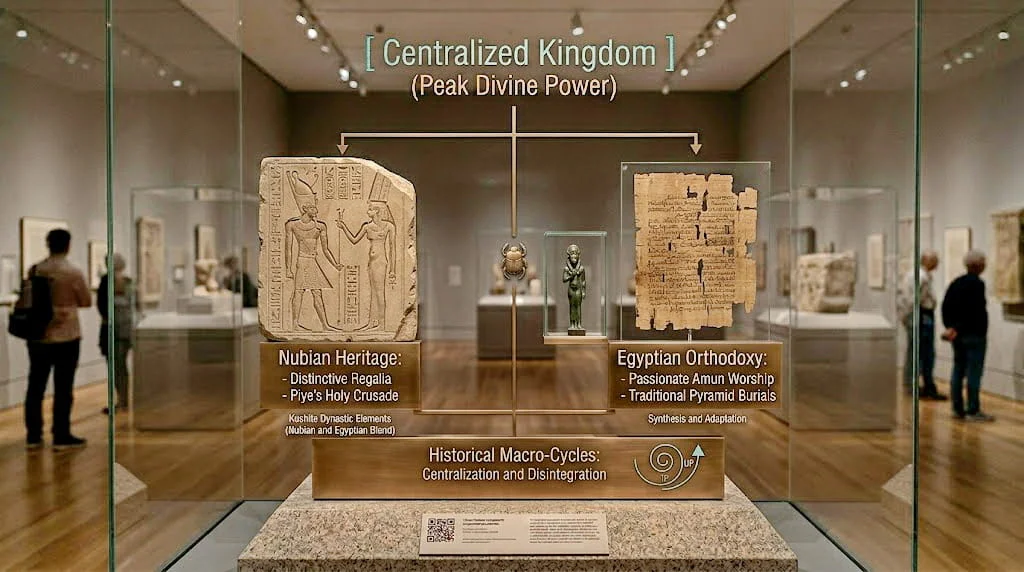
The Kushites: The Black Pharaohs of the South (25th Dynasty)

The ultimate example of cultural assimilation came from Nubia, located in modern-day Sudan. For centuries, Egyptian pharaohs had traded with, campaigned in, and colonized Nubia. During this time, the Nubians deeply embraced the worship of the Egyptian creator god, Amun.

The Kushites The Black Pharaohs of the South (25th Dynasty)

When Egypt fractured into rival factions during the Third Intermediate Period, the Kushite King Piye marched north from his capital at Napata. He did not launch his invasion to destroy Egypt, but to save it from its own internal chaos.

  • Restoring Ma’at: Piye viewed his campaign as a holy crusade to restore Ma’at and protect the temples of Amun.
  • The Revivalists: The Kushite pharaohs became great cultural revivalists. They commissioned art, literature, and temple reliefs that intentionally mimicked the classical styles of the Old and Middle Kingdoms. They even revived the ancient tradition of pyramid burials at El-Kurru and Nuri, proving their devotion to the oldest customs of the dynasties of ancient Egypt.

The Persians and Ptolemies: The Twilight of Dynastic Rule

Even during the twilight of pharaonic independence, this assimilation pattern continued. When the Persians conquered Egypt, forming the 27th Dynasty, Cambyses II and Darius I carved their names into temple walls as legitimate pharaohs. Later, following the conquests of Alexander the Great, the Greek Ptolemaic Dynasty built massive traditional temples at Edfu, Dendera, and Philae. They depicted themselves on these walls wearing double crowns, sacrificing to native deities, and upholding the ancient cosmic laws.

By demanding that every conqueror bow to the ancient theological template, the dynasties of ancient Egypt maintained their cultural independence and spiritual identity until the Roman Empire finally converted Egypt into a provincial breadbasket.

The Enduring Legacy of the Dynasties of Ancient Egypt

The long story of the dynasties of ancient Egypt is not just a collection of dates, wars, and ruined monuments. Instead, it represents one of the most successful social and political systems ever created by humanity. For over 3,000 years, this framework survived environmental disasters, internal civil wars, and foreign invasions.

The secret to this incredible longevity lay in its flexibility. A dynasty did not end just because a biological family died out. The system survived because the office of the pharaoh was divine. Any leader who took the throne—whether a local vizier, a female regent, or a foreign conqueror—could maintain the unbroken chain of history by embracing Ma’at and taking the sacred Five-Fold Titulary.

When the last native ruling house fell, and the Roman Empire eventually turned Egypt into a province, the era of the pharaohs came to an end. Yet, the monuments, the records, and the systemic framework left behind by the dynasties of ancient Egypt continue to captivate the modern world. They stand as an eternal monument to a civilization that mastered the art of political continuity and cosmic balance.

Divider

2 week group private tour – Egypt and Jordan

Our US-based agency takes small groups of experienced travelers to the most beautiful and exotic places in the world. In Dec ’19 – Jan ’20, we used the services of Egypt Fun Tours to plan, organize, and conduct an amazing trip to Cairo, Giza, Saqqara, Luxor, and Aswan. The New

More »

Goes well beyond “tour”

I am tempted to say “my friend Hani” runs an amazing service, because that is how he makes you feel. I first went on the 9-hour layover tour in summer 2011. Hani and driver picked me up at the airport at 3am, and by the time I left at noon

More »
hani ahmed 1

Hani Was our Awesome Tour Guide!

We had an 11-hour layover in Cairo on 12/15/2011. We wanted to go to see the Pyramids, Tahrir Square, and possibly the museum. We were so lucky to have a guide, Hani from Egypt Fun Tour, who made it possible to see all the above, plus the Bazaar, and time

More »
9-day tour package - Egypt Fun Tours

You’re in “GREAT HANDS” with Egypt Fun Tours!

We first went to Egypt in July 2010. We were to pass through Cairo on our way to Africa, and we had arranged to be picked up from the Cairo airport and shown around the city during our 6-hour layover. This was arranged through emails with Hamada, of Egypt Fun

More »

Lenka Traverlers

Egypt Fun Tours was contracted by our travel agency, Lenka Travelers, to arrange and guide us through parts of Egypt and Jordon. They did a fabulous job. The hotels, restaurants, places we visited, and transportation were the best. Our guide in Egypt, Mohammad, was very knowledgeable, spoke perfect English, and

More »
God_Anubis_Icon

Top-rated Tour Packages

God_Anubis_Icon
WhatsApp
Email
Print